Salmon Shark — The Warm-Blooded Shark of the North Pacific
The salmon shark (Lamna ditropis) is a stocky, warm-bodied mackerel shark of the North Pacific, a close relative of the porbeagle and the great white. Adults typically measure 2.0–2.6 m, reaching about 3 m and 220 kg. It keeps its internal body temperature roughly 8–11°C above the surrounding water, which lets it hunt salmon in Alaskan seas only a few degrees above freezing. It is listed as Least Concern and has no confirmed attacks on people.
Salmon Shark
How does a salmon shark stay warm?
Salmon sharks are regional endotherms. Networks of blood vessels called retia mirabilia act as heat exchangers, trapping the heat made by their swimming muscles so their core stays far warmer than the sea around them.
In a typical fish, blood flowing to the gills loses its heat to the water. In a salmon shark, the arteries carrying cold blood from the gills run alongside veins carrying warm blood from the muscles, in dense bundles. Heat passes from vein to artery before it can reach the gills, so it stays inside the body. The result is an internal temperature of about 16–19°C while the surface of the body sits near 8°C, some 8–11°C above the surrounding water. Warm muscles contract faster, warm eyes and brain work better, and warm digestion processes food faster.
Salmon sharks share this system with their relatives, the porbeagle, the makos and the great white, and the salmon shark takes it further into cold water than any of them. A 2005 satellite-tagging study in Science by Kevin Weng, Barbara Block and colleagues showed that salmon sharks range from subarctic water around 2–4°C to subtropical water above 20°C, an unusually wide thermal niche. The same study found that their hearts have specialised cardiac tissue that keeps pumping efficiently in the cold, the “cardiac physiology” part of the paper’s title. For a broader look at fish body temperature, see are sharks cold-blooded?
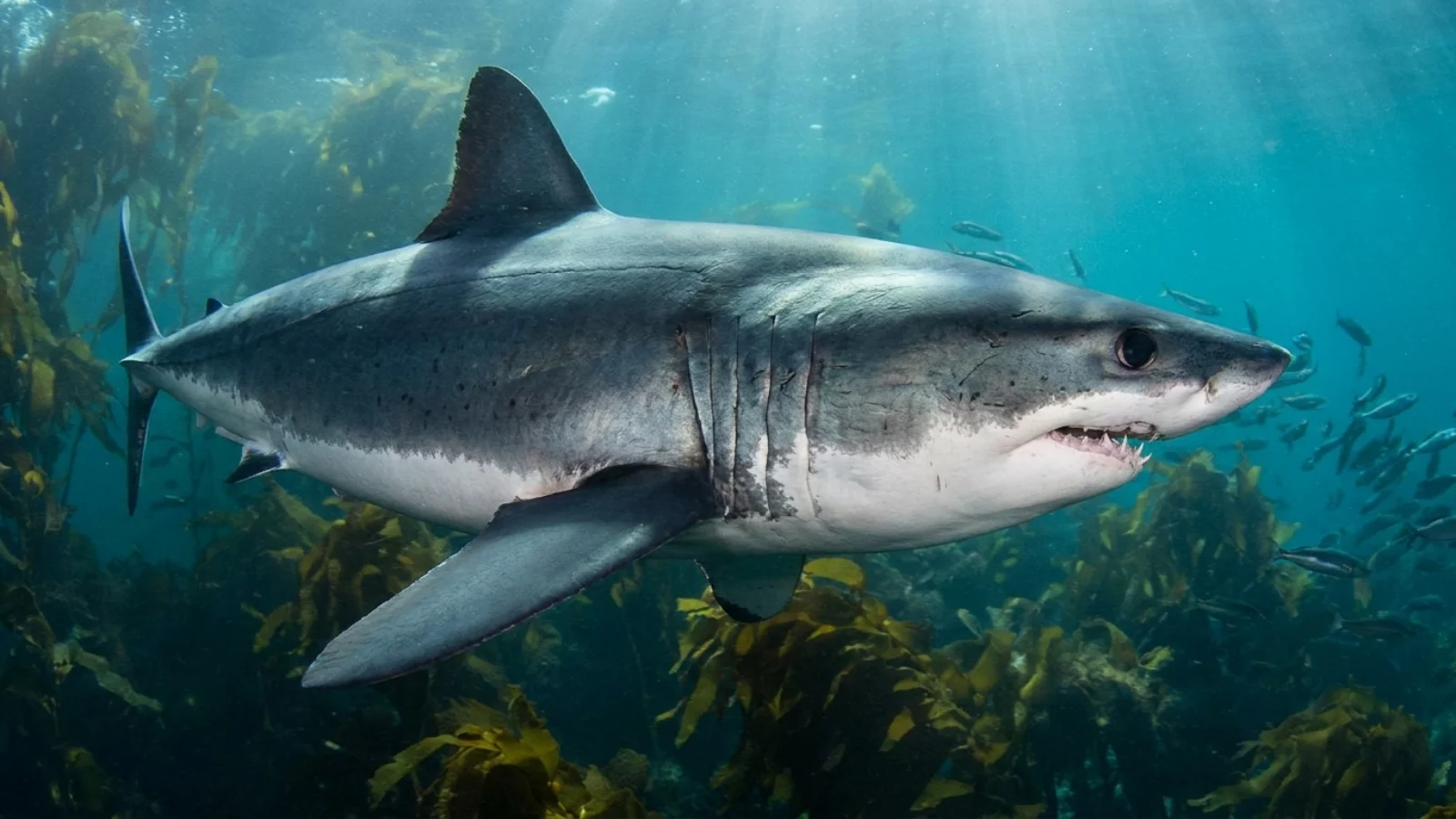
How do you identify a salmon shark?
A salmon shark looks like a small, stocky great white: a heavy torpedo body, a conical snout, a crescent-shaped tail with keels at the base, and a dark blue-grey back over a white belly blotched with dark spots.
The belly blotches are the best field mark in the North Pacific: great whites and makos have clean white bellies. Salmon sharks also have a small white patch at the rear base of the first dorsal fin, like the porbeagle, and a secondary keel on the tail below the main one. Adults typically measure 2.0–2.6 m, with the largest confirmed at about 3 m and weights up to about 220 kg; reports of 4.3 m and 450 kg sharks are unconfirmed. Teeth are smooth-edged, blade-like and fairly small, suited to gripping slippery fish rather than tearing large prey.
Where do salmon sharks live?
Salmon sharks range across the North Pacific from Japan and the Sea of Okhotsk to Alaska and south to Baja California, from subarctic water to the subtropics.
The population is split oddly by sex. Eastern North Pacific populations, off Alaska, Canada and the US West Coast, are dominated by females, while western populations off Japan and Russia are mostly male. The cause is not known. Many tagged females spend summer and autumn feeding in Alaskan waters, especially in Prince William Sound, then migrate south in winter, some to the subtropical waters off Hawaii and others down the coast toward Baja California, before returning north. Juveniles prefer water of about 12–16°C and use the California Current as a nursery; young salmon sharks occasionally strand on California beaches.
Do salmon sharks really eat salmon?
Yes. Pacific salmon are a major part of the diet when they gather off Alaska to return to their rivers, but salmon sharks also eat herring, pollock, sablefish, squid and even seabirds.
Each summer, salmon sharks concentrate in places like Prince William Sound where pink, chum and sockeye salmon are staging. Researchers tagging Chinook salmon have recorded tags that suddenly jumped to a warm, stable temperature, a sign the salmon had been swallowed by a warm-bodied predator, which pointed to salmon sharks. Some scientists have suggested this predation may have contributed to Chinook declines, though that link remains under study. Outside the salmon season, the sharks follow herring, pollock and squid, and individuals have been recorded diving to 668 m.
How do salmon sharks reproduce?
Salmon sharks are ovoviviparous with oophagy: the young hatch inside the mother and feed on unfertilised eggs. Litters are small, 2 to 6 pups, after about nine months.
Mating happens in late summer and early autumn, and pups are born the following spring off California and Baja California, likely on a two-year cycle. Females mature at about 8–10 years and males by about 5 years. Age studies in the eastern North Pacific have estimated maximum ages around 20–25 years. Some reports suggest litters are skewed toward males, about 2.2 males per female, but how common that is remains unknown.
Are salmon sharks dangerous to humans?
There are no confirmed attacks by salmon sharks on people. Their size and relationship to the great white mean they should be treated with respect, but they live mostly offshore in cold water few swimmers enter.
A few unconfirmed incidents have been blamed on salmon sharks in the North Pacific, but none has been positively identified. Divers who have filmed salmon sharks in Alaska describe them as curious but cautious. The greater risk is to the sharks: they are a sport catch in Alaska and British Columbia, with limits of two per person per year in Alaska.
Are salmon sharks endangered?
No. The IUCN lists the salmon shark as Least Concern. Large-scale Japanese drift-net fishing in the 1980s and 90s killed many, but the population appears stable today.
Salmon sharks are taken as bycatch in North Pacific fisheries and in a small directed fishery off Japan, where the meat and heart are eaten. The ban on high-seas drift nets in the early 1990s greatly reduced bycatch. The species’ wide range, relatively large population and moderate productivity keep it in the Least Concern category, though fishing of males off Japan has been suggested as one possible reason for the strange sex ratio across the Pacific.
How does the salmon shark compare with other mackerel sharks?
The salmon shark is the Pacific twin of the porbeagle and a scaled-down relative of the great white and makos.
It overlaps with the great white off California, and young great whites and salmon sharks are sometimes confused. Compared with the shortfin mako, it is heavier and far more cold-tolerant. Its sister species, the porbeagle, fills the same cold-water role in the North Atlantic and Southern Hemisphere.
| Species | Max length | Max weight | Unprov. bites (ISAF) | Lifespan | IUCN |
|---|---|---|---|---|---|
| Salmon shark | 3.0 m | 220 kg | 0 | ~20–25 yrs | LC |
| Great white shark | 6.0 m | 2,300 kg | 351 | 70 yrs | VU |
| Shortfin mako | 4.0 m | 570 kg | 10 | 30 yrs | EN |
| Common thresher | 5.7 m (confirmed) | 510 kg | 0 | 45–50 yrs (est.) | VU |
| Blue shark | 3.8 m | 206 kg | 13 | 20 yrs | NT |
| Basking shark | 10–12 m | ~5,000 kg | 0 | ~50 yrs | EN |
Bite counts: Florida Museum International Shark Attack File, species-implicated table (1580–2022). * Genus-level total. IUCN: LC Least Concern, NT Near Threatened, VU Vulnerable, EN Endangered, CR Critically Endangered, DD Data Deficient.
Are salmon sharks warm-blooded?
Partly. They are regional endotherms that keep their core about 8–11°C warmer than the surrounding water, using heat-exchanging blood vessels.
How big do salmon sharks get?
Typically 2.0–2.6 m, with the largest confirmed at about 3 m and 220 kg.
Are salmon sharks dangerous?
There are no confirmed attacks on humans. They live mostly offshore in cold water and are cautious around divers.
Where do salmon sharks live?
Across the North Pacific, from Japan and the Bering Sea to Alaska and south to Baja California. Tagged females migrate as far as Hawaii in winter.
Do salmon sharks eat salmon?
Yes. They feed heavily on Pacific salmon in Alaska in summer, along with herring, pollock, sablefish and squid.
Is a salmon shark a great white?
No, but they are related. Both are mackerel sharks in the family Lamnidae, and young great whites and salmon sharks can look similar. Salmon sharks have dark blotches on the belly.
Are salmon sharks endangered?
No. The IUCN lists the species as Least Concern.
Can you eat salmon shark?
Yes. It is eaten in Japan and is a legal sport catch in Alaska and British Columbia within strict limits. Like other large predators, its meat can contain elevated mercury.
Blane Perun has been exploring Earth’s oceans and marine life for over 25 years. Founder of TheSea.Org in 1999, underwater photographer, coral aquaculture pioneer, and explorer of 80+ countries.
About Blane Perun → All Shark Species A–Z →