Venus Flower Basket — The Deep-Sea Glass Sponge That Holds Two Shrimp Prisoner for Life
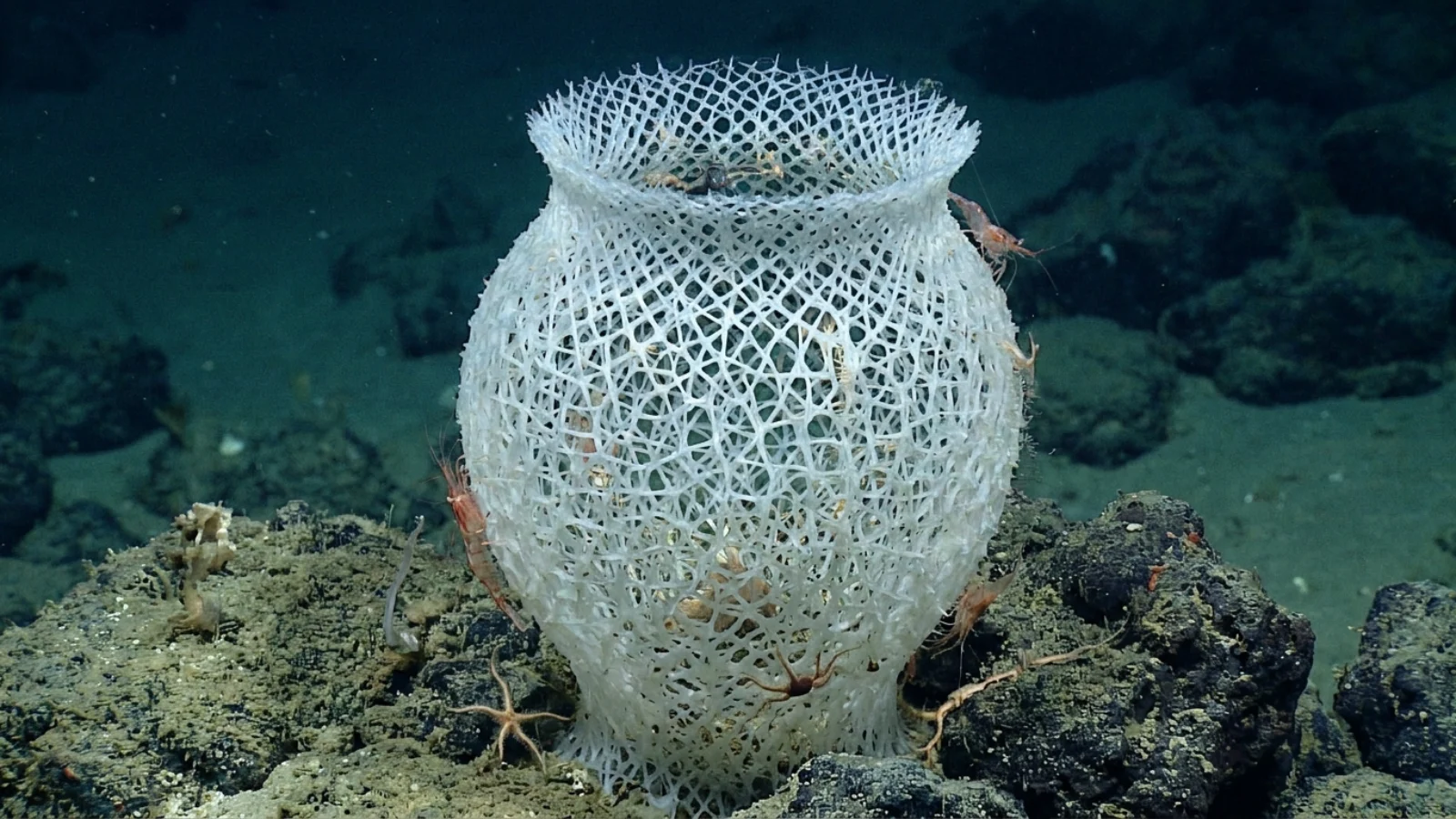
The Venus flower basket (Euplectella aspergillum) is a deep-sea glass sponge that builds a vase-shaped skeleton of fused silica — essentially glass — in an intricate lattice. It lives on soft seafloor in the western Pacific, mostly around the Philippines, at about 100–1,000 metres and most often below 500 metres. Most specimens are 10–30 cm tall. A pair of small shrimp often enters the sponge as larvae, grows too large to escape, and spends its life inside, which is why the dried skeleton is a traditional wedding gift in Japan.
Few deep-sea animals have had as strange a career on land as the Venus flower basket. Victorian collectors paid high prices for its bleached skeletons. Japanese couples have received them as wedding gifts. And in the 21st century, materials scientists and fluid engineers have published papers in Science and Nature arguing that this sponge does structural engineering better than we do. The living animal, meanwhile, sits quietly in the mud half a kilometre down, filtering water.
What is the Venus flower basket made of?
The Venus flower basket’s skeleton is made of silica — the same material as glass — built from six-rayed spicules that are fused into a square-grid lattice with diagonal reinforcements and spiral ridges.
All glass sponges (class Hexactinellida) build skeletons from silica spicules with six rays meeting at right angles. In Euplectella, those spicules are cemented together into a rigid, tubular cage. The grid runs in vertical and horizontal strands, with diagonal struts crossing every other square, like the bracing in a steel-frame tower. Spiral ridges wind around the outside. At the top, a sieve plate caps the tube; at the bottom, a tuft of long, flexible glass fibres anchors the sponge into soft sediment.
The living tissue is a thin layer over this frame. Collar cells with whip-like flagella pump water through the walls; the sponge filters out bacteria and fine organic particles and expels the water through the top. You can read more about how sponges work in our guides to sea sponge structure and glass sea sponges.
Why do shrimp live inside the Venus flower basket?
Pairs of small shrimp in the genus Spongicola enter the sponge as tiny larvae, feed and grow inside, and become too large to squeeze back out through the lattice. Usually one male and one female end up living there together for life.
For the shrimp, the arrangement is a safe house with room service. The glass cage keeps out predators, and the water the sponge pumps through its body carries food particles past them. The shrimp in turn may help keep the inside of the sponge clean. Their offspring are small enough to leave through the mesh and drift off to find a sponge of their own — and, eventually, a partner to be trapped with.
It is the shrimp couple, not the sponge, that gives the Venus flower basket its romantic symbolism. In Japan the dried skeleton, often with its pair of shrimp still inside, has traditionally been given as a wedding present symbolising the vow “till death do us part.” Related Spongicola shrimp live in other glass sponges too; see our cleaner shrimp and harlequin shrimp profiles for shallow-water relatives with their own odd partnerships.
Why do engineers study the Venus flower basket?
Because its glass skeleton is extraordinarily strong and damage-tolerant for such a brittle material. Research has also shown its shape reduces drag and creates gentle swirling flows inside the sponge.
In 2005, a team led by Joanna Aizenberg at Bell Labs, working with UC Santa Barbara and the Max Planck Institute of Colloids and Interfaces, published a study in Science describing seven levels of structural hierarchy in the Euplectella skeleton — from nanometre-scale silica spheres, through laminated glass layers bonded with organic material, to the braced lattice and spiral ridges. Each matches an engineering principle, such as diagonal bracing to resist shear and external ridges to stop a cylinder from buckling. The layered construction stops cracks from running straight through the glass.
The anchor fibres at the base turned out to transmit light like optical fibres, and because of their laminated structure they are much tougher than commercial glass fibre of similar thickness. In 2021, Giacomo Falcucci and colleagues published supercomputer flow simulations in Nature showing that the sponge’s holes and ridges reduce drag on the body and create low-speed vortices inside it, which may help it hold onto food particles and bring eggs and sperm together. The authors suggested the design could inform buildings, ships and aircraft.
Where does the Venus flower basket live?
The Venus flower basket lives on soft, muddy seafloor in the western Pacific, especially around the Philippines, at depths of about 100 to 1,000 metres.
It is most common below 500 metres, in cold, dark, stable water. The root tuft of glass fibres holds the sponge upright in sediment, like a tent peg in sand. Related Euplectella species occur elsewhere in the deep Pacific and Indian Oceans, and glass sponges in general are found in deep water worldwide, from Antarctica to the North Pacific, where some form large reefs.
Because it lives so deep, little is known about its population. The species has no special status on the IUCN Red List, and its population size is unknown. Glass sponges in general grow slowly and can live for a very long time — some deep-sea sponges are thought to be centuries or even thousands of years old (see deep-sea sponge lifespan) — which makes them vulnerable to bottom trawling and deep-sea mining.
How does the Venus flower basket reproduce?
Little is known. The Venus flower basket is thought to be hermaphroditic, releasing sperm that other sponges draw in with their feeding current, and producing free-swimming larvae that settle to start new sponges.
Sperm released by one sponge drift into another’s water flow, where they fertilise eggs. The resulting larvae swim briefly before settling on the bottom and building their first spicules. The 2021 flow simulations suggest the sponge’s internal vortices may help by keeping gametes circulating inside the body cavity rather than flushing them straight out. Some sponges can also reproduce asexually by budding or fragmentation, but this has not been documented for this species.
For more on sponge reproduction, see sea sponge reproduction; for a sponge that eats animals rather than filtering, see the carnivorous harp sponge.
Venus flower basket vs. other glass and deep-sea sponges
The Venus flower basket is the best known of the glass sponges, but it is only one of several deep-sea sponges with extraordinary biology.
| Sponge | Type | Notable for |
|---|---|---|
| Venus flower basket (Euplectella aspergillum) | Glass sponge | Fused silica lattice; resident shrimp pair |
| Carnivorous harp sponge (Chondrocladia lyra) | Demosponge | Traps and digests small crustaceans |
| Glass sponge reefs (e.g. off British Columbia) | Glass sponges | Reef-building sponges once thought extinct |
| Giant barrel sponge (Xestospongia muta) | Demosponge | Shallow Caribbean sponge, can live centuries |
For a broader look at the phylum, see our guides to sponges, deep-sea sponges and barrel sponges. And for another deep-reef animal that looks like a plant, read about the feather star.
What is a Venus flower basket?
A Venus flower basket (Euplectella aspergillum) is a deep-sea glass sponge from the western Pacific that builds a vase-shaped lattice skeleton of fused silica.
Why is it called a Venus flower basket?
For its delicate, basket-like glass lattice and its association with love: a male and female shrimp often live trapped inside it for life. Venus is the Roman goddess of love.
Is the Venus flower basket alive?
Yes, in the wild it is a living animal, covered in a thin layer of tissue that filters water. The white skeletons sold or displayed are the dead, dried silica frame.
Why are there shrimp inside the Venus flower basket?
Young Spongicola shrimp enter as larvae, grow too large to leave, and live inside as a pair, protected by the glass cage and fed by the water the sponge pumps through.
Why is the Venus flower basket a wedding gift?
In Japan the skeleton, with its resident shrimp pair, symbolises a couple together until death, so it has traditionally been given as a wedding present.
What is the Venus flower basket made of?
Silica (glass) spicules with six rays, fused into a braced lattice with spiral ridges, anchored by a tuft of long glass fibres.
How deep does the Venus flower basket live?
About 100 to 1,000 metres, most often below 500 metres, on soft sediment in the western Pacific.
How big is a Venus flower basket?
Most are 10 to 30 cm tall, with recorded specimens from 7.5 cm to 1.3 m.
Why do scientists study the Venus flower basket?
Its glass skeleton is very strong and crack-resistant, its anchor fibres conduct light like optical fibres, and its shape reduces drag. Studies in Science (2005) and Nature (2021) explored these properties for engineering.
Blane Perun has been exploring Earth’s oceans and marine life for over 25 years. Founder of TheSea.Org in 1999, underwater photographer, coral aquaculture pioneer, and explorer of 80+ countries.
About Blane Perun → More on Bizarre Sea Creatures →