Scalloped Hammerhead — The Schooling Hammerhead of the Seamounts
The scalloped hammerhead (Sphyrna lewini) is a mid-sized hammerhead shark, up to about 4.3 m, named for the notched, wavy front edge of its head. It is the hammerhead famous for forming daytime schools of hundreds around seamounts and islands such as Cocos, Galápagos and Malpelo, then splitting up to hunt squid and fish in deep water at night. Heavy fishing for its fins has made it Critically Endangered (IUCN 2019).
Scalloped Hammerhead
How do you identify a scalloped hammerhead?
Look at the front edge of the head. A scalloped hammerhead has a central notch flanked by smaller indentations, giving the leading edge a wavy, scalloped outline, and the hammer sweeps slightly backward.
The three common large hammerheads are often confused. The great hammerhead has a nearly straight front edge and a very tall, sickle-shaped first dorsal fin. The smooth hammerhead has a rounded head with no central notch. The scalloped hammerhead has the central notch, a more arched head, and a lower first dorsal fin. Underneath, the pectoral fins of a scalloped hammerhead have dark tips. The body is grey-brown to olive above and white below. Adults typically measure 1.5–2.5 m (males mature at about 1.5–1.8 m, females at about 2.4–2.5 m), with a maximum around 4.3 m and 152 kg.
Like all hammerheads, the scalloped uses its wide cephalofoil as a sensory array. The eyes at the tips give overlapping binocular vision in front and nearly 360-degree vision when the shark sweeps its head, and the underside of the hammer is packed with electroreceptors for detecting prey. Genetic work has also revealed a near-identical sister species, the Carolina hammerhead (Sphyrna gilberti) of the western Atlantic, which can only be told apart by vertebra counts and DNA.
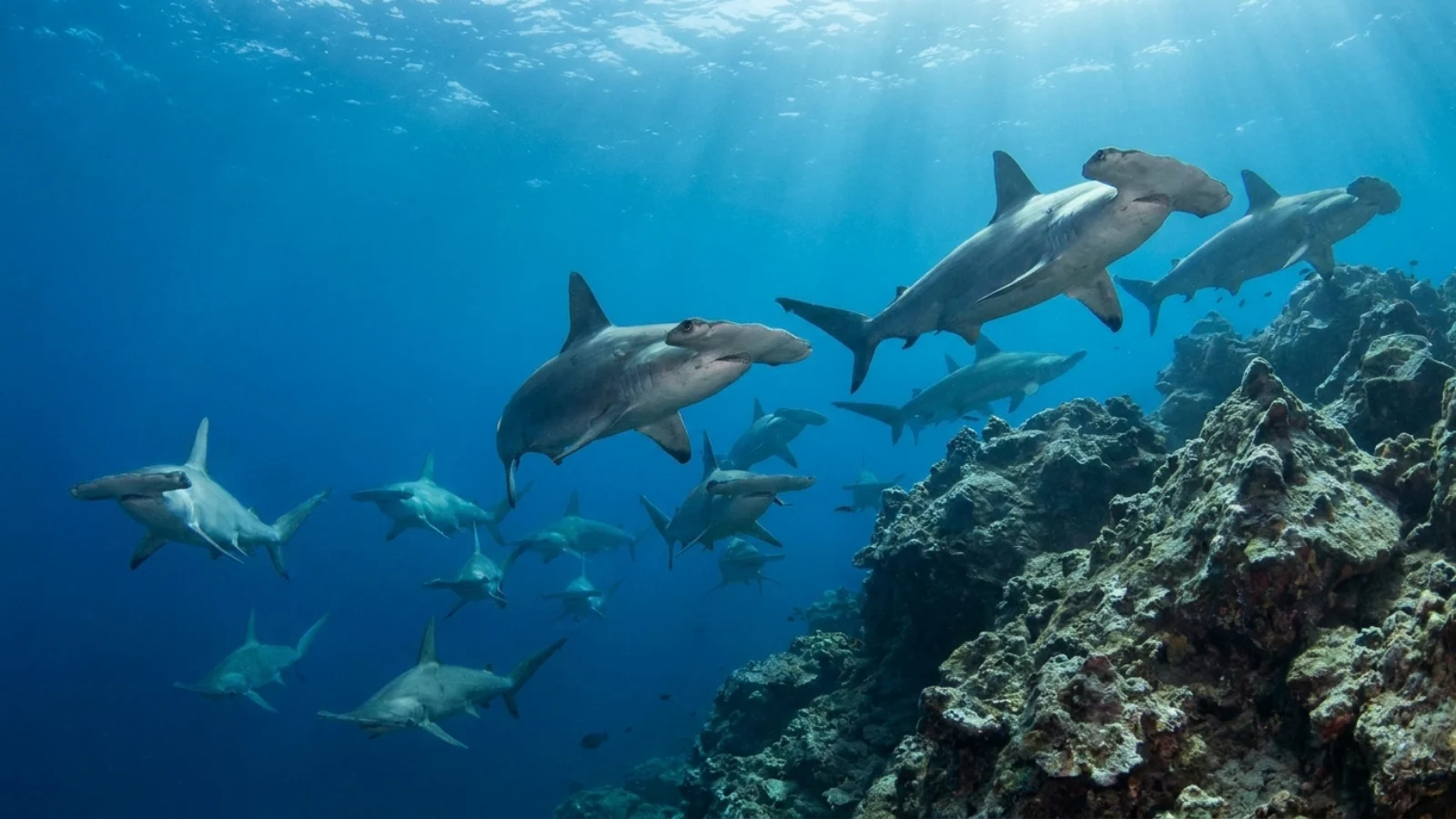
Why do scalloped hammerheads form schools?
By day, scalloped hammerheads gather in schools of dozens to hundreds around seamounts and island drop-offs. At night the schools break up and individuals head out into open water to hunt.
These schools are among the most famous sights in diving. At Cocos Island (Costa Rica), Darwin and Wolf islands in the Galápagos, Malpelo (Colombia) and seamounts in the Gulf of California, divers cling to rocks in the current and watch walls of hammerheads pass overhead. The schools are often dominated by females, and researchers think they serve several purposes: social sorting and mating, rest in a predictable location, and access to cleaning stations, where barberfish and king angelfish pick off parasites. When night falls, tagged sharks move away from the seamount, sometimes tens of kilometres, to feed, and return to the same site by morning, navigating with what may be a sensitivity to the magnetic patterns in the seafloor.
How do scalloped hammerheads dive so deep?
They hold their breath. A 2023 study in Science found that scalloped hammerheads close their gill slits and mouth during deep feeding dives, which keeps their bodies warm in water as cold as about 5°C.
Off Hawaii, tagged adults made repeated night dives to more than 800 m to hunt deep-sea squid and fish. Researchers led by Mark Royer of the University of Hawai‘i found that the sharks’ muscle temperature stayed almost constant during these dives, even though the water at depth was more than 20°C colder than at the surface. Video tags revealed why: the sharks closed their mouths and gill slits on the way down, so cold water was not flowing over the gills, where heat would normally be lost. They opened them again on the way back up. It is a behaviour previously known only in air-breathing animals, and it lets a tropical shark exploit the rich food of the deep sea.
Where do scalloped hammerheads live?
Scalloped hammerheads live in warm-temperate and tropical coastal and offshore waters around the world, from the surface to more than 500 m, though most are found shallower than about 25 m.
Pups are born in shallow, turbid bays and estuaries that act as nurseries. One of the best studied is Kāne‘ohe Bay on O‘ahu, Hawaii, where thousands of pups are born each summer, and another is Golfo Dulce in Costa Rica, where tagging has linked pups to the adult population around Cocos Island. Juveniles stay in their nursery for months to years, form loose schools, and gradually move into deeper water as they grow.
What do scalloped hammerheads eat?
Scalloped hammerheads feed mainly on squid and bony fish, plus smaller sharks, rays and crustaceans. Much of their hunting happens at night in deep water.
Stomach contents include sardines, mackerel, herring, reef fish, deep-water squid, octopus, lobsters, crabs, and small sharks and rays. Off Hawaii, adults dive to the deep scattering layer of squid and lanternfish, while pups in Kāne‘ohe Bay eat shrimp, crabs and small fish. A common prey animal over many reefs is the stingray, which hammerheads pin down using the head.
How do scalloped hammerheads reproduce?
Scalloped hammerheads are placental viviparous: pups are nourished through a yolk-sac placenta and born live after roughly 9–12 months. Litters are large for a shark, 12 to 41 pups.
Females mature at about 2.4–2.5 m and males at a much smaller size. Pupping usually happens in summer in shallow coastal nurseries, and females may give birth every year. Growth studies have aged scalloped hammerheads to more than 30 years. Large litters might suggest resilience, but very high pup mortality in nurseries and heavy fishing of adults have meant that populations have not withstood the pressure.
Are scalloped hammerheads dangerous?
Not usually. Scalloped hammerheads are shy around divers, and the ISAF records 18 unprovoked bites for all hammerhead species combined, none fatal.
Divers at Cocos or Galápagos quickly learn that the biggest challenge is getting close. Scalloped hammerheads are wary of scuba bubbles, and the classic technique is to hide behind a rock, breathe slowly and let the school come to you. See our article on whether hammerhead sharks attack humans for more.
Why are scalloped hammerheads Critically Endangered?
Fishing for fins. In 2019 the IUCN listed the scalloped hammerhead as Critically Endangered after estimating declines of more than 80% over three generations, with some Atlantic populations down more than 95%.
Hammerhead fins are among the most valuable in the shark-fin trade because of their high fin-needle count, and an estimated 1.3–2.7 million scalloped and smooth hammerhead fins enter the trade each year. Scalloped hammerheads are also highly vulnerable to capture: their schools make them easy to target, juveniles are caught in coastal nets in their nurseries, and hammerheads suffer very high mortality on longlines because they need to swim to breathe. In 2014 the species became the first shark listed under the US Endangered Species Act, for some regional populations, and it has been on CITES Appendix II since 2014. Marine reserves around Cocos, Galápagos and Malpelo protect some of the last great schools.
How does the scalloped hammerhead compare with other sharks?
The scalloped hammerhead is the mid-sized, schooling member of the hammerhead family, between the small bonnethead and the solitary great hammerhead.
Compared with the bonnethead, it is three to four times longer and lives over reefs and seamounts rather than seagrass flats. Compared with the great hammerhead, it is smaller, more social and more of a squid hunter.
| Species | Max length | Max weight | Unprov. bites (ISAF) | Lifespan | IUCN |
|---|---|---|---|---|---|
| Scalloped hammerhead | 4.3 m | 152 kg | 18* | 30+ yrs | CR |
| Great hammerhead | 6.1 m | 580 kg | 18* | 44 yrs | CR |
| Bonnethead shark | 1.5 m | n/a | 0 | 12–18 yrs | EN |
| Oceanic whitetip | 4.0 m | 170 kg | 15 | 22 yrs | CR |
| Tiger shark | 5.5 m | 900 kg | 142 | 27–50 yrs | NT |
| Blacktip shark | 2.8 m | 123 kg | 35 | 12–15 yrs | VU |
Bite counts: Florida Museum International Shark Attack File, species-implicated table (1580–2022). * Genus-level total. IUCN: LC Least Concern, NT Near Threatened, VU Vulnerable, EN Endangered, CR Critically Endangered, DD Data Deficient.
How big do scalloped hammerheads get?
Adults usually measure 1.5–2.5 m, with a maximum around 4.3 m (14 ft) and 152 kg. Females grow larger than males.
Why do scalloped hammerheads school?
They gather by day around seamounts and islands, likely for social and mating reasons, rest and access to cleaning stations. At night they disperse to hunt alone.
Are scalloped hammerheads dangerous?
They are shy and rarely approach divers. The ISAF records 18 unprovoked bites for all hammerhead species combined, with no deaths.
Where can you dive with scalloped hammerheads?
Cocos Island (Costa Rica), Darwin and Wolf in the Galápagos, Malpelo (Colombia), the Red Sea, Japan’s Yonaguni and the Gulf of California are the best-known sites.
Are scalloped hammerheads endangered?
Yes. The IUCN listed the species as Critically Endangered in 2019 because of heavy fishing for fins.
How can you tell a scalloped hammerhead from a great hammerhead?
The scalloped hammerhead has a notch in the centre of its head and a wavy front edge; the great hammerhead has a nearly straight head and a much taller, sickle-shaped first dorsal fin.
How deep do scalloped hammerheads dive?
Tagged adults off Hawaii dived to more than 800 m at night, holding their breath by closing their gills to stay warm in water around 5°C.
How many pups do scalloped hammerheads have?
Litters of 12 to 41 pups are born live after about 9–12 months of gestation, usually in shallow coastal nurseries.
Blane Perun has been exploring Earth’s oceans and marine life for over 25 years. Founder of TheSea.Org in 1999, underwater photographer, coral aquaculture pioneer, and explorer of 80+ countries.
About Blane Perun → All Shark Species A–Z →