Bamboo Shark — The Small Reef Shark That Hatches From an Egg
A bamboo shark is one of about seven to eight species of small carpet sharks in the genus Chiloscyllium, found on shallow reefs and sandy flats of the Indo-West Pacific. Most adults are under 1 m long, with slender bodies, long thick tails and short barbels. They are nocturnal, lay eggs, are completely harmless to people, and the brownbanded and whitespotted bamboo sharks are the species most often kept in home aquariums. Both are listed as Near Threatened.
Bamboo Sharks
What do bamboo sharks look like?
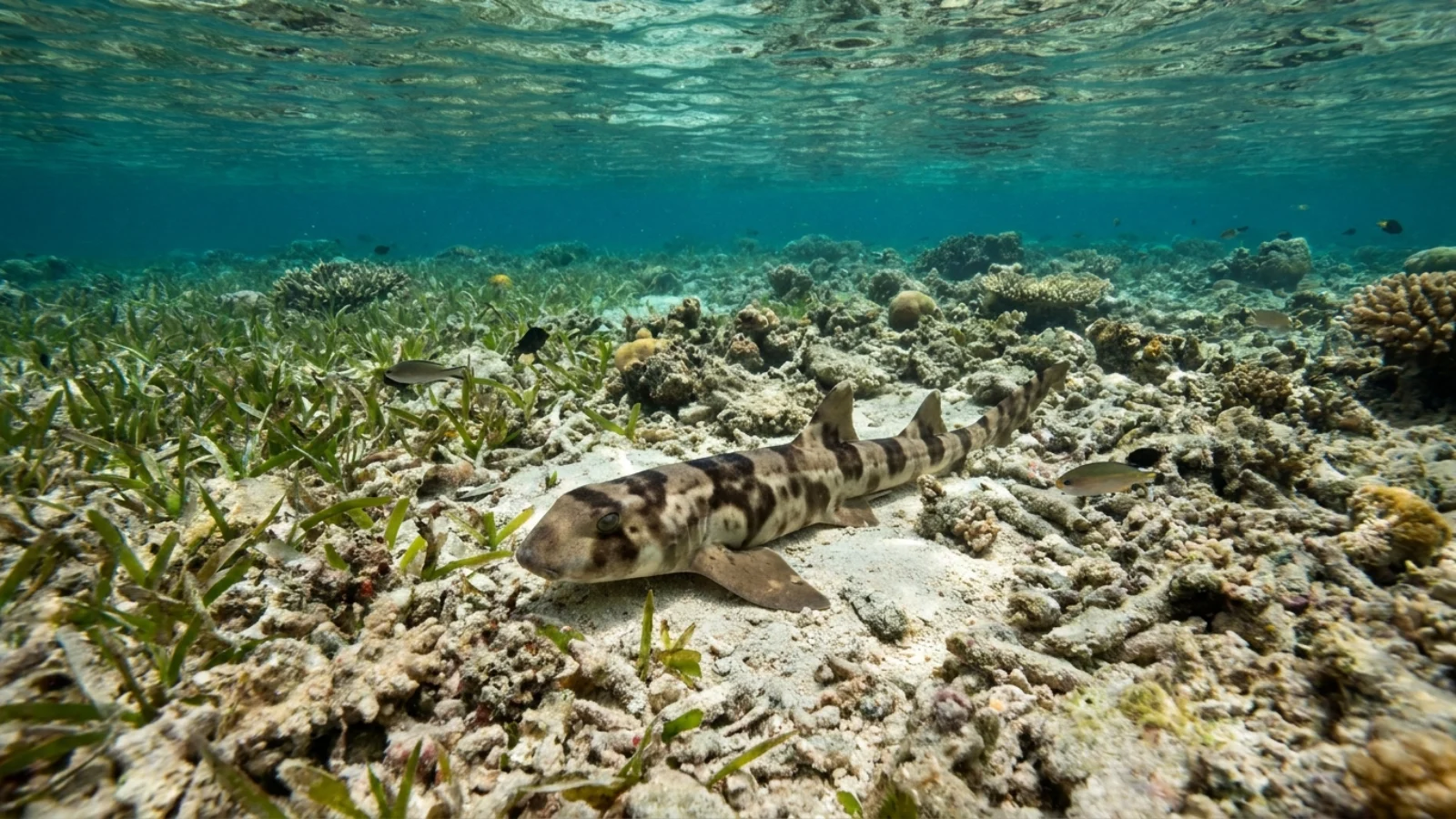
Bamboo sharks are slim, long-tailed little sharks with rounded snouts, short barbels, two dorsal fins set far back and a tail that makes up more than half the body. Juveniles are boldly banded; many adults lose the pattern.
The name probably comes from the banded juveniles, whose dark and light rings look like segments of bamboo. The brownbanded bamboo shark (Chiloscyllium punctatum) has dramatic black-and-white bands as a pup that fade to a plain tan or brown as an adult, and it reaches about 1.04 m. The whitespotted bamboo shark (C. plagiosum) keeps its pattern for life: dark bands overlaid with white and bluish spots, and it grows to about 93 cm. Other species include the grey bamboo shark, slender bamboo shark, Arabian carpetshark and Hasselt’s bamboo shark. All have small mouths with flattened teeth for crushing crabs and shellfish.
The anal fin sits just in front of the tail and is long and low, and the tail lacks a strong lower lobe, so a bamboo shark swims with an eel-like wriggle rather than the power strokes of a requiem shark. On the bottom it moves by “walking” on its pectoral and pelvic fins, much like its close relative the epaulette shark.
Where do bamboo sharks live?
Bamboo sharks live across the Indo-West Pacific, from the Arabian Sea and India to Japan, Southeast Asia and northern Australia, mostly in shallow water on reefs, tide pools, sand flats and seagrass beds.
The brownbanded bamboo shark is recorded from the intertidal zone down to about 85 m, and is often found in tide pools and on reef flats. By day bamboo sharks hide in crevices and under ledges, often with only the tail sticking out; at night they come out to hunt. Divers in Indonesia, Thailand, Malaysia and the Philippines commonly see them on night dives, resting on sand or nosing through rubble. If you dive Southeast Asia, our guides to scuba diving in Thailand and Bali cover sites where they are regular.
How long can a bamboo shark live out of water?
The brownbanded bamboo shark can survive out of water for up to about 12 hours, an adaptation to life in tide pools that drain or overheat at low tide.
Like the epaulette shark, bamboo sharks living on reef flats regularly face low oxygen and exposure. They can tolerate falling oxygen levels by slowing their metabolism, and they can survive being stranded for hours if kept moist. That hardiness is one reason they survive shipping and do well in aquariums, though it does not mean they should ever be kept out of water.
What do bamboo sharks eat?
Bamboo sharks are night-time bottom feeders. They eat crabs, shrimp, worms, snails, clams, squid and small fish, crushing hard-shelled prey with their flat teeth.
They locate prey by smell and electroreception, using their barbels to probe sand and crevices, and suck small animals out of holes. In aquariums they are usually fed squid, shrimp, clams, scallops and fish two to three times a week, with iodine supplements to prevent goitre, a thyroid problem common in captive sharks.
How do bamboo sharks reproduce?
Bamboo sharks are oviparous: females lay tough, flat egg cases that the embryos develop inside for about three to four months before hatching as miniature sharks.
In the whitespotted bamboo shark the egg cases are about 13 cm long, hatch after 14–15 weeks, and produce pups of about 15 cm. Because bamboo sharks breed readily in captivity, the eggs are widely studied, and they have provided some remarkable records. In 2002 Doug Sweet of the Belle Isle Aquarium in Detroit reported whitespotted bamboo shark eggs hatching from a female that had been kept away from males for six years, one of the first documented cases of parthenogenesis, or virgin birth, in a shark. Similar cases have also been documented in the bonnethead and the zebra shark.
Can you keep a bamboo shark as a pet?
Bamboo sharks are the sharks most often kept in home aquariums, but they are a serious commitment: an adult needs a tank of about 680 L (180 gallons) or more, and they can live for 25 years.
Aquarists favour the brownbanded and whitespotted species because they stay under a metre, are hardy, and can be captive-bred, which reduces the need for wild collection. They need a large footprint rather than a tall tank, sand and caves to hide in, excellent water quality and a varied, iodine-supplemented diet. Many hobbyists buy a cute 15 cm pup without planning for a metre-long shark, and public aquariums are often asked to take unwanted ones. If you are considering one, choose captive-bred animals and plan for the adult size from day one.
Are bamboo sharks dangerous?
No. Bamboo sharks are small and docile, with crushing teeth. They can nip if handled, but they are no threat to divers or swimmers.
Are bamboo sharks endangered?
Both the brownbanded and whitespotted bamboo sharks are listed as Near Threatened by the IUCN. They are caught in large numbers in Southeast Asian trawl and inshore fisheries for food, and collected for the aquarium trade.
Bamboo sharks are eaten in parts of Southeast Asia, Taiwan and Madagascar and are a frequent bycatch in shrimp trawls. Their shallow, coastal habitat is also under heavy pressure from development and reef degradation. Unlike many sharks, though, they breed well in aquariums, so the pet trade can be supplied largely by captive-bred animals.
How does the bamboo shark compare with other carpet sharks?
Bamboo sharks are among the smallest of the carpet sharks, the order that also includes the epaulette, zebra, nurse, wobbegong and whale sharks.
Their closest relatives are the walking epaulette sharks. The zebra shark is a larger, spotted carpet shark with a similar egg-laying life, and the nurse shark is the Atlantic giant of the same order.
| Species | Max length | Max weight | Unprov. bites (ISAF) | Lifespan | IUCN |
|---|---|---|---|---|---|
| Brownbanded bamboo shark | 1.04 m | n/a (small) | 0 | 25 yrs (aquaria) | NT |
| Epaulette shark | 1.07 m | n/a (small) | 0 | n/a | LC |
| Zebra shark | 2.5 m | n/a | 1 (2008) | 25–30 yrs | EN |
| Nurse shark | 3.08 m | ~110 kg+ | 9 | 24–40+ yrs | VU |
| Tasselled wobbegong | 1.8 m | n/a | 31* | n/a | LC |
Bite counts: Florida Museum International Shark Attack File, species-implicated table (1580–2022). * Genus-level total. IUCN: LC Least Concern, NT Near Threatened, VU Vulnerable, EN Endangered, CR Critically Endangered, DD Data Deficient.
Are bamboo sharks dangerous?
No. They are small, docile reef sharks with crushing teeth. They may nip if handled but are harmless to people.
How big do bamboo sharks get?
Most species reach 70–95 cm. The brownbanded bamboo shark grows to about 1.04 m and the whitespotted bamboo shark to about 93 cm.
Can you keep a bamboo shark as a pet?
Yes, but they need a tank of about 680 L (180 gal) or more as adults, excellent water quality and can live up to 25 years. Choose captive-bred sharks.
Do bamboo sharks lay eggs?
Yes. They lay flat, leathery egg cases that hatch after about 14–15 weeks into pups roughly 15 cm long.
How long can a bamboo shark live out of water?
The brownbanded bamboo shark can survive up to about 12 hours out of water, an adaptation to tide pools.
Why is it called a bamboo shark?
Probably because the young are banded in dark and light rings that look like bamboo segments.
Where do bamboo sharks live?
On shallow reefs, tide pools and sand flats of the Indo-West Pacific, from India and the Arabian Sea to Japan and northern Australia.
Are bamboo sharks endangered?
The two best-known species are Near Threatened because of heavy fishing and habitat loss in Southeast Asia.
Blane Perun has been exploring Earth’s oceans and marine life for over 25 years. Founder of TheSea.Org in 1999, underwater photographer, coral aquaculture pioneer, and explorer of 80+ countries.
About Blane Perun → All Shark Species A–Z →