The Ugliest Fish in the World — 15 Ugly Fish and Why They Look That Way
The fish most often called the ugliest in the world is the blobfish, which the Ugly Animal Preservation Society elected as its mascot and “ugliest animal”. Its famous sagging face is mostly decompression damage: in the deep sea, at 600 to 1,200 m, it looks like an ordinary fish. Other contenders include the slime-producing hagfish, the huge-mouthed monkfish, the fanged Atlantic wolffish, the goblin shark with its slingshot jaws, the deep-sea anglerfish and the stonefish. In almost every case the “ugly” feature is an adaptation for ambushing prey, surviving pressure or hiding in plain sight.
Most so-called ugly fish are ambush predators or deep-sea specialists: big mouths, warty camouflage, loose skin and gelatinous bodies are tools for catching food and saving energy, not accidents of nature.
What makes a fish “ugly”?
Ugliness is a human judgement, not a scientific category, and the fish on this list would no doubt return the compliment. What people tend to find ugly in a fish is a familiar set of features: an oversized mouth, a jutting lower jaw, bulging or tiny eyes, loose or warty skin, fangs that do not fit inside the mouth, and a body that looks shapeless or slimy out of water. Almost every one of those traits has a function. Big mouths and fangs belong to predators that ambush prey rather than chase it. Warts, flaps and lumpy skin are camouflage against rock, weed and coral. Gelatinous bodies and weak muscles are energy-saving designs for the deep sea, where food is scarce and swimming is expensive.
There is also a photographic problem. Many “ugly fish” photographs show deep-sea animals that were hauled to the surface in trawl nets, where the drop in pressure and the lack of water support distort their bodies. The blobfish is the most famous example, but the same applies to many deep-water sculpins, grenadiers and snailfish. A fair ranking would judge these fish in their own habitat. We have tried to describe each fish as it looks alive, and we give the verified size, depth and range for each one. The order below runs roughly from the fish most often voted ugliest to the more debatable entries.
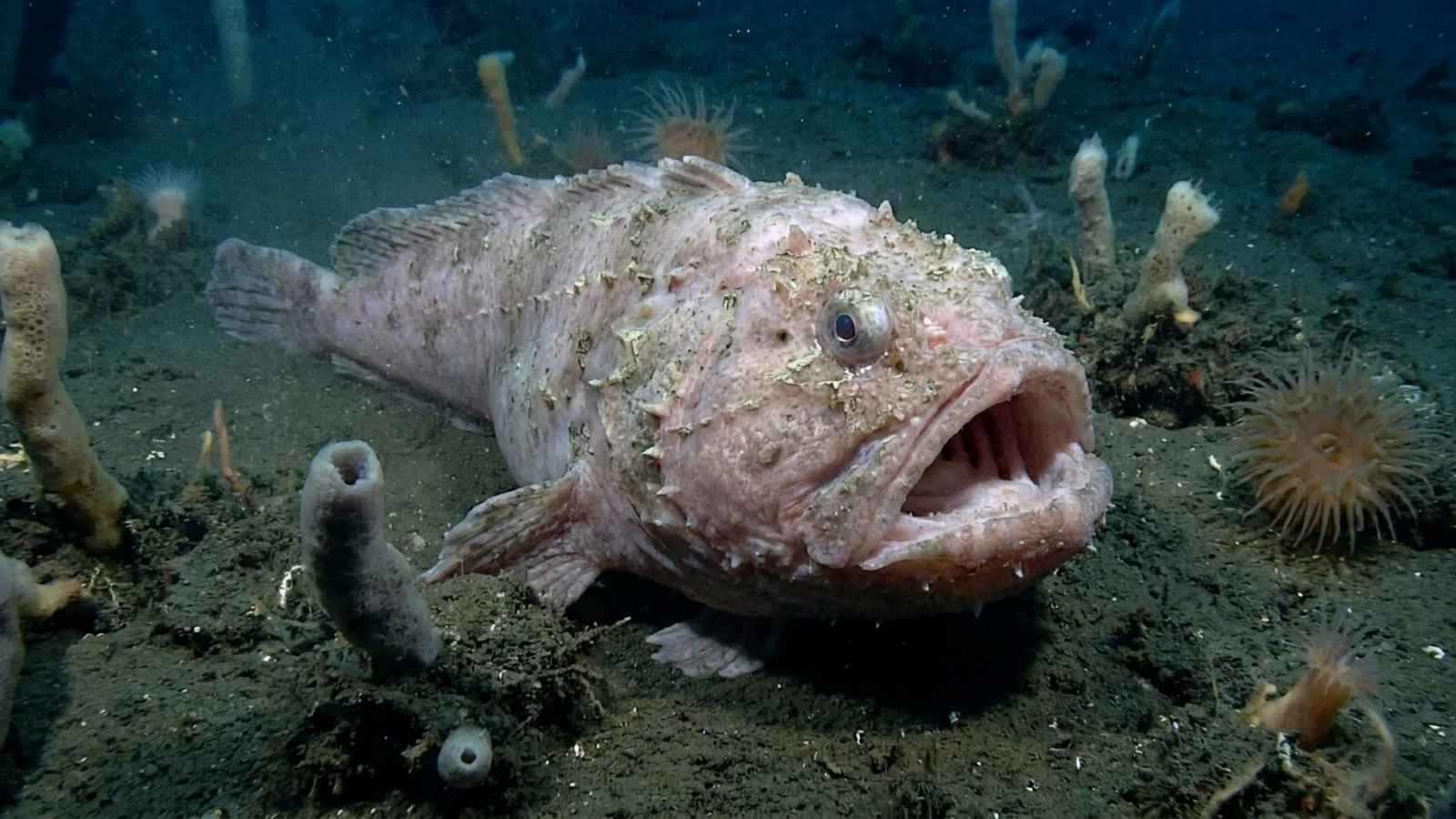
1. Blobfish
The blobfish is the undisputed champion. The Ugly Animal Preservation Society, a comedy-and-conservation project founded in Britain by the biologist and presenter Simon Watt, held an online public vote, launched in 2012, to choose a mascot. The winner, championed by the comedian Paul Foot and declared the ugliest animal on Earth, was the blobfish.
“Blobfish” is the common name for several deep-sea fish in the family Psychrolutidae, the fatheads. The smooth-head blobfish, Psychrolutes marcidus, lives off mainland Australia, Tasmania and New Zealand at depths of about 600 to 1,200 m, where the pressure is 60 to 120 times that at sea level. It is usually shorter than 30 cm. Instead of a gas-filled swim bladder, which would be hard to manage at that pressure, its body is a gelatinous mass slightly less dense than water, so it floats just above the seafloor without spending energy on swimming. It eats whatever drifts in front of it, mostly small crustaceans.
The famous sagging, pink, big-nosed face belongs to a related species, Psychrolutes microporos, two specimens of which were collected during the month-long NORFANZ expedition of 2003 on the Norfolk Ridge between Australia and New Zealand. Specimens pulled up quickly from the deep suffer severe tissue damage as the pressure drops, and they collapse into a jelly with a drooping proboscis. In its natural habitat a blobfish looks compact and recognisably fish-shaped, with no “nose” at all. The ugliest fish in the world, in other words, is largely an artefact of how it was photographed. Blobfish are caught as bycatch in bottom trawls, which is the real threat to them. Our blobfish profile and the page on blob sculpins go further into the family.
2. Hagfish
Hagfish are eel-shaped, jawless fish, and their reputation rests on slime. Along each flank runs a line of about 100 slime glands, and a threatened hagfish releases a milky, fibrous mucus that expands enormously as it mixes with seawater. A predator that bites a hagfish can end up with its mouth and gills clogged and is forced to let go. Underwater video has shown hagfish escaping sharks and wreckfish this way.
Hagfish have no true jaws; they scavenge carcasses of fish and whales on the seafloor, sometimes tying their bodies into a knot to gain leverage as they tear off flesh, and they can absorb dissolved organic matter through their skin and gills. Their skin is attached to the body only along the back and at the slime glands, so it hangs loose like a sack filled with blood. They are ancient: living hagfish look much like fossils about 300 million years old. The largest species, Eptatretus goliath, has been recorded at 127 cm. Despite their looks they are a valued food in Korea, and their tough skin is sold as “eel skin” leather for wallets and belts. Read more in our Pacific hagfish profile.
3. Monkfish (anglers)
Monkfish, or anglers, are flattened bottom-dwelling fish whose enormous head makes the rest of the body look like an afterthought. The European angler, Lophius piscatorius, lives in the north-east Atlantic from the Barents Sea to the Strait of Gibraltar, as well as the Mediterranean and Black Sea, and usually measures 40 to 60 cm, with deeper-water populations tending to be larger. Its very wide mouth is lined with inward-pointing teeth, and a modified fin spine on its head carries a fleshy lure that it waves to draw fish within range. The American angler, Lophius americanus, can reach 140 cm, though about 100 cm is more usual, and may live 30 years. It has been reported catching seabirds at the surface after storms. Monkfish are an important commercial fish.
4. Atlantic wolffish
The Atlantic wolffish, Anarhichas lupus, has a face that looks permanently annoyed, framed by a mouth full of teeth. Both jaws carry four to six fang-like conical teeth at the front, and behind them sit rows of blunt crushing molars. The species name lupus means “wolf”, for those canine-like front teeth. The teeth are tools for crushing hard-shelled prey such as crabs, sea urchins and molluscs, and wolffish help control green crab and urchin populations in the North Atlantic. The largest recorded specimen measured about 1.5 m and weighed almost 18 kg. Wolffish make natural antifreeze proteins to keep their blood fluid in near-freezing water, and both parents are involved in guarding the large eggs. In United States waters the species has declined, probably through overfishing and bycatch, and NOAA lists it as a Species of Concern. See our wolffish profile.
5. Goblin shark
The goblin shark is pink, flabby and long-snouted, and its jaws can shoot forward out of its head. The flat, blade-like snout is covered with ampullae of Lorenzini, sense organs that detect the tiny electric fields of nearby prey, and when it strikes, the highly protrusible jaws, armed with nail-like teeth, extend to snatch the prey. Goblin sharks live on upper continental slopes, in submarine canyons and around seamounts worldwide, usually deeper than 100 m, with adults deeper than juveniles; some researchers think they may dive as deep as about 1,300 m for short periods. The jaw is so mobile that preserved specimens fixed with their jaws in different positions were once mistakenly described as separate species. Our goblin shark profile has the full story.
6. Frilled shark
The frilled shark looks more like a sea serpent than a shark. Its name comes from the frilly edges of its six pairs of gill slits, and its long, flexible jaws carry about 300 recurved, needle-like teeth arranged so that slippery prey such as squid cannot escape. It hunts by bending its eel-like body and lunging. It is often called a living fossil because its body plan has changed little over a very long time, though fossil teeth of the living species date only from the early Pleistocene. Squid make up about 60 percent of its diet. Its gestation may last up to three and a half years, producing litters of 2 to 15 pups. A second species, the southern African frilled shark, was described in 2009. Read more in our frilled shark profile.
7. Common fangtooth
The common fangtooth, Anoplogaster cornuta, is a small fish with a big reputation. It grows to only about 18 cm, but its large, bony, sculptured head and mouth full of sharp fangs make it one of the most menacing-looking fish in the deep sea. Adults are dark brown to black and live mostly between 500 and 5,000 m in temperate and tropical oceans worldwide, while the young live nearer the surface. It is food for larger pelagic predators and of no interest to fisheries. Its outsized teeth help a small predator hold on to whatever it meets in water where meals are rare.
8. Deep-sea anglerfish
Deep-sea anglerfish, the ceratioids, are the classic monsters of deep-sea illustrations: black or brown balls of a fish with a huge mouth, needle teeth and a glowing lure dangling over the head. The real surprise is their reproduction. Early researchers found small females carrying what looked like parasites; these turned out to be dwarf males of the same species. In several families the males are tiny and free-living only until they find a female, after which they bite on and, in some species, fuse permanently with her, becoming little more than a source of sperm. Free-living males and unattached females in those species never develop mature gonads. Our page on deep-sea anglerfish explains the lure and the mating system.
9. Reef stonefish
The reef stonefish, Synanceia verrucosa, looks exactly like a lump of encrusted rock or dead coral, which is the point. It lives in shallow water in the Red Sea and Indo-Pacific and is the most widespread of the stonefishes. Its warty, algae-coloured skin hides it from prey and predators alike, and it waits motionless for small fish to swim close enough to be swallowed in a fraction of a second. Along its back are 12 to 14 dorsal spines, each sheathed in thick skin with venom glands at the base. Stepping on one is extremely painful and can be life-threatening; it is often described as the deadliest fish in the sea. Our stonefish page covers the venom and first aid.
10. Sarcastic fringehead
The sarcastic fringehead, Neoclinus blanchardi, is a slim, brownish tube blenny up to about 30 cm long that lives off the Pacific coast of North America. It spends most of its life hiding in a shell, crevice or burrow, and has been found living in human rubbish such as soda cans. What earns it a place on this list is its mouth. When two fringeheads dispute a territory, they open their jaws to an astonishing width and press their gaping mouths against each other, as if comparing sizes. The name refers to this aggressive, territorial behaviour. Males guard the eggs that the female lays under rocks or in old clam burrows.
11. Red-lipped batfish
The red-lipped batfish, Ogcocephalus darwini, looks as though it is wearing lipstick. It lives around the Galápagos Islands and off Peru at depths of about 3 to 76 m and grows to about 40 cm. Batfish are poor swimmers; they use their modified pectoral, pelvic and anal fins to “walk” over the seafloor. In adults the dorsal fin becomes a single spine-like projection that probably works as a lure. The batfish feeds on small fish and invertebrates such as shrimp, crabs, worms and molluscs. Why the lips are so red remains unclear; one suggestion is that colour helps individuals recognise each other during spawning. See our red-lipped batfish page.
12. Pacific barreleye
The Pacific barreleye, Macropinna microstoma, has a transparent, fluid-filled shield over the top of its head, through which its green tubular eyes can be seen. It hangs almost motionless at about 600 to 800 m, using its large fins for stability. For decades its eyes were thought to be fixed, pointing upward, but in 2008 researchers at the Monterey Bay Aquarium Research Institute, Bruce Robison and Kim Reisenbichler, showed that the eyes rotate within the shield. A barreleye scans upward for the silhouettes of prey and then turns its eyes forward as it tilts its body to feed. Robison has suggested that it may steal food from siphonophores.
13. Northern stargazer
Stargazers spend their lives buried in sand with only their eyes and upturned mouth showing, and a stargazer’s face, all mouth and eyes on top of a flat head, looks permanently startled. The northern stargazer, Astroscopus guttatus, lives along the US Atlantic coast between North Carolina and New York, at depths to about 37 m, and can reach 56 cm. It ambushes small fish and invertebrates that pass overhead. It is also one of the few marine fish that can produce an electric shock: two organs behind its eyes, made of about 200 thin layers of modified tissue, generate the charge. Our page on stargazers covers the family.
14. Warty frogfish
The warty frogfish, or clown frogfish, Antennarius maculatus, is a lumpy, round fish up to about 15 cm long, covered in small wart-like bumps. Like other frogfishes it has a huge, upward-facing mouth that can engulf prey as large as itself, and a lure on its head to attract it. Its colour is extremely variable, from white and cream through pink, yellow, red and brown to black, and frogfishes can change colour over a few weeks to match their surroundings; during coral bleaching events some have even turned white. Read more in our guide to frogfishes.
15. Asian sheepshead wrasse (kobudai)
The Asian sheepshead wrasse, called kobudai in Japan, earns its place with a huge bulbous forehead and a jutting chin that develop as it ages. All individuals begin life as females and later change sex to males, and it is the males that develop the exaggerated head. The transformation became famous when it was filmed near Sado Island, Japan, for the 2017 BBC series Blue Planet II. In Tateyama Bay, a Japanese diver who looks after an underwater Shinto shrine has maintained a decades-long relationship with one individual that comes when he rings a bell.
Ugly fish and conservation
The point behind the Ugly Animal Preservation Society’s joke is serious. Conservation funding and public attention tend to go to charismatic animals such as pandas and dolphins, while unattractive animals, including many fish, receive far less. Several fish on this list face real pressure. Blobfish are caught as bycatch in deep-sea bottom trawls. The Atlantic wolffish has declined in US waters. Deep-sea sharks such as the frilled shark reproduce very slowly, so even modest bycatch can matter. A fish that looks strange in a trawl photograph may be perfectly adapted to its habitat and highly vulnerable to human activity at the same time.
Ugly to us, perfect for their world
Taken together, these fish show how often “ugly” means “specialised”. The giant mouths of the monkfish, anglerfish, stargazer and frogfish are ambush-predator designs that let a fish catch prey without chasing it. The warts and colours of the stonefish and frogfish are camouflage. The slime of the hagfish and the gelatinous body of the blobfish are survival strategies for scavenging and saving energy. The teeth of the wolffish crush armoured prey, and the fangs of the fangtooth and frilled shark hold slippery food in a place where a missed meal may be the only one for days. For more strange faces from the deep, see our list of the deepest animals in the ocean.
What is the ugliest fish in the world?
The blobfish is most often named, after the Ugly Animal Preservation Society elected it as its mascot and the ugliest animal on Earth.
Why does the blobfish look so ugly?
Its sagging appearance is mostly decompression damage from being pulled up from 600 to 1,200 m; in the deep sea it looks like a normal fish.
Is the blobfish endangered?
It has not been fully assessed, but it is caught as bycatch in deep-sea bottom trawls off Australia and New Zealand.
Which ugly fish is dangerous?
The reef stonefish has venomous dorsal spines and is regarded as one of the most dangerous fish to step on.
Can you eat ugly fish?
Yes, several are eaten: monkfish is a popular food fish, and hagfish is valued in Korea.
Why do so many deep-sea fish look ugly?
Gelatinous bodies, big mouths and large teeth help them save energy and catch scarce food in the dark, high-pressure deep sea.
What fish has a transparent head?
The Pacific barreleye, whose eyes rotate inside a clear, fluid-filled shield on its head.
Which ugly fish has the most teeth?
The frilled shark has about 300 needle-like, backward-curving teeth.
- Wikipedia contributors, “Psychrolutes marcidus”, “Psychrolutes microporos”, “Ugly Animal Preservation Society”, “Hagfish”, “Lophius piscatorius”, “Lophius americanus”, “Atlantic wolffish” (accessed November 2026).
- Wikipedia contributors, “Goblin shark”, “Frilled shark”, “Anoplogaster cornuta”, “Anglerfish”, “Synanceia verrucosa”, “Sarcastic fringehead”, “Red-lipped batfish”, “Macropinna”, “Northern stargazer”, “Warty frogfish”, “Asian sheepshead wrasse” (accessed November 2026).
- Robison, B. H. and Reisenbichler, K. R. (2008), “Macropinna microstoma and the paradox of its tubular eyes”, Copeia 2008(4).
Blane Perun has been exploring Earth’s oceans and marine life for over 25 years. Founder of TheSea.Org in 1999, underwater photographer, coral aquaculture pioneer, and explorer of 80+ countries.
About Blane Perun →