Manatees Find Refuge in Florida’s Warm Waters — Blue Spring’s 932-Manatee Record
During a cold snap in late January 2024, Blue Spring State Park in Volusia County counted 932 manatees in its spring run, a park record that beat the 736 counted on New Year’s Day 2024. The spring stays at about 72–73 °F all year, and manatees, which suffer cold stress in water below about 68 °F, crowd into it whenever the St. Johns River cools. The Blue Spring herd has grown from about three dozen animals in the 1970s, a conservation success that contrasts with heavy losses on Florida’s Atlantic coast.
A record count at Blue Spring does not mean that manatees are suddenly more numerous. It means that cold weather pushed nearly every manatee in the area into the spring on the same morning. Counts are highest on the coldest days, so each record is a snapshot of both a growing herd and a hard winter.
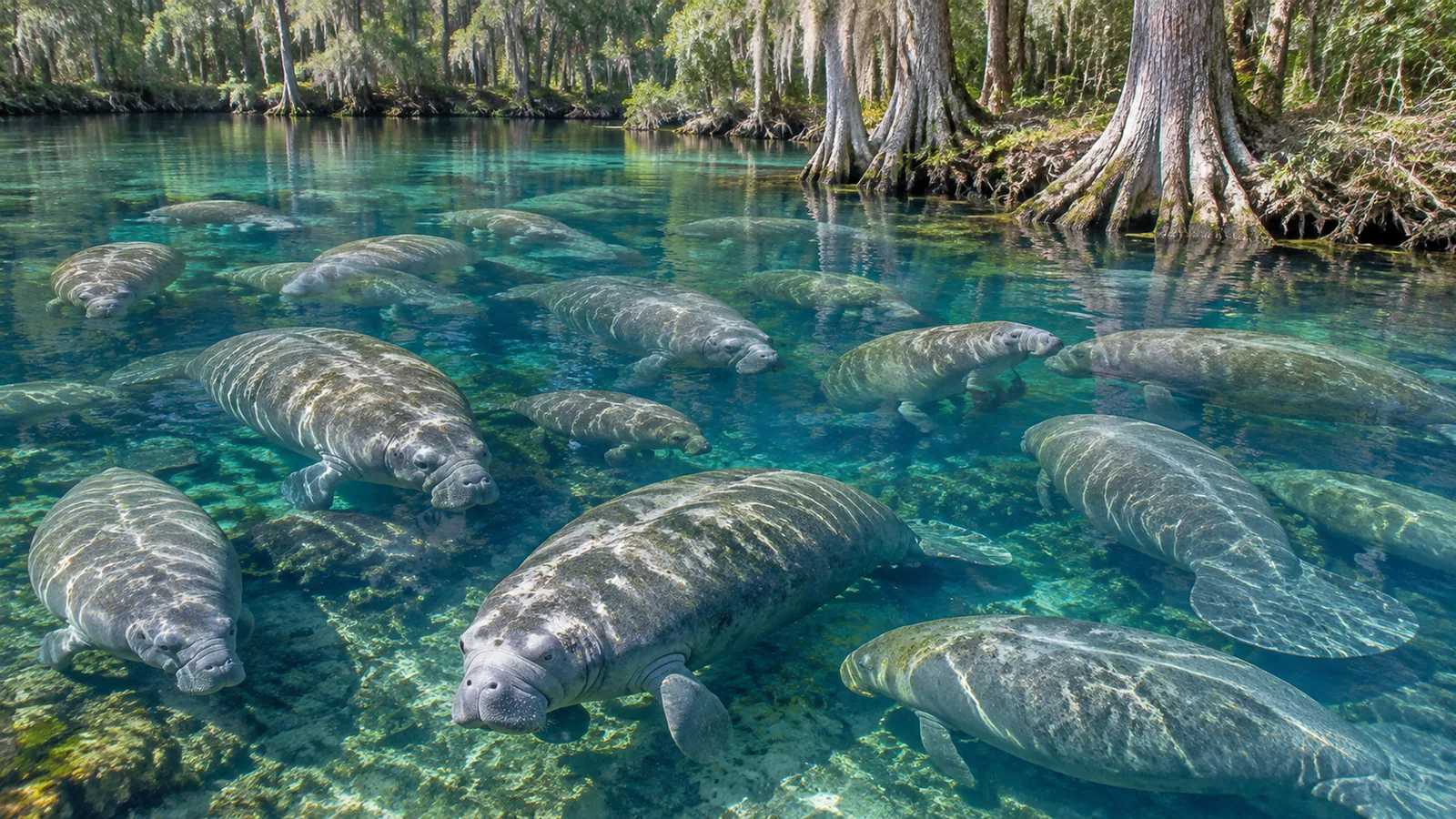
On a cold morning in late January 2024, the clear spring run at Blue Spring State Park filled with manatees. Grey backs packed the shallows from the boil to the river, and when the count was done, it stood at 932, the most ever recorded at the park. It beat a record set only weeks earlier, on New Year’s Day, of 736. This page looks at why the manatees came, how the Blue Spring herd grew so large, how counts are made and what has happened in the winters since.
What happened at Blue Spring in January 2024?
A cold front swept through Central Florida in mid-January 2024, dropping air temperatures into the 30s °F overnight and cooling the St. Johns River. Manatees that had been spread along the river and its lakes moved into Blue Spring’s warm spring run, as they do on every cold morning. This time, the count from the park’s boardwalk reached 932.
The figure was announced by the Friends of Blue Spring State Park and widely reported by Florida and national media. The previous record, 736, had been set on January 1, 2024. Earlier in the season, counts in the hundreds had already been common. The pictures of the spring run, with manatees lying almost shoulder to shoulder, became one of the most widely shared wildlife images of the winter.
Why do manatees need warm water?
Florida manatees are large, but they are poorly insulated. Unlike whales and seals, they have only a thin layer of fat, and their metabolic rate is low for a mammal of their size, because their diet of seagrass and other plants is low in energy. When the water around them cools, they cannot generate enough heat to stay warm.
The Florida Fish and Wildlife Conservation Commission notes that manatees begin to struggle when water temperatures fall to about 68 °F or below. Prolonged exposure to cold water causes cold stress syndrome, a condition that damages the skin, weakens the immune system and disrupts digestion, and it can kill. To survive the winter, manatees gather at warm-water refuges: natural springs, deep basins that hold heat, and the warm-water outfalls of power plants.
Why is Blue Spring so important?
Blue Spring is one of the largest springs on the St. Johns River, and its water emerges from the Floridan aquifer at about 72 to 73 °F all year. The spring run, about a third of a mile long, carries that warm water from the spring boil down to the river. On a cold day, the run is far warmer than the river around it, and manatees gather along its length.
Because the spring’s temperature is natural and constant, it is a more reliable refuge than a power-plant outfall, which can shut down or change. As older power plants close or are rebuilt, natural springs like Blue Spring are likely to become even more important for manatees in the future.
Why does spring water stay warm?
Florida’s springs are windows into the Floridan aquifer, a vast body of porous limestone that holds groundwater beneath most of the state. Water in the aquifer stays close to the average annual air temperature of the region where it entered the ground, which in central Florida is in the low 70s °F. It emerges at the springs at that temperature summer and winter alike, which is why the spring run feels cool to swimmers in July and warm to manatees in January.
Because the refuge depends on the spring’s flow, the volume of water coming out of the ground matters as much as its temperature. The St. Johns River Water Management District has set minimum flows for Blue Spring, partly to make sure that the spring run continues to provide enough warm water for a growing herd. Pumping too much groundwater from the aquifer could reduce that flow, shrinking the warm area just when more manatees need it.
How did the herd grow?
The growth of the Blue Spring herd is one of Florida’s great conservation stories. When research began at the spring in the 1970s, only about three dozen manatees used it in winter. The French oceanographer Jacques Cousteau filmed the spring’s manatees in the early 1970s, drawing national attention to the species, and the park became a centre for research and public education.
Over the decades, protection at the spring, slow-speed boating zones on the St. Johns River and the closing of the spring run to people during the winter allowed the herd to grow steadily. Researchers at the park and with Save the Manatee Club have identified individual manatees year after year from the scars and markings on their bodies, building one of the longest-running photo-identification records of any marine mammal population.
How are manatees counted?
Two kinds of counts are made at Blue Spring. Park staff count manatees from the boardwalk along the spring run, recording the number present at a given time. Researchers also carry out roll-call counts from a canoe, identifying individual manatees by their scars and recording which known animals are present. The two methods give different totals on the same day, because they measure different things and can be affected by wind, light and water clarity. Our guide to the Blue Spring manatee count explains how the daily numbers work and how to check them.
That is why record figures are sometimes reported differently. A boardwalk count of 932 and a roll-call record count are both valid, but they are not directly comparable. What matters for science is the long-term trend, built up from consistent methods over many years, which shows a herd that has grown many times over since the 1970s.
What have later winters brought?
The winters since 2024 have continued to bring large numbers. In the 2024–25 season, park staff counted 768 manatees from the boardwalk on January 9, 2025, and Save the Manatee Club researchers recorded a roll-call record of 760 individual manatees on January 26. Over that season, the club’s researchers recorded 879 different manatees at the spring, including 88 calves.
In the 2025–26 season, a severe and prolonged cold front in early February 2026, with overnight lows of 23 °F, brought another surge, and Save the Manatee Club reported a record count of 859. Together, these figures show that hundreds of manatees now depend on Blue Spring every winter, and that the herd’s numbers are holding up.
What happens to manatees that get too cold?
Not every manatee reaches a refuge in time. Animals caught in cold water for days can develop cold stress syndrome, which shows up as white patches and lesions on the skin, weight loss and lethargy. Young manatees, recently weaned and still learning where to find warm water, are especially vulnerable, and in severe winters cold stress becomes one of the leading causes of death.
Florida has a network of partners, including FWC biologists, zoos and aquariums, that rescue sick and injured manatees, treat them in critical-care facilities and release them once they recover. Members of the public who see a manatee that appears sick, injured or cold-stressed are asked to report it to the FWC Wildlife Alert hotline rather than approach it themselves. Blue Spring has long been one of the places where rehabilitated manatees are released back into the St. Johns River.
How are manatees protected at Blue Spring?
During manatee season, which runs from mid-November to mid-March, the spring run is closed to swimming, paddling and boating, so that the manatees can rest undisturbed in the warm water. Visitors watch from the boardwalk, which runs along the spring run and gives clear views of the animals below. Outside the season, when most manatees have dispersed into the river, swimming and paddling reopen.
The park also runs a live webcam, operated with Save the Manatee Club, that lets people around the world watch the manatees in winter. Volunteers and staff answer questions on the boardwalk and explain the rules. The aim is to let people see manatees closely without disturbing them, which helps build public support for protection.
How many manatees live in Florida?
Statewide, the Florida Fish and Wildlife Conservation Commission has estimated the population in recent years at roughly 7,000 to 11,000 manatees. The species was reclassified from endangered to threatened by the U.S. Fish and Wildlife Service in 2017, reflecting decades of growth from the low numbers of the 1970s and 1980s.
That growth has not been even. The St. Johns River population, centred on Blue Spring, has done particularly well. On Florida’s Atlantic coast, by contrast, the loss of seagrass in the Indian River Lagoon led to mass starvation in 2021, when more than 1,000 manatees died across the state, a record. Deaths fell in later years, but the Atlantic population remains vulnerable.
Why is the St. Johns River population doing so well?
Several factors help. Blue Spring provides a large, reliable natural refuge, so manatees in the St. Johns are less dependent on power plants. Boat-speed zones along the river reduce collisions, and the long protection of the spring itself has allowed the herd to grow without disturbance during the coldest months.
Food supply matters too. The St. Johns River and its lakes support beds of eelgrass and other aquatic plants, and manatees in the river have not suffered the same collapse in food as those in the Indian River Lagoon. The contrast between the two populations shows how important food, warm water and protection from boats are, and how quickly a population can decline if one of them fails.
What threats remain?
Watercraft collisions remain one of the leading known causes of manatee deaths in Florida, and almost every adult manatee carries scars from boat propellers. Cold stress kills manatees in severe winters, particularly young animals and those in poor condition. Habitat loss, water pollution and harmful algal blooms, including red tide on the Gulf coast, all take a toll.
Longer-term concerns include the future of warm-water refuges. Many manatees depend on power-plant outfalls that may close as plants are retired or modernised, and the flow of some natural springs has declined as groundwater is pumped for human use. Protecting springs like Blue Spring, and the aquifer that feeds them, is one of the most important long-term measures for manatee conservation.
How can you see manatees at Blue Spring?
The best time to see manatees at Blue Spring is on a cold morning in December, January or February, when the river is coldest and the most animals are in the spring run. Counts are usually highest early in the day, after a cold night, and fall as the river warms and manatees leave to feed. The park can reach capacity on cold weekends, so arriving early is wise.
Visitors should stay on the boardwalk, keep noise down and never try to touch or feed manatees. Feeding or harassing manatees is illegal under state and federal law. Binoculars and polarised sunglasses help cut the glare on the water, and the park’s webcam offers a view of the spring on days when visiting is not possible.
What does the record mean?
The record count of 932 manatees in January 2024 was a remarkable sight and a sign of real success. A herd that numbered a few dozen animals half a century ago now fills the spring run on cold mornings. It shows what long-term protection of habitat, careful management of people and boats, and dedicated research can achieve.
It is also a reminder of how much manatees depend on a handful of warm places. On the coldest days, hundreds of animals are packed into one short spring run. Keeping that refuge, and others like it, warm, clean and protected is the key to making sure future winters bring more records rather than losses.
What was the record manatee count at Blue Spring?
932, counted in late January 2024 during a cold snap.
Why do manatees go to Blue Spring?
The spring stays at about 72–73 °F all year, warmer than the river in winter.
At what temperature do manatees get cold stress?
Manatees struggle when water falls to about 68 °F or below.
When is manatee season at Blue Spring?
From mid-November to mid-March.
Can you swim with manatees at Blue Spring?
Not during manatee season; the spring run is closed to people.
How many manatees are there in Florida?
Recent FWC estimates range from roughly 7,000 to 11,000.
Are manatees still endangered?
They were reclassified as threatened in 2017.
What is the best time to see manatees at Blue Spring?
Early on a cold morning between December and February.
- Friends of Blue Spring State Park and Florida State Parks, Blue Spring manatee counts (January 2024)
- WUSF / NPR, “A Florida park just saw a record number of manatees gather together in its waters” (January 29, 2024)
- Save the Manatee Club, Blue Spring manatee sighting reports, 2024–25 and 2025–26 seasons
- Florida Fish and Wildlife Conservation Commission, manatee population and mortality data
- U.S. Fish and Wildlife Service, West Indian manatee reclassification (2017)
Blane Perun has been exploring Earth’s oceans and marine life for over 25 years. Founder of TheSea.Org in 1999, underwater photographer, coral aquaculture pioneer, and explorer of 80+ countries.
About Blane Perun →