Manatee Park, Fort Myers — Winter Warmth on the Orange River
Manatee Park is a Lee County park on State Road 80 (Palm Beach Boulevard) in east Fort Myers, beside the discharge canal of the Florida Power & Light plant on the Orange River. When Gulf and river water drops below about 68°F (20°C), Florida manatees move into the canal’s warmer water, and on cold mornings visitors can see them from the shoreline and observation decks. The best time is usually late December through February, especially the morning after a cold front. In warm weather the canal can be empty. Guided and rental kayak trips run on the Orange River in season.
Florida manatees cannot tolerate cold for long. Below about 68°F they risk cold stress, a potentially fatal condition. Natural warm springs are scarce in Southwest Florida, so manatees learned decades ago to use power plant outflows as winter refuges. The Fort Myers plant’s canal is one of these, and the park was built so people could watch without disturbing them.
Manatee Park is a short drive east of I-75 (exit 141) and within an easy drive of Bonita Springs and Naples. The park has boardwalks and observation decks over the canal, short nature trails, butterfly gardens, a playground and picnic areas. It opens from 8 a.m. to sunset, and pets are not allowed.
Manatee Park — at a glance
- Location: 10901 SR 80 (Palm Beach Blvd), Fort Myers, FL
- Operator: Lee County Parks & Recreation
- Water: FPL plant discharge canal and Orange River
- Trigger temperature: Gulf water below ~68°F (20°C)
- Best months: Late Dec–Feb (Nov–Mar possible)
- Kayaking: Guided tours and rentals, roughly Nov–Apr
When is the best time to see manatees at Manatee Park?
On a cold morning in winter. Manatees arrive when the water temperature falls below about 68°F, usually from late December through February, though early cold snaps in November and late ones in March also bring them in. The best visits come one to three days after a strong cold front, early in the day. On warm, sunny days in winter many manatees leave the canal to feed in the river and nearby waters, and numbers drop sharply. Our month-by-month guide to the best time to see manatees in Florida explains the pattern statewide.
| Conditions | Chance of seeing manatees |
|---|---|
| Cold front, air below ~50°F at night | Excellent |
| Average winter day | Good |
| Warm spell in winter | Fair to poor |
| April–October | Low; manatees disperse |
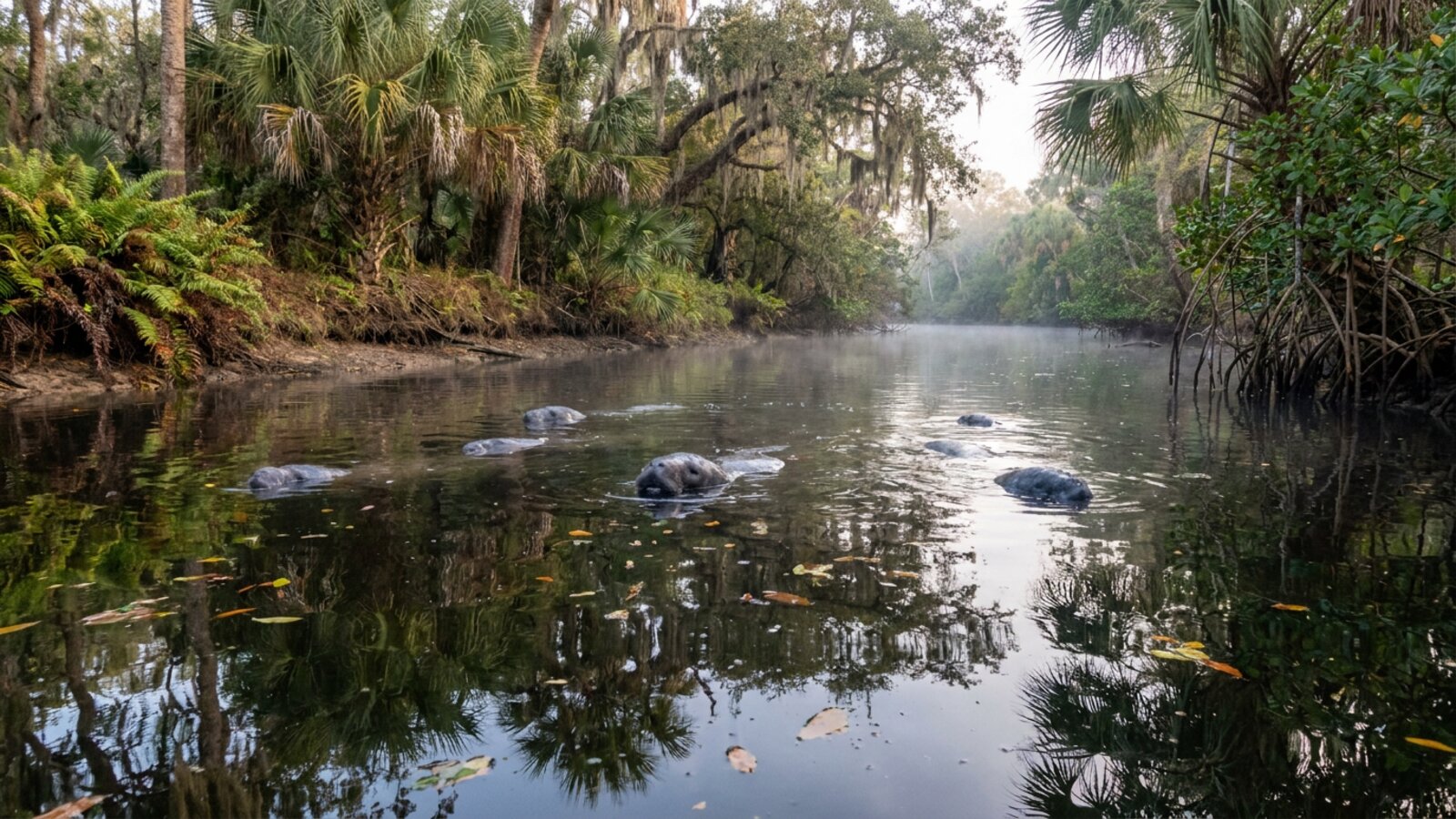
Look for “footprints”: smooth, round patches on the surface left by a manatee’s tail stroke just below. A snout breaking the surface with a puff of breath is the giveaway.
Can you kayak with manatees at Manatee Park?
Yes, in season. A concession runs guided manatee kayak tours and rents sit-on-top kayaks for paddling the Orange River from roughly November into April. Kayakers often see manatees resting or feeding along the river. Federal and state law protects manatees from harassment: don’t chase, touch, feed or give them water, keep your distance, and let them approach you if they choose.
Why do manatees need warm water?
Manatees have a low metabolic rate and little insulating fat for their size. Long exposure to water below about 68°F can cause cold stress syndrome, which weakens them and can kill. In cold winters, Florida has recorded hundreds of cold-related deaths. Warm springs, deep canals and power plant outflows act as refuges. The species overview is in West Indian manatee and manatee habitat.
What else is there to see?
- Butterfly and native plant gardens around the parking areas.
- Short nature trails and boardwalks along the canal.
- Wading birds such as herons, egrets and ibises on the river banks.
- A visitor and educational area with manatee information in season.
How does Manatee Park compare with other Florida manatee spots?
| Site | Water source | Swim allowed? |
|---|---|---|
| Manatee Park, Fort Myers | Power plant canal | No (kayak on river) |
| Manatee Viewing Center, Apollo Beach | Power plant canal | No |
| Crystal River | Natural springs | Yes, with rules |
| Manatee Springs State Park | Natural spring | Swimming in spring; no manatee interaction |
| Fort Pierce | Indian River Lagoon | No |
How to plan a visit
Go early on the coldest morning you can manage. Manatees are most concentrated in the canal after a chilly night, and the light is softer before the sun climbs. Weekends in January and February can be busy, especially when a cold front coincides with school holidays, so a weekday morning is usually calmer. Parking is paid at the park, and Lee County Parks & Recreation sometimes posts updates on manatee activity, so it is worth checking before a long drive.
- Bring polarised sunglasses. They cut surface glare so you can see manatee outlines below the water.
- Bring binoculars. Some animals rest in the middle of the canal or across the river.
- Dress for the weather. The best manatee days are, by definition, the coldest days of the year.
- Be patient. A resting manatee may stay submerged for many minutes between breaths; watch one spot and wait.
Getting there from Naples, Bonita Springs and Cape Coral
From Naples and Bonita Springs, take I-75 north to exit 141 and head east on State Road 80 (Palm Beach Boulevard); the park entrance is about a mile and a quarter from the interstate. Allow roughly 30–45 minutes from Bonita Springs and about an hour from Naples, more in peak-season traffic. From Cape Coral and downtown Fort Myers, SR 80 runs east along the Caloosahatchee River directly to the park. Because the best viewing is on cold mornings, plan to arrive soon after the park opens rather than in the afternoon, when manatees often drift out into the river to feed. Combine the trip with a walk along the boardwalks and the butterfly garden, which are worth seeing even on a warm day with few manatees in the canal.
What will you actually see?
On a good morning, grey backs and snouts break the surface across the canal, often in loose groups. Resting manatees lie near the bottom or just below the surface and rise slowly to breathe. Active ones cruise along the shoreline, and you may see the circular “footprints” on the water as they swim. In winter you will often see cows with calves staying close beside them. Many adults carry white propeller scars on their backs and tails, a reminder of how often Florida manatees are hit by boats; biologists use those scar patterns to identify individual animals over many years.
Photographers do best with a polarising filter and a moderate telephoto lens. Overcast days reduce glare, and shooting from the higher observation decks gives a better angle into the water than standing at the shoreline.
Kayaking etiquette on the Orange River
Paddling the Orange River is a quieter way to see manatees, and in season they often surface close to kayaks on their own. The rules are simple: observe passively, and let the animal decide how close to come. Our guide to kayaking with manatees covers other rivers and paddling etiquette.
- Do not paddle over or into groups of resting manatees, and never separate a mother and calf.
- Do not chase, touch, poke, feed or give water to manatees; all of these count as harassment.
- Keep paddle strokes gentle and avoid sudden noise around resting animals.
- Respect posted manatee protection or no-entry areas, which give animals somewhere undisturbed to rest.
- Report injured, entangled or distressed manatees to the FWC Wildlife Alert Hotline.
Why power plant refuges are a long-term worry
Power plant outflows have saved many manatees during cold snaps, but they are an artificial habitat that manatees have come to depend on. Plants can be retired, rebuilt or run differently, and a refuge that disappears in the middle of winter could leave hundreds of animals without warm water. Manatee recovery planning in Florida therefore treats the loss of warm-water habitat as a major long-term threat, and protecting and restoring natural springs, which provide stable warmth without depending on industry, is a central goal. The U.S. Fish and Wildlife Service reclassified the West Indian manatee from endangered to threatened in 2017, but the Florida starvation crisis that began in 2021 showed how quickly conditions can change. Places like Manatee Park are both a viewing site and a reminder of how much these animals rely on a handful of warm places. On the Atlantic coast, the closest equivalent is Manatee Lagoon in West Palm Beach.
- Exit: I-75 exit 141, about 1.25 miles east
- Hours: 8 a.m. to sunset daily
- Pets: Not allowed
- Species: Florida manatee, Trichechus manatus latirostris
When is the best time to see manatees at Manatee Park Fort Myers?
Cold mornings from late December through February, especially after a cold front.
Are manatees at Manatee Park year-round?
No. They gather in winter when water drops below about 68°F and disperse in warm months.
Can you swim with manatees at Manatee Park?
No. You can view them from shore or kayak the Orange River.
Is there a fee at Manatee Park?
Admission is free; parking is paid.
Can you kayak at Manatee Park?
Yes, guided tours and rentals operate in season.
Why are manatees near the power plant?
The plant’s discharge canal is warmer than surrounding water in winter.
Are dogs allowed at Manatee Park?
No, pets are not permitted.
What time of day is best to see manatees at Manatee Park?
Early morning on a cold day, when manatees are most concentrated in the warm canal. On mild afternoons many leave to feed in the river.
- Lee County Parks & Recreation. Manatee Park information.
- Florida Wildlife Viewing. Manatee Park at Fort Myers (location, 68°F trigger, best months, hours, kayaking).
- Florida Fish and Wildlife Conservation Commission. Manatee cold stress and warm-water refuges.
Blane Perun has been exploring Earth’s oceans and marine life for over 25 years. Founder of TheSea.Org in 1999, underwater photographer, coral aquaculture pioneer, and explorer of 80+ countries.
About Blane Perun →