Feather Star — The Stalkless Crinoid That Walks, Swims and Regrows Its Arms
A feather star is a free-living crinoid, an echinoderm related to starfish, sea urchins and sea cucumbers, with feathery arms that it uses to catch plankton from the water. Unlike their cousins the sea lilies, adult feather stars have no stalk: they grip the reef with small claw-like cirri and can crawl and even swim by waving their arms. About 550–600 species are known, from shallow coral reefs to the deep sea. They start life with five arms, but these branch, giving 10 arms in many species and up to about 200 in some.
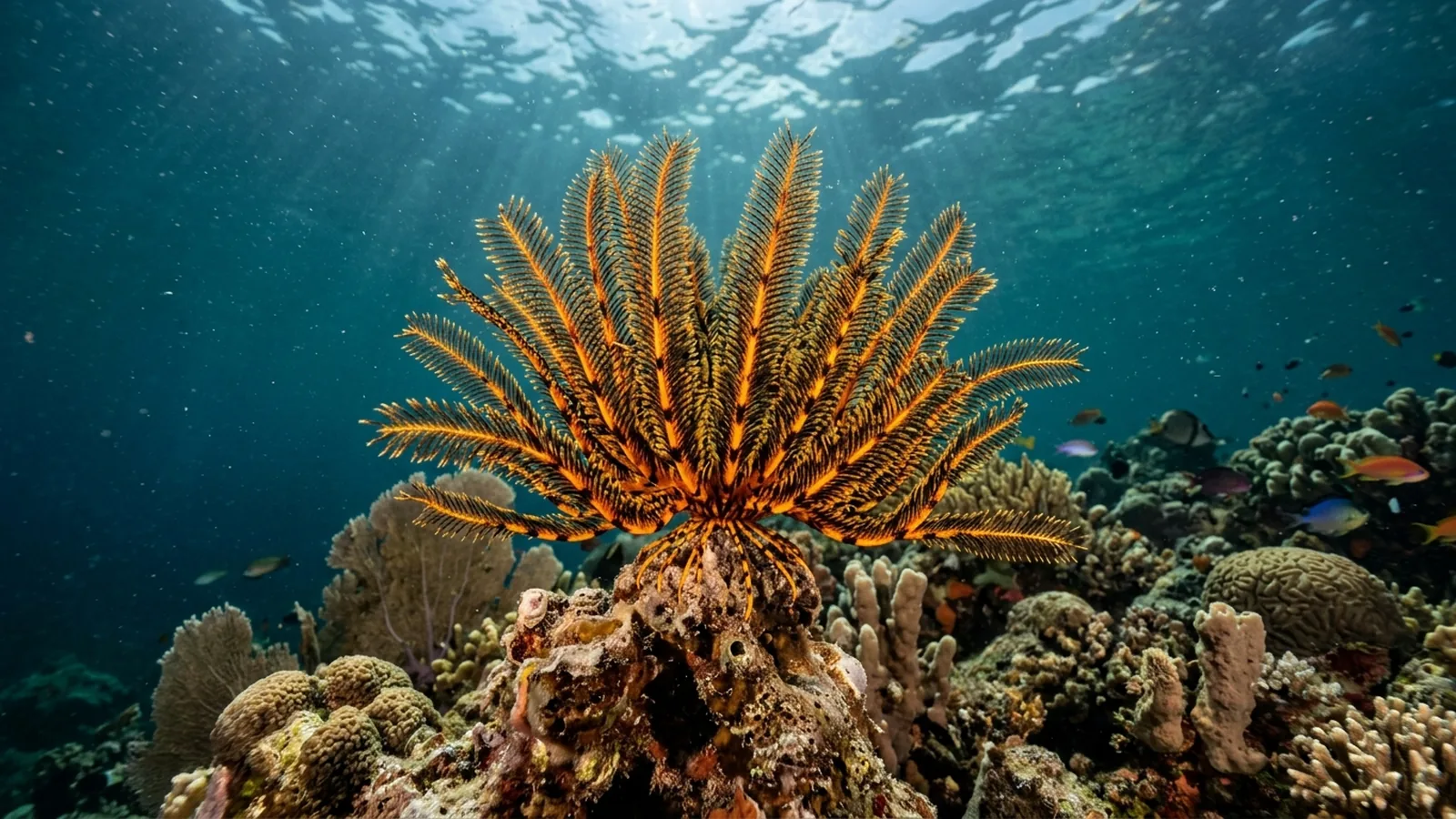
On a good Indo-Pacific reef, feather stars are everywhere: perched on sea fans and coral heads like bright yellow, black, red or green shuttlecocks, arms spread into the current. Most divers swim past them as decoration. Look closer and they are among the strangest animals on the reef — descendants of a group that once carpeted ancient seas, able to walk, swim, shed and regrow limbs, and serve as a home for a whole community of hitchhikers.
What is the difference between a feather star and a sea lily?
Both are crinoids, but sea lilies stay attached to the seafloor on a long stalk for life, while feather stars lose their stalk as juveniles and become free to move.
Feather stars do go through a stalked stage. After a free-swimming larval phase, the young crinoid settles and grows on a short stalk, a stage called a pentacrinoid. As it matures it breaks free and spends the rest of its life gripping surfaces with cirri — jointed, claw-tipped appendages on the underside of the body. Sea lilies keep their stalk, which can still reach about a metre in living species and reached more than 20 metres in some fossil forms.
Today feather stars are by far the more successful group. There are about 550–600 species of feather star against only about 95 living sea lilies, which mostly survive in deep water. Our older crinoids page covers the class as a whole; this page focuses on the feather stars divers actually see.
Can feather stars swim?
Yes. Many feather stars can swim by raising and lowering their arms in alternating groups, rising off the bottom in a slow, graceful pulsing motion. Most of the time, though, they crawl or stay perched.
Swimming is usually an escape behaviour, triggered when a feather star is disturbed or attacked, or used to move to a better feeding perch. The arms beat in sequence — in ten-armed species, alternate sets of five lift and fall — so the animal rises and drifts like a feathery parachute. It is one of the most beautiful things you can see on a night dive when a light catches a swimming feather star.
Crawling is more routine. Feather stars pull themselves along with their arms or walk on their cirri, climbing sea fans, sponges and coral heads to reach the strongest current. Many species hide in crevices by day and climb to exposed perches at night to feed.
What do feather stars eat?
Feather stars are suspension feeders. They spread their arms into the current and catch plankton and drifting organic particles on sticky tube feet, then pass the food along grooves to the mouth.
Each arm is lined with side branches called pinnules, giving the feathery look. Tiny tube feet along the pinnules flick food particles into a mucus-lined groove, and cilia move the food down the arm to the mouth at the centre of the upper surface. Unusually for an echinoderm, both the mouth and the anus face upward.
Because they depend on current, feather stars are a quick visual read of water movement on a reef: where they are thick and fully open, the current is bringing in food. Many divers use them, along with sea fans and sea pens, to judge where the fish action will be.
Can feather stars regrow their arms?
Yes. Feather stars can shed arms deliberately and regrow them, as long as part of the central body and its nerve centre survives.
Arm loss is common. Fish nip off arm tips, and a feather star can drop an arm to escape a predator’s grip, much like a lizard dropping its tail. The lost arm regrows over weeks to months. In the laboratory, crinoids are a model for studying regeneration because they can rebuild complex structures including nerves and muscle. Sea lilies can go further and regenerate the entire crown.
Regeneration is a family trait among echinoderms; see our piece on how starfish regenerate missing parts.
What animals live on feather stars?
Feather stars host a whole community of small animals, including crinoid shrimps, squat lobsters, clingfish, worms and ghost pipefish, many of them coloured to match their host exactly.
For an underwater photographer, a feather star is a treasure chest. Tiny shrimps and squat lobsters live among the arms in the same colour pattern as their host, often striped yellow and black. Specialised clingfish shelter at the base of the arms. Ornate ghost pipefish hover head-down beside feather stars, using them as camouflage. Small myzostomid worms crawl over the arms and disc, some feeding on food particles the feather star collects.
These hitchhikers gain shelter and, in some cases, food. Most do little harm. Spotting them takes slow, careful looking; a feather star should never be touched or moved, because the arms break easily. For related critters, see our guides to pipefish and seahorses and pipefish.
Where do feather stars live?
Feather stars live in every ocean, from shallow tropical reefs to polar seas and the deep sea. They are most diverse in the Indo-West Pacific, from the Indian Ocean to Japan.
In the Indo-Pacific, genera such as Comanthus, Oxycomanthus and Tropiometra crowd reefs in dozens of colours; Raja Ampat and other parts of the Coral Triangle are famous for them (see our Raja Ampat guide). In the Atlantic, Antedon is the best-known genus, and in the Caribbean the swimming crinoid Analcidometra armata and the golden crinoid Davidaster rubiginosus are common reef sights. Some Antarctic and deep-sea feather stars are large and abundant, and a few live deeper than 1,000 metres.
| Species | Arms | Arm length | Depth |
|---|---|---|---|
| Antedon bifida (NE Atlantic) | 10 | 50–100 mm | Intertidal to 450 m |
| Oligometra serripinna (Indo-Pacific) | 10 | 10–45 mm | ~6–25 m |
| Tropiometra carinata | 10 | 100–180 mm | Intertidal to 84 m |
| Davidaster (Nemaster) rubiginosus (Caribbean) | 20–35 | 100–200 mm | 1–334 m |
How old are feather stars?
Crinoids appear in the fossil record more than 480 million years ago, in the Ordovician, and once formed vast underwater meadows. Feather stars, the stalkless comatulids, appeared much later, around the early Jurassic.
About 6,000 crinoid species are known from fossils. In the early Carboniferous, roughly 360 million years ago, crinoids were so abundant that some limestones are made almost entirely of their broken stems. The end-Permian mass extinction nearly wiped them out; all living crinoids descend from one surviving lineage. Losing the stalk and gaining the ability to move may be part of why feather stars thrived afterwards — mobile crinoids can escape predators that stalked forms cannot.
Feather stars are part of the same echinoderm family tree as brittle stars, starfish, sea urchins and sea cucumbers. See our echinoderms overview for the full group.
What is a feather star?
A feather star is a stalkless crinoid, an echinoderm related to starfish and sea urchins. It uses feathery arms to catch plankton and grips surfaces with claw-like cirri.
Can feather stars swim?
Yes. Many feather stars swim by raising and lowering alternate groups of arms, usually to escape a threat or move to a new perch. Most of the time they crawl or stay still.
Is a feather star a starfish?
No, but they are related. Both are echinoderms. Feather stars are crinoids, a separate class from starfish (Asteroidea).
How many arms does a feather star have?
All start with five arms that branch. Many species have 10 arms; some have 20 to 40, and a few have up to about 200.
What do feather stars eat?
Plankton and organic particles. Tube feet on the arms flick food into grooves that carry it to the mouth.
Are feather stars dangerous to touch?
They are harmless to people, but they are fragile and can shed arms when handled. Divers should not touch them.
Can you keep a feather star in an aquarium?
They are very difficult to keep. They need constant fine plankton and strong, variable flow, and most starve in home aquariums.
What is the difference between a feather star and a sea lily?
Sea lilies stay attached on a stalk all their lives. Feather stars lose their stalk as juveniles and become free-moving.
Can feather stars regrow arms?
Yes. They can shed arms to escape predators and regrow them, as long as the central body survives.
Blane Perun has been exploring Earth’s oceans and marine life for over 25 years. Founder of TheSea.Org in 1999, underwater photographer, coral aquaculture pioneer, and explorer of 80+ countries.
About Blane Perun → More on Bizarre Sea Creatures →