Unicornfish — The Reef Fish With a Horn Nobody Can Fully Explain
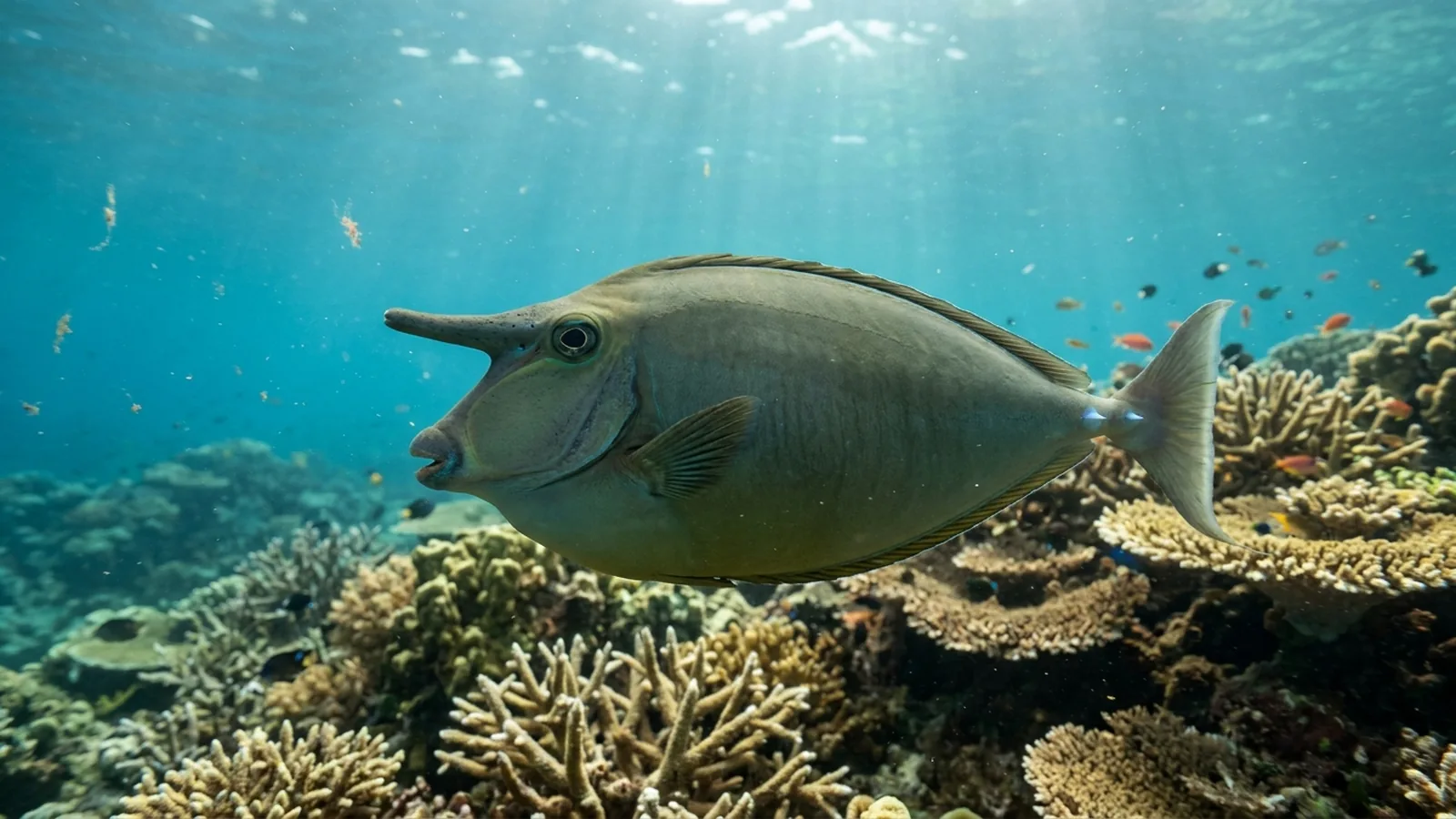
A unicorn fish, or unicornfish, is a surgeonfish of the genus Naso, found on coral reefs across the Indian and Pacific Oceans. Several species grow a bony horn on the forehead as adults, which gives the group its name. The best-known species, the bluespine unicornfish (Naso unicornis), reaches about 70 cm, eats tough brown seaweed, carries two blade-like spines on each side of the tail, and has been aged at up to 55 years. What the horn is for is still not known for certain.
Swim along an outer reef in Hawaii, the Red Sea or the Great Barrier Reef and you will often see big, grey, oval fish cruising in loose groups along the drop-off, some of them sporting a stubby horn in front of the eyes. They look like something drawn from a medieval bestiary. Unicornfish are ordinary reef residents in one sense — common, widespread, eaten throughout the Pacific — and genuinely odd in another, because the most obvious thing about them is still a scientific puzzle.
What is the unicornfish horn for?
Nobody knows for certain. The horn is a bony forehead protuberance that grows as the fish matures, and the main ideas are that it plays a role in display, species and sex recognition, or hydrodynamics. It is not used as a weapon.
In the bluespine unicornfish, juveniles have no horn at all. It starts to grow as the fish reaches adult size and develops in both sexes, though males tend to have slightly longer horns on average. That pattern — absent in young fish, slightly larger in males — is consistent with a signal used between adults, such as in courtship or in recognising members of the same species. Unicornfish can also change colour quickly during display, which adds to the idea that the head is used for signalling.
The horn is not a spear. There are no records of unicornfish ramming prey or rivals with it, and it is blunt and rounded. Some researchers have suggested it might affect water flow over the head as the fish swims in surge, but this has not been demonstrated. Different Naso species have very different horns: the spotted unicornfish (Naso brevirostris) grows a long, tapering horn, while some species, such as the orangespine unicornfish (Naso lituratus), have none at all. If the horn had a single vital function, you would expect all of them to have it.
Are unicornfish dangerous?
Unicornfish are not aggressive, but the sharp blades on each side of the tail can cut, and eating them carries a risk of ciguatera poisoning.
Like all surgeonfish, unicornfish carry “scalpels” at the base of the tail. In Naso these are fixed, keel-like blades rather than the folding spine of tangs such as the Achilles tang. The bluespine unicornfish has two on each side, each set on a bright blue plate — the source of its name. Males have much larger tail spines than females. Fishers handling unicornfish learn to respect them, because a thrashing tail can slice a hand. Divers who leave them alone have nothing to worry about.
The other risk is on the plate. FishBase notes reports of ciguatera poisoning from Naso unicornis. Ciguatera toxins come from microalgae on reefs and build up in herbivorous and predatory reef fish. Most unicornfish are safe to eat, but in ciguatera hotspots local advice is worth following.
What do unicornfish eat?
The bluespine unicornfish is a herbivore that eats coarse, leafy brown and red algae such as Sargassum. It is one of the few reef fish that can handle large, fleshy seaweeds.
Most reef grazers, such as parrotfish and many tangs, scrape or crop fine algal turf. The bluespine unicornfish takes bigger, tougher plants. That makes it an important player in keeping reefs from being overgrown by macroalgae after disturbances like bleaching or storms. Read more on how algae shape coral reefs.
In Hawaii it eats the invasive red seaweed Gracilaria salicornia, which sounds like a win — but researchers found that fragments passing through its gut can survive and regrow, so the fish may also spread the invader. Other unicornfish species feed differently: some, including the spotted unicornfish, feed on zooplankton in open water above the reef as adults.
How big do unicornfish get, and how long do they live?
The bluespine unicornfish grows to about 70 cm, with 50 cm common, and the heaviest recorded weighed 5.8 kg. It has been aged at up to 55 years.
| Species | Horn | Max length | Notes |
|---|---|---|---|
| Bluespine unicornfish (N. unicornis) | Short, blunt | ~70 cm | Herbivore; two blue tail plates each side |
| Spotted unicornfish (N. brevirostris) | Long, tapering | ~60 cm | Adults feed on zooplankton |
| Orangespine unicornfish (N. lituratus) | None | ~45 cm | Bright orange tail blades; common in aquaria |
| Whitemargin unicornfish (N. annulatus) | Long in large adults | ~100 cm | Largest in the genus |
A 55-year lifespan is remarkable for a fish that lives on shallow reefs. FishBase rates its resilience as very low, with a minimum population doubling time of more than 14 years, which means heavily fished populations recover slowly. Long-lived, slow-recovering herbivores are exactly the kind of fish reef managers worry about.
Where do unicornfish live?
Unicornfish live on coral and rocky reefs across the tropical Indo-Pacific, from the Red Sea and East Africa to Hawaii, the Marquesas and the Tuamotus.
The bluespine unicornfish ranges north to southern Japan and south to Lord Howe Island, in water of about 25–29°C. Adults favour channels, lagoons and seaward reef faces with strong surge, mostly in the top 12 metres or so, though the species has been recorded to 180 metres. Juveniles stay in shallow, protected bays and harbours. Unicornfish often move in small groups or mixed schools along the reef edge.
They are active by day and rest in the reef at night. FishBase records pair-spawning in the bluespine unicornfish, in which a male and female rise together off the reef to release eggs and sperm into the water column; the eggs and larvae drift in the plankton for weeks before settling. Larval and juvenile unicornfish look quite different from adults, with no horn and a deeper body. On a dive, the easiest way to recognise an adult bluespine is the pair of bright blue spots at the base of the tail and the short horn in front of the eyes.
They are a familiar sight on dives and snorkels in Hawaii; see our pages on Hawaii’s coral reefs and snorkeling Molokini. In the Red Sea, the species was first described by Peter Forsskål in 1775.
Why are unicornfish called kala in Hawaii?
In Hawaiian, kala means “thorn,” a reference to the sharp spines on the tail. The name covers all three horned unicornfish species found in Hawaii.
Kala was an important food in pre-contact Hawaii, eaten raw, grilled or baked. Its tough skin had another use: stretched over half a coconut shell, it made the head of a small knee drum. Across the Pacific the fish has many names — dawa in New Caledonia, ta in Fiji — and it appears on stamps, logos and traditional artwork. The strong, distinctive flavour of its flesh comes from its seaweed diet.
Unicornfish are close relatives of the tangs and surgeonfish many divers and aquarists know. For the wider family, see our surgeonfish guide, and compare their algae-cropping role with rabbitfish and other coral reef fish.
What is a unicorn fish?
A unicorn fish (unicornfish) is a surgeonfish of the genus Naso from Indo-Pacific reefs. Several species grow a bony horn on the forehead as adults.
What is the horn on a unicorn fish for?
Its function is not known for certain. Leading ideas are signalling for courtship or species and sex recognition, and possibly hydrodynamics. It is not used as a weapon.
Do all unicornfish have horns?
No. Some Naso species, such as the orangespine unicornfish, have no horn. In horned species, juveniles lack the horn and it grows as they mature.
Are unicornfish dangerous?
They are not aggressive, but the fixed, blade-like spines at the base of the tail can cut if a fish is handled. Eating them can occasionally cause ciguatera poisoning.
How big do unicornfish get?
The bluespine unicornfish reaches about 70 cm and 5.8 kg. The whitemargin unicornfish can reach around 1 metre.
How long do unicornfish live?
The bluespine unicornfish has been aged at up to 55 years, very long for a reef fish.
What do unicornfish eat?
The bluespine unicornfish eats coarse brown and red seaweeds such as Sargassum. Some other species feed on zooplankton.
Where do unicornfish live?
On reefs throughout the tropical Indo-Pacific, from the Red Sea and East Africa to Hawaii and French Polynesia, mostly in shallow, surge-swept water.
Can you keep a unicornfish in an aquarium?
Some species are sold, but they grow large, live for decades and need very big systems with plenty of swimming room and algae-based diets.
Blane Perun has been exploring Earth’s oceans and marine life for over 25 years. Founder of TheSea.Org in 1999, underwater photographer, coral aquaculture pioneer, and explorer of 80+ countries.
About Blane Perun → More on Bizarre Sea Creatures →