What Is a Narwhal Tusk Used For? — Mostly a Showpiece for Mates, With a Sensory Twist
A narwhal’s tusk is a tooth — usually the left upper canine — that grows through the lip in a left-handed spiral to about 1.5–3 m. Most males have one; only a small minority of females do. The best-supported explanation is sexual selection: males use tusks to display, size each other up and occasionally spar, much like deer antlers. The tusk also has millions of tiny tubules that may let it sense changes in the water, and drones have filmed narwhals using it to tap and stun Arctic cod.
An erupted canine tooth with a soft pulp core, dentine layer and porous outer cementum but no hard enamel. It keeps growing throughout life. About 1 in 500 males grows two tusks, and some females grow one.
Is the narwhal tusk used to attract mates?
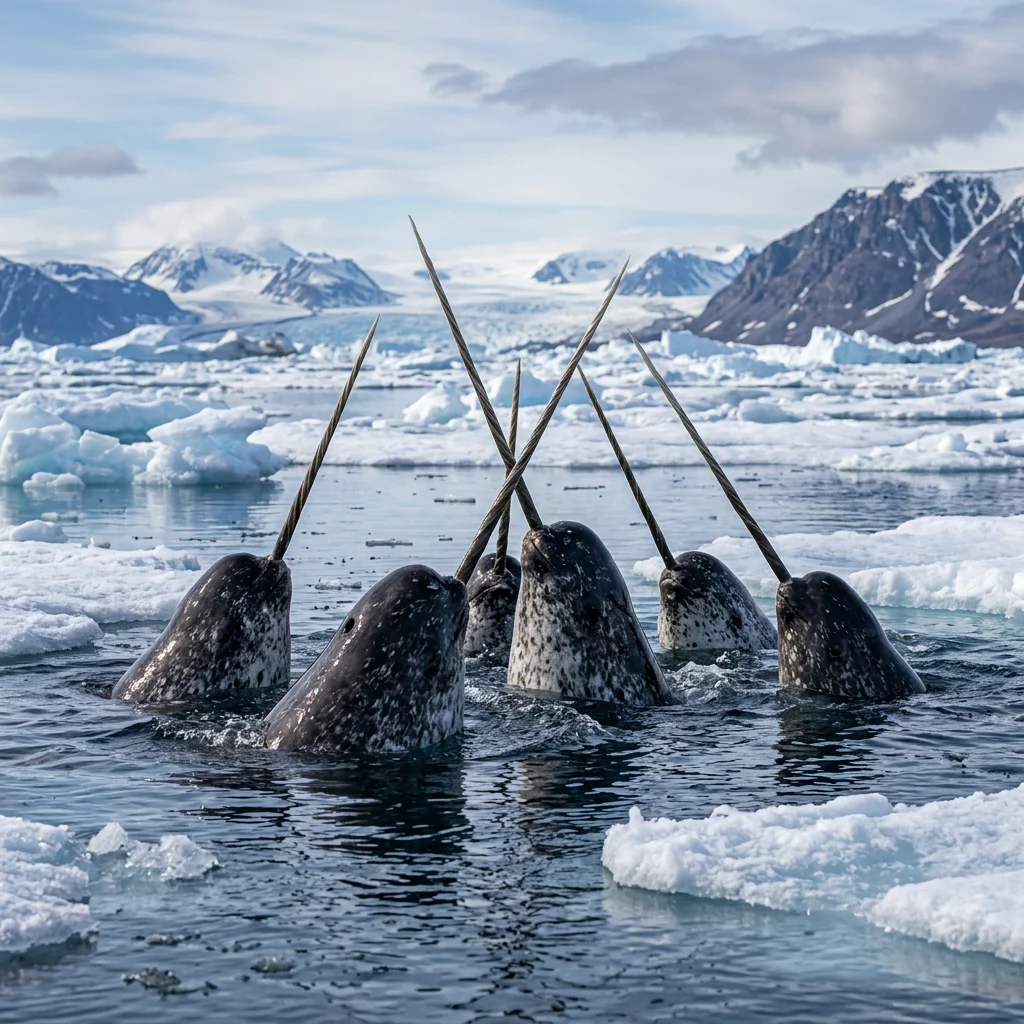
This is the leading explanation.
A 2020 study by Zackary Graham and colleagues found that tusk length increases disproportionately with body size, a pattern typical of sexually selected traits such as antlers and peacock tails. Big tusks are an honest signal of a male’s condition. Males are seen “tusking,” crossing and rubbing tusks at the surface, which may be how they compare one another, and broken tusks and head scars show that real fights happen too.

Can a narwhal tusk sense the environment?
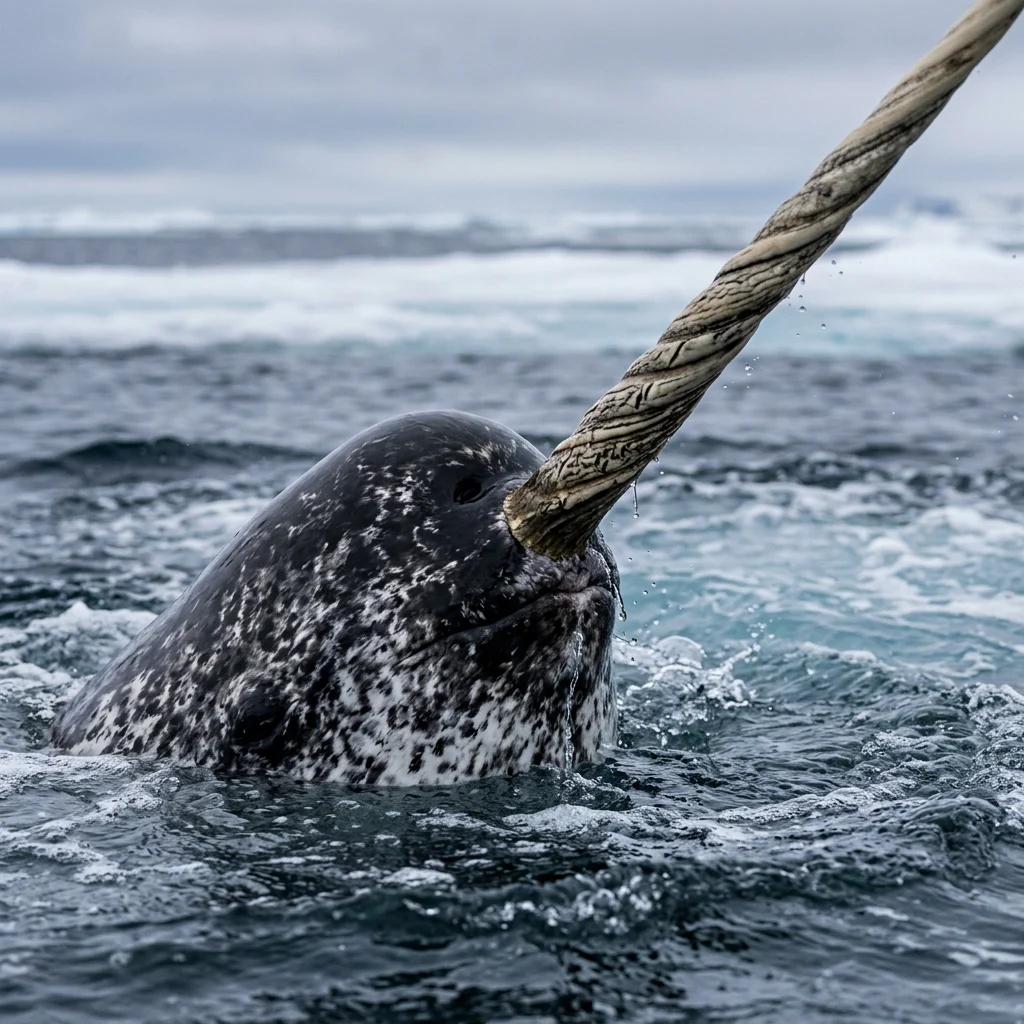
Possibly. The tusk is surprisingly porous.
Martin Nweeia and colleagues showed in 2014 that tubules run from the tusk’s outer surface to the nerve-rich pulp inside, and that changing the salt concentration of water around the tusk changed narwhals’ heart rates. They proposed the tusk can detect salinity or temperature, perhaps helping narwhals find freezing sea or sense females. Critics point out that most females, which survive just as well, lack tusks, so sensing is unlikely to be the tusk’s main purpose.
Do narwhals use their tusks to hunt?
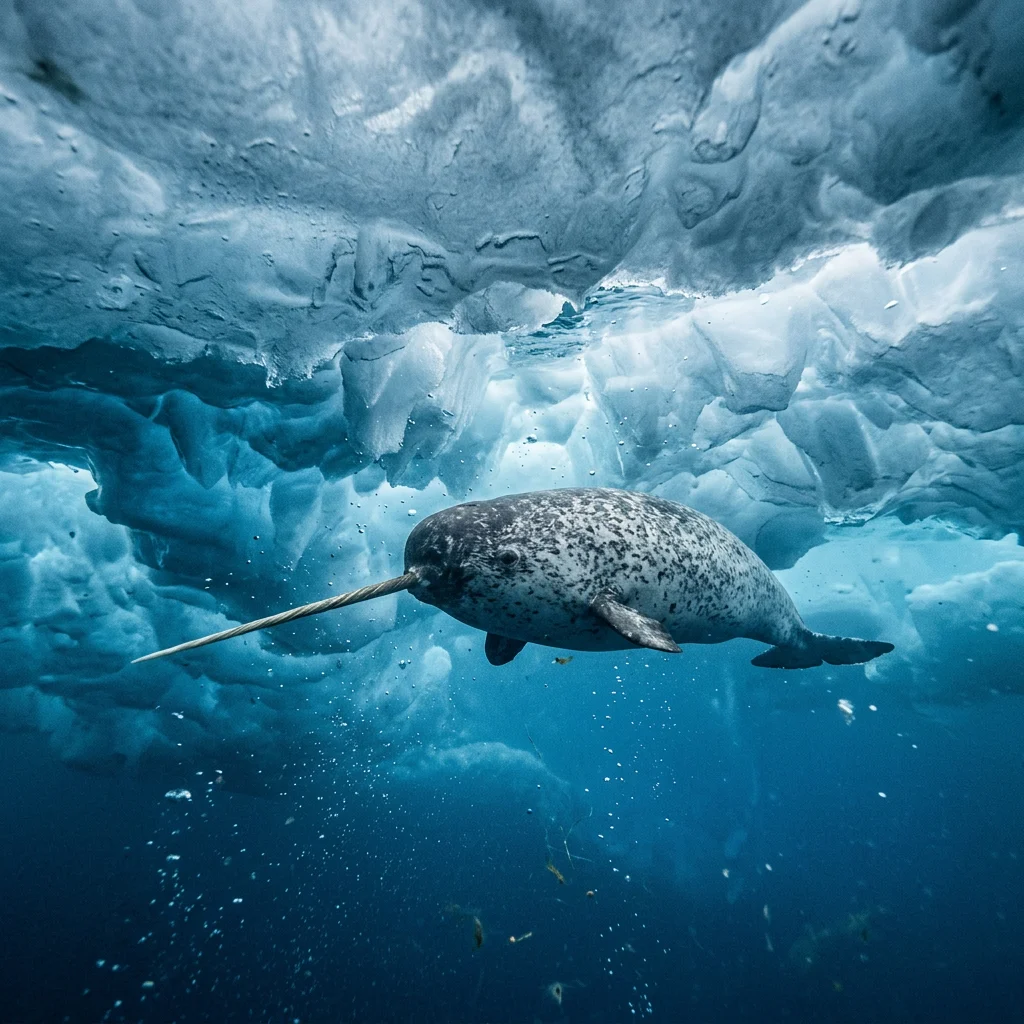
Sometimes, according to drone footage.
In 2017, WWF Canada and Fisheries and Oceans Canada released drone video from Tremblay Sound, Nunavut, showing narwhals tapping Arctic cod with their tusks, stunning the fish before eating them. It is the first direct evidence of the tusk used for feeding. Narwhals still catch most prey, including Greenland halibut, cod and squid, by suction feeding, since they have no functional teeth in the mouth. See the narwhal profile.
What is a narwhal tusk not used for?
Several popular ideas don’t hold up.
| Myth | Reality |
|---|---|
| Breaking sea ice | Narwhals use their backs or find leads; tusks would snap |
| Spearing prey | Prey is sucked in, not speared |
| Digging the seabed | No evidence; worn tips come from other uses |
| Unicorn horns | Medieval traders sold tusks as unicorn horns |
Medieval Europeans paid fortunes for narwhal tusks as “unicorn horns,” believed to neutralise poison. The Danish coronation throne is partly made of them. Compare the narwhal’s closest relative in are belugas dolphins or whales.
How does a narwhal tusk grow?
A narwhal starts life with two small canine teeth embedded in the upper jaw, one on each side. In almost every animal only the left one keeps growing. It pushes forward through the bone and out through the upper lip, and in males it becomes the tusk. The right canine usually stays buried in its socket for life. When it also erupts, which happens in roughly one male in 500, the animal ends up with two tusks. Both tusks still twist in the same left-handed direction, so the pair is not a mirror image of each other.
Females are not tuskless as a rule. Around 15 per cent grow a tusk, and theirs is usually shorter and less obviously spiralled than a male’s. A female with two tusks is far rarer. The best-known example is a double-tusked skull collected in 1684 and now held by the zoological museum in Hamburg.
Behind and below the tusks, the narwhal’s snout holds a handful of tiny vestigial teeth. They vary in shape and internal structure, often stay inside open sockets and play no part in feeding. Anatomists read this as evolution in progress: over millions of years the narwhal’s mouth has become functionally toothless, and the only tooth that still does any visible work is the one that left the mouth altogether.
The tusk itself is hollow for much of its length and weighs about 10 kg in a large male. It grows from the root, where new dentine is added year after year, and keeps lengthening as the animal ages. That steady growth means a tusk is also a record of the animal’s life, a point that has become important for research.
Why does the tusk spiral to the left?
The spiral is one of the most striking things about the tusk, and it has a mechanical explanation rather than a decorative one. In 1988 the Canadian biologists Michael Kingsley and Malcolm Ramsay set out a simple idea in the journal Arctic. Teeth grow by adding new material at the root. If growth is perfectly even all the way round, the tooth grows straight. If one side grows a little faster, the tooth curves, which is exactly what happens in walrus and elephant tusks.
A curved tusk two or more metres long would be a serious handicap for an animal that swims fast and dives deep. Kingsley and Ramsay proposed that the narwhal avoids this by rotating the tusk slowly as it grows. Each part of the root passes in turn through faster- and slower-growing zones, so the uneven growth is spread evenly around the shaft. The result is a straight axis with a spiral pattern on the surface. The ridges of the spiral, on this view, are the visible trace of uneven growth around the root.
The explanation fits the way the tusk is used. Narwhals in their winter range dive to at least 800 m many times a day, and many dives go deeper than 1,500 m. Whatever its social role, a tusk on an animal that lives like that has to stay straight, light and hard to snap. Narwhal tusks are also surprisingly flexible: they bend noticeably without breaking, which matters when two males cross tusks at the surface.
What does tusk size tell us about mating?
The strongest evidence for the sexual-selection explanation comes from measurements rather than observations. The 2020 study by Zackary Graham, Eva Garde, Mads Peter Heide-Jørgensen and Alexandre Palaoro used body and tusk measurements from 245 adult male narwhals gathered over 35 years in Greenland. They compared the tusk with the tail fluke, a body part that has no plausible sexual function and should simply grow in step with body size.
The contrast was stark. Among males of the same body size, tusk length ranged from about 1.5 to 8.2 feet, more than a four-fold difference. Fluke length in the same animals ranged only from about 1.5 to 3 feet. The tusk also grew disproportionately longer as males got bigger. That pattern, called positive allometry, is what biologists expect from ornaments and weapons that are under sexual selection, from beetle horns to deer antlers.
Graham’s interpretation was that the tusk works both as a signal and as a weapon in male-male contests. The message is roughly “I am bigger than you”, and because only males in good condition can grow and keep a very long tusk, the signal is hard to fake. Females may also use tusk size to judge a male’s quality, although nobody has yet observed narwhal courtship in enough detail to test that directly. The authors suggested that aerial and underwater drones could eventually show how tusks are used in the wild.
The survival argument points the same way. A structure that is essential for feeding or breathing would be present in both sexes. Most female narwhals have no tusk, yet they live at least as long as males and raise calves successfully, so the tusk cannot be needed for day-to-day survival. A trait that only one sex carries and that varies so much in size is the classic signature of competition for mates.
How convincing is the sensing idea?
The sensory hypothesis grew out of detailed anatomy. Martin Nweeia, a dentist and researcher at Harvard School of Dental Medicine, and his colleagues found that the narwhal tusk lacks the hard enamel that seals most mammal teeth. Its outer cementum layer is porous, and tiny tubules run inward through the dentine toward the pulp, where nerves are found. In a human tooth, exposed tubules of this kind are what makes cold drinks painful.
In the 2014 study, the team placed captured narwhals in a temporary holding area and bathed their tusks alternately in fresh water and seawater. Heart rates changed when the water around the tusk changed, which they interpreted as a sensory response. They suggested the tusk might help males detect changes in salinity, perhaps linked to freezing sea ice, or pick up chemical cues from females in the water. They also argued that the tusking behaviour, where males rub tusks together, could be a way of sharing information rather than a contest.
Other researchers accept that the tusk is innervated but doubt that sensing explains why it exists. The trials involved few animals, and a sensory organ that most females lack would be an odd adaptation for a species where both sexes face the same environment. The most common view today is that both things can be true: the tusk evolved mainly as a sexual signal, and the nerve-rich tissue gives the animal some sensory feedback from it as a side effect.
What can tusks tell scientists about a changing Arctic?
Because a tusk adds one growth layer a year, it works like a tree ring. In 2021 a team led by Rune Dietz of Aarhus University and Jean-Pierre Desforges of McGill University published an analysis in Current Biology of tusks from 10 narwhals from Northwest Greenland. The tusks were between 150 and 248 cm long, and their growth layers covered the years 1962 to 2010, roughly half a century.
Each yearly layer was tested for mercury and for stable isotopes of carbon and nitrogen, which show what kind of prey an animal was eating and where in the food web it sat. Before about 1990, the narwhals mainly ate prey linked to sea ice, such as Greenland halibut and Arctic cod, in years when ice cover was extensive but variable. After 1990, as sea ice in the region declined steadily, their diet shifted toward open-water prey such as capelin and polar cod.
Mercury followed a different path. Through the 1990s it stayed relatively low, because the newer prey sit lower in the food chain. From around 2000, mercury in the tusks rose sharply without any matching change in diet. The authors linked this mainly to mercury emissions from coal burning in South-East Asia, and possibly to changes in how mercury cycles through a warming Arctic. Dietz described the narwhal as the Arctic mammal most affected by climate change, and the tusk gives a year-by-year record of how that change has reached individual animals.
How do scientists work out a narwhal’s age?
Ageing a narwhal is surprisingly hard. Toothed whales such as dolphins and sperm whales are normally aged by counting growth layers in their teeth, but narwhals have no ordinary teeth to section, and females usually have no tusk at all. Researchers in Greenland solved this with a chemical clock in the eye.
The lens of the eye is laid down before birth and is never replaced. Over time, the amino acid aspartic acid in the lens slowly converts from one mirror-image form to the other, a process called racemization, and the ratio between the two forms increases with age. In a 2007 study in the Journal of Mammalogy, Eva Garde, Mads Peter Heide-Jørgensen and colleagues used this method on narwhals from West Greenland. The oldest female was estimated at about 115 years, give or take around 10, and the oldest male at about 84 years.
Tusks helped calibrate the method. In a later paper in Polar Research, the same group compared racemization in eye lenses with growth layers counted in tusks from the same animals, giving an independent check on the rate. The result places narwhals among the longest-lived mammals, alongside the bowhead whale, and means that some narwhals swimming in the Arctic today may be around a century old.
What does the narluga skull reveal about narwhal teeth?
The clearest demonstration that narwhal teeth follow unusual rules came from a hybrid. In 1990, Mads Peter Heide-Jørgensen was shown a strange skull that a hunter in West Greenland had kept. It was larger than either a narwhal or a beluga skull and had features of both. Instead of a single tusk or the neat row of peg teeth of a beluga, it had a jumble of teeth that pointed outward, some of them twisted like a small tusk.
In 2019, a team led by Eline Lorenzen at the Natural History Museum of Denmark, with Mikkel Skovrind as first author, extracted DNA from those teeth and compared it with samples from belugas and narwhals. The animal was a male, the offspring of a female narwhal and a male beluga, and it had reached full maturity. Its odd teeth suggest it fed differently from either parent, probably closer to the seabed. The skull shows how the developmental programme that produces one long spiralled tooth in a narwhal can go in very different directions when mixed with beluga genes.
How did narwhal tusks shape human history?
For Inuit communities, the tusk has long been a material as well as a symbol. It was used to make tools and weapons, including a lance head now in the British Museum that pairs a narwhal tusk shaft with a blade of meteorite iron. One Inuit story explains the spiral as a woman’s twisted braid: dragged into the sea by a harpooned narwhal, she became a narwhal herself and her hair became the tusk.
In Europe, the tusk became the unicorn’s horn. Norse and later traders carried tusks south, where they were sold for many times their weight in gold as protection against poison. Cups were carved from them, and royal treasuries prized them. Queen Elizabeth I was given a tusk by Martin Frobisher after his Arctic voyages in the 1570s, and it was reportedly valued at £10,000, about the price of a castle at the time. A tusk in the Musée de Cluny in Paris, almost three metres long, was said by legend to have been a gift from Harun al-Rashid to Charlemagne.
The myth unravelled slowly. In 1555 the Swedish writer Olaus Magnus published an image of a horned sea creature that he called a narwal. In 1638 the Danish naturalist Ole Worm showed that the so-called unicorn horns were narwhal teeth. Even then, Worm wondered whether the powdered tusk still worked as an antidote, and tested it on poisoned animals. Belief in its powers faded, but the tusks kept their prestige, which is why Denmark’s royal throne is decorated with them.
How are narwhal tusks protected and traded today?
Narwhals are still hunted for food in Canada and Greenland, where whale skin, known as muktuk, is an important traditional food. Tusks from these hunts are sold, sometimes carved, and are a valuable source of income for remote Arctic communities. Hunts are managed by quotas set nationally and advised by bodies such as the North Atlantic Marine Mammal Commission.
International trade in tusks is regulated under CITES, which lists the narwhal on Appendix II, so export permits are needed. The United States has banned most imports of narwhal products since the Marine Mammal Protection Act of 1972. The European Union banned imports from 2004 and lifted the ban in 2010. Smuggling cases still occur, often involving tusks moved across the Canada–US border.
The narwhal as a species is not considered endangered. The IUCN assessed it as Least Concern in 2017, based on a combined estimate of around 170,000 animals across sub-populations surveyed between 2000 and 2017. Some local populations, especially in East Greenland, have declined, and narwhals remain among the Arctic whales most exposed to climate change. They rely on dense winter pack ice, and when sea ice freezes quickly they can be trapped in small openings, an event the Inuit call a savssat.
How does the narwhal tusk compare with other tusks?
The narwhal is not the only animal whose tusk is a tooth, but it is the odd one out in several ways. Elephant tusks are incisors, and walrus and warthog tusks are canines, as the narwhal’s is. All of them curve, because they grow unevenly at the root, and the narwhal is the only one that corrects this by spiralling. It is also the only tusk that grows out straight forward through the upper lip rather than downward or sideways.
Walrus tusks, which both sexes carry, are used for hauling out onto ice, for defence and in dominance displays. The narwhal’s tusk is mainly a male trait and has no known role in getting onto ice. Among toothed whales, males of several beaked whale species have one or two tusk-like teeth in the lower jaw that they use in fights, leaving long paired scars on rivals. Like the narwhal, they have lost most of their other teeth and catch prey by suction. The pattern suggests that in deep-diving suction feeders, teeth are freed from feeding and can be shaped instead by competition between males.
What is a narwhal tusk made of?
It is a tooth: pulp, dentine and cementum, with no enamel.
Do female narwhals have tusks?
Some do, but only a small minority.
How long is a narwhal tusk?
Usually 1.5–3 m.
Can a narwhal have two tusks?
Yes, about 1 in 500 males has two.
Does a narwhal tusk grow back if broken?
No, a broken tusk does not regrow, though the canal may seal over.
Is it legal to own a narwhal tusk?
Trade is regulated under CITES and banned in some countries, including the US for most imports.
- Graham, Z. A. et al. (2020). The longer the better: evidence that narwhal tusks are sexually selected. Biology Letters 16: 20190950.
- Nweeia, M. T. et al. (2014). Sensory ability in the narwhal tooth organ system. The Anatomical Record 297: 599–617.
- Fisheries and Oceans Canada / WWF-Canada (2017). Drone footage of narwhals using tusks to stun Arctic cod, Tremblay Sound.
- Kingsley, M. C. S. & Ramsay, M. A. (1988). The spiral in the tusk of the narwhal. Arctic 41: 236–238.
- Garde, E. et al. (2007). Age-specific growth and remarkable longevity in narwhals (Monodon monoceros) from West Greenland as estimated by aspartic acid racemization. Journal of Mammalogy 88: 49–58.
- Dietz, R. et al. (2021). Analysis of narwhal tusks reveals lifelong feeding ecology and mercury exposure. Current Biology 31: 2012–2019.
- Skovrind, M. et al. (2019). Hybridization between two high Arctic cetaceans confirmed by genomic analysis. Scientific Reports 9: 7729.
Blane Perun has been exploring Earth’s oceans and marine life for over 25 years. Founder of TheSea.Org in 1999, underwater photographer, coral aquaculture pioneer, and explorer of 80+ countries.
