Alligator vs Crocodile — 9 Differences, and Where Both Live in Florida
Look at the snout and the teeth. An alligator has a broad, rounded, U-shaped snout, and when its mouth is shut the lower teeth are hidden inside the upper jaw. A crocodile has a narrower, pointed, V-shaped snout, and its lower teeth, especially the big fourth tooth, stay visible when the mouth is closed. Alligators are darker, live mainly in fresh water and are found only in the southeastern US and eastern China. Crocodiles are paler, handle salt water well thanks to working salt glands, and live across the tropics. They are separate families that split more than 80 million years ago. South Florida is the only place on Earth where both live side by side in the wild.
If you live in Southwest Florida like I do, you see alligators in every retention pond and golf-course lake. Crocodiles are a different story: shy, coastal and mostly confined to the mangrove fringe from Biscayne Bay through the Keys and around Florida Bay. Telling them apart takes about two seconds once you know what to look for. Here are the nine differences that matter, from field marks you can see from a kayak to the biology underneath.
What are the 9 differences between alligators and crocodiles?
| # | Feature | Alligator | Crocodile |
|---|---|---|---|
| 1 | Snout shape | Broad, rounded U | Narrow, pointed V (mugger is an exception) |
| 2 | Teeth with mouth closed | Lower teeth hidden; overbite | Lower teeth visible, fourth tooth sticks up |
| 3 | Colour | Blackish to dark grey | Lighter olive, grey-green or tan |
| 4 | Salt tolerance | Weak salt glands; mainly fresh water | Working lingual salt glands; estuaries and sea |
| 5 | Sensory pits (ISOs) | Only on the head and jaws | On almost every body scale |
| 6 | Range | SE United States and eastern China | Americas, Africa, Asia, Australia |
| 7 | Number of species | 2 (American, Chinese) | About 16 or more true crocodiles |
| 8 | Limbs | Shorter upper arm and thigh bones | Relatively longer limb bones |
| 9 | Temperament | American alligator generally shy of people | Varies: Nile and saltwater crocs are the most dangerous crocodilians |
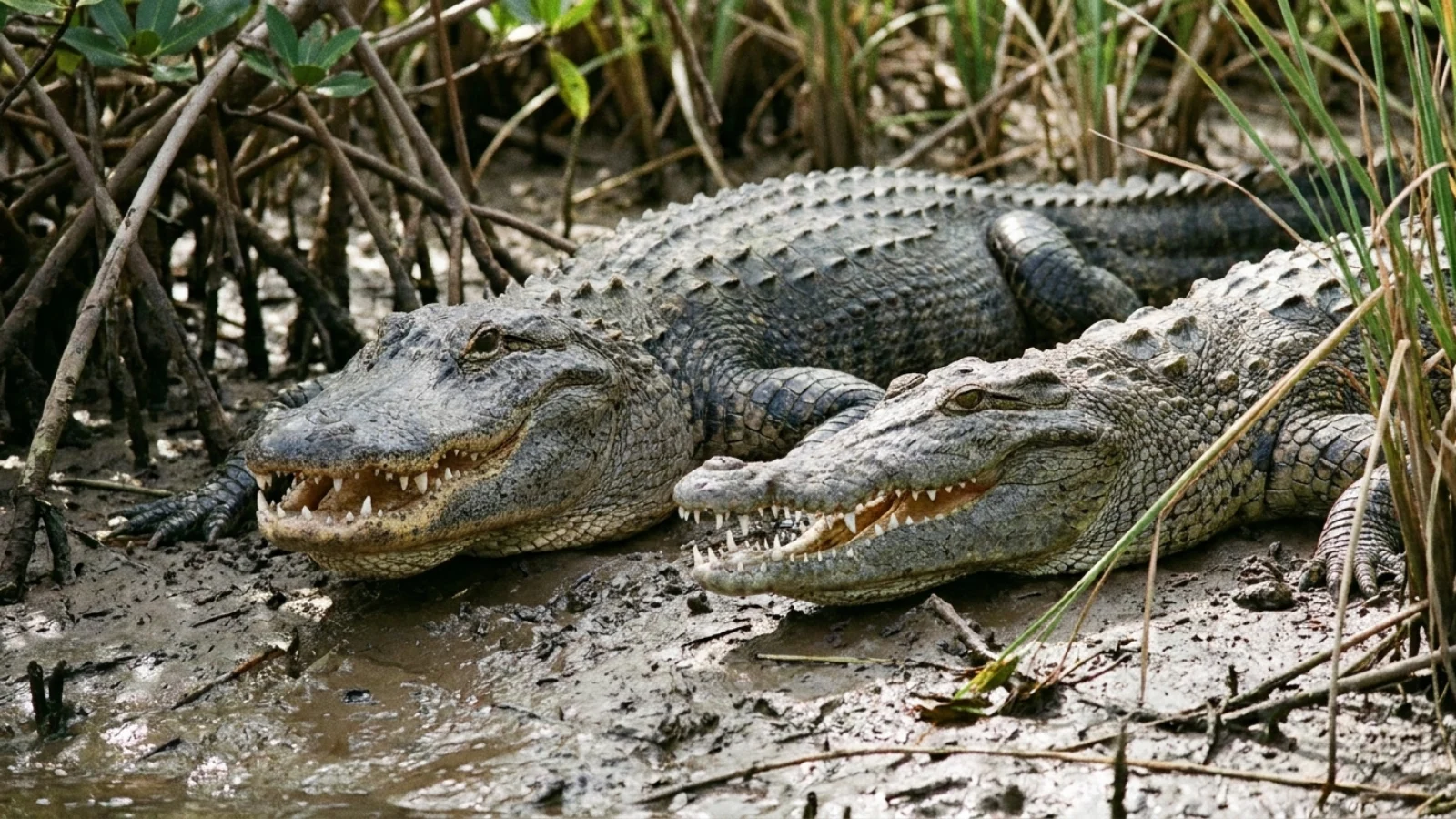
How can you tell an alligator from a crocodile at a glance?
Snout first, teeth second, colour third. Those three work for almost every sighting.
The snout. Seen from above, an alligator’s head is a wide shovel with a rounded tip. A crocodile’s tapers to a point. The one awkward exception is India’s mugger crocodile, which has an unusually broad snout.
The smile. An alligator’s upper jaw is wider than the lower, so with the mouth closed the lower teeth fit into sockets inside the upper jaw and disappear. A crocodile’s jaws are about the same width, so the lower teeth slot into grooves on the outside and remain visible, giving that jagged, interlocking grin. The giveaway is the big fourth lower tooth, which pokes up outside the upper lip in crocodiles and is hidden in alligators.
The colour. American alligators are almost black when wet. American crocodiles are a lighter grey-green to olive-tan. Colour varies with water and age, so treat it as a supporting clue.
Why can crocodiles live in salt water but alligators can’t?
Salt glands. Both groups have glands on the tongue, but in crocodiles they work well enough to pump out excess salt; in alligators they barely function.
That single difference shapes where each animal lives. Crocodiles colonised coasts and islands and spread around the tropics; the saltwater crocodile regularly crosses open sea between islands. Alligators can tolerate brackish water for short periods but have to return to fresh water to rebalance. In Florida, that is why you find gators in ponds and canals and crocs in mangrove creeks, cooling-canal systems and coastal bays. More in American crocodile and American alligator.
Which is bigger, an alligator or a crocodile?
Crocodiles, as a group. The saltwater crocodile is the largest living reptile. In Florida, though, alligators are far more numerous and the two native species overlap in size.
| Species | Typical adult male | Notes |
|---|---|---|
| Saltwater crocodile | ~4–5 m; largest over 6 m | Largest living reptile |
| Nile crocodile | ~3.5–5 m | Responsible for many human deaths in Africa |
| American crocodile | ~3–4 m in Florida; larger in Central and South America | Coastal and shy |
| American alligator | ~3.4 m average (females ~2.6 m) | Exceptional males near 450 kg |
| Chinese alligator | ~1.5–2 m | Critically endangered |
On bite force, a 2012 study by Gregory Erickson and colleagues measured all 23 crocodilian species then recognised. The saltwater crocodile topped the list at about 16,400 newtons (3,690 lbf); the American alligator managed about 9,450 newtons (2,125 lbf). Both are among the strongest bites ever measured in a living animal.
Where do alligators and crocodiles live together?
Only in South Florida. Everglades National Park, Florida Bay, Biscayne Bay and the Keys are the one place in the world where the two coexist in the wild.
Florida has an estimated 1.3 million alligators, found in all 67 counties. American crocodiles are far rarer and confined to the southern tip of the peninsula and the Keys. When they were listed as endangered in 1975, fewer than 300 were thought to remain and only 10–20 nests were found a year. Protection worked: the U.S. Fish and Wildlife Service downgraded them to threatened in 2007, and the FWC now estimates 1,500–2,000 crocodiles (not counting hatchlings), with more than 100 nests a year. Their ranges meet in brackish water around Flamingo and Florida Bay, where a kayaker can, on a good day, see both in an afternoon. Despite the overlap, the two never interbreed; see can alligators breed with crocodiles?
Why do alligators and crocodiles only overlap in South Florida?
The answer comes down to two limits that pull in opposite directions: salt and cold. Alligators are held back by salt. Their lingual glands are too weak to get rid of the salt they take in, so they cannot live for long in the sea and have never spread along tropical coastlines the way crocodiles have. Crocodiles are held back by cold. They are tropical animals with little tolerance for chilly water, so they cannot push far into the temperate zone where alligators thrive.
Florida sits exactly where those two limits cross. The peninsula reaches far enough south to give crocodiles warm, frost-free coastal water in the Keys, Florida Bay and the mangrove shoreline of the Ten Thousand Islands. At the same time, it is covered in fresh water, from the Everglades marsh to tens of thousands of lakes, ponds and canals, which suits alligators perfectly. The result is a narrow band in the far south of the state where fresh water drains into salt water and both animals can find what they need within a short swim of each other.
Elsewhere the two never meet. The American crocodile ranges from Florida through the Caribbean, Mexico and Central America to northern South America, but there are no alligators in any of those places. The American alligator ranges north to North Carolina and west to Texas, well beyond the reach of any crocodile. The only other alligator, the Chinese alligator, lives in the lower Yangtze region, far from crocodile country. That is why Everglades National Park can fairly claim to be the only place on Earth where alligators and crocodiles live side by side.
How do alligators and crocodiles cope with cold weather?
Cold is the one test where the alligator clearly wins. American alligators survive winters in the Carolinas, where water can freeze. When a pond ices over, they sometimes stay submerged with just the tip of the snout poking up through the ice so they can keep breathing, a behaviour that has been filmed in North Carolina. Their metabolism slows dramatically, they stop feeding and they wait for the water to warm up again.
American crocodiles have no such tricks, and Florida’s crocodiles live close to their cold limit. In January 2010, an unusually long cold spell hit South Florida for about ten days. Researchers with the U.S. Geological Survey and the University of Florida found a record 151 dead American crocodiles afterwards. In the same period, they found no dead American alligators. The study suggested that the crocodiles had kept basking in the open during the cold, perhaps trying to warm up as they would on a normal winter day, and were exposed to lethal temperatures, while alligators had stopped basking and retreated into deeper, warmer water.
The same cold spell killed dozens of invasive Burmese pythons, while native snakes came through unharmed. For scientists, the lesson was that rare extreme cold events, rather than average winter temperatures, may set the northern boundary for tropical reptiles in Florida. For anyone comparing alligators and crocodiles, it is a vivid illustration of why gators can live in Georgia and crocs cannot.
How do alligators and crocodiles nest in Florida?
Both species lay hard-shelled eggs and leave the sex of their young to temperature, but their nesting habits are different enough to tell you which animal you are dealing with. Alligators build mound nests. The female rakes together a pile of vegetation, sticks, leaves and mud near the water, lays her eggs inside, and covers them with more plant material. As the vegetation rots it gives off heat, which helps keep the eggs warm. According to the U.S. Fish and Wildlife Service, a female lays about 20 to 50 eggs, each about the size of a goose egg, and guards the nest through an incubation period of about 65 days. In Florida, egg laying takes place in early summer and hatching in late summer.
Florida’s crocodiles nest earlier and differently. A long-term study of crocodile nesting in South Florida, published by Frank Mazzotti and colleagues in 2022, found that courtship probably happens from late January to February, and that most eggs are laid in April and May. Crocodiles dig either hole nests, excavated into creek banks or canal banks, or mound nests of sand on beaches, rather than heaps of rotting vegetation. Incubation takes about 90 days, and the hatchlings usually emerge in July and August.
In both species, the female stays close to the nest and helps the hatchlings out when they start to call from inside the eggs. She may carry them to the water in her mouth. Young alligators often stay near their mother for a year or more, while young crocodiles tend to disperse sooner. Hatchlings of both species are small, roughly 15 to 25 cm long, and are eaten by wading birds, raccoons, fish, snakes and larger crocodilians, so only a small fraction survive to adulthood.
How did both species come back from the brink in Florida?
Alligators and crocodiles share a conservation story, and it is one of the great successes of American wildlife law. By the middle of the 20th century, decades of hunting for hides and loss of wetlands had made alligators scarce in much of their range. The American alligator was listed as endangered in 1967, under a law that came before the Endangered Species Act of 1973. With hunting stopped and the hide trade regulated, populations rebounded quickly, and in 1987 the U.S. Fish and Wildlife Service declared the alligator fully recovered.
There is a twist that links the two animals directly. Even though alligators are no longer in danger, they are still listed as threatened under federal law “due to similarity of appearance”. The reason is that alligator hides and products look so much like those of endangered crocodiles and caimans that enforcing trade rules would be impossible otherwise. In other words, the alligator’s legal status depends on the crocodile’s.
The American crocodile came back more slowly. It was listed as endangered in 1975, when only a few hundred animals remained in Florida. Long-term monitoring shows how the recovery unfolded: the Mazzotti study counted 93 nests in the 1970s, 171 in the 1980s, 352 in the 1990s, 912 in the 2000s and 1,485 in the 2010s, more than 3,000 nests in total. Nest success also rose, from about 61% in the 1970s to nearly 90% in the 2010s. In 2007 the crocodile was reclassified from endangered to threatened.
Where do Florida’s crocodiles nest?
Most crocodile nests in Florida are clustered in a handful of places. The biggest is Cape Sable, the remote western tip of the Everglades mainland, which accounted for about 39% of all nests recorded between 1970 and 2020. Northeastern Florida Bay held another quarter, and the area around Flamingo several percent more. Most of these sites are inside Everglades National Park.
The most surprising nesting ground is the cooling-canal system of Florida Power and Light’s Turkey Point nuclear and fossil-fuel power plant, south of Miami on Biscayne Bay. The canals were dug to cool water from the plant, and their banks turned out to be ideal places for crocodiles to dig nests, with warm water, little disturbance and few people. The first nest there was recorded in 1978, and by 2020 Turkey Point had produced more than 500 nests, roughly 18% of the Florida total. The utility has run a crocodile monitoring programme for decades, and the plant is now one of the best-known examples of wildlife benefiting from an industrial site.
The third key site is Crocodile Lake National Wildlife Refuge on North Key Largo, set aside specifically to protect crocodile nesting habitat. Like Turkey Point, it is largely closed to the public, which is part of why the crocodiles do well there.
Are crocodiles spreading north in Florida?
As their numbers have grown, American crocodiles have been turning up farther north on both coasts, and this is where the alligator vs crocodile question becomes a practical one for people in Southwest Florida. Historically, successful crocodile nesting on the Gulf coast was limited to areas south of U.S. 41 in Collier and Monroe counties. In 2020, two nests hatched north of that line at Rookery Bay near Naples, producing 16 hatchlings.
Farther north, Sanibel Island was designated a crocodile refuge area in 1998, and a few individuals have lived around J.N. “Ding” Darling National Wildlife Refuge for years. One well-known female, nicknamed Wilma, nested near the refuge in most years, but her eggs never hatched. In 2025, the Sanibel-Captiva Conservation Foundation reported that the Florida Fish and Wildlife Conservation Commission was monitoring a new crocodile nest on the island. Individual crocodiles have been recorded as far north as St. Petersburg on the Gulf coast.
For residents of Naples, Marco Island and Fort Myers, that means a large crocodilian in a brackish canal or on a beach is no longer automatically an alligator. The field marks in the table above, the snout and the teeth, are the quickest way to check. If it is a crocodile, the rules are the same as for alligators: keep well back, never feed it and report a problem animal to FWC rather than approaching it.
What about caimans and Nile crocodiles in Florida?
Florida’s crocodilian picture is complicated by non-native species that started as pets. The spectacled caiman, a smaller relative of the alligator native from southern Mexico to northern Argentina, has established breeding populations in localized areas of Miami-Dade and Broward counties. Caimans were imported in large numbers as pets after alligators were protected in the mid-20th century, and escaped or released animals eventually began to breed. Researchers from the University of Florida run surveys to find and remove them, partly because they may compete with native wildlife in Everglades restoration areas.
Caimans are easy to confuse with small alligators. They are usually more olive or brown, have a bony ridge between the eyes that looks like the bridge of a pair of spectacles, and often show more of their teeth. In a family-tree sense, caimans belong with alligators in the family Alligatoridae, not with crocodiles.
In 2016, a team led by Michael Rochford published DNA evidence that three juvenile Nile crocodiles had been captured in South Florida between 2000 and 2014, including in the Everglades and on a porch in Miami. The animals were genetically identical and linked to populations in southern Africa, and the pet trade was considered the most likely source. There is no evidence that Nile crocodiles are breeding in Florida, but the discovery was a reminder that the state’s warm climate can support crocodilians that are far more dangerous than its native species.
How does Florida law treat alligators and crocodiles?
The law reflects the difference in their numbers. Alligators are common enough to be managed as a game species. The Florida Fish and Wildlife Conservation Commission runs a statewide alligator hunt from August 15 to November 1, with more than 8,000 permits issued each year and two alligators allowed per permit. FWC also runs a nuisance alligator programme, which sends licensed trappers to remove alligators that are at least 4 feet long and pose a threat to people, pets or property.
Crocodiles have no hunting season. As a federally threatened species they are fully protected, and it is illegal to kill, harass or capture one. Problem crocodiles are handled by trained agents and are usually relocated rather than killed. Feeding either animal is illegal in Florida, because a fed crocodilian learns to associate people with food and becomes far more likely to approach.
Alligator vs crocodile: where to see both in Florida
If you want to see both animals in one trip, Everglades National Park is the place. In the north of the park, the Anhinga Trail and Shark Valley are excellent for alligators, especially in the dry season from December to April, when water levels drop and animals gather in the remaining deep pools. In the south, the marina at Flamingo is famous for crocodiles, which often bask along the canal banks and are used to boats coming and going. On a good day, you can see both species in a single afternoon by driving the main park road from one end to the other.
Biscayne National Park and the waters around the upper Keys also have crocodiles, though they are harder to find. In Southwest Florida, alligators are common in almost every freshwater habitat, from Corkscrew Swamp Sanctuary to the canals of Naples and Cape Coral, while crocodiles are best looked for around Rookery Bay, Marco Island and the Ten Thousand Islands. For more on where gators live, when they mate and how to stay safe, see our guide to alligators in Florida; for the bite-force comparison in detail, see alligator bite force.
How are alligators and crocodiles related?
They are cousins in the same order, Crocodylia, but in different families that split more than 80 million years ago, while dinosaurs were still alive.
The order has three living families: Alligatoridae (two alligators and six caimans), Crocodylidae (the true crocodiles) and Gavialidae (the gharial and false gharial). Caimans, such as the spectacled caiman introduced in South Florida, are actually closer to alligators than to crocodiles. Even the chromosomes differ: alligators have 32, caimans 42, and most crocodiles 30–34. For more on the whole group see the crocodiles hub; for how to tell their hides apart, see alligator vs crocodile skin.
What is the main difference between an alligator and a crocodile?
Snout and teeth. Alligators have a broad U-shaped snout and hide their lower teeth when the mouth is closed; crocodiles have a narrow V-shaped snout and show their lower teeth.
Are there crocodiles in Florida?
Yes. About 1,500–2,000 American crocodiles live in South Florida and the Keys. They are federally threatened and mostly coastal.
Which is more aggressive, an alligator or a crocodile?
Crocodiles as a group, especially Nile and saltwater crocodiles. American alligators and American crocodiles are both generally wary of people.
Which is bigger, an alligator or a crocodile?
The largest crocodiles are bigger: saltwater crocodiles can exceed 6 m. American alligator males average about 3.4 m.
Who would win, alligator or crocodile?
A large saltwater or Nile crocodile would outweigh and outbite any alligator. In Florida the two species rarely fight and mostly avoid each other.
Can alligators live in salt water?
Only briefly. Their salt glands are weak, so they return to fresh water. Crocodiles can live in salt water indefinitely.
Is a caiman an alligator or a crocodile?
Caimans belong to the alligator family, Alligatoridae.
Can alligators and crocodiles mate?
No. They are in different families and have never been recorded producing hybrids.
Blane Perun has been exploring Earth’s oceans and marine life for over 25 years. Founder of TheSea.Org in 1999, underwater photographer, coral aquaculture pioneer, and explorer of 80+ countries.
