Seal vs Sea Lion — 7 Ways to Tell Them Apart
Look at the ears and the walk. Sea lions (and fur seals) are “eared seals” in the family Otariidae: they have small external ear flaps, long front flippers they use like wings to swim, and they can turn their back flippers forward to walk on all fours. True seals (family Phocidae) have only ear holes, short front flippers and back flippers that cannot turn forward, so on land they wriggle and bounce on their bellies, and in water they swim with side-to-side strokes of their hind end. Sea lions also bark loudly, while most seals grunt, slap or sing underwater.
If it has ear flaps and can stand up on its front flippers, it is a sea lion or fur seal; if it lies on its belly and humps along like a caterpillar, it is a true seal.
Seal vs sea lion: the quick difference
Seals and sea lions are both pinnipeds, the group of flipper-footed marine mammals that also includes the walrus. There are 34 living pinniped species. One is the walrus. About fifteen are eared seals in the family Otariidae, which includes all the sea lions and fur seals. The remaining eighteen or so are the true seals, or earless seals, in the family Phocidae, which includes harbor seals, gray seals, elephant seals, monk seals, leopard seals and many others.
In everyday English the word “seal” is used loosely for all of them, which is where the confusion starts. When people ask about seal vs sea lion, they are really asking how to tell a true seal from an eared seal. The good news is that the two families differ in their ears, their flippers, the way they move on land and in water, their voices and even how they raise their pups. Once you know the field marks, you can usually tell which one you are looking at from a beach or a boat in a few seconds.
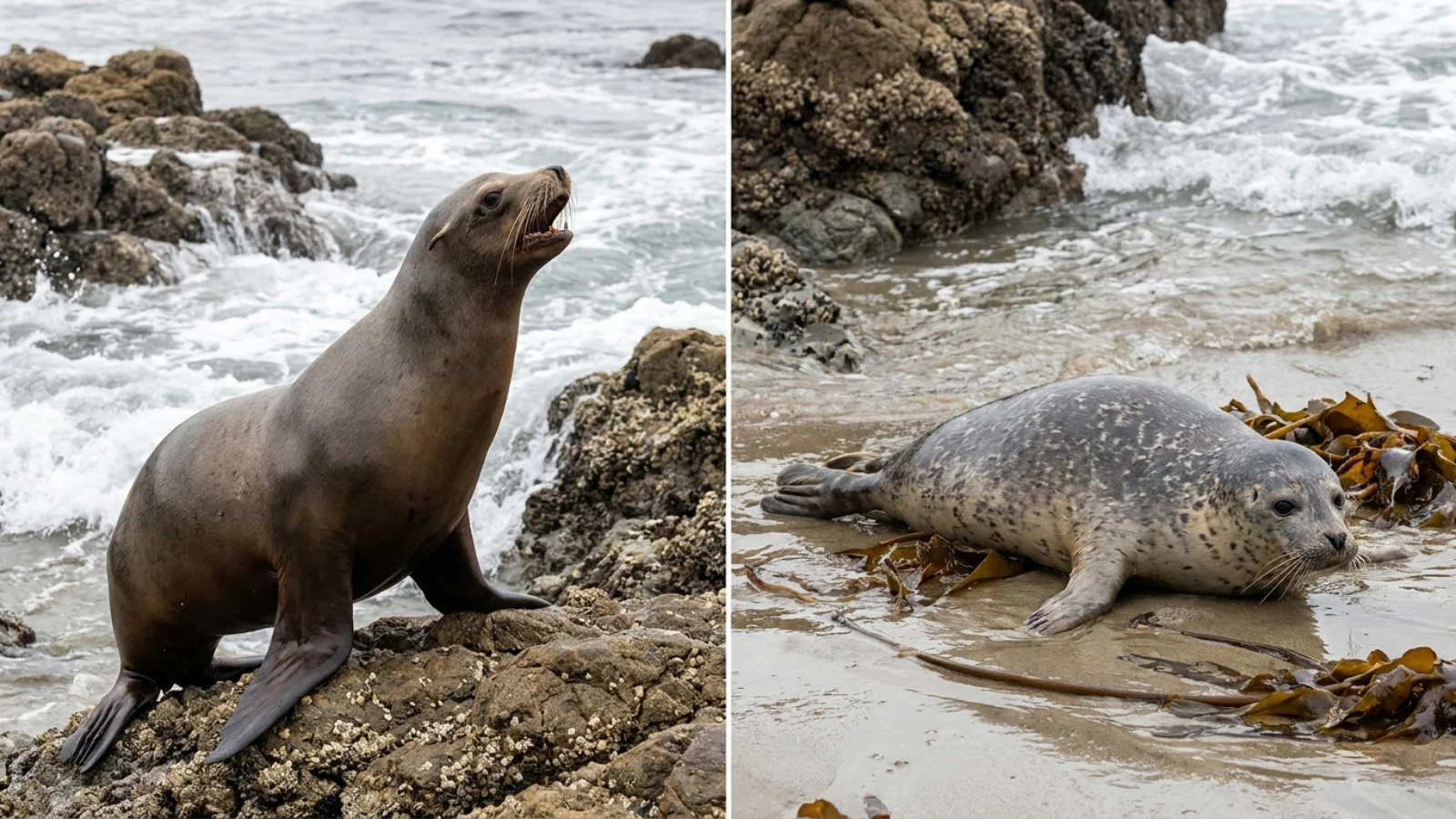
1. Ears: flaps or holes?
The simplest test is the ear. Sea lions and fur seals have small, visible external ear flaps, called pinnae, on the sides of the head. The family name Otariidae comes from the Ancient Greek ōtárion, meaning “little ear”, for exactly this reason. True seals have no ear flaps at all, only a small opening on each side of the head that can be hard to spot unless the animal is close and dry.
The flaps are small and lie flat when the animal is wet, so they can be missed at a distance, but they are usually visible in photographs and when a sea lion is hauled out and dry. A true seal’s head, by contrast, looks smooth and rounded, almost like a bowling ball with eyes and whiskers. Inside the head, true seals have their own diving adaptations: the middle ear is lined with blood sinuses that inflate during a dive and help keep the pressure constant.
2. Front flippers: long wings or short paddles?
Sea lions have proportionately much larger front flippers than true seals, backed by large chest muscles. The flippers are long and look rather like leathery wings. When a sea lion is resting on land it often props itself up on them, chest raised and head held high, a posture true seals cannot easily copy.
A true seal’s front flippers are short and are usually held close to the body. Seals use them mainly for steering in the water and for stabilising themselves on land. If the animal in front of you is lying flat with its front flippers tucked against its sides, it is almost certainly a true seal.
3. Walking on land: all fours or galumphing?
This is the most entertaining difference. Sea lions, fur seals and walruses can rotate their hind flippers forward and under the body, so they can “walk” on all four flippers. Sea lions build momentum by swaying their heads and necks from side to side as they move, and they are surprisingly agile; they have been recorded climbing flights of stairs, and on docks and piers they can move faster than many people expect.
True seals cannot do this. Their hind flippers are bound to the pelvis and cannot be turned forward, so on land they move by flopping and wriggling their bodies forward on their bellies while the front flippers keep them stable, a motion sometimes called galumphing or “worm-style” locomotion. The polar explorer Edward Wilson called it lolloping. In some species the front flippers push against the ground like oars. True seals can move more easily on ice, where they slide.
4. Swimming: wings in front or a tail stroke behind?
In the water the two families swim in completely different ways. Sea lions swim mainly with their front flippers, in a wing-like stroke similar to penguins and sea turtles, gliding between strokes and using their hind flippers to manoeuvre. They are fast and agile, capable of high bursts of speed and tight turns; a California sea lion can bend so far backwards in a dorsal turn that the back of its head touches its hind flippers.
True seals swim with their hind flippers and the back of the body, sweeping them from side to side, while the front flippers are mainly used for steering. Their style is less flashy but highly efficient. While sea lions are known for speed and manoeuvrability, true seals are known for economical long-distance movement, which lets most species forage far from land. Sea lions, in contrast, tend to stay tied to rich upwelling zones close to their breeding sites. Pinnipeds generally swim at around 5 to 15 knots, slower than many dolphins but more flexible.
5. Noise: barks or grunts and songs?
If you hear loud, repetitive barking from a crowded rocky shore or a harbour, you are almost certainly listening to sea lions. Male otariids have strong barks, growls and roars, and airborne calls are more common in eared seals than in true seals.
Most true seals are quieter on land. Northern seals in the subfamily Phocinae do not bark; instead they communicate by slapping the water and grunting, and a few species have been documented clapping their flippers underwater as a percussive signal in aggressive and display behaviour. The southern seals are different again. Male elephant seals roar on land to establish dominance, and Weddell and leopard seals are famous for their underwater songs. Hauled-out harbor seals may slap themselves with their flippers as a warning sound. So a loud bark points to a sea lion, but silence does not always mean a seal.
6. Body shape, coat and whiskers
Sea lions have a more dog-like head, with a longer muzzle, sharp, well-developed canine teeth and a visible neck. True seals are more spindle-shaped and streamlined, with a shorter muzzle and a rounder head that seems to flow straight into the body. True seals also have retractable nipples and internal testicles, which keep the body outline smooth.
The coat helps too. Sea lions are covered in coarse, short guard hairs that lie flat and sleek when wet. Fur seals, the other branch of the eared seal family, have a thick underfur beneath the guard hairs. True seals also have short fur, and in species that live on ice the pups have thicker coats than the adults. Even the whiskers differ: in sea lions and walruses they are normally smooth, while most true seals have wavy whiskers. Those whiskers are remarkably sensitive; harbor seals can follow the hydrodynamic trail left by a moving object minutes earlier, rather like a dog following a scent.
7. Where you are standing
Geography is a powerful clue. True seals live in the oceans of both hemispheres, mostly in polar, subpolar and temperate waters, with the tropical monk seals as the main exception. One species, the Baikal seal, lives only in fresh water. Sea lions and fur seals live in subpolar, temperate and equatorial waters of the Pacific and Southern Oceans, the southern Indian Ocean and the Atlantic, but they are conspicuously absent from the North Atlantic.
That gives a handy rule. If you are watching pinnipeds on the coasts of Britain, Ireland, Scandinavia, eastern Canada or New England, the wild animals you see are seals, usually harbor or gray seals, or occasionally walruses in the Arctic. On the Pacific coast of North America, around South America, southern Africa, Australia, New Zealand and the Galápagos, you may meet both families, so the ears and the walk become important.
Size: who is bigger?
It depends on the species, because both families cover a huge size range. True seals range from the ringed seal, about 1.17 metres long and 45 kilograms, to the southern elephant seal, which reaches about 5.8 metres and 4,000 kilograms and is the largest member of the order Carnivora. Among eared seals, males range from the Galápagos fur seal, the smallest at about 70 kilograms, to the Steller sea lion, which can exceed 1,000 kilograms.
Eared seals show extreme differences between the sexes. Mature males weigh two to six times as much as females, with much larger heads, necks and chests, making otariids the most sexually dimorphic of all mammals. A huge, thick-necked animal with a mane surrounded by many smaller ones on a breeding beach is a classic sea lion scene. Elephant seals, which are true seals, also show large sex differences, so size alone is not a reliable test.
Pups and parenting: two different strategies
The two families even raise their young differently. In many true seals, a pregnant female builds up fat at sea, then hauls out to give birth and fasts while nursing. Their milk is extremely rich, up to about 60 percent fat, which lets pups grow very fast in a short time. Northern elephant seal pups gain about 4 kilograms a day. Lactation lasts from just three to five days in the hooded seal to five to seven weeks in the monk seals. The mother then leaves, and the pup lives off its fat stores while it learns to dive and feed. The harbor seal is a partial exception, making short feeding trips between nursing bouts.
Sea lions and fur seals take the opposite approach. The mother nurses her pup for a few days, then leaves it on shore while she forages at sea, for as little as a day if food is close or up to three weeks if it is not, and returns to nurse again. Lactation lasts six to eleven months in most otariids, and up to three years in the Galápagos fur seal. Otariid pups are weaned at heavier weights, but seal pups grow faster.
Breeding behaviour differs too. All otariids breed on land in well-defined seasons, usually in dense colonies on beaches or rocky islands, where males defend territories through vocal and visual displays and occasional fights. The Australian sea lion is an oddity, with a breeding cycle of about 17.5 months instead of a year. Female New Zealand sea lions are the only otariids known to lead their pups up to 2 kilometres inland into forests during the breeding season.
What about fur seals and walruses?
Fur seals cause a lot of confusion because they are called seals but are actually eared seals, close relatives of sea lions. They have ear flaps, long front flippers and walk on all fours. Compared with sea lions, fur seals are generally smaller, show even greater size differences between males and females, eat smaller prey and make longer foraging trips. Their thick underfur made them a major target of the commercial fur trade. Molecular studies show that the traditional split between fur seals and sea lions does not reflect true family history, but the names remain useful for describing the two body types.
The walrus sits in its own family, Odobenidae. Like sea lions, it can walk on all fours by turning its hind flippers forward, but like true seals it swims mainly with its hind limbs and has no external ear flaps. With its tusks, nearly hairless skin and flattened snout, it is hard to confuse with anything else.
How are seals and sea lions related?
For a long time scientists debated whether the two families had separate origins, with sea lions descended from bear-like ancestors and true seals from otter-like ones. Morphological and molecular evidence now supports a single origin for all pinnipeds from one common ancestor. Enaliarctos, a fossil from California about 24 to 22 million years old, already had flippers and a flexible spine. The earliest known fossil true seal is Noriphoca gaudini from Italy, from the late Oligocene or earliest Miocene. Eared seals arose in the North Pacific about 15 to 17 million years ago and diversified rapidly into the Southern Hemisphere, where most species now live; the earliest known fossil otariid is Eotaria crypta from southern California.
The German naturalist Johann Karl Wilhelm Illiger first recognised pinnipeds as a distinct group in 1811 and gave them the name Pinnipedia; the American zoologist Joel Asaph Allen reviewed the world’s pinnipeds in a monograph in 1880. The two main families have since taken very different routes through evolution: one towards land-based agility and speed, the other towards efficient swimming and long, deep foraging trips.
Sea lions, seals and people
The differences matter in practice. Sea lions’ ability to walk, climb and haul out on man-made structures brings them into close contact with people. In the United States, pinnipeds are protected under the Marine Mammal Protection Act of 1972, and since then California sea lion numbers have risen to around 250,000, with many animals using docks and other man-made sites to haul out. That success has created conflicts with boat owners and fishers, and it is one reason sea lion bites are more often in the news than seal bites; we cover the risks in are sea lions dangerous?.
True seals are more often seen resting on sandbars, rocks and ice floes,. Either way, the advice is the same: keep your distance, never feed them, and keep dogs on a lead. Animals come ashore to rest, moult, give birth and nurse, so a hauled-out seal or sea lion is not necessarily stranded or in trouble.
Seals and sea lions also have deep cultural roots. In Homer’s Odyssey the sea god Proteus herds a colony of seals, and in Orkney and the Hebrides the Celts told stories of selkies, seals that could shed their skins and walk on land as humans.
So which one are you looking at?
Check the ears, then watch it move. Ear flaps, long front flippers, a walk on all fours and a loud bark mean a sea lion or fur seal. A smooth, rounded head with ear holes, short front flippers, a belly-crawl on land and a quiet grunt or underwater song mean a true seal. Add where you are standing, and the question of seal vs sea lion is usually settled in seconds. For more on each family, see our guides to seals and sea lions. Along the Pacific coast there is often a third animal in the same harbour; see sea otter vs seal vs sea lion.
| Feature | True seal (Phocidae) | Sea lion / fur seal (Otariidae) |
|---|---|---|
| Ears | Holes only | Small external flaps |
| Front flippers | Short, held close to the body | Long and wing-like |
| On land | Wriggles on belly | Walks on all four flippers |
| Swimming | Side-to-side hind-flipper stroke | Wing-like front-flipper stroke |
| Voice | Grunts, slaps, underwater songs | Loud barks and roars |
| Nursing | Short, intense (days to weeks) | Long (6-11 months, up to 3 years) |
| Range | Both hemispheres, incl. North Atlantic | Pacific, Southern Ocean; absent from North Atlantic |
What is the main difference between a seal and a sea lion?
Sea lions have ear flaps and walk on all fours; true seals have ear holes and wriggle on their bellies.
Are sea lions a type of seal?
Yes, in the broad sense. They are eared seals (Otariidae), a different family from true seals (Phocidae).
Can seals walk on land?
Not really. True seals cannot turn their hind flippers forward, so they wriggle and bounce instead.
Which is bigger, a seal or a sea lion?
The biggest is a seal: the southern elephant seal, up to about 5.8 m and 4,000 kg.
Do seals bark like sea lions?
Most do not. Northern seals grunt and slap the water; some southern seals roar or sing underwater.
Are fur seals seals or sea lions?
Fur seals are eared seals, close relatives of sea lions, with ear flaps and an all-fours walk.
Are there sea lions in the Atlantic?
Not in the North Atlantic; eared seals live in the South Atlantic, Pacific and Southern Ocean.
Is a walrus a seal or a sea lion?
Neither. The walrus has its own family, Odobenidae.
- Wikipedia contributors, “Pinniped”, “Earless seal” and “Eared seal”, Wikipedia (accessed November 2026).
- Allen, J.A. (1880), History of North American Pinnipeds.
- Marine Mammal Protection Act of 1972 (United States).
Blane Perun has been exploring Earth’s oceans and marine life for over 25 years. Founder of TheSea.Org in 1999, underwater photographer, coral aquaculture pioneer, and explorer of 80+ countries.
About Blane Perun →