Whale Shark — Rhincodon typus, the Largest Fish in the Ocean
The whale shark (Rhincodon typus) is the largest fish on Earth, reaching 12+ m in length and weighing over 20,000 kg. Despite its size and the word "shark" in its name, it is a docile filter feeder that strains plankton, fish eggs, and small fish through gill rakers — not a predator. Whale sharks are spotted to identify individuals and tracked across the Indo-Pacific in some of the longest fish migrations recorded. They are the largest of the four sharks with a dedicated Q&A sub-cluster on this site.
Whale Shark
Identification — the unmistakable spotted giant
A whale shark cannot be confused with anything else in the sea. The size, the broad flat head, and the constellation of pale spots on dark skin are diagnostic.
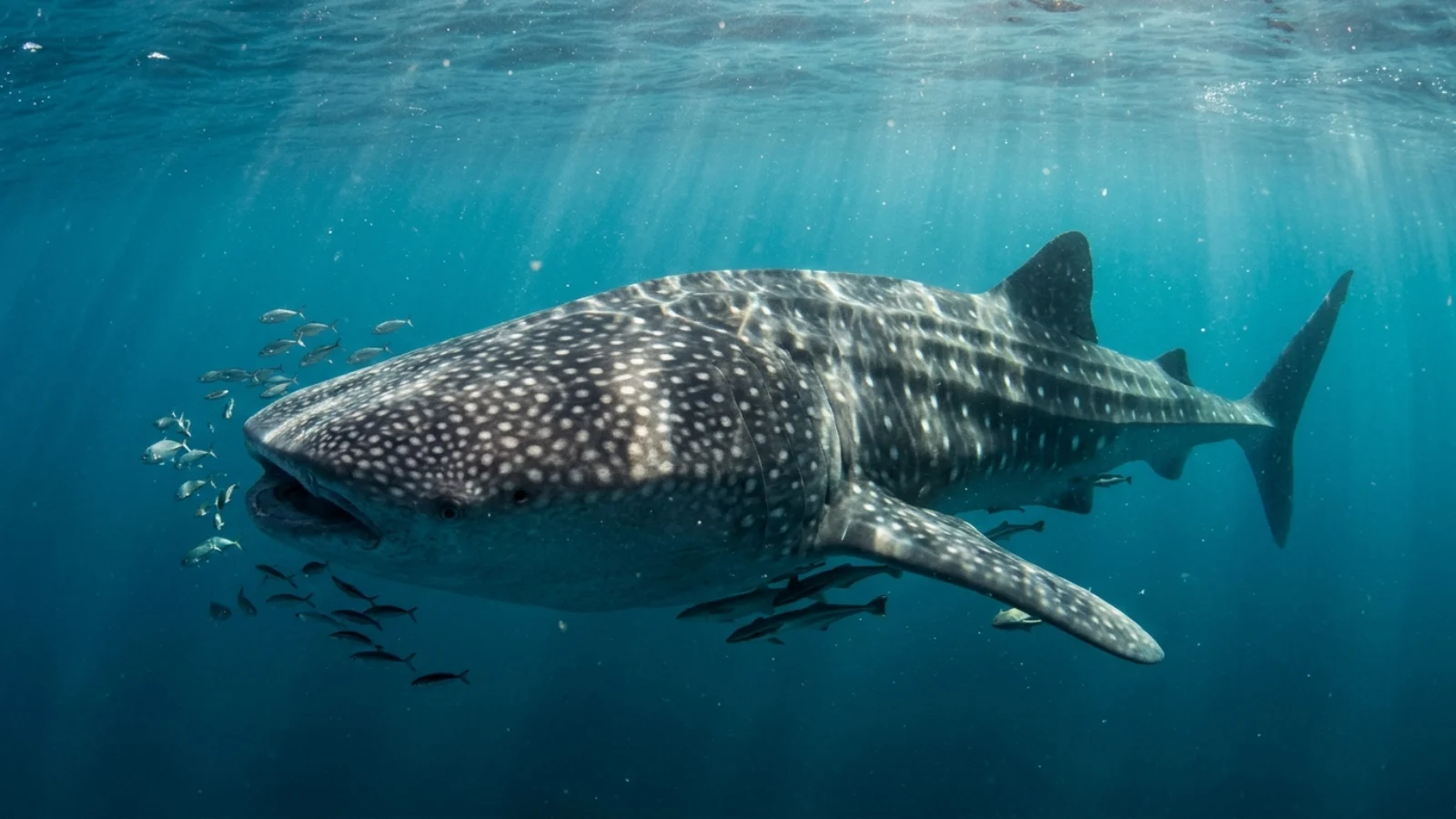
The whale shark's body plan is unique among sharks: a flattened, broad head with a terminal mouth (rather than the underslung mouth of most sharks), three prominent ridges running along each flank, and a large lunate caudal fin. The skin is among the thickest of any animal — up to 15 cm — and is covered in a unique pattern of pale yellow and white spots and stripes on a dark grey-blue background. The pattern is unique to each individual, like a fingerprint, and is the basis for the global photo-identification network Wildbook for Whale Sharks.
The mouth, which can open to 1.5 m wide, contains ~3,000 tiny teeth in 300+ rows, but these are vestigial and play no role in feeding. The whale shark feeds by filtration: water is drawn into the mouth, food particles are trapped on the gill rakers, and filtered water exits through the gills.
Range — circumtropical with predictable seasonal aggregations
Whale sharks roam the entire tropical band of the world ocean, but the species is most reliably encountered at a handful of seasonal aggregation sites tied to plankton blooms and fish-spawning events.
The major aggregation sites are Holbox and Isla Mujeres off the Yucatan Peninsula (May–September), Ningaloo Reef in Western Australia (March–August), Donsol and Oslob in the Philippines (December–May), the Maldives (year-round), Djibouti and the Gulf of Tadjoura (October–February), and Mafia Island off Tanzania (October–March). Each site corresponds to a predictable seasonal food event — plankton blooms at Holbox and Ningaloo, snapper spawning at the Yucatan and Belize.
Satellite-tagging work by Eckert and colleagues, and more recently by the Marine Megafauna Foundation, has documented individual whale sharks travelling over 13,000 km in one tracking period — among the longest documented migrations of any fish. Whale sharks routinely descend to 1,900+ m, with the deepest recorded dive at 1,928 m.
Diet — the largest filter feeder on Earth
A whale shark filters thousands of cubic metres of water per day to extract the plankton and small fish that fuel its enormous body.
The whale shark uses three feeding modes. Passive ram filtration — swimming forward with the mouth open — works at the lowest plankton densities. Active suction feeding — opening and closing the buccal cavity to vacuum food — is used at higher densities, often during fish-spawning events. Vertical feeding — hanging in the water column with the mouth pointed up — is documented at the densest aggregations, where plankton or fish eggs concentrate at the surface.
A feeding whale shark processes an estimated 6,000 litres of water per hour through the gill rakers. Stomach analyses have documented copepods, krill, jellyfish, fish eggs, sardines, anchovies, mackerel, squid, and on at least one occasion the remains of a small tuna. The species is also notable for being one of the few large filter feeders to seek out spawning fish, particularly snapper at the Yucatan and tunas in the Indian Ocean.
Reproduction — the most mysterious large-fish reproductive system
Whale shark reproduction is poorly understood despite decades of work. Only one pregnant female has ever been examined; her uterus contained ~300 embryos at a wide range of developmental stages.
A pregnant female whale shark caught in Taiwan in 1995 contained ~300 embryos at varying stages of development, a unique finding among sharks. The species is ovoviviparous: eggs hatch internally and the female gives birth to live pups 40–60 cm long. Where this birth occurs is unknown — no neonate whale shark has ever been observed in the wild — but recent research at the St. Helena aggregation in the South Atlantic has identified the site as a possible mating ground based on observations of paired adults.
Maturity is estimated at ~30 years, and the species may live 80–130 years based on radiocarbon dating of vertebral growth bands (Ong et al. 2020). Like other large sharks, whale sharks reproduce slowly relative to fishing and shipping pressure.
Conservation — an Endangered species in the global fin trade
The IUCN listed Rhincodon typus as Endangered in 2016, citing population declines of more than 50% in the Indo-Pacific over three generations.
Whale sharks face two main threats. Targeted fishery, primarily in southern China and historically in Taiwan, has been documented at thousands of individuals per year despite international protection — a 2014 BLOOM Association investigation documented a single Chinese facility processing more than 600 whale sharks annually. Vessel strikes are the second major threat, particularly in the Yucatan, the Maldives, and the Galapagos, where high tourist boat traffic overlaps with surface-feeding sharks. The species is listed on CITES Appendix II and is fully protected in most jurisdictions.
Where the whale shark sits among the major shark species
Comparing whale sharks against the major predatory species at a glance.
The whale shark dwarfs every other shark by length and mass — a mature individual is roughly twice the length and ten times the mass of an adult great white. Yet it has zero recorded unprovoked attacks on humans. The species defines the upper bound of shark size and the opposite end of the predator spectrum from the tiger and bull.
| Species | Max length | Max weight | Bite force | Attacks (unprov.) | Lifespan |
|---|---|---|---|---|---|
| Great white shark | 6.0 m | 2,300 kg | ~4,000 PSI | 354 | 70 yrs |
| Tiger shark | 5.5 m | 900 kg | ~6,000 PSI | 142 | 27–50 yrs |
| Bull shark | 3.5 m | 320 kg | 1,250 PSI | 121 | 16 yrs |
| Oceanic whitetip | 4.0 m | 170 kg | n/a | 15 | 22 yrs |
| Shortfin mako | 4.0 m | 570 kg | n/a | 10 | 30 yrs |
| Great hammerhead | 6.1 m | 580 kg | n/a | 17 | 44 yrs |
| Whale shark | 12.0 m | 19,000 kg | n/a (filter) | 0 | 80–130 yrs |
Related on TheSea
Is a whale shark a whale or a shark?
A whale shark is a shark, not a whale. It is a fish — cartilaginous, gill-breathing, cold-blooded — and belongs to the class Chondrichthyes. The "whale" in the name refers to the size and the filter-feeding lifestyle, which parallels the baleen whales' way of feeding but is unrelated genetically. More on shark vs mammal classification.
How big do whale sharks get?
The largest reliably measured whale shark was 12.65 m long, captured in Pakistan in 1949. Most adult whale sharks fall in the 5.5–10 m range. Anecdotal reports of 18+ m animals exist but have never been verified. Full discussion of the largest specimens.
Are whale sharks dangerous to humans?
No. Whale sharks have zero recorded unprovoked attacks on humans. They are docile filter feeders and tolerate snorkellers and divers in close proximity. The risk of a whale-shark encounter is from incidental contact — the tail of a 10-m animal moving at speed has serious mass — not from intent.
Where can I swim with whale sharks?
The most established sites are Holbox and Isla Mujeres in Mexico (May–September), Ningaloo Reef in Australia (March–August), Donsol in the Philippines (December–May), and the Maldives (year-round). Avoid Oslob in the Philippines, where the operation provisions sharks with food and is widely criticised by conservationists.
Why are whale sharks endangered?
The IUCN listed Rhincodon typus as Endangered in 2016 after Indo-Pacific population estimates fell by more than 50% over three generations. The two main pressures are targeted fisheries (primarily southern China) and vessel strikes at high-traffic aggregation sites. Full conservation overview.
Blane Perun has been exploring Earth’s oceans and marine life for over 25 years. Founder of TheSea.Org in 1999, underwater photographer, coral aquaculture pioneer, and explorer of 80+ countries.
About Blane Perun → More on Sharks →