Cleaner Shrimp — The Reef’s Parasite Pickers and How They Advertise
Cleaner shrimp are reef shrimp that make a living removing parasites, dead skin and mucus from fish, which visit their “cleaning stations” and hold still to be groomed. The best-known is the skunk cleaner shrimp (Lysmata amboinensis), a 5–6 cm red-and-white striped shrimp from the Red Sea and Indo-West Pacific, but cleaning has evolved in several shrimp families.
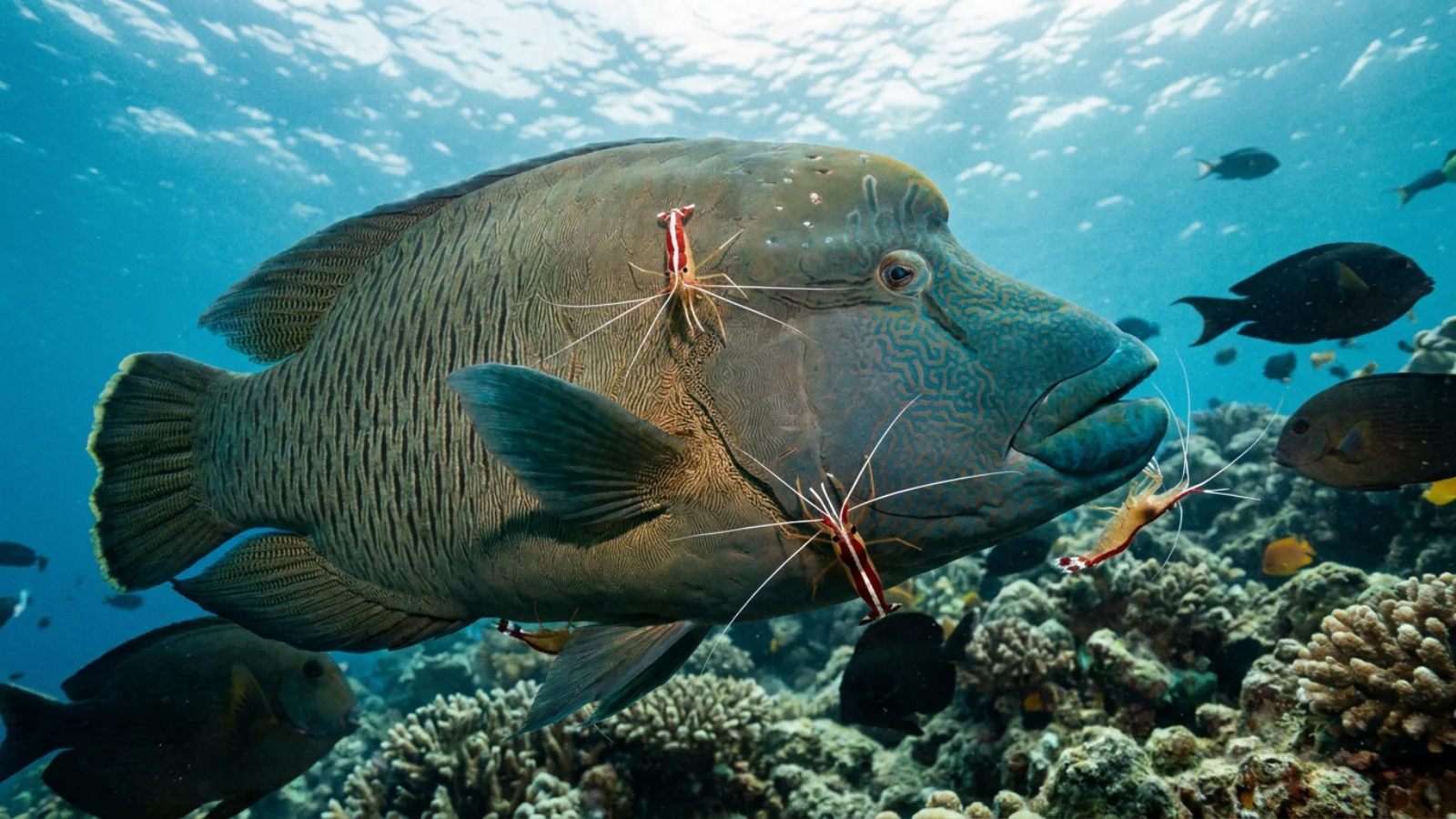
Cleaning is one of the most striking partnerships on a reef. A grouper or moray that would eat a shrimp anywhere else opens its mouth and gill covers and lets the shrimp walk inside. Both sides benefit: the fish loses parasites, and the shrimp gets fed.
Which shrimp are cleaner shrimp?
“Cleaner shrimp” is a job, not a single family. Most cleaners belong to the Lysmata shrimps (Lysmatidae, formerly placed in Hippolytidae) and the palaemonid shrimps, with a few cleaners among the Stenopodidae, Alpheidae and Pandalidae.
| Cleaner | Family | Notes |
|---|---|---|
| Skunk cleaner, Lysmata amboinensis | Lysmatidae | Red-and-white back stripe, Indo-Pacific |
| Fire shrimp, L. debelius | Lysmatidae | Scarlet, deeper caves |
| Atlantic skunk cleaner, L. grabhami | Lysmatidae | Atlantic counterpart |
| Banded coral shrimp, Stenopus hispidus | Stenopodidae | Red-and-white bands, worldwide tropics |
| Spotted cleaner, Periclimenes / Ancylomenes | Palaemonidae | Live on anemones |
| Yellow-beaked cleaner, Urocaridella | Palaemonidae | Group stations on the Great Barrier Reef |
Other reef shrimp, such as the anemone shrimp and saron shrimp, may clean occasionally but are not dedicated cleaners.
How do cleaner shrimp advertise to fish?
Cleaner shrimp signal with movement. Many wave their long white antennae, and some species perform a “rocking dance,” swaying from side to side at the mouth of their station. Research by J. H. Becker, L. M. Curtis and A. S. Grutter at Lizard Island on the Great Barrier Reef found that hungry yellow-beaked cleaner shrimp rocked more, stayed closer to clients and were preferred by fish over well-fed shrimp (details below).
Skunk cleaners at a station often climb onto a fish and tap it with their antennae, signaling that they are cleaners rather than prey. Fish in turn pose: they hover head-up or head-down, flare their gill covers and open their mouths.
Why don’t fish eat cleaner shrimp?
Because a live cleaner is worth more than a meal. Fish that visit stations regularly carry fewer parasites, and studies of cleaning fish and shrimp on the Great Barrier Reef have linked cleaners to healthier fish communities. The shrimp’s conspicuous colors, white antennae and dancing make it easy to recognize. Cheating can happen: cleaners sometimes take healthy mucus instead of parasites, and clients may respond by jolting or leaving.
What is the skunk cleaner shrimp?
Lysmata amboinensis is the classic aquarium cleaner shrimp. It grows to about 5–6 cm, has a yellow-orange body with a red stripe split by a white line down the back, and white antennae. It lives across the Indo-West Pacific from Kenya to Japan, French Polynesia and Hawaii and in the Red Sea, usually in pairs in caves and on ledges at roughly 5–40 m, often near moray eels.
Like other Lysmata, it is a protandric simultaneous hermaphrodite: every shrimp matures as a male and later becomes able to function as both sexes. In a pair, the shrimp alternate roles; mating happens right after one shrimp molts. A brood contains roughly 200–500 eggs carried under the abdomen, and the larval period lasts several months (see below).
The rocking dance, tested
The best evidence that cleaner shrimp signal to fish comes from the yellow-beaked cleaner shrimp, an Urocaridella species studied at Lizard Island on the Great Barrier Reef. These shrimp live in caves and crevices and gather at cleaning stations where up to about 25 shrimp may live close together. When a potential client swims near, several shrimp move out into the water and sway from side to side, a movement researchers call the rocking dance.
In a 2005 study in Current Biology, J. H. Becker, L. M. Curtis and A. S. Grutter showed that the dance was followed by a cleaning interaction every time they observed it. Hungry shrimp, which are more willing to clean, spent more time rocking and stayed closer to their clients, a small grouper called the bluespotted rockcod (Cephalopholis cyanostigma), than well-fed shrimp did. When the fish were given a choice, they preferred the hungry, rocking shrimp. The dance therefore works as a genuine advertisement that changes how fish behave. Competition between shrimp may be part of the story: another species, Urocaridella antonbruunii, has been observed cleaning a sleeping fish at night, perhaps to avoid competing with other cleaners during the day.
White antennae built to be seen
Many cleaner shrimps also whip their long white antennae at passing fish. White is one of the most reliably visible colors underwater, and a 2024 study by E. M. Caves, A. L. Davis and S. Johnsen found that some cleaners have evolved structures that make their antennae even brighter. Using electron microscopes and light models, they found that the antennae of three dedicated cleaner species from two families (Palaemonidae and Lysmatidae) had either thick chitin layers about 6 micrometers deep or densely packed microscopic spheres about 300 to 400 nanometers across, both of which raise reflectance across the visible spectrum. Two species that clean only occasionally or not at all had no such structures, and their antennae reflected less light. The authors concluded that the antennae of full-time cleaners may have been shaped by selection to be conspicuous signals.
Do cleaner shrimp really remove parasites?
For a long time, cleaner shrimp were assumed to clean without much direct evidence. In 2004, Becker and Grutter published a study with the blunt title “Cleaner shrimp do clean.” They found crustacean parasites, gnathiid isopods and copepods, in the guts of wild Urocaridella and Periclimenes holthuisi shrimp. In the laboratory, P. holthuisi reduced loads of a skin fluke (Benedenia) on captive surgeonfish (Ctenochaetus striatus) by 74.5 percent within 48 hours.
In the Caribbean, the Pederson cleaner shrimp (Ancylomenes pedersoni) runs stations from the corkscrew anemone Bartholomea annulata. Working at St. Thomas in the U.S. Virgin Islands, L. K. Huebner and N. E. Chadwick (2012) recorded the shrimp cleaning fish from at least 16 families. Most cleanings lasted less than 20 seconds. Surgeonfish were cleaned most often, while lizardfish and groupers received the longest sessions. Most anemones hosted fewer than four shrimp, groups of up to nine were rare, and the number and length of cleanings rose with the number of shrimp living on the anemone.
Not every shrimp sold as a cleaner deserves the name. The spotted cleaner shrimp Periclimenes yucatanicus, which also lives on Caribbean anemones, was long suspected of being a cleaner mimic, since only one wild cleaning event had been reported and it did not reduce parasites on surgeonfish in an earlier test. A 2017 field study in Curaçao by B. M. Titus, C. Vondriska and M. Daly found that it does signal to fish and does clean them, but its cleanings are brief, so it seems to be an occasional rather than a dedicated cleaner.
Pederson’s cleaner shrimp: a station inside an anemone
In the Caribbean, the most familiar cleaner is Pederson’s cleaner shrimp, Ancylomenes pedersoni. It is a small, transparent shrimp with bluish and violet markings and long white antennae, and within its range it is unlikely to be confused with anything else. The American carcinologist Fenner A. Chace Jr. described it in 1958 as Periclimenes pedersoni. It lives at about 1 to 15 meters, often on reefs around Bermuda and throughout the Caribbean, always in association with a sea anemone, either the corkscrew anemone (Bartholomea annulata) or the giant Caribbean anemone (Condylactis gigantea).
Living among stinging tentacles takes preparation. A shrimp new to an anemone acclimatizes by pressing its body and legs against the tentacles for gradually longer periods. After that it can move through them without being stung, but if it is separated from its host for a few days it has to repeat the process. Reported group sizes vary: up to 26 shrimp have been found on one anemone, although most anemones host only one or two, and the St. Thomas survey found groups larger than about nine to be rare.
The anemone itself becomes the advertisement. Researchers have shown that fish recognize Bartholomea annulata as a place where cleaning is likely to be on offer, and larger anemones are more likely to be visited. The shrimp attracts attention by lashing its antennae, and visiting fish hold still while it removes and eats external parasites, even inside the gill covers and mouth. When a neon goby sets up a cleaning station nearby, the shrimp and the goby may clean the same client at the same time.
Cleaner shrimp versus cleaner fish
Cleaner shrimp do a similar job to cleaner fish such as the cleaner wrasses and neon gobies, and the two sometimes work side by side. Both remove parasites, and both pick at mucus and dead tissue around wounds, which may reduce infection and help healing. Cleaning also appears to lower stress in client fish.
There are differences too. Cleaner shrimp are generally more cryptic than cleaner fish, living in crevices or on anemones, which may be why signals such as the rocking dance and antenna whipping are so important to them. They are not infected by the parasites they remove, whereas cleaner fish can catch some of their clients’ parasites, and some shrimp also eat the free-swimming stages of parasites in the water. On the other hand, cleaner wrasses are well known for “cheating” by biting healthy mucus and scales, and much less is known about how often shrimp cheat, so the comparison is still an active area of research.
Cleaner shrimp on fish farms
Cleaner shrimp may become useful far from the reef. Fish farms rely heavily on chemicals to treat parasites, and cleaner fish used as a biological alternative can catch the same parasites as their clients. Shrimp do not. In a 2018 study, D. B. Vaughan, A. S. Grutter and K. S. Hutson tested four cleaner shrimp species, including the skunk cleaner, the banded coral shrimp and the peppermint cleaner shrimp Lysmata vittata, against three harmful parasites of a farmed grouper: a skin fluke, a ciliate protozoan and a leech. All four shrimp reduced parasites on the fish, and most also ate the free-living early stages of the parasites in the water, something cleaner fish do not do. The peppermint cleaner shrimp performed best, reducing parasites by up to 98 percent. The authors called cleaner shrimp a sustainable candidate for biological control, partly because some species can be bred in captivity.
Lysmata: shrimp that are both sexes
The skunk cleaner’s sex life is one of the most unusual among decapods. Every Lysmata shrimp starts life as a male, then after a few molts becomes a hermaphrodite with working male and female tissue in its gonads. There are no pure females. Scientists call this protandric simultaneous hermaphroditism, and every Lysmata species studied so far has proved to use it.
In a pair of skunk cleaners, mating follows a molt: the shrimp that has just molted acts as the female and broods the eggs, while its partner acts as the male. When the other shrimp molts, the roles reverse. A spawn contains roughly 200 to 500 greenish eggs carried on the swimmerets. They lighten as they develop, a few turn silvery on the day of hatching, and the larvae, about 3 to 4 millimeters long, are released around dusk.
Why the family name changed
Older books place the skunk cleaner and its relatives in the family Hippolytidae, while newer sources use Lysmatidae. The change reflects genetic work showing that the old Hippolytidae was not a natural group. When Y. Wang and colleagues sequenced the complete mitochondrial genome of Lysmata amboinensis in 2020, a loop of DNA 16,735 base pairs long containing 13 protein-coding genes, their family tree again suggested that the traditional Hippolytidae is polyphyletic, meaning it lumps together shrimps from separate lineages. Placing Lysmata and its close relatives in their own family keeps the classification in line with their evolutionary history, which is why aquarium labels and scientific papers may use different family names for the same shrimp.
A long life in the plankton
The larvae drift and molt for months. One description counts 14 larval stages and gives a larval period of about 5 to 6 months, by the end of which the larvae are about 2 centimeters long. A 2022 laboratory study by L. F. de Sousa and colleagues described ten zoeal stages followed by a decapodite stage, noting that complete larval descriptions exist for only three of the 48 Lysmata species then known. The difference partly reflects how stages are counted and reared, so both figures appear in the literature.
That long larval phase is why the skunk cleaner remains hard to farm. Adults spawn regularly in aquariums, but most larvae die before settling, and most skunk cleaners in the aquarium trade are still wild-caught. There has been concern about the effect of collecting on wild reefs, although no clear effect has been shown.
Other Lysmata species breed far faster. In the red-striped shrimp Lysmata vittata, which has become established in the western Atlantic, a 2019 study by D. F. R. Alves and colleagues found the ovarian tissue redeveloped about 6.3 days after spawning and embryos took about 8.4 days to develop, a quick cycle that may help explain its success as an invader.
Can you keep cleaner shrimp in a reef tank?
Yes. Skunk cleaners are among the hardiest and most reef-safe invertebrates. They ignore corals, scavenge leftover food, and often clean fish within days of being added. Keep them in pairs or small groups, give them caves, and acclimate slowly because shrimp tolerate rapid salinity changes poorly. Avoid copper medications and predators such as large wrasses, triggerfish, puffers and hawkfish.
Where can divers see cleaner shrimp?
Almost any healthy tropical reef. Look at the mouths of caves, beneath ledges, around large barrel sponges, and around anemones in the Caribbean, where Ancylomenes pedersoni cleans from corkscrew anemones. In the Indo-Pacific, hold a still hand near a station and skunk cleaners will often hop on and pick at your cuticles. For more species, see the reef shrimp hub and the peppermint shrimp.
What do cleaner shrimp eat?
Parasites, dead skin, mucus and tissue around wounds on fish, plus leftover food and detritus.
Are cleaner shrimp reef safe?
Yes. Skunk cleaner shrimp do not harm corals and are safe with most reef fish and invertebrates.
How big do skunk cleaner shrimp get?
About 5–6 cm (2–2.4 in).
Why don’t fish eat cleaner shrimp?
Fish benefit from having parasites removed, and cleaners advertise their role with bright colors, antennae waving and a rocking dance.
How many cleaner shrimp should I keep?
A pair is ideal. Because they are hermaphrodites, any two adults can pair and breed.
Do cleaner shrimp cure ich?
No. They pick off some parasites but cannot control a full outbreak.
What is a cleaning station?
A fixed spot on the reef where cleaner shrimp or fish wait for clients that come to be cleaned.
How long do cleaner shrimp live?
In aquariums, skunk cleaners commonly live several years with good care.
- Wikipedia: Cleaner shrimp (families, stations, rocking dance).
- University of Queensland (2005): Hungry little dancers make top cleaners (Becker, Grutter & Goldizen).
- Gdynia Aquarium: Pacific cleaner shrimp (Lysmata amboinensis) species profile.
- Becker, J.H., Curtis, L.M. & Grutter, A.S. (2005). Cleaner shrimp use a rocking dance to advertise cleaning service to clients. Current Biology. doi:10.1016/j.cub.2005.02.067
- Becker, J.H. & Grutter, A.S. (2004). Cleaner shrimp do clean. Coral Reefs. doi:10.1007/s00338-004-0429-3
- Caves, E.M., Davis, A.L. & Johnsen, S. (2024). Nanoscale ultrastructures increase the visual conspicuousness of signalling traits in obligate cleaner shrimps. Journal of Experimental Biology. doi:10.1242/jeb.248064
- Huebner, L.K. & Chadwick, N.E. (2012). Patterns of cleaning behaviour on coral reef fish by the anemoneshrimp Ancylomenes pedersoni. Journal of the Marine Biological Association of the UK.
- Titus, B.M., Vondriska, C. & Daly, M. (2017). The ‘cleaner’ shrimp Periclimenes yucatanicus engages in true symbiotic cleaning interactions. Royal Society Open Science. doi:10.1098/rsos.170078
- Vaughan, D.B., Grutter, A.S. & Hutson, K.S. (2018). Cleaner shrimp are a sustainable option to treat parasitic disease in farmed fish. Scientific Reports. doi:10.1038/s41598-018-32293-6
- de Sousa, L.F. et al. (2022). Complete larval development of Lysmata amboinensis reared under laboratory conditions. Zootaxa. doi:10.11646/zootaxa.5099.5.1
- Alves, D.F.R. et al. (2019). Sexual system, reproductive cycle and embryonic development of Lysmata vittata. PLoS ONE. doi:10.1371/journal.pone.0210723
- Wang, Y. et al. (2020). Complete mitochondrial genome of Lysmata amboinensis. Mitochondrial DNA Part B. doi:10.1080/23802359.2020.1842262
- Wikipedia: Lysmata amboinensis; Lysmata; Ancylomenes pedersoni.
Blane Perun has been exploring Earth’s oceans and marine life for over 25 years. Founder of TheSea.Org in 1999, underwater photographer, coral aquaculture pioneer, and explorer of 80+ countries.
About Blane Perun →