Leaf Sheep — The Tiny Sea Slug That Steals Chloroplasts From Algae
The leaf sheep (Costasiella kuroshimae) is a tiny sea slug, only 5–10 mm long, that looks like a cartoon sheep made of green leaves. It belongs to the sacoglossans, or sap-sucking slugs, and feeds on Avrainvillea green algae. As it eats, it keeps the algae’s chloroplasts alive inside its own cells, a process called kleptoplasty, so for a short time it can photosynthesise like a plant. It was described from Kuroshima Island, Okinawa, in 1993 and lives in the western Pacific, including Japan, the Philippines and Indonesia.
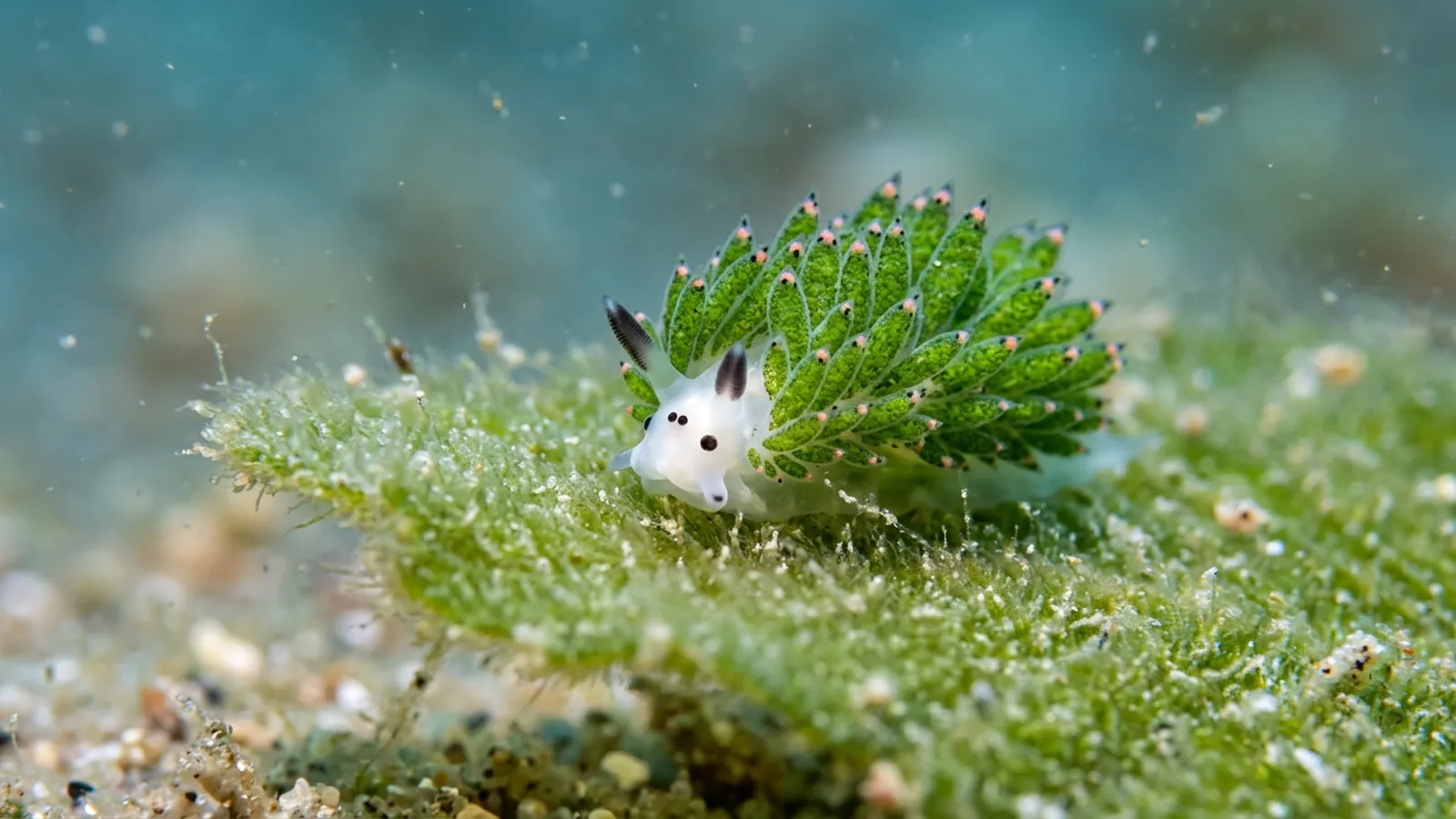
The leaf sheep is the sea slug that launched a thousand macro photographs. Two dark eyes, two little “ears” and a woolly coat of green leaves make it look like something from an animated film. What makes it scientifically interesting is less its face than its biology: it is one of a small group of animals that can borrow the photosynthetic machinery of the plants they eat.
Why is it called a leaf sheep?
The leaf sheep is named for its sheep-like face and its back covered in leaf-shaped green cerata. The “ears” are rhinophores, and the green colour comes from chloroplasts taken from the algae it eats.
On the head are two rhinophores — scent sensors — that stick up like a sheep’s ears, and two small dark eyes set close together. In most sea slugs the eyes are hidden in the skin; in the leaf sheep they are clear and dark, which is what gives it a face. Behind the head, the body is covered in rows of plump leaf-like projections called cerata. These contain branches of the digestive gland, help with breathing and defence, and are where most of the stolen chloroplasts end up.
The cerata are often green with white or bluish tips, so a leaf sheep sitting on its algae is surprisingly hard to see. Other nicknames include sea sheep and leaf slug. Despite the cartoon looks, it is a real animal that crawls slowly over a single species of seaweed.
Is the leaf sheep really solar-powered?
Partly, and only for a short time. The leaf sheep keeps working chloroplasts from its food, but studies class its chloroplast retention as short-term, and how much energy photosynthesis actually provides is uncertain.
This is where the internet version and the science part ways. Headlines call the leaf sheep “solar-powered” or “the animal that photosynthesises.” What happens is real but limited. When the slug feeds, it pierces individual algal cells with its single-row radula, sucks out the contents and digests most of it — but it keeps the chloroplasts intact and stores them inside cells lining its digestive gland. For a while those chloroplasts keep capturing light and making sugars.
A 2014 study in the Journal of Molluscan Studies by Gregor Christa and colleagues examined the genus Costasiella and classified C. kuroshimae as a short-term retainer of functional chloroplasts. A close relative, Costasiella ocellifera, survived without photosynthesis for at least 38 days. Researchers increasingly think the stored chloroplasts work as a food larder as much as a solar panel: the slug can slowly digest them when algae are scarce, which helps it survive even in the dark.
Why can the slug not keep its chloroplasts forever? A chloroplast is not self-sufficient. It carries a small genome of its own, but most of the proteins it needs to repair itself are encoded in the alga’s nucleus, which the slug digests. Without that repair supply, the photosynthetic machinery gradually wears out under light, and the chloroplasts die. An older idea that some slugs had acquired the necessary algal genes into their own DNA has not been supported by genome studies. The slug simply has to keep eating to refresh its stock.
What does the leaf sheep eat?
The leaf sheep feeds almost exclusively on green algae of the genus Avrainvillea, a fan-shaped seaweed that grows on sandy and silty bottoms.
Sacoglossans are specialists. Each species tends to feed on one genus of algae, and its radula — a single row of blade-like teeth — is shaped to puncture that alga’s cell walls. The leaf sheep spends most of its life on its food plant, where its green colour is excellent camouflage. Divers usually find it by searching patches of Avrainvillea on sand slopes rather than coral heads.
That specialisation is also why leaf sheep are not kept in aquariums. Without a steady supply of the right living alga they decline fast, and they are far too small and fragile to be practical pets.
Where do leaf sheep live?
Leaf sheep live in warm, shallow waters of the western Pacific. They were described from Kuroshima in Okinawa, Japan, and are regularly found in the Philippines and Indonesia.
The species is named after its type locality, Kuroshima Island in the Yaeyama group of the Ryukyu Islands. Since its description by Mamoru Ichikawa in 1993, it has become a signature subject at muck- and macro-diving destinations such as Anilao in the Philippines and Lembeh and Bali in Indonesia. It lives on sand and rubble slopes where its food alga grows, typically within recreational diving depths.
Finding one takes patience and good eyesight. At under a centimetre, a leaf sheep is about the size of a grain of rice, and it sits motionless on green algae. Most divers see their first one when a guide points at a seaweed blade with a pointer and waits for them to focus. If you are planning a trip, see our Philippines diving guide and scuba diving Bali.
How do leaf sheep reproduce?
Leaf sheep are simultaneous hermaphrodites: each has both male and female organs. Two slugs exchange sperm, and each lays eggs in tiny spiral ribbons on algae.
Self-fertilisation is not the norm in sea slugs, so mating takes two animals. After mating, each leaf sheep lays a small coil of white eggs on its food plant. The eggs hatch into larvae that may spend time in the plankton before settling on suitable algae and transforming into the adult form. Young slugs must find and eat the right alga to acquire their first chloroplasts — they are not inherited from the parent.
Lifespan has not been well documented for the leaf sheep. Most small sacoglossans live for months rather than years.
Leaf sheep vs. other sap-sucking sea slugs
The leaf sheep is one of several sacoglossans that keep chloroplasts, but it holds them for a much shorter time than the champions of kleptoplasty.
| Slug | Region | Chloroplast retention |
|---|---|---|
| Leaf sheep (Costasiella kuroshimae) | W. Pacific | Short-term |
| Costasiella ocellifera | Caribbean | Survived at least 38 days without photosynthesis |
| Lettuce sea slug (Elysia crispata) | Caribbean | Long-term (weeks to months) |
| Eastern emerald elysia (Elysia chlorotica) | NW Atlantic | Long-term (months) |
The Caribbean lettuce sea slug is the one reef keepers know best; it is sold to eat nuisance algae, and it uses the same chloroplast-stealing trick. For a completely different kind of cute slug, see the sea bunny, a sponge-eating nudibranch, or the open-ocean blue glaucus.
Leaf sheep are not nudibranchs, even though they are often called one online. Nudibranchs and sacoglossans are separate groups of sea slugs that both lost their shells. You can read more about the wider family tree in our guide to sea slugs and gastropods.
What is a leaf sheep?
A leaf sheep (Costasiella kuroshimae) is a tiny sap-sucking sea slug, 5–10 mm long, with a sheep-like face and leaf-shaped green cerata on its back. It lives in the western Pacific.
Can leaf sheep photosynthesise?
For a short time, yes. It keeps chloroplasts from the algae it eats inside its own cells, where they keep working. This is called kleptoplasty. How much energy it gains this way is uncertain, and its retention is classed as short-term.
Is the leaf sheep a nudibranch?
No. Despite often being called one, the leaf sheep is a sacoglossan, a separate group of shell-less sea slugs that feed by sucking the contents of algal cells.
How big is a leaf sheep?
Only about 5 to 10 mm long, roughly the size of a grain of rice.
What do leaf sheep eat?
Green algae of the genus Avrainvillea. Leaf sheep are specialist feeders and live on their food plant.
Where can I see a leaf sheep?
In the western Pacific: Japan (especially Okinawa), the Philippines and Indonesia. Macro-diving sites such as Anilao and Lembeh are well known for them.
Can you keep a leaf sheep as a pet?
No. Leaf sheep need a specific living alga to eat, are extremely small and fragile, and do not survive long in home aquariums.
Are leaf sheep real?
Yes. The leaf sheep is a real species, Costasiella kuroshimae, described by Mamoru Ichikawa in 1993 from Kuroshima Island in Okinawa, Japan.
How do leaf sheep reproduce?
They are hermaphrodites. Two individuals exchange sperm and both lay small spiral ribbons of eggs on algae.
Blane Perun has been exploring Earth’s oceans and marine life for over 25 years. Founder of TheSea.Org in 1999, underwater photographer, coral aquaculture pioneer, and explorer of 80+ countries.
About Blane Perun → More on Bizarre Sea Creatures →