Sea Sponge Structure — Glass Needles, Limestone Stars and Protein Fibres
A sea sponge’s structure is held up by a skeleton of spicules and/or spongin. Spicules are tiny mineral needles, stars and hooks made of silica (glass) in demosponges and glass sponges or calcium carbonate in calcareous sponges. Spongin is a flexible collagen protein that forms the soft fibres of bath sponges. Around this skeleton, sponges are built on one of three body plans — asconoid, syconoid or leuconoid — and grow in forms from thin crusts to barrels nearly 2 m wide.
Spicule shape and chemistry are the main way scientists identify sponges and divide them into classes. They also determine how a sponge feels and whether it is useful to people: only sponges with a pure spongin skeleton and no spicules make good bath sponges. See sea sponge species for the four classes.
A sponge has no organs, no muscles in the usual sense and no nervous system, yet some grow taller than a person and live for centuries or millennia. What holds them up is a skeleton made of mineral spicules, protein fibres, or both, and what keeps them alive is a plumbing system of pores, canals and pumping chambers. This page looks at how those two systems are built. For the cells themselves, see sea sponge anatomy; for the four classes, see sea sponge species.
What are the basic building blocks of a sponge?
A sponge’s body is a jelly-like layer called the mesohyl, made mainly of collagen, sandwiched between two thin layers of cells. The outer skin is made of flat cells called pinacocytes. The inner surfaces of the water channels are lined, in places, with choanocytes, or collar cells, each with a whip-like flagellum surrounded by a collar of tiny projections. The beating flagella drive water through the sponge, and the collars trap bacteria-sized food particles. Water enters through many small pores called ostia, which in most sponges are controlled by tube-shaped cells called porocytes that act as closable valves, and leaves through one or more larger openings called oscula. Most sponges work rather like chimneys, taking water in low and expelling it high.
Within the mesohyl are several kinds of wandering cells. Archaeocytes are amoeba-like and totipotent, able to become any other cell type, and help with feeding and clearing blocked pores. Sclerocytes secrete the mineral spicules. In demosponges, spongocytes secrete spongin, the protein fibre of the skeleton. Because cells can move and change role, sponges can slowly remodel their whole shape over their lives to take best advantage of local currents. That flexibility explains much of the variety in sponge form described below.
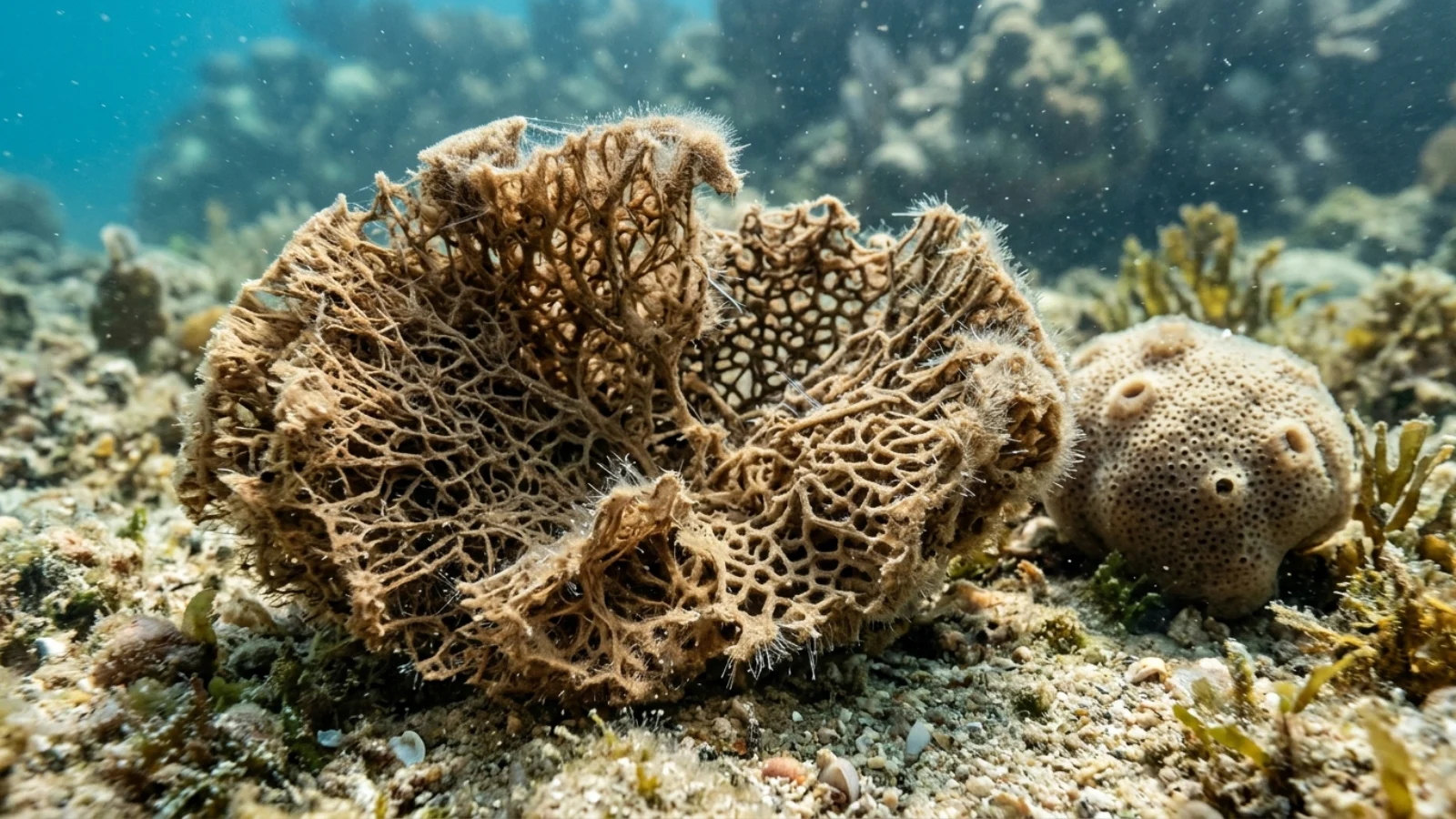
What are sponge spicules?
Microscopic skeletal elements secreted by sclerocytes, in a huge variety of shapes and two different minerals.
| Spicule type | Material | Found in |
|---|---|---|
| Monaxons (needles) | Silica or calcium carbonate | Many demosponges and calcareous sponges |
| Triaxons / hexactines (six-rayed) | Silica | Glass sponges |
| Tetraxons (four-rayed) | Silica | Some demosponges |
| Microscleres (tiny stars, hooks, sigmas) | Silica | Demosponges; identification features |
| Calcareous triactines | Calcium carbonate (magnesium calcite) | Calcareous sponges |
Spicules are the main structural elements in most sponges. They come in two size classes. Megascleres are the larger spicules, some visible to the naked eye, and form the main framework. Microscleres are much smaller and are scattered through the tissue, where they reinforce it and often act as identification features. Of the four living classes, three (demosponges, glass sponges and homoscleromorphs) make their spicules of amorphous silica, essentially glass, and one, the calcareous sponges, makes them of magnesium-rich calcite. The composition, size and shape of spicules are the main characters taxonomists use to classify sponges, often down to species level, which is why sponge identification usually requires a microscope rather than a photograph.
Making glass at sea temperature is a remarkable trick. Siliceous sponges draw dissolved silicic acid from seawater and deposit it as silica around a protein filament that runs down the centre of each spicule. The key enzymes, called silicateins, sit in that axial filament and catalyse the formation of biosilica. So far silicateins have been found only in sponges; diatoms build their glass shells with a different set of molecules. Some Antarctic demosponges obtain extra silica by eating diatoms. Human engineers can only make comparable silica structures at high temperatures, which is why sponge glass attracts so much interest from materials scientists.
How big can a spicule get?
Most spicules are fractions of a millimetre long, but glass sponges hold the records. The deep-sea glass sponge Monorhaphis chuni, described by Franz Eilhard Schulze in 1904 from material collected by the German Deep Sea Expedition, anchors itself in the sediment with a single giant basal spicule that can be up to about 3 m long. Because the silica is laid down in concentric layers, like tree rings, these giant spicules can be used to estimate age and to read past ocean chemistry. One study estimated an individual at about 11,000 years old; five others, collected from 1,100 to 2,100 m at three western Pacific sites, were estimated at 6,000 to 18,000 years, growing radially at about 140 micrometres per thousand years. Some researchers regard glass sponges as among the longest-lived animals on Earth.
The Venus’ flower basket, Euplectella aspergillum, is the most famous example of what glass spicules can build. This western Pacific sponge, usually 10 to 30 cm tall and most common below 500 m, fuses its six-rayed spicules into a rigid, tube-shaped lattice, and like many glass sponges its central cavity opens through a sieve formed by the skeleton. Its anchoring spicules, some as thin as a human hair, conduct light in ways that have interested fibre-optics researchers, and the lattice’s mechanical design has been studied as a model for lightweight structures. The lattice also shelters small mutualistic shrimp, and studies of its skeletal pattern have found that it reduces drag on the sponge and shapes the flow of water around and through it.
What is spongin?
A modified collagen, secreted by spongocytes, that forms the flexible fibres of many demosponge skeletons.
Spongin is a protein, not a mineral, and it is found only in demosponges. It forms a network of tough, elastic fibres that runs through the mesohyl, either on its own or binding spicules together into bundles and tracts. Spongin is what gives many reef sponges their springy, rubbery feel. In the bath sponges of the genera Spongia and Hippospongia, the skeleton is almost pure spongin with no spicules. When the living tissue is removed by drying, rotting and washing, what remains is a soft, absorbent, durable mesh, which is why these are the only sponges that make good natural bath sponges. A sponge whose fibres are studded with glass spicules would scratch the skin.
Spongocytes also have a role in reproduction and survival. Many freshwater sponges, and a few marine ones, produce gemmules: survival pods made of clusters of nutrient-filled archaeocytes wrapped in a shell of spongin, often reinforced with spicules. The gemmules can wait out winter or drought and then hatch into a new sponge. Spongin’s fibrous scaffold has also attracted applied interest; researchers have tested it as a support for catalysts that break down phenolic pollutants such as bisphenol A in wastewater.
Do all sponges have a skeleton?
No. A few sponges get by with no mineral skeleton at all. The homoscleromorphs are a small class whose spicules, where present, are all very small and simple, and two genera, Oscarella and Pseudocorticium, have none. Oscarella species are soft, lobed, encrusting sponges found off every continent and in every ocean except the Arctic; they rely on the collagen of the mesohyl for support. At the other extreme, some demosponges add a solid limestone skeleton to their spicules. These coralline sponges, sometimes called sclerosponges, lay down dense aragonite or calcite in layers that look like those of reef corals. Because some live for hundreds of years, their layered skeletons are used, like coral cores, to reconstruct past ocean temperature and salinity.
What are the three sponge body plans?
Asconoid, syconoid and leuconoid, which differ in how the water canals and pumping chambers are arranged.
The three plans are solutions to a geometric problem. A sponge’s tissue needs food and oxygen in proportion to its volume, but its pumping capacity depends on the area of surface lined with choanocytes. As any shape grows, volume increases faster than surface area, so a sponge that simply scales up eventually cannot pump enough water to feed itself.
The asconoid plan is the simplest: a tube or vase with a central cavity, the spongocoel, lined by a single layer of choanocytes. It works only at very small sizes, and asconoid sponges seldom exceed about 1 mm in diameter. The syconoid plan pleats the body wall into folds. The inner pockets of the folds are lined with choanocytes and connect to the outside through pores, which multiplies the pumping surface and lets syconoid sponges grow to a few centimetres. The leuconoid plan goes further, filling the body almost completely with mesohyl threaded by a network of small, choanocyte-lined chambers connected by branching canals to the intakes and outlets. This multiplies the pumping surface many times over, and it is the plan used by most sponges and by all the large ones, including essentially all demosponges.
The three names describe levels of organisation rather than strict evolutionary groups. All three plans occur within the calcareous sponges, a class of mostly small (typically under 10 cm), shallow-water, often drab species that is distributed worldwide but most common in the tropics. That makes the class a natural place to compare the plans side by side, and simple calcareous sponges such as Sycon and Leucosolenia are standard textbook examples. Glass sponges have their own variation: their living tissue is mostly a syncytium, a continuous web of cytoplasm with many nuclei, draped over the spicule scaffold like a cobweb, with very little mesohyl.
What shapes do sponges grow in?
Encrusting, massive, branching, tubular, vase, barrel and fan forms, often varying within a species depending on water flow.
Sponge growth form is strongly shaped by the environment. In strong currents and surge, sponges tend to be low and encrusting or rounded, presenting little resistance to the water. In calm water they grow taller tubes, vases, fans and branches that lift their pores into cleaner water and use the flow over their oscula to help draw water through. The same species can change form from one site to another, which complicates identification by shape alone.
The largest reef sponges are barrels. The Caribbean giant barrel sponge, Xestospongia muta, can reach 1.8 m in diameter and is common below 10 m down to about 120 m. Its firm, leuconoid body ends in a cone-shaped cavity, the osculum, through which filtered water leaves. On Conch Reef in the Florida Keys, where a population has been monitored since 1997, the largest living sponges, about the size of an oil barrel, were estimated to be about 130 years old; the largest individual with a photograph, now dead, was estimated at about 2,300 years. It is sometimes called the “redwood of the reef”. See giant sea sponge.
Some sponges have structures adapted to very particular lifestyles. Boring sponges of the genus Cliona live inside coral skeletons and shells, excavating networks of chambers by a combination of chemical etching and mechanical removal of tiny chips. A 2019 study in Scientific Reports by Webb and colleagues found that the sponge lowers the pH at the etching surface using extensions filled with acidic vesicles, and that contractile, muscle-like cells may help carry the chips away. Carnivorous sponges abandon filter feeding altogether. The harp sponge Chondrocladia lyra, described in 2012 from 3,300 to 3,500 m off California by researchers at the Monterey Bay Aquarium Research Institute, anchors in soft sediment with a root-like rhizoid and spreads one to six horizontal arms, each bearing evenly spaced vertical branches like the strings of a lyre, which snag small crustaceans. Carnivorous sponges have been recorded as deep as 8,840 m, yet one species lives in Mediterranean caves at only 17 to 23 m, entangling crustaceans less than 1 mm long in fine threads. See glass sea sponge for the deep-sea glass sponges.
Why does sponge structure matter outside biology?
Sponge skeletons have practical and scientific uses well beyond the reef. Spicule shape and chemistry are the backbone of sponge taxonomy, and isolated spicules preserved in sediments and rocks are used by palaeontologists to trace sponges through time; sponge fossils are recorded from rocks around 580 million years old. The layered skeletons of glass sponges and coralline sponges act as natural archives of past seawater chemistry and temperature. Glass sponge lattices inspire engineers designing light, strong structures and optical fibres that form at low temperature. And the soft spongin skeleton of bath sponges supports a harvest and trade that continues today in places such as Tarpon Springs in Florida and the Greek island of Kalymnos. All of these uses rest on the same simple fact: the sponge’s body is mostly water and jelly, but its skeleton is built to last. For the types of bath sponge and how they compare, see natural bath sponges; for the divers who collected them, sponge diving; for a common modern use and its risks, menstrual sea sponges; and for where the skeleton sits in the body, the sponge diagram and sponge body types.
What is a sea sponge skeleton made of?
Spicules of silica (glass) or calcium carbonate, fibres of the protein spongin, or a mix. A few sponges have little or no skeleton.
What are spicules?
Tiny mineral elements, from needles to stars and hooks, secreted by cells called sclerocytes. Their shape is used to identify sponges.
What is spongin?
A modified collagen found only in demosponges that forms flexible skeletal fibres. Bath sponges are almost pure spongin.
What are the three sponge body types?
Asconoid (simple tube), syconoid (folded wall) and leuconoid (many chambers and canals). Most sponges are leuconoid.
How long is the longest sponge spicule?
The glass sponge Monorhaphis chuni grows a single anchor spicule up to about 3 m long.
Why are bath sponges soft?
Their skeleton is spongin fibre with no glass or limestone spicules, so it stays soft and springy after cleaning.
Do all sponges have a skeleton?
No. Homoscleromorph sponges such as Oscarella lack spicules and rely on collagen in the mesohyl.
How do sponges make glass?
Enzymes called silicateins in a central filament of each spicule turn dissolved silicic acid from seawater into silica.
- Wikipedia. Sponge; Sponge spicule; Spongin; Silicatein; Homoscleromorpha; Oscarella; Demosponge (coralline sponges).
- Wikipedia. Monorhaphis chuni (giant basal spicule, age estimates); Venus’ flower basket; Hexactinellid.
- Wikipedia. Giant barrel sponge, Xestospongia muta (size, depth, Conch Reef age estimates); Chondrocladia lyra.
- Webb A.E. et al. (2019). pH regulation and tissue coordination pathways promote calcium carbonate bioerosion by excavating sponges. Scientific Reports. doi:10.1038/s41598-018-36702-8
- World Porifera Database / WoRMS. Classification of the four living sponge classes.
Blane Perun has been exploring Earth’s oceans and marine life for over 25 years. Founder of TheSea.Org in 1999, underwater photographer, coral aquaculture pioneer, and explorer of 80+ countries.
About Blane Perun → More on Sponges →