Blue Glaucus — The Tiny “Blue Dragon” That Steals Venom From a Man o’ War
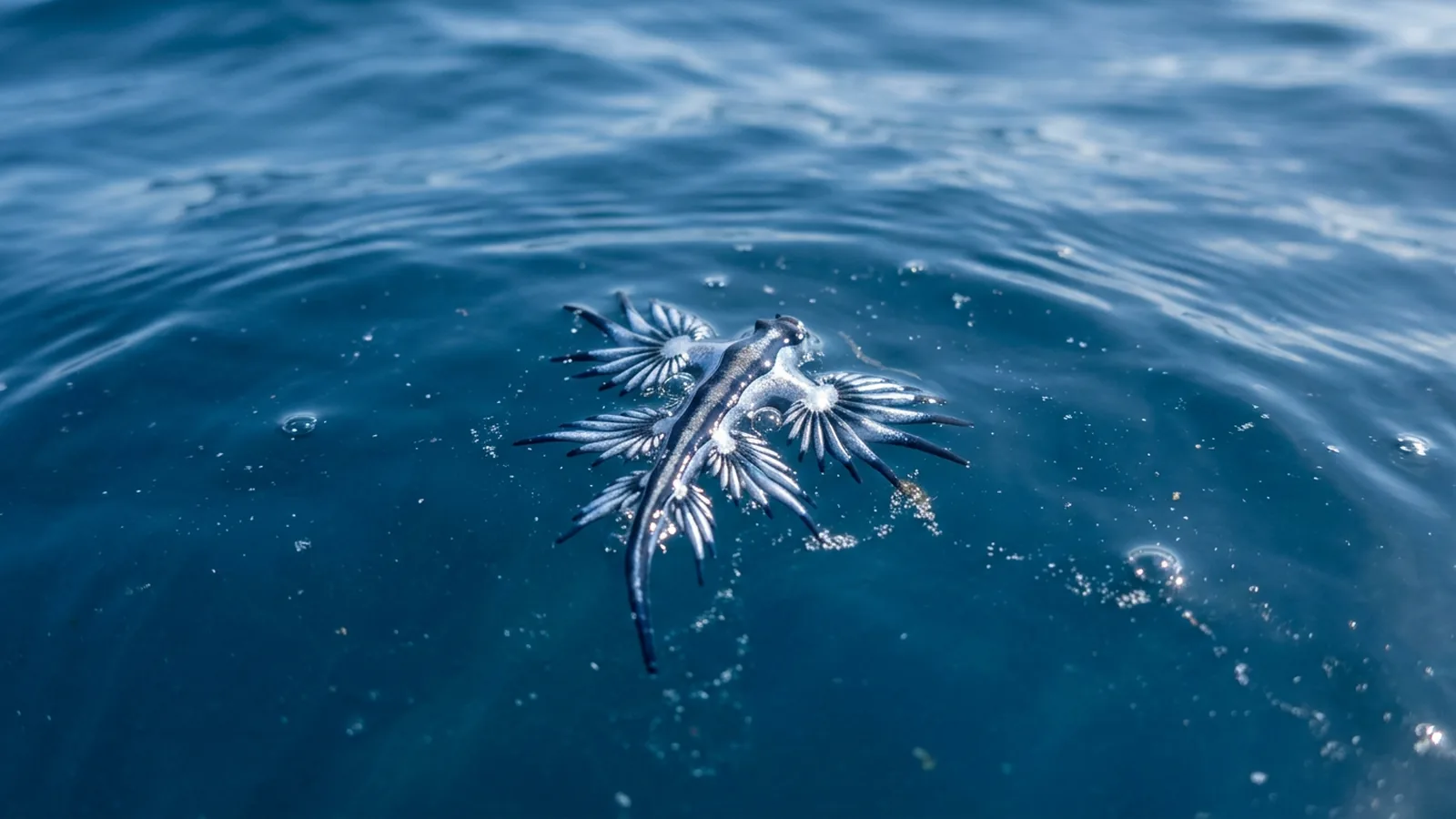
The blue glaucus (Glaucus atlanticus), also called the blue dragon or sea swallow, is a small open-ocean sea slug, usually about 3 cm long, that floats upside down on the sea surface by holding a bubble of gas in its stomach. It feeds on venomous drifting animals such as the Portuguese man o’ war and stores their unfired stinging cells in the tips of its finger-like cerata. That makes it capable of a painful sting, sometimes reported as worse than the man o’ war’s own. Blue glaucus live in warm and temperate oceans worldwide and occasionally wash up on beaches in large numbers.
Every so often, a beach somewhere in the world closes because of an animal smaller than a thumb. In August 2025 it happened at Guardamar del Segura on Spain’s Costa Blanca, where blue dragons washed up and lifeguards cleared the water for several hours. The blue glaucus looks like a piece of jewellery or a tiny Pokémon. It is also one of the few animals that makes its weapons by stealing them from something more dangerous than itself.
How does the blue glaucus float upside down?
The blue glaucus floats by swallowing air and keeping a gas-filled sac in its stomach. It drifts upside down at the surface, with its blue foot facing the sky and its silver back facing the sea floor.
The blue glaucus is part of the pleuston, the community of animals that live right at the boundary between sea and air. It has almost no control over where it goes: wind and currents carry it, along with the drifting animals it eats. That is why blue dragons tend to appear in clusters, often together with man o’ war and by-the-wind sailors, after onshore winds.
Its colours are a textbook example of countershading. The side facing up — anatomically its belly, or foot — is bright blue, blending into the water when seen by birds from above. The side facing down — its true back — is silvery grey, blending into the bright surface when seen by fish from below.
Can a blue dragon sting you?
Yes. A blue glaucus can deliver a painful sting if handled, because it carries live stinging cells taken from the man o’ war and similar animals it eats.
When the blue glaucus eats a man o’ war, it does not fire the prey’s nematocysts — the microscopic harpoon cells that deliver venom. Instead it sorts and transports the unfired cells to small sacs called cnidosacs at the tips of its cerata. Because it can collect and concentrate the most potent cells, its sting can be stronger than that of the man o’ war itself.
Reported symptoms from handling blue dragons include intense pain, nausea, vomiting, skin rashes, raised welts and blistering, sometimes with lasting skin discolouration. Treat a blue dragon sting like a man o’ war sting: get out of the water, carefully remove any fragments without bare hands, rinse with seawater (not fresh water), and seek medical help for severe pain, breathing difficulty or a spreading reaction. See our guide to man o’ war stings.
What does the blue glaucus eat?
The blue glaucus eats venomous drifting animals at the ocean surface, especially the Portuguese man o’ war, the by-the-wind sailor (Velella) and the blue button (Porpita). It also eats violet sea snails.
The Portuguese man o’ war is a colonial siphonophore whose tentacles can trail many metres below the float. The blue glaucus grips the colony with its jaws and eats through the tentacles, apparently immune to the stinging cells. Experiments and observations suggest specialised mucus and tissue protect it, but the exact mechanism is still being studied.
In captivity, blue glaucus will sometimes attack and eat each other. In the wild, their pleustonic food supply is patchy, so they eat what the wind brings them.
Where do blue glaucus live?
Blue glaucus live in warm and temperate waters of the Atlantic, Pacific and Indian Oceans, drifting at the surface far offshore. They are usually seen only when wind pushes them onto beaches.
Records come from South Africa, Mozambique, eastern Australia, Europe and the Azores, the Caribbean, Bermuda, Texas, the Gulf of California, Peru, India and Thailand. Recent years have produced a run of sightings: Texas in April 2022, Phuket in 2023 and 2025, and Lanzarote and Alicante in the summer of 2025. Some researchers link range shifts, such as a northward move in the Gulf of California observed in 2015–2016, to warming water.
Despite its worldwide range, the blue glaucus is not one big mixed population. Genetic work shows limited gene flow between Afro-Eurasian and American populations, because cold Arctic and Southern Ocean waters act as barriers. In 2014 a study by Celia Churchill and colleagues also split the related Indo-Pacific Glaucus marginatus into a complex of four species — so “blue dragon” can refer to more than one animal.
Are blue dragons rare? Not necessarily. They live far offshore and are tiny, so most people never see one, but when the right wind lines up, beaches can be dotted with hundreds at once. Their abundance rises and falls with their prey: years with big man o’ war and Velella strandings tend to bring blue dragons too. The species has not been assessed by the IUCN, and there are no population estimates. If you find them on a beach, local lifeguards and marine-science groups often want photos and locations, because citizen-science reports are one of the main ways their range is tracked.
How does the blue glaucus reproduce?
Blue glaucus are hermaphrodites. Two individuals mate belly to belly, and both then lay strings of eggs, often on driftwood or on the remains of prey.
Each egg string holds up to about 20 eggs, and a blue glaucus can lay dozens of strings per hour — an average of 55 per hour has been reported. Because the adults depend on floating surfaces, laying eggs on drifting objects keeps the next generation at the surface where their food lives. They can live up to about a year under good conditions.
Is the blue glaucus a nudibranch?
Yes. The blue glaucus is an aeolid nudibranch, a shell-less sea slug in the family Glaucidae. Its feathery cerata are typical of aeolids, which store stinging cells from their cnidarian prey.
Many shallow-water aeolid nudibranchs do the same trick on a smaller scale, eating hydroids, anemones or corals and storing their nematocysts. In the reef-aquarium world, the Aiptasia-eating nudibranch (Berghia) is a familiar example. What makes the blue glaucus unusual is that it does it upside down, on the open sea surface, with the most dangerous drifter of all.
| Blue glaucus | Portuguese man o’ war | |
|---|---|---|
| What it is | Sea slug (nudibranch) | Colonial siphonophore |
| Size | ~3 cm | Float ~30 cm; tentacles many metres |
| Venom | Stolen nematocysts | Its own nematocysts |
| Colour | Blue and silver | Blue-purple float |
| Stings humans? | Yes, painfully | Yes, painfully |
For other cute but surprising sea slugs, see the sea bunny and the leaf sheep. For more surface drifters, read our guides to jellyfish and blue jellyfish.
What is a blue dragon sea creature?
The blue dragon is the blue glaucus (Glaucus atlanticus), a small nudibranch sea slug about 3 cm long that floats upside down on the ocean surface and feeds on venomous drifters like the Portuguese man o’ war.
Is the blue glaucus poisonous?
It is venomous to touch rather than poisonous to eat. It stores stinging cells (nematocysts) from the man o’ war in its cerata and can deliver a painful sting.
Can a blue dragon kill you?
There are no confirmed human deaths. The sting can be very painful and cause nausea, vomiting and skin reactions. Seek medical help for severe symptoms or allergic reactions.
How big is a blue glaucus?
Usually about 3 cm (just over an inch) long, though slightly larger individuals are occasionally found.
Where are blue dragons found?
In warm and temperate oceans worldwide, drifting at the surface. They wash up on beaches in places such as South Africa, eastern Australia, Spain, Texas, the Caribbean and Thailand.
Why do blue dragons float upside down?
They hold a gas bubble in the stomach that keeps them at the surface, with the blue foot facing up. The blue-and-silver colours camouflage them from birds above and fish below.
What do blue dragons eat?
Portuguese man o’ war, by-the-wind sailors (Velella), blue buttons (Porpita) and violet sea snails. They also sometimes eat each other.
Can you keep a blue dragon as a pet?
No. They need a steady supply of live man o’ war and other drifting cnidarians, can sting, and do not do well in home aquariums.
What should I do if I touch a blue dragon?
Treat it like a man o’ war sting: remove any fragments without bare hands, rinse with seawater, avoid rubbing, and get medical care for severe pain or any breathing problems.
Blane Perun has been exploring Earth’s oceans and marine life for over 25 years. Founder of TheSea.Org in 1999, underwater photographer, coral aquaculture pioneer, and explorer of 80+ countries.
About Blane Perun → More on Bizarre Sea Creatures →