Bull Shark — Carcharhinus leucas, the Only Large Shark That Thrives in Fresh Water
The bull shark (Carcharhinus leucas) is a stocky, aggressive, mid-sized predatory shark famous for one trait no other large shark shares: a fully functional osmoregulatory system that lets it move freely between salt water and fresh. Bull sharks have been documented 4,000 km up the Amazon, in Lake Nicaragua, and in the Mississippi above St. Louis. Combined with its preference for shallow turbid coastal water and its high aggression, the bull shark is widely considered the most dangerous shark to humans on a per-encounter basis. It is one of the four sharks with a dedicated Q&A sub-cluster on this site.
Bull Shark
Identification — the stocky, blunt-nosed coastal hunter
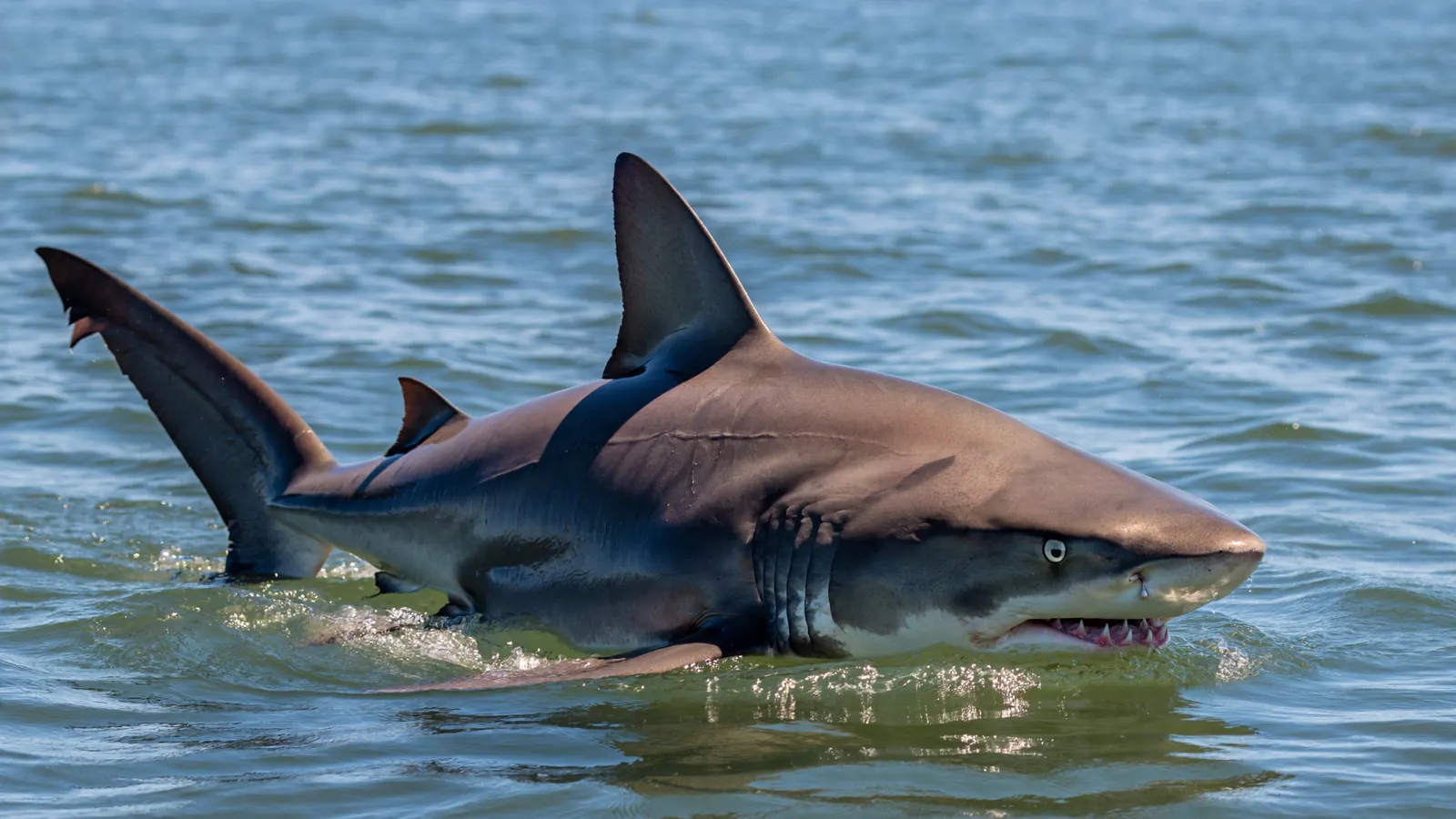
Bull sharks are heavy-bodied for their length, with a short rounded snout, small eyes, and the characteristic carcharhinid lateral undulation when swimming.
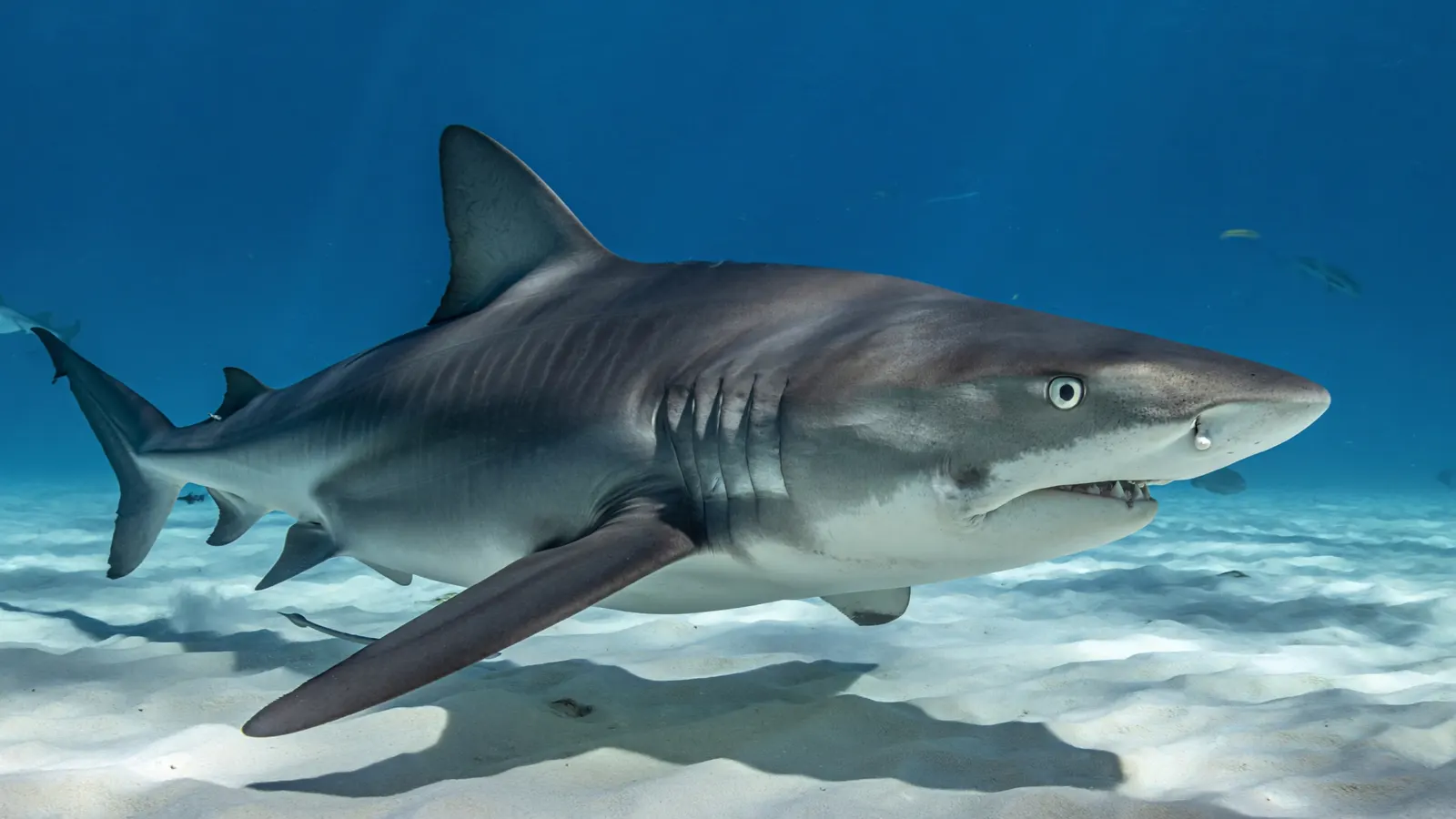
A mature bull shark is built like a barrel with fins. The species reaches a typical adult length of 2–3.5 m, with exceptional individuals at 4 m and around 320 kg. The body is grey or olive-grey above and white below; juveniles often show black-tipped fins that fade with age. Diagnostic features against similar carcharhinids: short blunt snout (about as wide as long), small eyes (smaller than most coastal sharks of the same size), and a first dorsal fin that originates over the pelvic-fin base.
Females are typically larger than males of the same age, and the largest reliably measured individual was a 4.0-m, 318-kg female caught off the Florida coast in 1986. Recent acoustic-tagging work in the Florida Keys has identified individuals exceeding 3.5 m as resident around specific reef tracts for years at a time.
Range — the only large shark in fresh water
Bull sharks are unique among large sharks in their ability to enter, hunt in, and reproduce in fresh water. The trait depends on a specialised osmoregulatory system that recycles urea and adjusts kidney function as ambient salinity changes.
In marine waters, bull sharks occur worldwide in tropical and subtropical coastal seas. The freshwater records are what make the species exceptional. They have been documented:
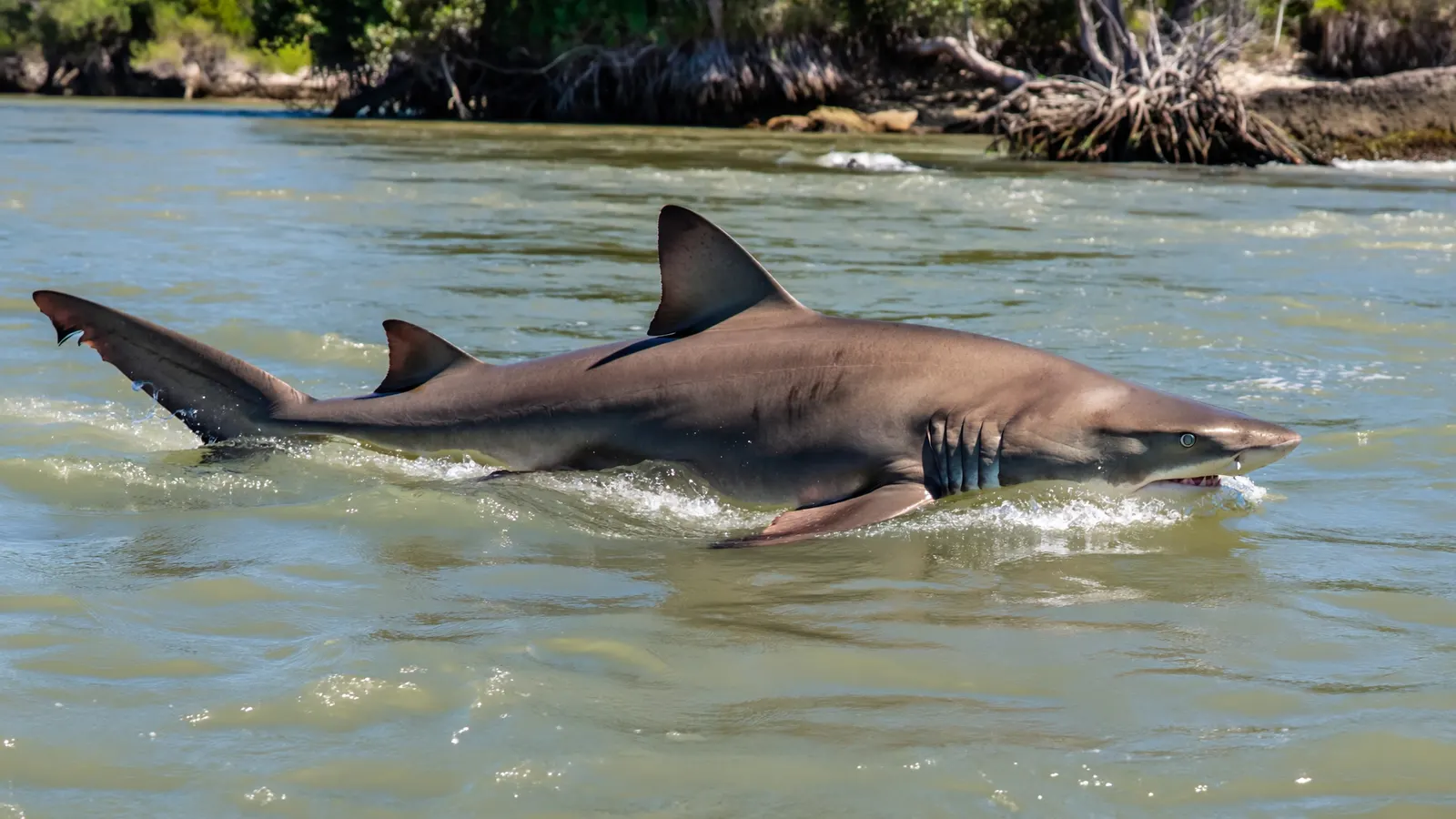
4,000 km up the Amazon at Iquitos, Peru. 3,700 km up the Mississippi at Alton, Illinois (1937). In Lake Nicaragua, where individuals were once thought to be a separate species (the "Lake Nicaragua shark") before tagging proved they were bull sharks travelling between the lake and the Caribbean via the San Juan River. In the Zambezi and Limpopo rivers in southern Africa — the same species there is called the Zambezi shark. In the Brisbane River after the 2011 floods, where multiple individuals appeared in suburban streets and golf course lakes.
The osmoregulatory machinery that makes this possible — specialised rectal glands, kidneys, and rectal-gland regulation by hormones — was first described by Thorson, Cowan, and Watson (1973) and has been studied extensively since. The system is not free: bull sharks in fresh water have higher metabolic costs than in marine water, which is why no large population stays in fresh water permanently.
Diet — opportunistic and almost completely carnivorous
Bull sharks eat almost anything they can catch in their habitat. The diet skews toward bony fish but includes other sharks, dolphins, sea turtles, sea birds, and on documented occasions, terrestrial mammals that entered the water.
Stomach contents from sampled bull sharks have included sardines, mullet, snapper, tarpon, smaller carcharhinid sharks (including conspecifics), dolphins, sea turtles, cormorants and other seabirds, crabs, octopus, and on multiple Australian and African occasions, livestock and dogs that entered the water. The species is one of the few sharks documented attacking and consuming hippos in African rivers, although the hippo is much more typically the predator in those interactions.
In freshwater systems the diet shifts toward catfish and other freshwater fish, with documented attacks on river otters and crocodilians. The bull shark's tolerance of murky water gives it a sensory edge over prey that rely on vision in those habitats.
Bite force — the strongest pound-for-pound bite of any large shark
Despite weighing about a third as much as a great white, the bull shark has been measured biting at 1,250 PSI — the highest weight-adjusted bite force of any shark studied.
Habegger and colleagues (2012) measured anterior bite forces in bull sharks of various sizes and reported peak posterior values of 1,250 PSI in adult animals. That figure is lower in absolute terms than the great white or tiger shark, but those species are several times larger. Per kilogram of body mass, the bull shark bites harder than any other shark studied. The teeth are triangular and serrated, similar in shape to great white teeth though much smaller. Combined with the species' habit of striking and shaking, the bite is sufficient to remove large pieces of soft tissue in a single attack.
Attack record — consistently ranked among the most dangerous sharks
ISAF places the bull shark as the species responsible for the third-most unprovoked attacks. Many researchers consider it the most dangerous shark per encounter because of where it hunts.
ISAF records 121 unprovoked bull shark attacks, with about 21% fatal. The numbers are smaller than the great white's 354 or the tiger shark's 142, but the per-encounter risk is widely considered higher because of where bull sharks hunt: shallow, turbid, coastal water that overlaps heavily with swimming and surfing zones. Many shark attacks attributed to "unidentified species" in turbid water in Florida, Australia, and South Africa are likely bull shark attacks based on circumstances and bite morphology.
The 1916 Jersey Shore attacks — four fatalities in two weeks that became the source for Jaws — are now widely attributed to a bull shark rather than a great white, partly because the third and fourth attacks occurred in Matawan Creek, 24 km inland in fresh water. Bull sharks are the only shark capable of operating that far up an estuary.
Reproduction — the only viviparous large shark with confirmed freshwater breeding
Bull sharks are placentally viviparous: pups develop with a true placental connection to the mother. Some populations breed and pup in fresh water, the only large shark known to do so.
Females reach sexual maturity at ~8 years, males at 6. Gestation is 10–11 months, producing litters of 1–13 pups, each 56–81 cm long. Major nursery grounds include the Indian River Lagoon (Florida), the lower Brisbane River and Pumicestone Passage in Queensland, and the lower St. Lucia estuary in South Africa. In Lake Nicaragua, pupping has been documented in the lake itself — the only large-shark population known to complete its full life cycle in fresh water.
Where the bull shark sits among the major shark species
Comparing bull sharks against the major species at a glance.
The bull shark is smaller than its tiger and great white counterparts but bites harder per kilogram and operates in habitats those species avoid — murky, brackish, fresh. Its attack count is lower in absolute terms but is concentrated in shallow water where humans are most exposed.
| Species | Max length | Max weight | Bite force | Attacks (unprov.) | Lifespan |
|---|---|---|---|---|---|
| Great white shark | 6.0 m | 2,300 kg | ~4,000 PSI | 354 | 70 yrs |
| Tiger shark | 5.5 m | 900 kg | ~6,000 PSI | 142 | 27–50 yrs |
| Bull shark | 3.5 m | 320 kg | 1,250 PSI | 121 | 16 yrs |
| Oceanic whitetip | 4.0 m | 170 kg | n/a | 15 | 22 yrs |
| Shortfin mako | 4.0 m | 570 kg | n/a | 10 | 30 yrs |
| Great hammerhead | 6.1 m | 580 kg | n/a | 17 | 44 yrs |
| Whale shark | 12.0 m | 19,000 kg | n/a (filter) | 0 | 80–130 yrs |
Related on TheSea
How big does a bull shark get?
Adult bull sharks typically reach 2–3.5 m (7–11 ft). The largest reliably measured individual was a 4.0-m, 318-kg female caught off Florida in 1986. Females are consistently larger than males of the same age. Full size discussion.
Can bull sharks really live in fresh water?
Yes, and they're the only large shark that does. Bull sharks have a specialised osmoregulatory system that recycles urea and adjusts kidney function as ambient salinity changes. Documented records include 4,000 km up the Amazon, 3,700 km up the Mississippi to Alton, Illinois (1937), and a permanent breeding population in Lake Nicaragua. Full freshwater overview.
Are bull sharks the most dangerous shark?
Many researchers say yes — not because of the absolute number of attacks (great whites have more), but because of where bull sharks hunt. Murky shallow coastal water overlaps with swimming and surfing more than open ocean does, so per-encounter risk is higher. The 1916 Jersey Shore fatalities, the source of Jaws, are now thought to have been a bull shark.
What's the difference between a bull shark and a tiger shark?
Both are large coastal predators in tropical seas, but they barely overlap behaviourally. Tiger sharks reach 5.5 m, hunt in clear warm water, and have serrated turtle-cracking teeth. Bull sharks reach 4 m, prefer turbid shallow water, and tolerate fresh water. Detailed head-to-head comparison.
Where can I dive with bull sharks safely?
The most established sites are Bimini and Tiger Beach in the Bahamas, Beqa Lagoon in Fiji, and Playa del Carmen in Mexico (winter months). All operate as commercial baited dives with experienced guides and decades of incident-free operation. Bull sharks are predictable in those settings — unpredictable in shallow turbid water without operators present.
Blane Perun has been exploring Earth’s oceans and marine life for over 25 years. Founder of TheSea.Org in 1999, underwater photographer, coral aquaculture pioneer, and explorer of 80+ countries.
About Blane Perun → More on Sharks →