Vaquita Facts — The World’s Rarest Marine Mammal
The vaquita (Phocoena sinus) is the smallest porpoise and the smallest cetacean in the world, about 1.5 m long, with dark rings around its eyes and dark “lipstick” on its mouth. It lives only in the upper Gulf of California, Mexico. Drowning in illegal gillnets has cut its numbers to around ten animals, making it the most endangered marine mammal on Earth.
Most people have never seen a vaquita, and almost no one ever will. Even the scientists who have spent decades studying this porpoise see it only in brief glimpses from survey boats: a small triangular fin, a quick roll, then nothing. It was not formally described until 1958, it lives in one small corner of one sea, and in the space of a single human lifetime it has gone from several hundred animals to around ten. It is the clearest example I know of how a single fishing practice, in a single place, can push a mammal to the brink. Here are the facts about the vaquita: what it is, how it lives, why it is disappearing and what is being done.
Vaquita facts at a glance
The vaquita is a true porpoise, one of seven species in the family Phocoenidae. It is the smallest of them all, and the only one confined to a single small area of warm, shallow, murky water.
Its Spanish name means “little cow”, and local fishermen also called it the cochito, or “little pig”. Its scientific name, Phocoena sinus, means “porpoise of the gulf”. Kenneth Norris and William McFarland described the species in 1958 from skulls found on beaches; a complete specimen was not examined until years later, and good photographs of live animals did not appear until the 1980s and 1990s. Its closest relatives are thought to be Burmeister’s porpoise of South America and the spectacled porpoise, suggesting that an ancestor crossed the equator from the south during a cooler period long ago. For all seven porpoises side by side, see porpoise species.
What does a vaquita look like?
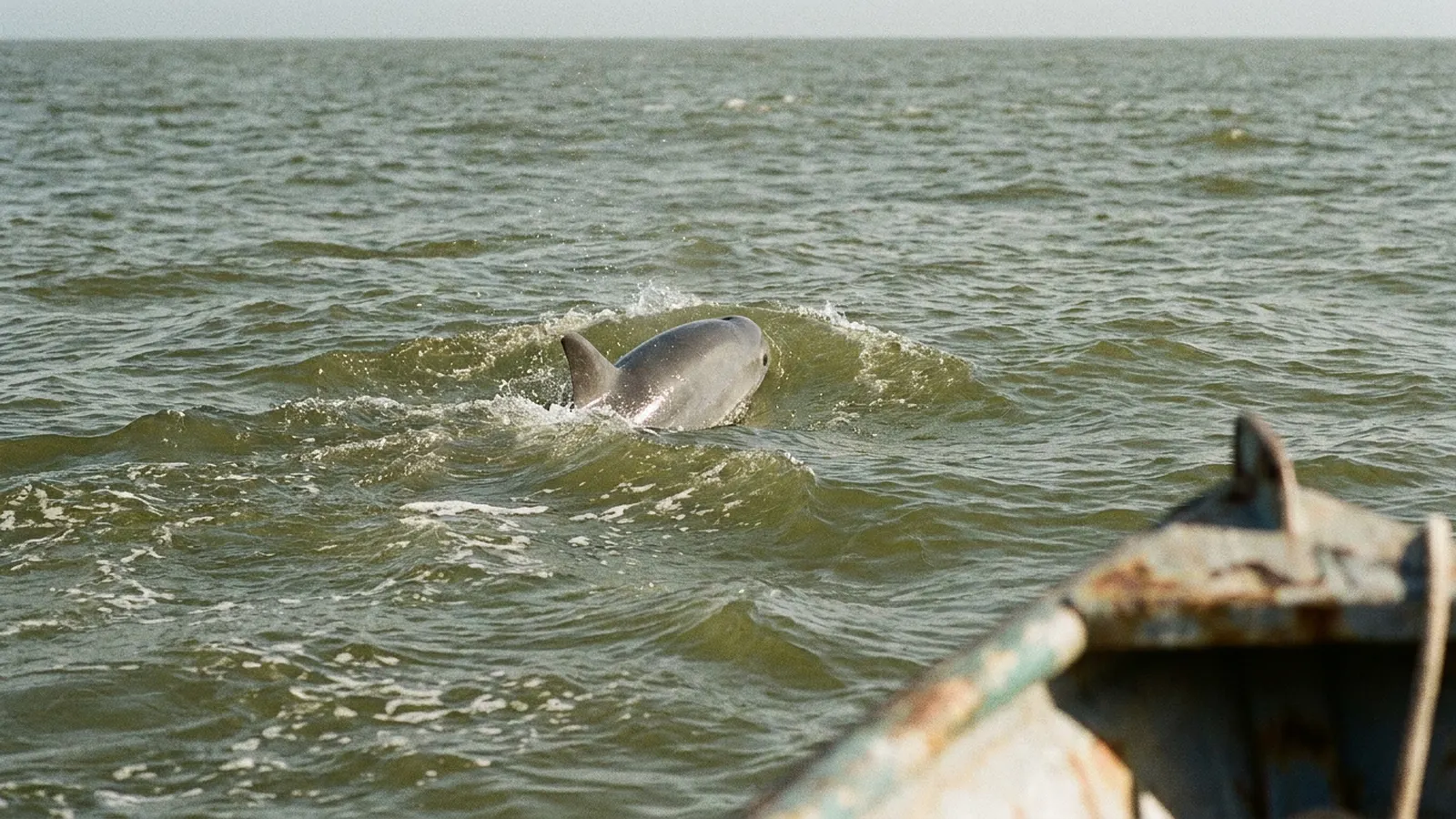
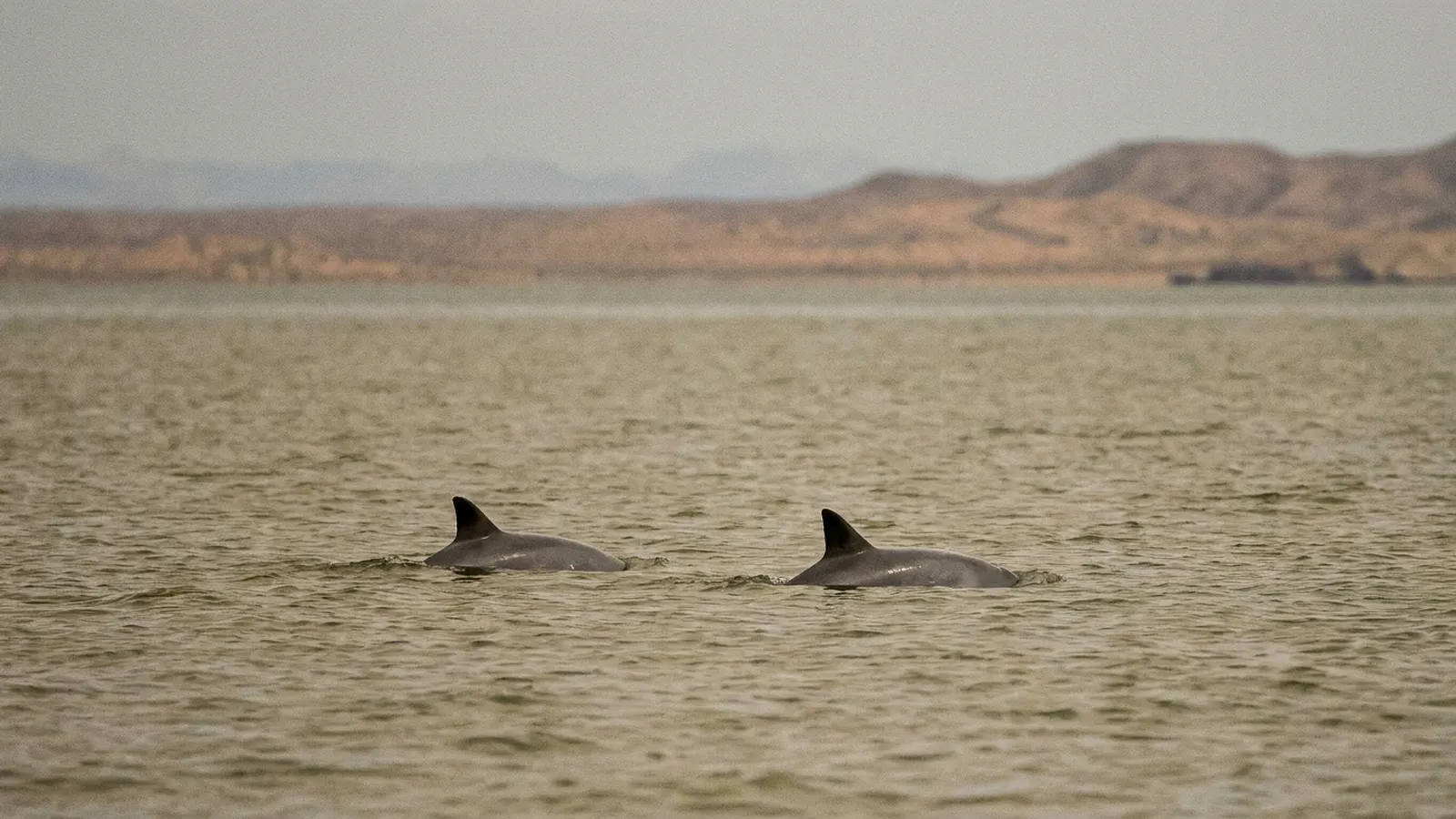
A vaquita is small and stocky, about 1.4 to 1.5 metres long, roughly the length of an adult human lying down, and weighs around 40 to 55 kg. Females are slightly larger than males, as in most porpoises. The back is dark grey, fading to pale grey on the sides and white on the belly. The face is the giveaway: a large dark ring around each eye and dark patches on the lips, which give it a made-up, almost cartoonish look. Its dorsal fin is tall and triangular for its body size, more so than in other porpoises, which may help it shed heat in the warm waters of the northern Gulf where summer temperatures run high. Like all porpoises, it has spade-shaped teeth rather than the cone-shaped teeth of dolphins; see dolphin vs porpoise.
| Feature | Vaquita | Harbour porpoise | Bottlenose dolphin |
|---|---|---|---|
| Length | ~1.5 m | ~1.5–1.9 m | ~2–4 m |
| Weight | ~40–55 kg | ~50–70 kg | ~150–650 kg |
| Face | Dark eye rings and lips | Plain, rounded | Distinct beak |
| Dorsal fin | Tall, triangular | Low, triangular | Curved, falcate |
| Range | Upper Gulf of California only | N Atlantic, N Pacific, Black Sea | Worldwide warm seas |
| Population | ~10 | Hundreds of thousands | Hundreds of thousands |
Where vaquitas live and what they eat
The vaquita has the smallest range of any marine mammal. It lives only in the northern end of the Gulf of California, also called the Sea of Cortez, near the mouth of the Colorado River, between the towns of San Felipe in Baja California and Puerto Peñasco in Sonora. In recent years the remaining animals have been found mainly in a small area of a few hundred square kilometres off San Felipe. The water there is shallow, mostly under 50 metres, warm and turbid with sediment, and the tides are among the largest in the region.
Vaquitas feed near the bottom on small fish such as croakers and grunts, plus squid. They are shy, avoid boats and surface quietly, usually alone or in pairs or small groups. Like other porpoises, they use high-frequency echolocation clicks to find prey in murky water, and those clicks are how scientists now track them: underwater acoustic detectors moored across their range record vaquita clicks and give a measure of how many remain.
Vaquita life history
Much of what we know about vaquita biology comes from animals that died in nets, because live vaquitas are so hard to study. Females appear to reach maturity at around three to six years old, carry a single calf for roughly ten to eleven months, and give birth in spring, mostly in March and April. Calves are thought to nurse for several months. Many porpoises breed every year or every other year, and recent survey sightings of females with calves in consecutive years suggest some vaquitas may breed annually. The oldest vaquitas aged from tooth layers were around 20 years old. With such a slow, small population, every adult female drowned in a net is a serious loss, and that arithmetic is why scientists say even a handful of deaths a year is too many.
Why the vaquita is disappearing
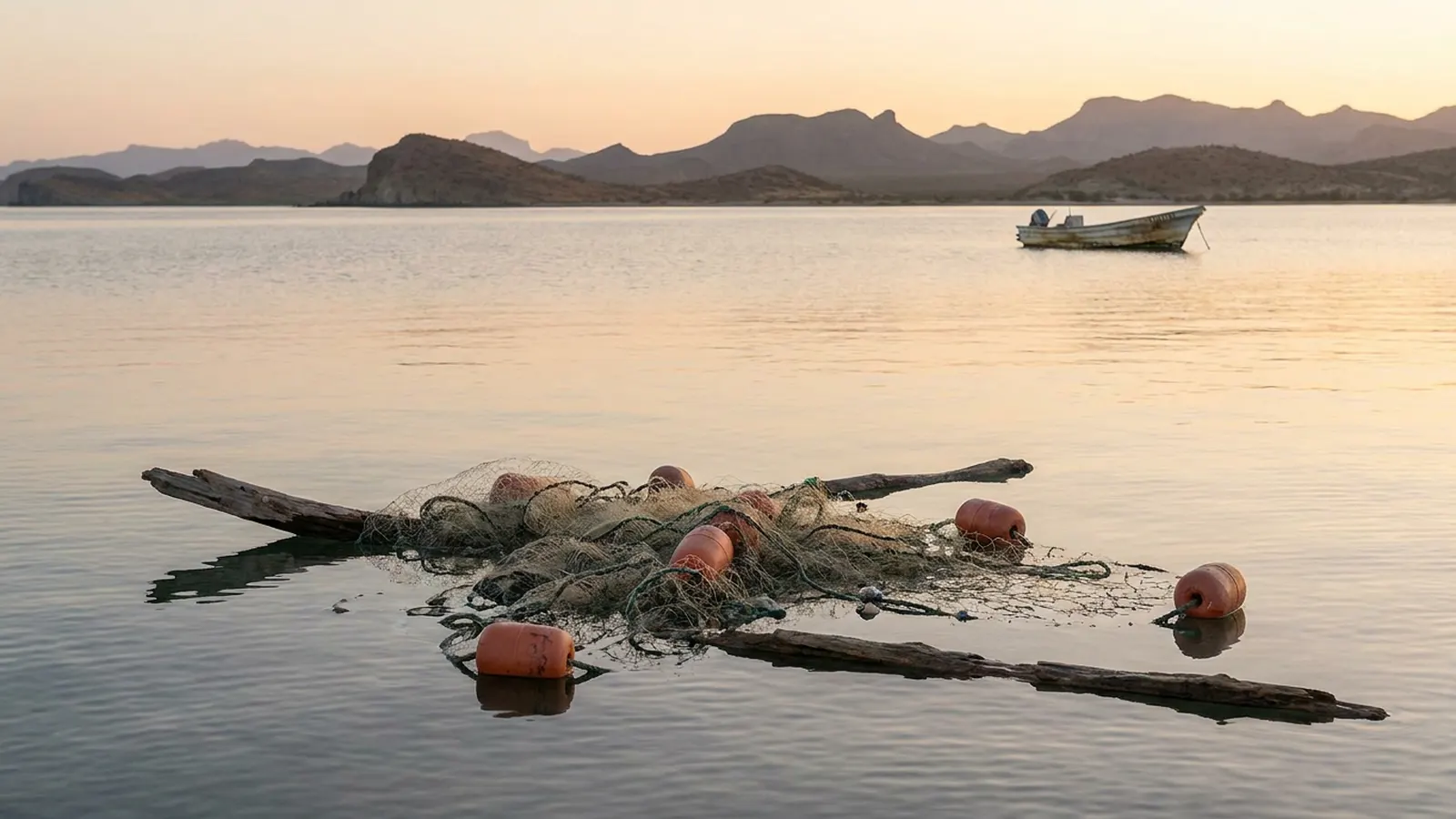
The vaquita has one overwhelming threat: drowning in gillnets. Gillnets are walls of fine mesh set across the water, and porpoises cannot detect them well enough to avoid them. Vaquitas swim in, get tangled and suffocate. For decades this happened as bycatch in legal shrimp and finfish gillnet fisheries in the upper Gulf.
From about 2011 onward the problem exploded because of the totoaba, a large fish that also lives only in the Gulf of California. The totoaba’s swim bladder is highly prized in parts of China, where dried bladders sell for very high prices on the black market. Totoaba fishing is illegal in Mexico and international trade is banned under CITES, but organised crime networks drove a surge of illegal gillnetting for totoaba, with nets of a mesh size that also kills vaquitas. The vaquita population, already in decline, went into free fall.
How many vaquitas are left?
Survey estimates trace the collapse. A large survey in 1997 estimated about 570 vaquitas. By 2008 the figure was around 250. Acoustic monitoring and visual surveys later showed a decline of roughly half every couple of years, and by 2016 there were thought to be about 30. Since then, the visual surveys organised with Mexico’s government and international scientists have counted only around ten or fewer animals in each recent year, sometimes including calves. Exact numbers vary from survey to survey, but every recent estimate is in single or low double digits.
There is a sliver of good news in those surveys. The animals that remain look healthy, they are still having calves, and a 2022 genetic study in Science led by Jacqueline Robinson concluded that the vaquita has naturally low genetic diversity but carries relatively few harmful mutations, so inbreeding is unlikely to doom it. In the scientists’ words, the species could still recover if gillnet deaths stop. The problem is not the animal; it is the nets.
What is being done to save it
Mexico has declared a vaquita refuge and, later, a Zero Tolerance Area off San Felipe where all fishing nets are banned, backed by navy patrols and net removal. Starting in 2022, concrete blocks fitted with hooks were sunk across the Zero Tolerance Area to snag any gillnet set there, making illegal netting costly and difficult. Conservation groups such as Sea Shepherd have spent years pulling ghost and illegal nets out of the area, and researchers and fishers have tested vaquita-safe fishing gear such as small trawls and traps for shrimp and finfish.
In 2017 an international team attempted a different approach, VaquitaCPR, to catch some vaquitas and hold them in a protected sea pen. It ended quickly: one young animal was released after showing signs of stress, and an adult female died after capture. Scientists concluded that vaquitas cannot be safely held, and the focus returned to protecting them in the wild. See the rarest sea animals for how the vaquita compares with other species on the edge.
Why the vaquita matters to me
I have spent most of my life around the ocean as a reef keeper since 1996 and as a diver on reefs from the Caribbean to the South Pacific, and I have watched plenty of reef species thin out over the years. The vaquita is different because the cause is so specific and the fix is so clear. It is not losing its habitat to warming water or dying from a mystery disease. It is drowning in nets set for another fish, to supply a black market thousands of miles away. Remove the nets and, according to the people who study it most closely, it can come back.
If I had one practical recommendation, it is to pay attention to where seafood from the upper Gulf of California comes from and support fisheries using vaquita-safe gear. The vaquita is also a reminder that the Marine Mammal Protection Act and similar laws only work when they are enforced on the water. For more on porpoises and their relatives, see our marine mammals section.
The vaquita’s closest living relative lives thousands of kilometres to the south: Burmeister’s porpoise of South America, which is also threatened by gillnet bycatch.
How many vaquitas are left in 2026?
Recent surveys have counted around ten or fewer, which makes the vaquita the world’s rarest marine mammal.
Where do vaquitas live?
Only in the northern Gulf of California, Mexico, mainly near San Felipe.
How big is a vaquita?
About 1.4–1.5 m long and 40–55 kg, the smallest of all whales, dolphins and porpoises.
Why are vaquitas endangered?
They drown in gillnets, especially illegal nets set for the totoaba fish, whose swim bladder is sold on the black market.
What does vaquita mean?
“Little cow” in Spanish.
Are there vaquitas in zoos or aquariums?
No. A 2017 attempt to hold vaquitas in a sea pen ended after one died, and none are kept in captivity.
Can the vaquita still be saved?
Scientists say yes, if gillnet deaths are stopped; the remaining animals are healthy and still breeding.
- IUCN Red List: Phocoena sinus assessment.
- NOAA Fisheries: Vaquita species page and survey reports.
- Robinson, J.A. et al. (2022). The critically endangered vaquita is not doomed to extinction by inbreeding depression. Science 376: 635–639.
- Norris, K.S. & McFarland, W.N. (1958). A new harbor porpoise of the genus Phocoena from the Gulf of California. Journal of Mammalogy 39(1): 22–39.
- Rojas-Bracho, L. et al. (2019). A field effort to capture critically endangered vaquitas for protection from entanglement in illegal gillnets. Endangered Species Research 38: 11–27.
Blane Perun has been exploring Earth’s oceans and marine life for over 25 years. Founder of TheSea.Org in 1999, underwater photographer, coral aquaculture pioneer, and explorer of 80+ countries.
About Blane Perun → More on porpoises →