Sea Butterfly — The Swimming Snail Whose Shell Is Dissolving in an Acidifying Ocean
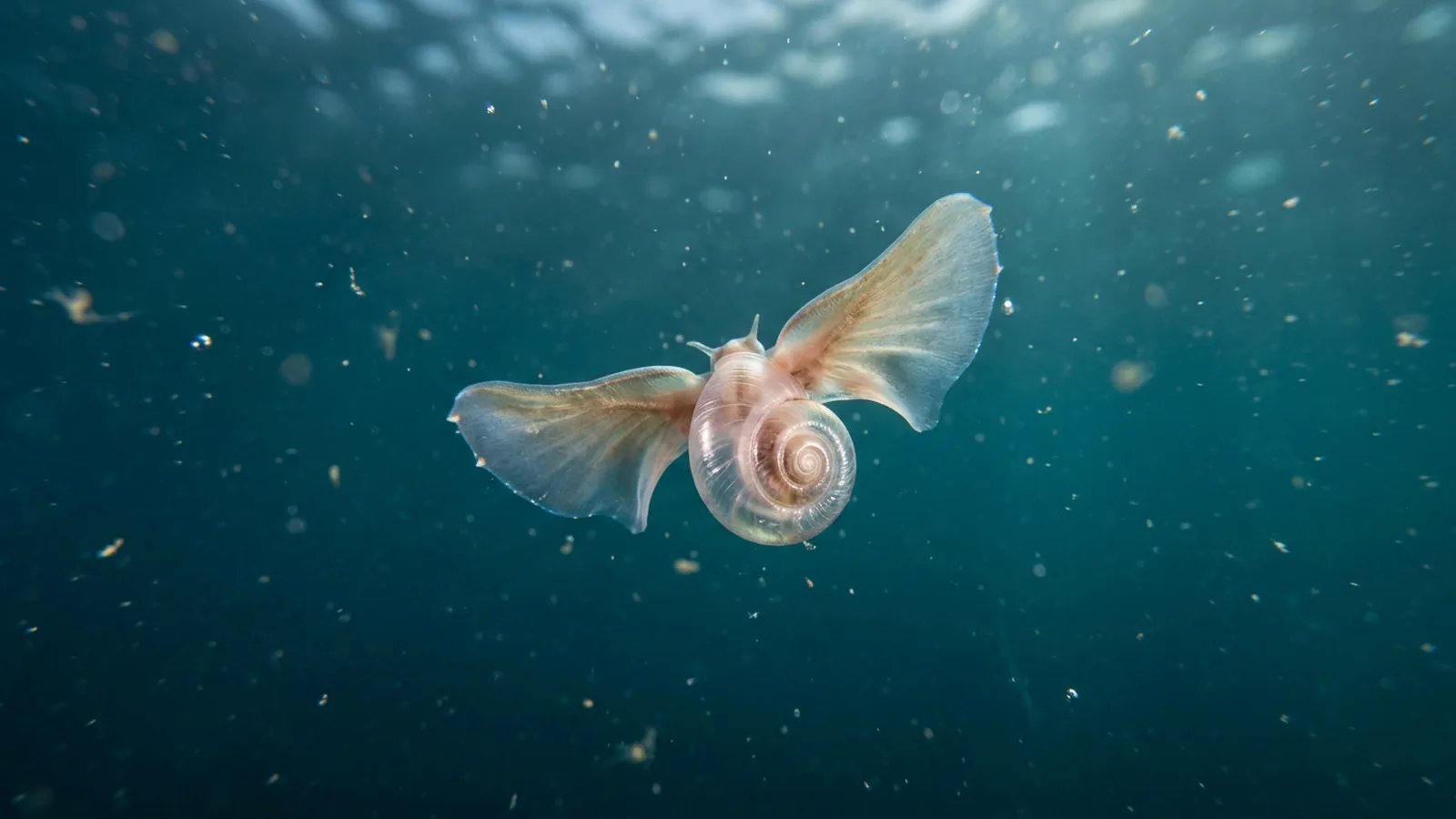
A sea butterfly is a tiny swimming sea snail, a shelled pteropod, that “flies” through open water by flapping two wing-like flaps evolved from its foot. Most are smaller than 1 cm. Species such as Limacina helicina live in huge numbers in polar and temperate seas, feed by casting sticky mucus nets to trap plankton, and are a key food for fish such as pink salmon, mackerel and herring. Because their thin shells are made of aragonite, a fragile form of calcium carbonate, sea butterflies are one of the first animals visibly damaged by ocean acidification.
If you could shrink yourself to the size of a sesame seed and swim through Arctic plankton, some of the most common animals around you would be snails — snails flapping past like moths. Sea butterflies are among the most abundant animals in polar oceans, quietly sitting at the base of the food web that feeds salmon and whales. They are also, in the words many oceanographers use, the canary in the coal mine for a changing ocean.
Is a sea butterfly a snail?
Yes. A sea butterfly is a marine snail that has given up crawling. Its foot has evolved into two flapping wings called parapodia, and it swims through open water all its life.
Pteropods (“wing-feet”) are gastropods, the same group as whelks, periwinkles and garden snails. The wings are the same body part a whelk uses to crawl over rock. Sea butterflies keep a shell, usually a tiny coiled or cone-shaped one, and swim by beating their parapodia in a figure-of-eight stroke that biomechanics researchers have compared to the way insects fly — so the butterfly name is closer to the truth than it sounds.
Their naked relatives, the sea angels, lost the shell entirely. The two groups are linked in a predator-prey relationship: the sea angel (Clione limacina) feeds almost exclusively on sea butterflies, using hooked tentacles to pull the snail out of its shell. Hundreds of pteropod species are known; Georges Cuvier described the group in 1804.
Shell shapes vary a lot. Limacina species carry a tiny coiled shell, like a miniature garden snail turned on its side. Others, such as Clio and Creseis, have straight needle- or cone-shaped shells, and Cavolinia has a rounded, almost bulbous shell with spines. Some shell-bearing pteropods are so delicate and translucent that the shell looks like glass; empty shells sinking to the seafloor build up as “pteropod ooze” in some parts of the deep ocean.
How do sea butterflies eat?
Sea butterflies feed by releasing a large web of sticky mucus that traps phytoplankton, small zooplankton and drifting particles. They then reel in the net and eat it, food and all.
The mucus web can be many times the size of the animal. A sea butterfly hangs motionless below it, letting particles settle on the sticky surface, then folds the web into a food packet and moves it to its mouth. Filming this has been difficult because the slightest disturbance makes the snail drop its net and swim off, which is why the behaviour was only properly documented in the late 20th century.
Many sea butterflies also join the daily vertical migration of plankton: they rise toward the surface at night to feed and sink deeper by day to avoid predators. Some species live permanently in the twilight zone below 200 metres. Their sinking mucus nets, faecal pellets and shells carry carbon from the surface toward the deep sea, making pteropods part of the ocean’s carbon pump.
Why are sea butterflies important?
Sea butterflies are a major food source in cold seas. They are eaten by pink salmon, mackerel, herring, cod, seabirds and baleen whales, and they help move carbon from the surface to the deep ocean.
In the North Pacific, the Southern Ocean and the Arctic, Limacina pteropods can occur in densities of hundreds to thousands per cubic metre. They are a high-energy food: small, abundant and packaged in a shell that is easy to crunch. Juvenile salmon, especially pink salmon, rely on them heavily in some years, along with krill and other planktonic crustaceans.
That role makes sea butterflies an early-warning system for the food web. Anything that reduces pteropod numbers ripples up to the fish and whales that depend on them.
How does ocean acidification affect sea butterflies?
As seawater absorbs carbon dioxide it becomes more acidic and less saturated with aragonite, the mineral sea butterflies use to build their shells. In corrosive water their shells become pitted, thin and fragile, and can dissolve.
The ocean has absorbed roughly a third of the carbon dioxide released by humans. When CO₂ dissolves in seawater it lowers pH and reduces the carbonate ions shell-builders need. Aragonite is more soluble than calcite, the form used by many other animals, so pteropods feel the change early. Where water becomes undersaturated with respect to aragonite, unprotected shell starts to dissolve.
This is not just a laboratory prediction. A 2011 NOAA survey of the California Current, analysed by Nina Bednaršek and colleagues in a 2014 Proceedings of the Royal Society B paper, found that on average 53 percent of nearshore pteropods and 24 percent of offshore pteropods had severe shell dissolution. Undersaturated water in the top 100 metres of that ecosystem had grown more than sixfold since pre-industrial times; severe dissolution in nearshore habitats had roughly doubled and was projected to triple by 2050. Seasonal upwelling that brings old, CO₂-rich deep water to the surface makes the US West Coast an early hotspot.
| Finding (California Current) | Value |
|---|---|
| Nearshore pteropods with severe dissolution | 53% |
| Offshore pteropods with severe dissolution | 24% |
| Growth of undersaturated water (top 100 m) since pre-industrial | More than 6× |
| Projected severe dissolution by 2050 | Triple pre-industrial levels |
The same chemistry threatens corals and other calcifiers. See our pieces on ocean acidification and coral reefs and how carbon dioxide affects sea urchins.
Where do sea butterflies live?
Sea butterflies live in every ocean, from the tropics to the poles. They are most diverse in warm waters, but individual species such as Limacina helicina are most abundant in cold Arctic, sub-Arctic and Southern Ocean waters.
Tropical seas host many species in small numbers; polar seas host a few species in vast numbers. Limacina helicina dominates the Arctic and North Pacific, while the closely related Limacina antarctica (sometimes treated as a form of L. helicina) is common in the Southern Ocean. Cold water holds more CO₂ and is naturally closer to aragonite undersaturation, which is why polar sea butterflies are expected to feel acidification first.
Divers rarely notice them. At a few millimetres long and nearly transparent, sea butterflies are best seen in a jar of plankton or under a light on a night dive in cold water, where they flicker past like snowflakes.
How do sea butterflies reproduce?
Most sea butterflies are protandric hermaphrodites: they mature first as males and later become females. They release eggs into the water or in floating egg masses.
Limacina helicina generally lives about a year, sometimes a little longer, and in polar seas its breeding is timed to spring and summer plankton blooms. Juveniles overwinter, building their shells through the darkest and most corrosive months of the year — one reason scientists worry about the young stages most.For more tiny drifters that hold up the ocean food web, see ostracods, krill and copepods. For more sea slugs and snails with strange lifestyles, read about the blue glaucus, leaf sheep and sea bunny.
What is a sea butterfly?
A sea butterfly is a tiny swimming sea snail, a shelled pteropod, that flaps two wing-like flaps evolved from its foot. Most are under 1 cm long.
Is a sea butterfly a real butterfly?
No. Sea butterflies are marine snails (gastropods). The name comes from their flapping, wing-like parapodia, which work in a way similar to insect wings.
What is the difference between a sea butterfly and a sea angel?
Sea butterflies (Thecosomata) have shells and eat plankton with mucus nets. Sea angels (Gymnosomata) are shell-less predators that feed mainly on sea butterflies.
What do sea butterflies eat?
Phytoplankton, small zooplankton and organic particles, trapped in a sticky mucus web that the snail then eats.
Why are sea butterflies dissolving?
Ocean acidification. As seawater absorbs CO2 it becomes corrosive to aragonite, the mineral in their shells. A 2014 study found severe shell dissolution in 53% of nearshore pteropods off the US West Coast.
What eats sea butterflies?
Pink salmon, mackerel, herring, cod, seabirds, baleen whales and sea angels.
How big is a sea butterfly?
Usually under 1 cm. Common species are roughly 3 to 12 mm, about the size of a lentil or pea.
Where do sea butterflies live?
In all oceans. They are most diverse in the tropics, but species such as Limacina helicina are most abundant in the Arctic, North Pacific and Southern Ocean.
Why are sea butterflies called the canary in the coal mine?
Because their thin aragonite shells react quickly to changes in ocean chemistry, they show the effects of acidification earlier than most animals.
Blane Perun has been exploring Earth’s oceans and marine life for over 25 years. Founder of TheSea.Org in 1999, underwater photographer, coral aquaculture pioneer, and explorer of 80+ countries.
About Blane Perun → More on Bizarre Sea Creatures →