Jellyfish Sting Treatment — Vinegar, Hot Water and When to Get Help
For most jellyfish stings: get out of the water, remove clinging tentacles without rubbing, rinse with vinegar if you are in box jellyfish waters, then soak the sting in hot water at about 45 degrees Celsius (113 Fahrenheit) for 20 minutes or more. A randomised trial found hot water relieved bluebottle sting pain far better than ice, and lab studies show vinegar stops undischarged stinging cells of box jellyfish and man o’ war from firing. Do not use urine, alcohol, fresh water or ice. Call emergency services for difficulty breathing, chest pain, a sting to the face or a large area, signs of allergy, or any box jellyfish or Irukandji sting.
Rinse, vinegar where advised, hot water for 20 minutes, and emergency help for severe symptoms; skip the urine and the ice.
How do you treat a jellyfish sting?
Most jellyfish stings cause sharp, burning pain, red welts or lines on the skin, and itching that fades over hours to days. They are unpleasant but not dangerous. A few species, especially tropical box jellyfish, can cause severe or even fatal stings, and anyone can have an allergic reaction. First aid aims to stop more venom being injected, relieve pain and spot the rare emergency early.
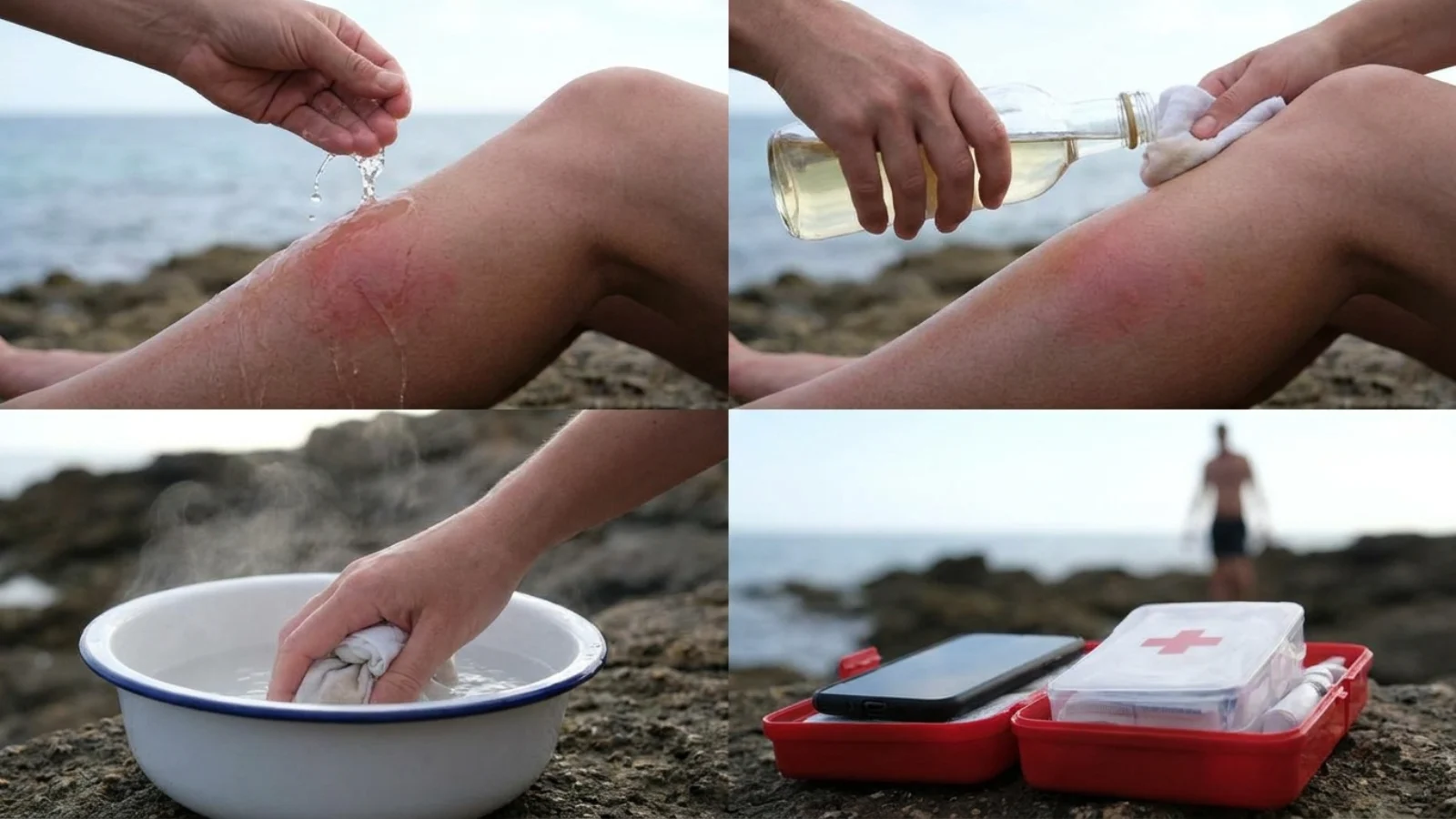
The steps that are best supported by research are these. Get out of the water calmly, so you do not get stung again or get into difficulty swimming. Remove any tentacles still stuck to the skin, using tweezers or a gloved hand rather than bare fingers, and do not rub the area. If you are in a place with box jellyfish, or the sting may be from a man o’ war, rinse the area generously with vinegar. Then immerse the stung area in hot water, as hot as can be tolerated without scalding, around 45 degrees Celsius (113 Fahrenheit), for at least 20 minutes, or use a hot shower or hot pack. Pain relievers can help afterwards.
The advice varies by species and by country, and the evidence behind every treatment is limited. But the overall direction of recent research is clear: heat helps, vinegar helps for some of the most dangerous species, and many popular remedies make things worse.
How a jellyfish sting works
To understand the advice, it helps to know what is happening in the skin. A jellyfish’s tentacles are covered in stinging cells called cnidocytes, each containing a capsule called a nematocyst with a coiled, hollow thread inside. Each cell has a hair-like trigger, the cnidocil, which responds to touch and to chemicals. When it is triggered, calcium stored in the capsule is released, water rushes in, and the pressure fires the thread out like a harpoon into whatever touched it, injecting venom.
It is one of the fastest movements in nature. The discharge takes a few microseconds and reaches accelerations of about 40,000 g, and a 2006 study suggested it can happen in as little as 700 nanoseconds, with accelerations of up to 5,410,000 g. The pressure at the tip of the thread has been estimated at more than 7 gigapascals, comparable to a bullet.
The key point for first aid is that most of the stinging cells on a tentacle do not fire during the sting. In a 2017 study of Portuguese man o’ war, Christie Wilcox, Angel Yanagihara and colleagues found that only a small percentage, 1 percent or less, of tentacle stinging cells discharged during a sting. The rest remain loaded. Anything that triggers them, rubbing, fresh water, the wrong chemical, can inject far more venom than the original contact. Anything that disables them, or breaks down the venom already in the skin, can help.
Step 1: Get out and stay calm
Leave the water as soon as you are stung, and help anyone else who has been stung to do the same. Some stings, particularly from box jellyfish and the man o’ war, cause such intense pain that swimmers can panic or struggle, so getting to shore matters more than anything else. On patrolled beaches, tell a lifeguard; many beaches in jellyfish areas have first-aid kits and, in Australia, jugs of vinegar placed along swimming beaches for this purpose.
Step 2: Deal with the tentacles
Tentacles often stick to the skin and keep stinging. Remove them carefully with tweezers, a gloved hand or a stick, without rubbing the skin. Do not use a towel to wipe them off, and do not rub sand into the area.
Older advice often said to scrape tentacles off with a credit card or razor, sometimes after coating them with shaving cream or a sand-and-seawater slurry, and to rinse the area with seawater because fresh water fires the stinging cells. Newer lab work has questioned this. In a 2017 study in the journal Toxins, Yanagihara and Wilcox tested first aid on the Hawaiian box jellyfish Alatina alata and the Australian box jellyfish Chironex fleckeri and found that seawater rinsing, previously thought to be a harmless alternative, significantly increased the amount of venom delivered, and their results did not support scraping or seawater rinsing to remove tentacles. Increases in venom did not happen when tentacles were first doused with vinegar or treated with heat.
Seawater is still widely recommended because it is always available on the beach. A 2025 systematic review for the International Liaison Committee on Resuscitation (ILCOR) concluded that the evidence on jellyfish first aid is of very low quality and suggested seawater given its availability at no cost on the coast. If you have nothing else, rinsing gently with seawater is better than fresh water, and much better than rubbing. If vinegar is available in box jellyfish waters, use it first.
Step 3: Vinegar, for the right jellyfish
Vinegar is the most debated jellyfish treatment. Household vinegar is a solution of about 3 to 10 percent acetic acid, and it works by stopping undischarged stinging cells from firing. It does not neutralise venom already injected, and it does not relieve pain by itself.
For box jellyfish, vinegar is standard first aid. Flushing with vinegar is used to deactivate undischarged nematocysts on tentacles stuck to the skin, preventing further venom release, and vinegar is provided on Australian beaches and in other places with venomous box jellyfish. A 2014 study reported that vinegar increased venom release from already-discharged stinging cells, but that study has been criticised on methodological grounds.
For the Portuguese man o’ war and bluebottles, advice has changed. Most recommendations used to advise against vinegar. A 2012 systematic review of jellyfish treatment in North America and Hawaii, by Ward and colleagues in the Annals of Emergency Medicine, found 19 relevant studies and concluded that vinegar causes pain or nematocyst discharge in the majority of species studied, but that if the sting is from a bluebottle, vinegar may be beneficial. The 2017 man o’ war study by Wilcox and colleagues then tested rinse solutions on both Atlantic and Pacific species. Commercial vinegars, and a newly developed commercial spray, were the most effective rinses, irreversibly preventing the stinging cells from firing. Even slight dilution of vinegar reduced its protective effect.
For milder jellyfish such as sea nettles and moon jellies, the picture is mixed: the 2012 North American review found that vinegar worsened pain or triggered stinging cells in most of the species studied. If you do not know what stung you and you are not in box jellyfish waters, hot water is the more widely supported treatment.
Step 4: Hot water, not ice
Heat has the strongest evidence of any jellyfish sting treatment. Jellyfish venoms are sensitive to heat at temperatures safe for human skin, which supports soaking the stung area in hot water.
The best-known trial was carried out by Loten and colleagues on two beaches in eastern Australia between December 2003 and March 2005 and published in the Medical Journal of Australia in 2006. They randomly assigned 96 people stung by bluebottles to hot water immersion at 45 degrees Celsius or to ice packs. After 10 minutes, 53 percent of the hot water group reported less pain, compared with 32 percent of the ice group. After 20 minutes, the figures were 87 percent and 33 percent. The trial was stopped early because hot water was clearly effective. Radiating pain also occurred less often with hot water, 10 percent versus 30 percent. The authors concluded that immersion in water at 45 degrees Celsius for 20 minutes is an effective and practical treatment.
A 2016 systematic review by Wilcox and Yanagihara reached the same conclusion: most studies support hot water immersion for pain relief and better outcomes, even though ice packs are often recommended by emergency personnel. Their 2017 box jellyfish study found that applying ice severely worsened Alatina alata stings in the lab, while heat markedly reduced the damage caused by both species tested. A 2017 study of man o’ war first aid recommended vinegar rinsing followed by heat at 45 degrees Celsius.
Use water as hot as the person can comfortably tolerate without burning, and test it on unaffected skin first, especially for children. Keep the sting immersed for at least 20 minutes, or longer if pain returns when it is removed. If hot water is not available, a hot pack or a hot shower is a reasonable alternative.
What the best reviews say about the evidence
It is worth being honest about how weak the evidence base is. A 2023 Cochrane review of treatments for jellyfish stings found only nine studies, six randomised and three quasi-randomised, involving 574 participants. It rated the certainty of evidence for every outcome as very low, because of serious risk of bias, imprecision and inconsistency. In trials of accidental stings from bluebottles and from box jellyfish that do not cause Irukandji syndrome, the review was unsure whether heat or cold gave better pain relief, although the bluebottle results pointed towards heat.
The 2025 ILCOR review, which found seven randomised or quasi-randomised trials and three other studies, listed seawater, heat therapy, cold packs, lidocaine, benzocaine, meat tenderiser, vinegar, commercial sting products and sodium bicarbonate among treatments that may relieve symptoms, but again judged the evidence to be very low quality. In other words, no treatment has been proven beyond doubt, and recommendations rest on a mix of small trials, lab studies and experience. Hot water and, for dangerous box jellyfish, vinegar are the options with the most consistent support.
What not to put on a jellyfish sting
Several popular remedies have no evidence behind them and may make stings worse. According to a review of box jellyfish first aid, there is no scientific evidence that urine, ammonia, meat tenderiser, sodium bicarbonate, boric acid, lemon juice, fresh water, steroid cream, alcohol, cold packs, papaya or hydrogen peroxide will stop further stinging, and some of these may cause harm. The 2017 man o’ war study found that alcohols and folk remedies such as urine, baking soda and shaving cream caused varying amounts of immediate stinging-cell discharge and failed to prevent further discharge, so they likely worsen stings.
Urine is the most famous myth, thanks partly to a 1997 episode of the sitcom Friends. It does not work and may make things worse; for the full story, see does pee help a jellyfish sting? Fresh water, including bottled water and tap water, can trigger stinging cells because of the change in salt concentration. Rubbing with a towel or sand also fires them mechanically.
Treatment by type of jellyfish
Box jellyfish (Chironex and relatives). These are the most dangerous jellyfish in the world. Chironex fleckeri has caused at least 79 deaths since the first report in 1883, mostly in northern Australia, although even in this species most encounters result only in mild envenoming; most recent Australian deaths have been in children. Call emergency services immediately, flood the sting with vinegar, keep the person still, and be ready to start CPR if they stop breathing. For more, see box jellyfish.
Irukandji jellyfish. These tiny box jellyfish cause Irukandji syndrome, which can include severe abdominal, back and chest pain, a racing heart, high blood pressure and, rarely, death. At least two deaths in Australia have been attributed to them. Out of 62 people treated for Irukandji envenomation in Australia in 1996, almost half could go home with few or no symptoms after six hours, and only two remained in hospital about a day later. Treat with vinegar and seek urgent medical care. See Irukandji jellyfish.
Portuguese man o’ war and bluebottles. These are siphonophores rather than true jellyfish, but they sting in the same way. Remove tentacles, consider vinegar based on the newer research, then use hot water at 45 degrees Celsius for at least 20 minutes. For more, see man-of-war sting.
Sea nettles, moon jellies and other mild stingers. Stings are usually painful but limited. Rinse gently, remove any tentacles, and use hot water for pain. Over-the-counter pain relievers and soothing creams can help with lingering itching.
When to get medical help
Call emergency services or go to the nearest emergency department if the person has difficulty breathing, chest pain, a racing or irregular heartbeat, severe abdominal or back pain, confusion, collapse or swelling of the face, lips or throat. Stings may cause anaphylaxis, a severe allergic reaction that can be fatal. Get medical advice for any sting to the eyes, mouth or face, stings over a large part of the body, stings in young children or older adults, and any suspected box jellyfish or Irukandji sting.
Watch the sting over the following days. Most stings settle on their own, but delayed skin reactions can appear days or weeks later and are easily mistaken for insect bites or eczema. A 2026 case report described a delayed papular rash appearing ten days after a jellyfish sting. A rash that returns, spreads or becomes infected should be checked by a doctor.
Preventing jellyfish stings
The easiest treatment is not to be stung. Pay attention to local warnings and lifeguard flags, avoid swimming when jellyfish are reported or when bluebottles are washing ashore, and do not handle jellyfish or loose tentacles on the beach. In places with dangerous box jellyfish, such as tropical Australia, swim inside stinger nets where they are provided; nets are one of the preventive measures used on Australian beaches.
So, what is the best jellyfish sting treatment?
For most stings, get out of the water, remove tentacles without rubbing, and soak the area in hot water at about 45 degrees Celsius for at least 20 minutes, which a randomised trial found relieved pain for 87 percent of bluebottle sting victims, compared with 33 percent for ice. In box jellyfish areas, and possibly for man o’ war stings, rinse with undiluted vinegar first to stop more stinging cells from firing. Skip urine, alcohol, fresh water, ice and rubbing. Call for emergency help for breathing problems, chest pain, collapse, severe pain, signs of allergy, or any box jellyfish or Irukandji sting. To learn which jellyfish you might meet, see our jellyfish hub.
What is the best treatment for a jellyfish sting?
Remove tentacles, use vinegar for box jellyfish, then hot water at about 45 C for 20 minutes or more.
Does vinegar help a jellyfish sting?
For box jellyfish, yes, and lab work supports it for man o’ war; it can worsen some milder stings.
Should you put ice on a jellyfish sting?
Hot water works better; in one trial 87% improved with hot water vs 33% with ice.
How hot should the water be for a jellyfish sting?
About 45 C (113 F), as hot as tolerated without burning, for at least 20 minutes.
Does peeing on a jellyfish sting help?
No. Urine can trigger stinging cells and make things worse.
How long does a jellyfish sting last?
Pain usually fades in hours; marks can last days, and delayed rashes can appear later.
When should you go to the hospital for a jellyfish sting?
For breathing trouble, chest pain, collapse, allergy signs, face or eye stings, or box jellyfish stings.
Should you rinse a jellyfish sting with fresh water?
No. Fresh water can make stinging cells fire; use vinegar where advised, or seawater.
- Loten, C. et al. (2006), “A randomised controlled trial of hot water (45 C) immersion versus ice packs for pain relief in bluebottle stings”, Medical Journal of Australia.
- Wilcox, C.L. & Yanagihara, A.A. (2016), “Heated debates: hot-water immersion or ice packs as first aid for cnidarian envenomations?”, Toxins 8: 97; Yanagihara, A.A. & Wilcox, C.L. (2017), “Cubozoan sting-site seawater rinse, scraping, and ice can increase venom load”, Toxins 9: 105.
- Wilcox, C.L., Headlam, J.L., Doyle, T.K. & Yanagihara, A.A. (2017), “Assessing the efficacy of first-aid measures in Physalia sp. envenomation”, Toxins 9: 149.
- Ward, N.T. et al. (2012), “Evidence-based treatment of jellyfish stings in North America and Hawaii”, Annals of Emergency Medicine; McGee, R.G. et al. (2023), “Interventions for the symptoms and signs resulting from jellyfish stings”, Cochrane Database of Systematic Reviews.
- Pek, J.H. et al. (2025), “First aid treatment of jellyfish stings: a systematic review”, Cureus (ILCOR First Aid Task Force); Aleksiev, T. (2026), “Delayed papular dermatitis after a jellyfish sting”, Dermatology Reports.
- Wikipedia contributors, “Cnidocyte”, “Box jellyfish”, “Jellyfish” and “Portuguese man o’ war” (accessed November 2026).
Blane Perun has been exploring Earth’s oceans and marine life for over 25 years. Founder of TheSea.Org in 1999, underwater photographer, coral aquaculture pioneer, and explorer of 80+ countries.
About Blane Perun →