Stingray Barb — How a Sting Works and How to Treat It
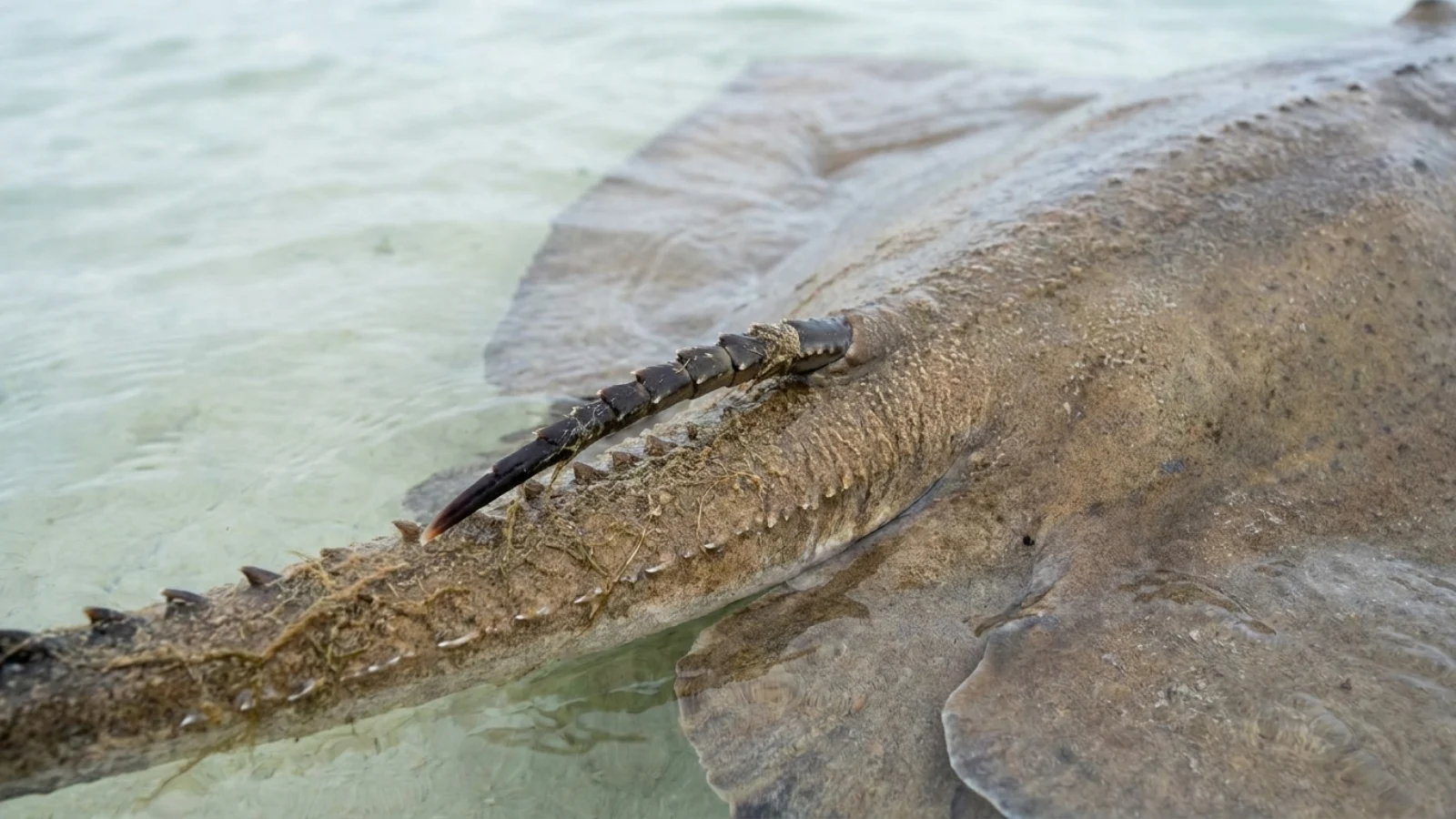
A stingray barb is a stiff, flattened spine on the top of a stingray’s tail, edged with backward-pointing serrations and lined with venom glands. It is purely defensive: when a ray is stepped on or grabbed, it whips its tail up and drives the barb into the threat, tearing tissue and leaving venom (and sometimes fragments of spine) in the wound. Barbs range from about 2.5 cm (1 in) on a round stingray to 38 cm (15 in) on the giant freshwater stingray. The venom is heat-sensitive, so first aid is to soak the wound in water at about 45°C (113°F) for 30–90 minutes, then get it checked for retained fragments.
How does a stingray barb work?
The barb works in two stages: a mechanical wound from the serrated spine, then venom that causes intense pain and can affect the heart and blood vessels.
Stingrays do not attack; the barb is a last-resort defence for an animal that spends most of its life lying on the bottom. When something pins the disc — usually a wader’s foot — the ray arches its tail forward over its back like a scorpion and drives the spine into whatever is holding it. Because the serrations point backwards, the barb goes in easily but tears on the way out, and pieces of the spine or its covering tissue can break off in the wound. As the spine penetrates, venom from glandular tissue along grooves on its underside is released into the wound.
Emergency medicine references describe the injury in two phases. The physical trauma can be severe if the barb hits a vital organ. The venom then causes vasospasm (constriction of blood vessels), intense local pain that can last up to 48 hours, swelling and, in serious cases, systemic effects such as vomiting, muscle cramps, low blood pressure, heart-rhythm problems and seizures. The key fact for first aid is that the venom is heat-labile: it breaks down when warmed.
How do you treat a stingray sting?
Get out of the water, control bleeding, and soak the wound in water as hot as the person can stand, around 45°C (113°F), for 30 to 90 minutes.
| Step | What to do | Why |
|---|---|---|
| 1. Leave the water | Help the person to shore; watch for fainting. | Pain can be overwhelming and cause collapse. |
| 2. Rinse and control bleeding | Rinse with clean water; apply pressure. Do not pull out a deeply embedded barb in the chest, neck or abdomen. | Removing an impaled barb can worsen internal bleeding. |
| 3. Hot-water soak | Immerse the wound in water at about 45°C / 113°F (test on unaffected skin) for 30–90 minutes, topping up as it cools. | Heat denatures the venom; pain often returns within seconds if the limb is removed early. |
| 4. Get medical care | Doctors may X-ray or ultrasound the wound, clean it, and update tetanus. | Retained spine fragments cause infection and slow healing. |
| 5. Watch for infection | Redness, swelling, pus or fever in the following days need review; some doctors prescribe antibiotics covering Vibrio. | Marine wounds carry seawater bacteria. |
Lifeguards on Florida and California beaches treat stings with exactly this routine, and in a 2014 NPR report a veteran instructor described pain returning within 5–10 seconds of pulling a foot out of the hot water. Expect to need patience: the soak can take an hour or more. Most stings heal well, but deep punctures and wounds with retained material can take weeks.
How big is a stingray barb?
Barb size scales with the ray. A small round stingray carries a spine about an inch long; the biggest rays carry spines the length of a steak knife.
| Species | Barb length | Where |
|---|---|---|
| Round stingray | ~2.5 cm (1 in) | Southern California |
| Yellow stingray | Short, but painful | Florida Keys, Caribbean |
| Southern stingray | Several cm | Florida, Caribbean |
| Australian bull ray / short-tail stingray | “Steak-knife” size | Australia |
| Giant freshwater stingray | Up to 38 cm (15 in) | South-East Asian rivers |
Not every ray has one. Manta rays lack a functional sting, and skates, guitarfish, electric rays and sawfish have no barb at all. Some stingrays carry two or more spines at once, because a new spine grows in before the old one drops.
Do stingray barbs grow back?
Yes. Stingrays shed their barbs periodically and grow replacements, much as sharks replace teeth.
Studies of round stingrays in California found that most of the year each ray carries one spine, but secondary spines start appearing in early July, peak around September and October, and replacement is complete by December. Aquariums that clip or pinch the barbs of cownose rays and southern stingrays for touch pools have to repeat the process because the barbs regrow. Shed barbs sometimes turn up on beaches and in the stomachs of predators; great hammerhead sharks, which specialise in eating rays, are often found with stingray spines lodged in their mouths.
How do you avoid a stingray barb?
Do the stingray shuffle: slide your feet along the bottom instead of stepping, so rays feel you coming and swim away.
Almost every sting happens when a wader steps on a ray buried in the sand. Shuffling your feet nudges the ray before your weight lands on it, and it simply glides off. The technique is promoted by lifeguards and University of Florida extension agents from the Atlantic beaches to the Gulf. It is not 100% effective, but it prevents most injuries. In Southwest Florida, where Atlantic and southern stingrays bury themselves along Sanibel, Fort Myers Beach, Naples and Marco Island, it is the single most useful beach skill you can teach a child. Other tips: wear thick-soled water shoes in murky water, probe ahead with a stick, and never grab or pin a ray when snorkelling or fishing. For anglers, cut the line or use a dehooker rather than handling the ray.
Is a stingray barb poisonous?
It is venomous. Tissue along the spine releases a protein venom into the wound that causes intense pain, swelling and, rarely, effects on the heart and blood pressure.
Why does hot water help a stingray sting?
The venom is heat-labile. Soaking the wound at about 45°C (113°F) for 30–90 minutes breaks the venom down and relieves pain.
Should you pull out a stingray barb?
Small fragments in a foot or hand can be removed by a doctor. Never remove a barb embedded in the chest, neck or abdomen; keep it still and call emergency services.
How long does a stingray sting hurt?
Severe pain usually peaks within the first hour or two; local pain can last up to 48 hours, and wounds with retained fragments can stay sore for weeks.
Do all stingrays have barbs?
Most stingrays and eagle rays do. Manta rays have no functional sting, and skates, guitarfish, electric rays and sawfish have none.
Can a stingray barb kill you?
Rarely. Deaths occur when a large barb penetrates the chest or abdomen, as in the 2006 death of Steve Irwin. One researcher estimates a stingray fatality roughly every five or six years worldwide.
Do stingray barbs grow back?
Yes. Stingrays shed and replace their barbs; round stingrays grow replacement spines between July and December.
What is the stingray shuffle?
Sliding your feet along the bottom instead of stepping, so buried rays sense you and swim away before you can step on them.
Blane Perun has been exploring Earth’s oceans and marine life for over 25 years. Founder of TheSea.Org in 1999, underwater photographer, coral aquaculture pioneer, and explorer of 80+ countries. Based in Southwest Florida, where stingrays work the grass flats and smalltooth sawfish still raise their young in the mangroves of Charlotte Harbor and the Ten Thousand Islands.
About Blane Perun → All Rays, Skates & Sawfish →