Do Sperm Whales Eat Sharks? — Occasionally — but Squid Make Up Most of the Menu
Yes, sperm whales sometimes eat sharks, but rarely. Stomach-content studies find that cephalopods, mainly deep-sea squid, make up the great majority of most sperm whale diets, in some studies outnumbering fish by more than a thousand to one. Fish, including small sharks, dogfish, skates and rays, appear occasionally, especially where large males feed near the bottom at high latitudes, as off Iceland. Sharks are much more often found scavenging dead sperm whales than being eaten by live ones.
An adult sperm whale eats roughly 3% of its body weight a day, which for a large male can mean more than a tonne. It hunts by echolocation in darkness, usually at 300–800 m and sometimes 1–2 km down, and swallows prey whole.
What do sperm whales mostly eat?
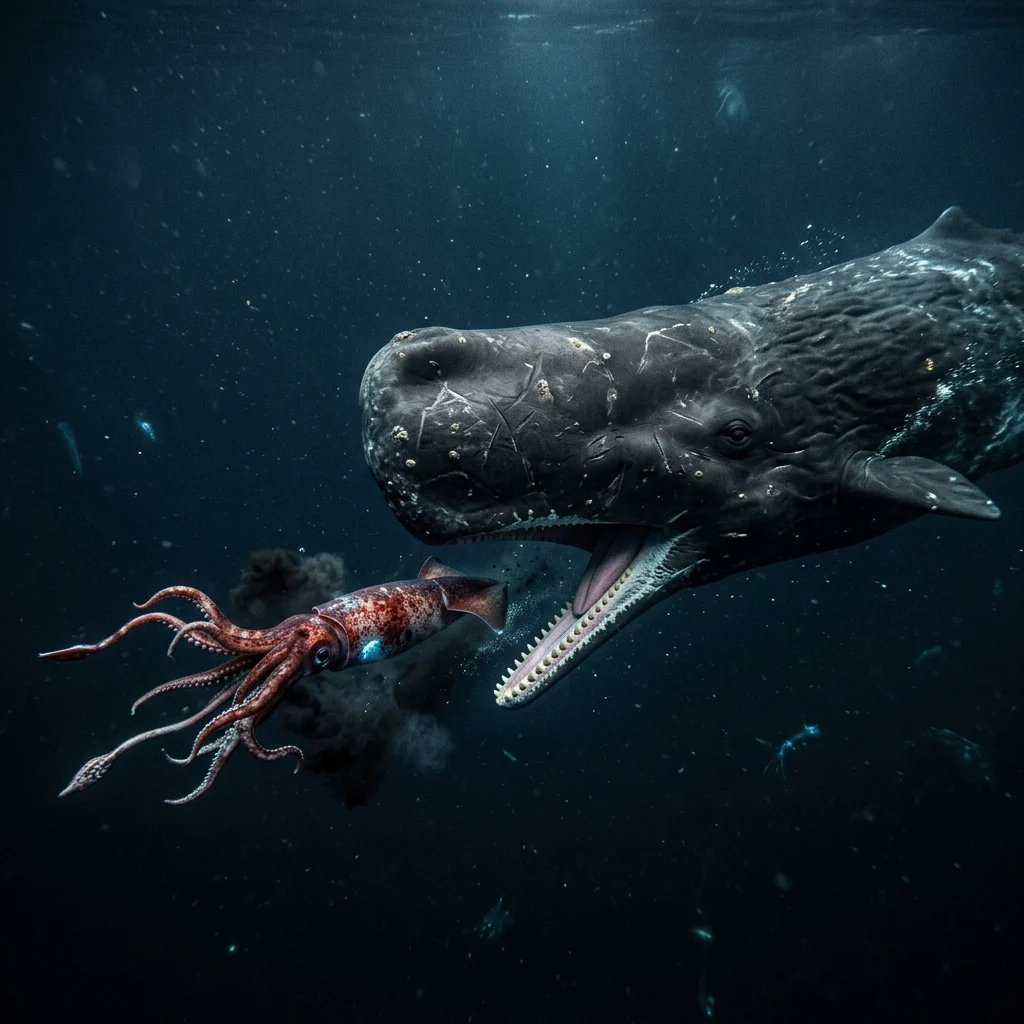
Medium-sized deep-sea squid, by the thousand.
| Prey group | Share of diet (typical) | Examples |
|---|---|---|
| Squid | Most of diet in most regions | Histioteuthids, octopoteuthids, jumbo squid, occasionally giant squid |
| Fish | Small share; large off Iceland and New Zealand | Lumpsucker, sablefish, toothfish |
| Sharks and rays | Occasional | Dogfish, small deep-water sharks, skates; one megamouth attack |
| Octopus | Occasional | Deep-water octopods |
Squid beaks resist digestion and accumulate in the stomach, which is why diet studies count them so easily.
Detailed stomach studies show just how lopsided the diet can be. Malcolm Clarke, Helen Martins and Paul Pascoe examined 17 sperm whales caught off the Azores between 1981 and 1984 and counted 28,738 cephalopods against just 16 fish. By estimated mass, the squid families Octopoteuthidae (about 40%) and Histioteuthidae (about 33%) dominated, followed by giant squid of the family Architeuthidae at about 12%. The most common squid weighed only 400–450 grams, roughly one hundred-thousandth of the whale’s own body mass. A study around the Galápagos Islands found a similar pattern, with Histioteuthis (62%), Ancistrocheirus (16%) and Octopoteuthis (7%) making up most of the prey, all of them squid weighing between about 12 and 650 grams.
The kind of squid matters. In the Azores sample, about 77.5% of the species eaten had light organs and 82% were neutrally buoyant, meaning they hang in the water without much effort and swim relatively slowly. Clarke and colleagues suggested that whales may get roughly three-quarters of their food by working through slow, luminous shoals of such squid and the rest by chasing larger, faster cephalopods. A shark, by contrast, is a muscular, fast-reacting fish that does not glow, does not form dense shoals at sperm whale feeding depths and is rarely the easiest meal available.
A sperm whale’s stomach is built for this diet. It has four chambers, the first of which is thick-walled and muscular, crushing food that the whale cannot chew and resisting the hooks and suckers of swallowed squid. Indigestible squid beaks collect in the second chamber, where as many as 18,000 have been counted in a single animal. Most are vomited up, but some pass into the intestine, where the irritation they cause is thought to trigger the formation of ambergris, the waxy substance once prized by perfumers.
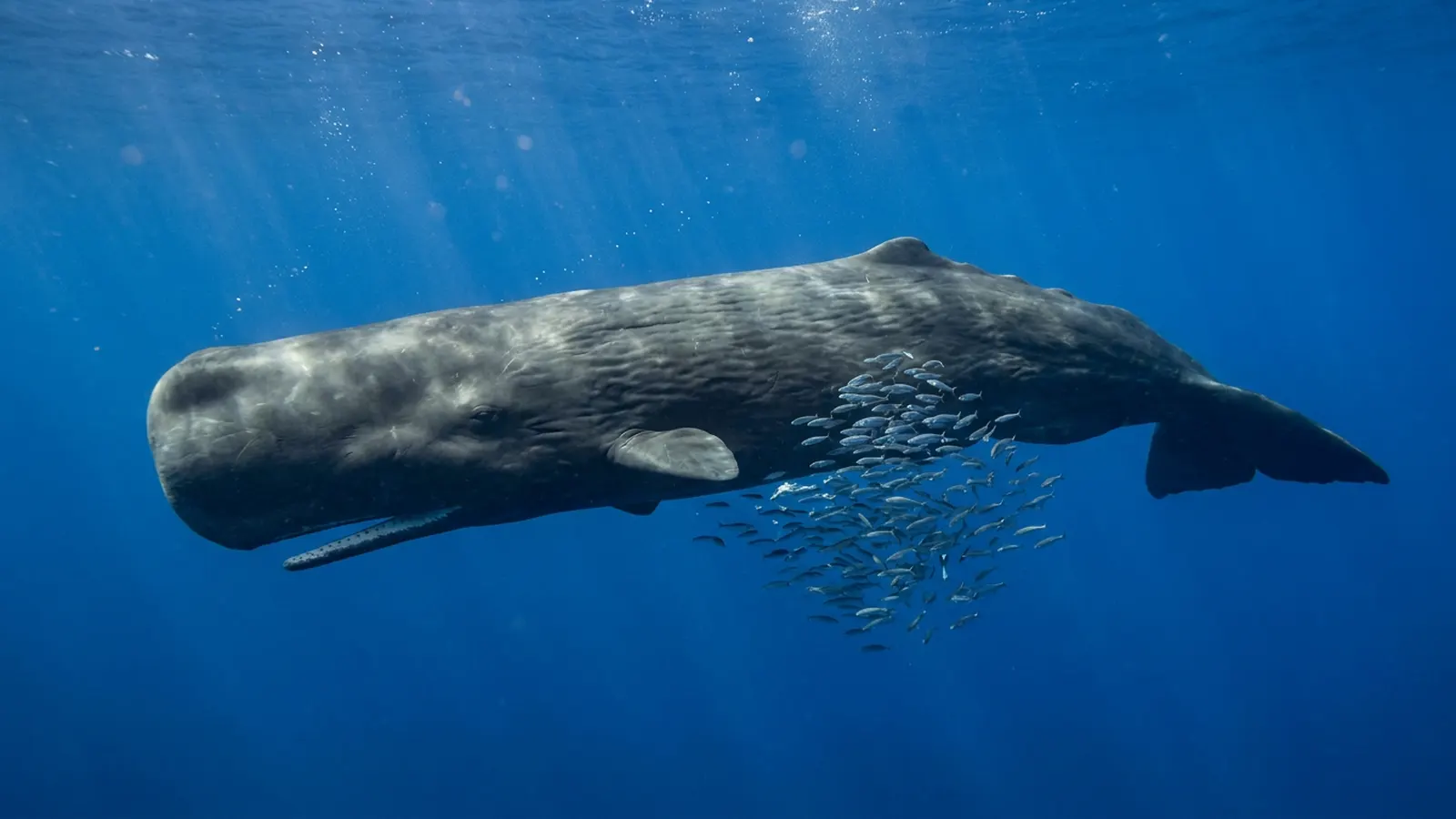
Which sperm whales eat the most fish?
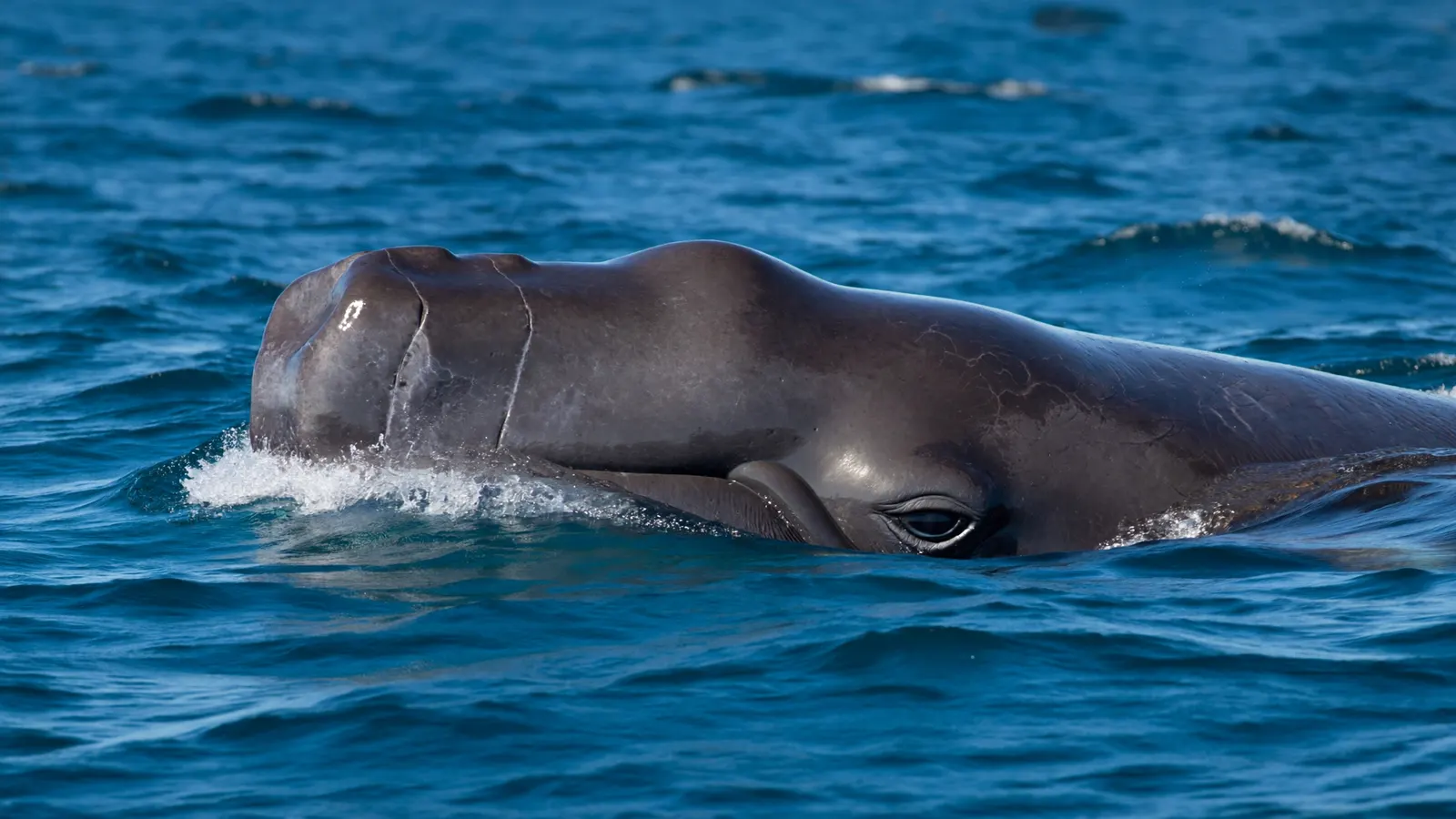
Fish become far more important at high latitudes, and that is where the shark question gets interesting. Sperm whale societies are split by sex. Females and their young stay in tropical and temperate waters year-round, while males leave their family groups and, once sexually mature, move toward higher latitudes where the water is colder and feeding is richer. Only adult males reach the polar edges of the range. These big bulls, up to about 16 metres on average, often feed close to the seabed along continental slopes and take a much wider range of prey than the females.
Iceland provides the best-documented example. A study published in 1986 in the Journal of the Marine Biological Association of the United Kingdom examined the stomachs of 221 sperm whales, all males, landed at an Icelandic whaling station between 1977 and 1981. Fish remains turned up in 87% of stomachs and cephalopods in 68%, and the lumpsucker (Cyclopterus lumpus) formed a major part of the diet. At least eight fish species and 22 cephalopod species were identified, and the prey had been caught at depths from about 400 metres to at least 1,200 metres. Rock fragments and pieces of fishing net in some stomachs showed that these whales were feeding at or near the bottom.
New Zealand offers another example. An older study of whales taken by the New Zealand whaling fleet in the Cook Strait region found a squid-to-fish ratio of 1.69 to 1 by weight, so fish made up well over a third of the diet there. In the Gulf of Alaska, sperm whales have learned to pick sablefish off commercial longlines as they are hauled in, and they take toothfish from longlines in southern waters. Video has even recorded a large male “bouncing” a longline to shake fish loose. Fishers complain about the losses, although the amount of fish taken this way is small compared with what a whale needs each day.
See the sperm whale and giant squid vs sperm whale.
When do sperm whales eat sharks?
Mostly when feeding near the sea floor in cold or productive waters.
Records of sharks in sperm whale stomachs come mostly from whaling-era studies, when thousands of stomachs were opened. The sharks involved are usually small, slow, deep-water species such as dogfishes, which make easy targets for a whale feeding near the bottom. There is no evidence that sperm whales actively hunt large predatory sharks like great whites.
The best-known record of this kind comes from South Africa, where a sperm whale killed about 160 km south of Durban after a dive lasting 1 hour 50 minutes was found to have two dogfish of the genus Scymnodon, sharks that normally live near the sea floor, in its stomach. Reference works on the species list demersal rays and sharks among the less common prey, and note that some items may be taken accidentally while the whale is feeding on something else. That is a plausible route for many shark records: a whale sweeping up squid near the bottom may also swallow a slow-moving dogfish or skate that happens to be in the way.
The most dramatic shark record involves a much larger animal. On 30 August 1998, off Manado in North Sulawesi, Indonesia, researchers watched three sperm whales attacking or harassing a megamouth shark, a rare filter-feeding species that can exceed 5 metres in length. The shark, the 13th megamouth ever recorded, had injuries to the base of its dorsal fin and its gills consistent with the whales’ attack. The Florida Museum of Natural History describes it as the only confirmed predation event on megamouths, and it is often cited as evidence that sperm whales will take large sharks when the opportunity arises. Even so, it remains a single observation, and it is not clear whether the whales intended to eat the shark or whether the encounter was closer to play or aggression.
Do sharks attack sperm whales?
Mostly as scavengers, or on calves.
Large sharks such as tiger sharks and great whites feed heavily on sperm whale carcasses. Live adult sperm whales are too large and too well defended; groups form a protective “marguerite” formation, heads in and tails out, around calves when threatened. Calves and weakened whales are vulnerable to killer whales. See what attacks killer whales and megalodon vs blue whale.
The animals that do threaten sperm whales are other toothed whales. Killer whales are the main natural predator, usually targeting groups of females with calves and trying to separate a calf from the group. Pilot whales and false killer whales sometimes harass sperm whales too. Large killer whale pods have occasionally killed adult females, but fully grown bulls are believed to be too big, powerful and aggressive to be at risk, and solitary bulls have been seen coming to the aid of vulnerable groups nearby.
How often do sharks feed on sperm whales?
Far more often than the reverse. A dead sperm whale is one of the biggest single food packages in the ocean, and large sharks travel to find it. When a sperm whale carcass drifted in the Seychelles in April 2017, researchers led by James Lea filmed tiger sharks and bull sharks feeding on it. Tiger sharks carried out 75 of the 78 recorded feeding events, with five or six circling the carcass at any time and up to 14 sharks present at once. Most bites (about 78%) were taken from blubber, with the rest from pectoral fins, bone and organs. Tawny nurse sharks gathered underneath to pick up falling scraps. Tiger sharks had not been seen in five years of earlier research in the area, which suggests they came from far away to feed.
Off the coast of New South Wales, Australia, a team led by James Tucker documented white sharks and tiger sharks scavenging a sperm whale carcass in 2015, as well as humpback and fin whale carcasses in 2018. Both species used test bites and head-shaking to remove flesh, and aggression between sharks was minimal. Scientists think carcasses like these can be important feeding events for large sharks and may draw them closer to shore than usual. None of this involves live, healthy sperm whales, and there is no reliable record of a shark killing an adult.
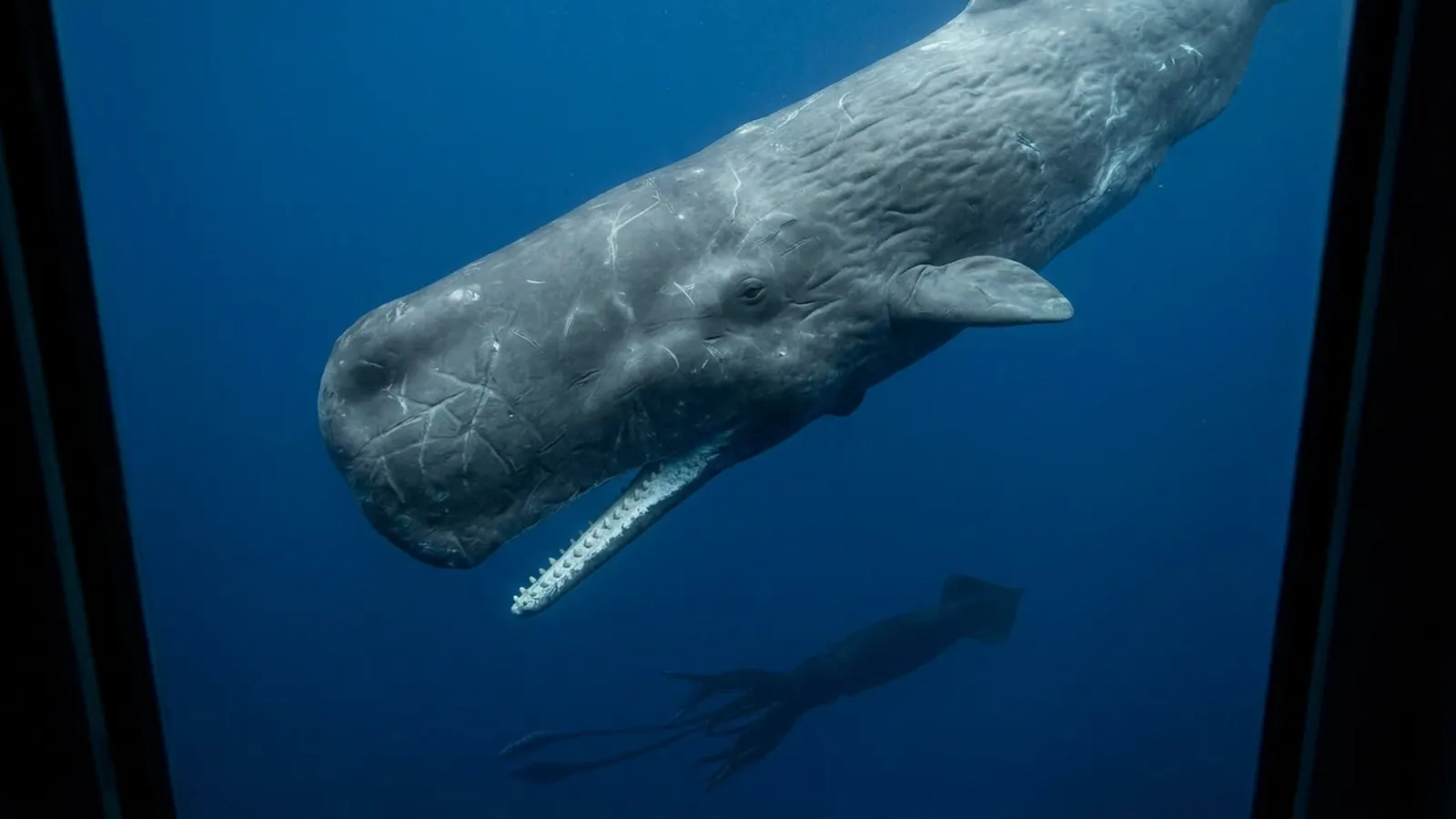
How much does a sperm whale eat?
Sperm whales are prodigious feeders, eating around 3% of their body weight a day. For a male averaging about 16 metres and roughly 45 tonnes, that is well over a tonne of food daily; for a female of about 11 metres and 15 tonnes, it is still several hundred kilograms. Because the typical squid weighs only a few hundred grams, a whale may need to catch hundreds or even thousands of individual prey each day, one at a time, in the dark. One estimate puts the total annual prey consumption of the world’s sperm whales at about 91 million tonnes, comparable to the roughly 115 million tonnes of seafood eaten by people.
All of this happens on long, deep dives. Sperm whales usually dive to between 300 and 800 metres, sometimes to 1–2 km, and the deepest recorded dives reach about 2,250 metres. A typical dive lasts around 35 minutes, though some last more than an hour and the longest approach two hours. Between dives a whale spends about eight minutes at the surface breathing. Tagging studies have shown that whales often hunt upside down near the bottom of their dives, which may let them see squid silhouetted against faint light from above.
How do sperm whales catch prey without seeing it?
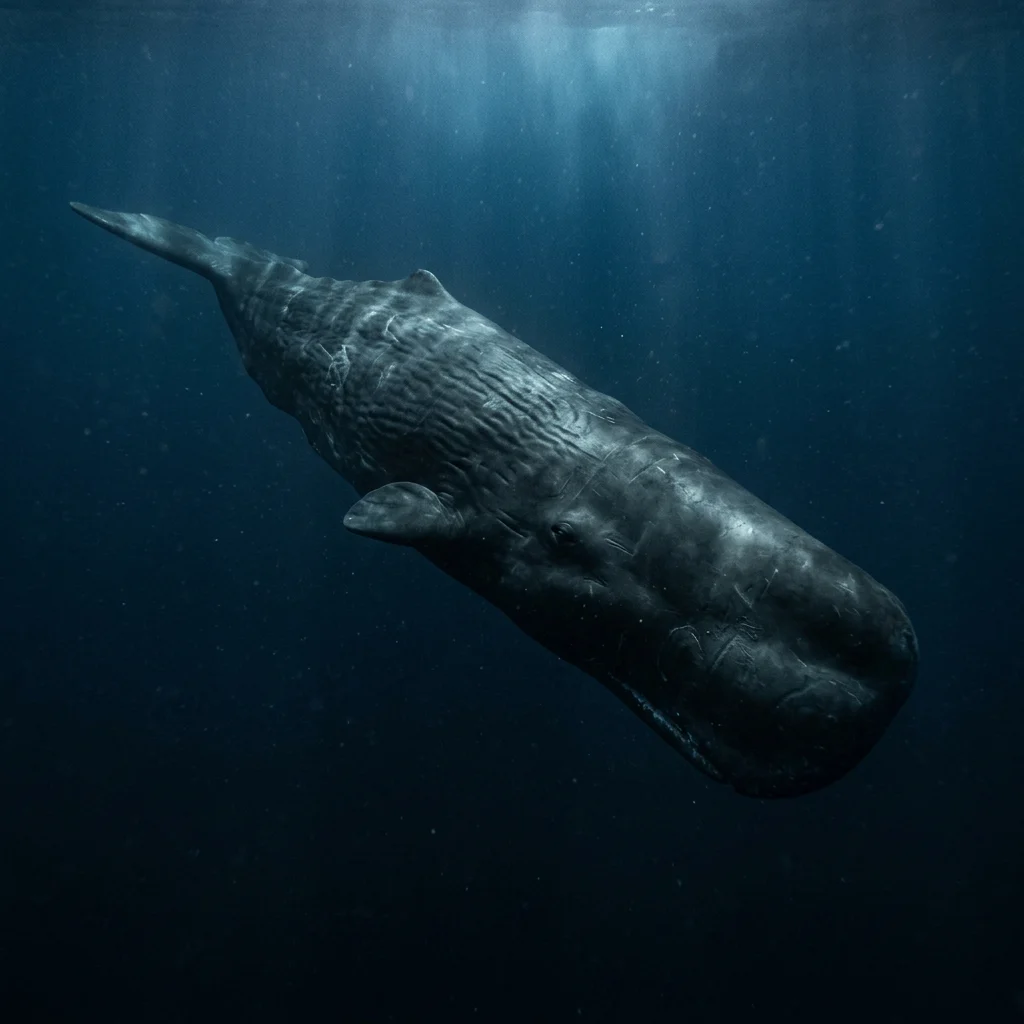
With the most powerful biological sonar known.
The sperm whale’s huge head holds the spermaceti organ and junk, which focus clicks with source levels of about 230–236 decibels (re 1 µPa at 1 m), among the loudest sounds made by any animal. As a whale closes on prey, its clicks speed up into a rapid “creak” just before capture. Their narrow lower jaw has 18–26 pairs of teeth, but whales with deformed jaws or missing teeth have been found well fed, suggesting suction helps.
It was once suggested that sperm whales might stun prey with their loud clicks, but experiments have failed to reproduce the supposed injuries and the sound levels reaching a squid appear to be well below what would be needed to disable it. The idea is now treated with scepticism. The function of the teeth is also debated: they appear to be unnecessary for catching squid, and one hypothesis is that they are used mainly in fights between males, which often carry tooth-rake scars.
Did ancient sperm whales eat bigger prey?
The modern sperm whale’s focus on squid seems to be a relatively recent specialisation. Fossil members of the sperm whale lineage, the Physeteroidea, go back to the late Oligocene, more than 23 million years ago, and most date from the Miocene. Many of these early forms differed from the living species in their tooth count and in the shape of the face and jaws. Several had functional teeth in the upper jaw as well as the lower, and Acrophyseter, a late Miocene species from Peru, combined teeth in both jaws with a short snout and an upward-curving lower jaw. Palaeontologists read these features as signs that some fossil sperm whales were not deep-sea squid specialists at all, but hunters of larger prey closer to the surface. The living sperm whale, with its toothless upper jaw and slender lower jaw, is built for a different job: catching large numbers of soft-bodied prey in the deep sea.
Common misconceptions about sperm whales and sharks
Popular accounts sometimes present sperm whales as shark hunters, or pit them against great white sharks in imaginary battles. The evidence points the other way. There is no record of a sperm whale hunting a great white, tiger or other large predatory shark, and the documented shark prey are small, slow, bottom-living species such as dogfishes, plus one well-known attack on a megamouth, itself a slow-moving plankton feeder. Sharks, for their part, interact with sperm whales mainly as scavengers on carcasses.
Another misconception is that the sperm whale’s diet is dominated by giant squid. Giant squid are eaten, and in the Azores sample they made up about 12% of the estimated mass, but most prey are medium-sized squid weighing well under a kilogram. The dramatic sucker scars on sperm whale skin come from large squid, yet battles between sperm whales and giant or colossal squid have never been directly observed. The everyday reality is a steady harvest of ordinary deep-sea squid, with fish, the occasional skate and, rarely, a shark taken along the way.
Do sperm whales eat great white sharks?
There is no evidence they do. Recorded shark prey are small deep-water species such as dogfishes, plus one attack on a megamouth shark.
What is a sperm whale’s main food?
Deep-sea squid.
Do sperm whales eat giant squid?
Yes, occasionally, but most squid they eat are medium-sized species.
How much does a sperm whale eat a day?
Roughly 3% of its body weight.
Do sharks eat sperm whales?
Mostly as carcasses. Tiger, white and bull sharks have all been filmed scavenging dead sperm whales; healthy adults are too large.
Why are squid beaks found in sperm whales?
The hard beaks resist digestion and build up in the stomach; some are bound into ambergris.
Can sperm whales eat humans?
There is no credible record of a sperm whale eating a person.
- Kawakami, T. (1980). A review of sperm whale food. Scientific Reports of the Whales Research Institute 32: 199–218.
- Clarke, M. R. (1980). Cephalopoda in the diet of sperm whales of the Southern Hemisphere. Discovery Reports 37.
- Whitehead, H. (2003). Sperm Whales: Social Evolution in the Ocean. University of Chicago Press.
- NOAA Fisheries. Species directory: whales, dolphins and porpoises. fisheries.noaa.gov.
- Clarke, M.R., Martins, H.R. & Pascoe, P. (1993). The diet of sperm whales (Physeter macrocephalus Linnaeus 1758) off the Azores. Philosophical Transactions of the Royal Society B.
- Martin, A.R. & Clarke, M.R. (1986). The diet of sperm whales (Physeter macrocephalus) captured between Iceland and Greenland. Journal of the Marine Biological Association of the UK 66.
- Lea, J.S.E. et al. (2018). Life after death: behaviour of multiple shark species scavenging a whale carcass. Marine and Freshwater Research 70: 302–306.
- Tucker, J.P. et al. (2019). Whale carcass scavenging by sharks. Global Ecology and Conservation 19: e00655.
- Florida Museum of Natural History. Megamouth shark species profile.
Blane Perun has been exploring Earth’s oceans and marine life for over 25 years. Founder of TheSea.Org in 1999, underwater photographer, coral aquaculture pioneer, and explorer of 80+ countries.
About Blane Perun → More on Whales →