Are Belugas Dolphins or Whales? — Toothed Whales, Cousins of the Narwhal — Not Dolphins
Belugas are whales, not dolphins. They are toothed whales (Odontoceti) in the family Monodontidae, which they share with only one other species, the narwhal. True oceanic dolphins belong to a different family, Delphinidae. The confusion is understandable: all dolphins are technically small toothed whales, and belugas are only about 3.5–5.5 m long, closer to large dolphins than to giants like the blue whale.
Order Cetacea → suborder Odontoceti (toothed whales) → superfamily Delphinoidea → family Monodontidae (beluga, narwhal). Its closest relatives are the porpoises (Phocoenidae); the oceanic dolphins (Delphinidae), including orcas and pilot whales, are the next branch out.
How are belugas different from dolphins?
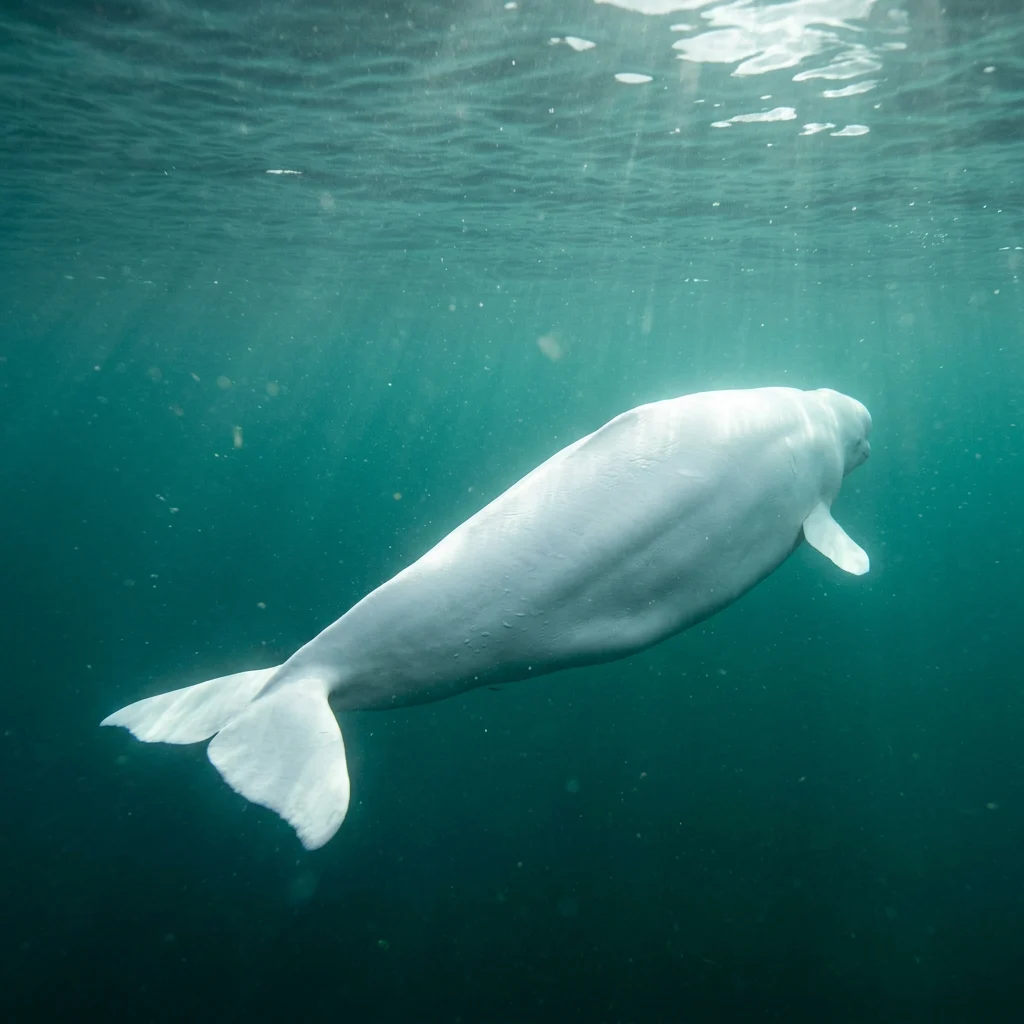
Several features set them apart from the dolphin family.
| Feature | Beluga | Typical dolphin |
|---|---|---|
| Dorsal fin | None; a low dorsal ridge | Usually prominent |
| Neck | Unfused neck vertebrae; can turn head | Mostly fused; limited turning |
| Colour | Adults white, calves grey | Grey, black, patterned |
| Forehead | Large, mobile melon that changes shape | Melon, less mobile |
| Habitat | Arctic, ice edges, estuaries | Mostly temperate and tropical |
| Family | Monodontidae | Delphinidae |
The missing dorsal fin is an adaptation to life under sea ice, and the flexible neck helps them hunt in shallow estuaries and among ice floes.

What does the family tree actually say?
Belugas are closer to porpoises than to dolphins.
To answer the question properly, it helps to separate everyday words from scientific groups. In biology, a group counts as natural if it contains an ancestor and all of its descendants. “Toothed whales” (Odontoceti) is a natural group, and it includes sperm whales, beaked whales, river dolphins, oceanic dolphins, porpoises, narwhals and belugas. “Whale” in the everyday sense, meaning any large cetacean, is not a natural group, because some animals called whales are more closely related to dolphins than to other whales. The same is true of “dolphin” used loosely, because the river dolphins of South America and Asia belong to several separate lineages.
Within the toothed whales, belugas sit in a group called Delphinoidea, along with two other families: the oceanic dolphins (Delphinidae) and the porpoises (Phocoenidae). Genetic studies have repeatedly found that the beluga and narwhal family, Monodontidae, is most closely related to the porpoises. The lineage leading to belugas, narwhals and porpoises split from the oceanic dolphins within roughly the past 11 million years. So if you had to choose a closest “everyday” relative for the beluga, a porpoise would be a better answer than a dolphin.
That relationship also explains why both answers to the title question feel partly right. Belugas are whales because every dolphin, porpoise and beluga is a toothed whale. Belugas are not dolphins, because they are not members of the oceanic dolphin family or any of the river dolphin families. A beluga, a harbour porpoise and a bottlenose dolphin are close cousins that went their separate ways millions of years ago.
Where did belugas come from?
Fossils suggest the beluga family began in warm water.
Today the beluga and the narwhal are among the most cold-adapted mammals on Earth, but their family did not start out in the Arctic. Fossil relatives have been found far south of the modern range. Bohaskaia monodontoides, described in 2012, comes from Pliocene rocks of the western North Atlantic in the eastern United States, and an extinct beluga relative named Casatia thermophila, whose name means “heat-loving”, was found in Pliocene deposits in Italy. Other extinct relatives are known from the Pacific. Together these finds suggest that the family originated in temperate or even warm seas and that the two surviving species adapted to polar life later, as the climate cooled and their warm-water relatives disappeared.
Why do people call belugas dolphins?
Because of their size, sociability and smile.
Belugas live in social pods, are curious and vocal, and have an upturned mouth that looks like a smile. Their scientific name, Delphinapterus, even means “dolphin without a wing,” a nod to their missing dorsal fin. But being dolphin-like is not the same as being a dolphin. In everyday English, “whale” and “dolphin” are size-based labels, and belugas fall in the middle.
Are all dolphins whales?
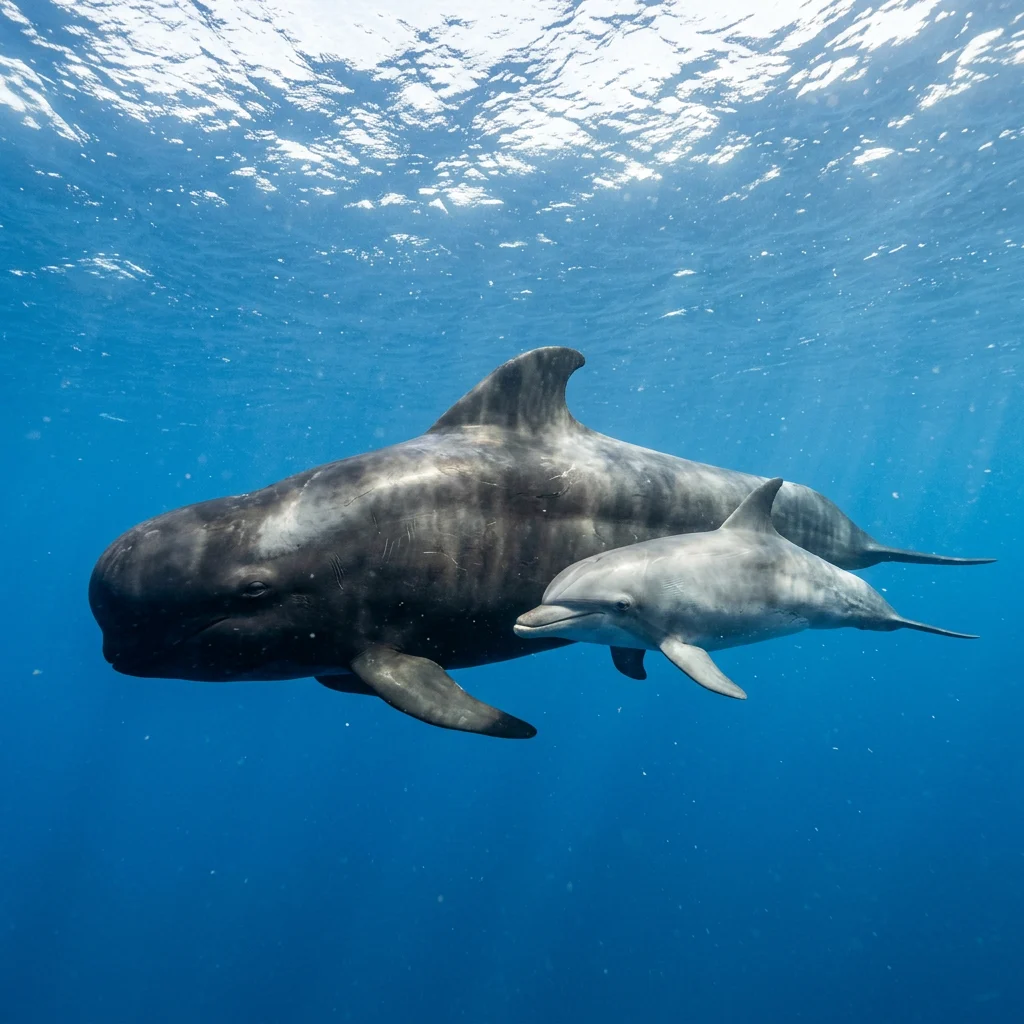
In the scientific sense, yes: all dolphins are toothed whales.
Cetaceans split into baleen whales (Mysticeti) and toothed whales (Odontoceti). Every dolphin and porpoise is a toothed whale. Ironically, the orca, or “killer whale,” and the pilot whales are actually in the dolphin family, while the beluga, called a whale, is not. See dolphins vs porpoises, oceanic dolphins and orca.
How are belugas related to narwhals?
They are the only two living members of the same family, and they can interbreed.
Belugas and narwhals share a rounded head with a large melon, no true dorsal fin, a stocky body and a life tied to Arctic sea ice. Their differences are mainly in the teeth. Belugas have a row of simple, peg-like teeth in both jaws, while narwhals have only two teeth, and in most males the left one grows into a long spiral tusk. Narwhals are more strictly Arctic and live mainly in the Atlantic sector, while belugas occur right around the Arctic and into sub-Arctic seas in both the Atlantic and the Pacific.
The two species occasionally hybridise. An unusual skull collected in West Greenland in 1990 ended up in the Natural History Museum of Denmark. Genetic analysis published in Scientific Reports in 2019 by Mikkel Skovrind, Eline Lorenzen and colleagues showed that it came from a male first-generation hybrid with a narwhal mother and a beluga father, sometimes nicknamed a “narluga”. Its skull was larger than either parent’s, its teeth were long, pointed and angled forward, and chemical analysis of the bone suggested it fed mainly on the seabed, unlike either parent. The researchers found no sign of interbreeding between the two species in at least the past 1.25 million years, so hybrids appear to be extremely rare.
What features make a beluga a beluga?
A flexible neck, a ridge instead of a fin, and a white coat that takes years to develop.
Belugas are medium-sized toothed whales. Adults are about 3.5 to 5.5 m long and weigh up to about 1,500 kg, and males can be up to a quarter longer than females. A newborn calf averages about 1.6 m and 78 kg. Instead of a dorsal fin, a beluga has a tough ridge along its back, which is thought to help the animal break thin ice and move under ice without damage. Its neck vertebrae are not fused, as they are in most dolphins, so it can nod and turn its head, which is useful when hunting in shallow, cluttered water.
Blubber can account for up to 40 percent of a beluga’s body weight, a vital insulation in near-freezing water. The skin is thick and grows quickly, and in summer belugas gather in shallow estuaries where they rub against gravel and sand to shed old, yellowed skin. Their famous white colour develops slowly. Calves are born dark grey and lighten over many years. NOAA describes them becoming white around sexual maturity, while monitoring in the North Atlantic suggests that full whiteness may take around 14 years in females and 18 in males.
What makes belugas unique among whales?
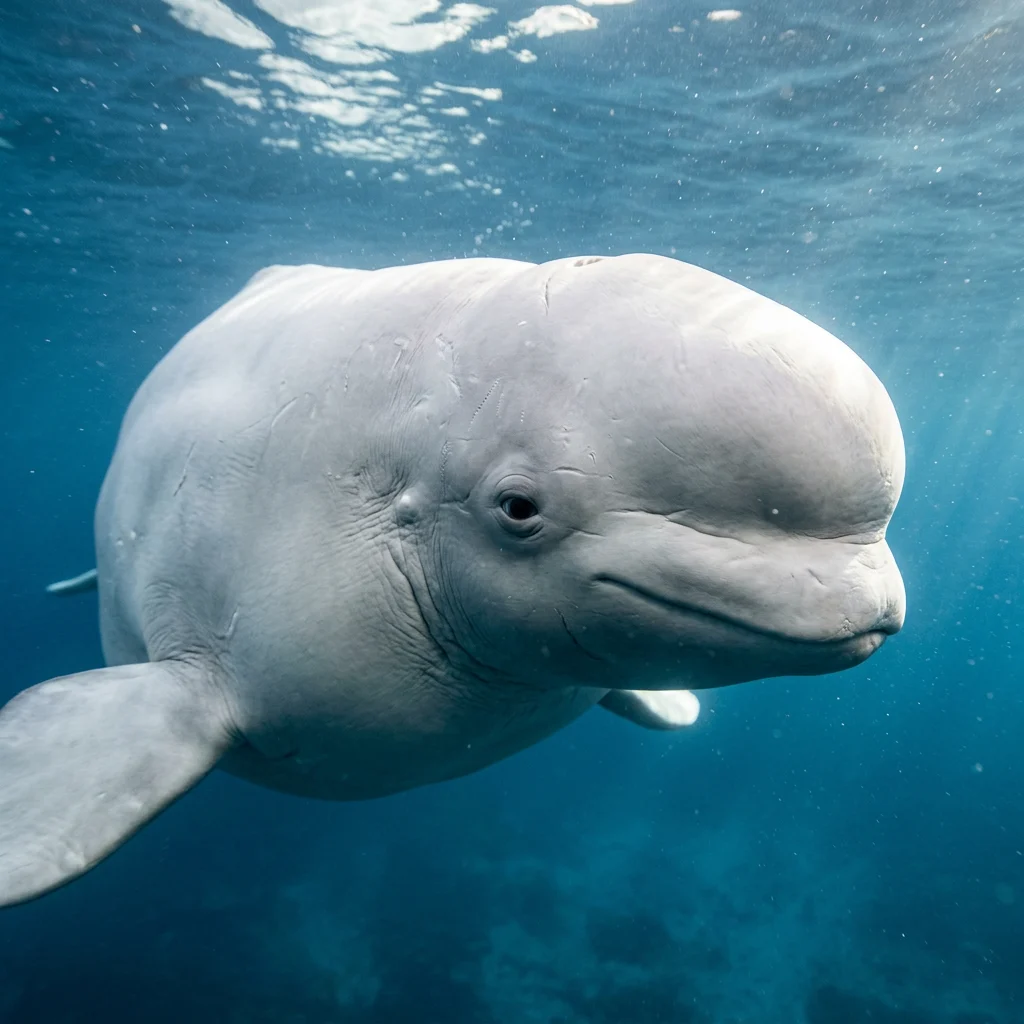
Voice, flexibility and a seasonal moult.
Belugas are among the most vocal cetaceans, producing whistles, clicks, chirps and squeals, and can change the shape of their melon to focus sound. Unusually for whales, they moult each summer, rubbing old yellowed skin off on gravel in shallow estuaries such as Canada’s Cunningham Inlet. They can swim backwards and turn their heads sideways, and they can dive to about 1,000 m to hunt cod, flatfish, shrimp and squid.

Why are belugas called sea canaries?
Their range of whistles, clicks and squeals is unusually wide.
Sailors and whalers named belugas “sea canaries” because their calls can sometimes be heard through a ship’s hull. Belugas produce whistles, chirps, clicks, buzzes and squeals, and they use high-frequency echolocation clicks to find prey and navigate under ice. The melon on the forehead, a fatty structure that focuses outgoing sound, is so flexible in belugas that they can visibly change its shape.
Belugas also appear to be capable vocal learners. A captive male called NOC, caught in Manitoba in the late 1970s and cared for by the US Navy’s marine mammal programme in San Diego, began making sounds that resembled human speech in 1984. Researchers led by Sam Ridgway reported in Current Biology in 2012 that NOC produced these sounds by changing the pressure in his nasal passages and adjusting the phonic lips that whales use to make sound, bringing his calls several octaves lower than normal beluga calls, close to the rhythm and pitch of human voices. The behaviour faded after about four years.
How do belugas live and breed?
Long pregnancies, long childhoods and long lives.
Belugas mate in late winter or early spring, and calves are born about 14 months later, usually in summer. A mother has a single calf at a time and nurses it for about two years, and young belugas become sexually mature at around five to eight years old. Lifespans can be long. Age is estimated by counting the growth layers in the teeth, and the oldest beluga on record had 80 layers. Studies using radioactive carbon from Cold War bomb tests, which marks tooth layers laid down in the late 1950s and 1960s, have confirmed that one layer is laid down each year.
Belugas are very social. Groups range from a few animals to several hundred, and in summer large numbers gather in river mouths and estuaries in places such as Hudson Bay, the Beaufort Sea and the White Sea. Many return to the same summer areas year after year. Mothers and calves form the core of most groups, and adult males often travel together in separate pods.
What do belugas eat and how deep do they dive?
Belugas are opportunistic feeders. In much of the Arctic, Arctic cod and polar cod are the most important prey, but belugas also eat capelin, sand lance, salmon, herring, flounder, shrimp, squid, octopus, crabs, clams and marine worms, depending on the region and season. Their flexible necks and good hearing suit them to picking prey off the bottom in shallow water as well as chasing fish in open water.
In summer belugas often stay in shallow coastal waters. At other times they dive much deeper. NOAA reports that belugas can dive to about 1,000 m and stay down for up to around 25 minutes. Tracking studies have shown that some populations travel hundreds to thousands of kilometres between summer estuaries and winter feeding areas among offshore pack ice, where they rely on cracks and openings in the ice to breathe.
Where do belugas live and how many are there?
Around the Arctic, in about 20 separately managed stocks.
Belugas live in the Arctic and sub-Arctic seas of Canada, Alaska, Greenland, Russia and Norway, often entering rivers and estuaries in summer. The global population is estimated at at least 200,000, and the species was assessed as Least Concern by the IUCN in 2017, but some isolated populations are in trouble: the Cook Inlet belugas in Alaska number only a few hundred and are endangered, and the St Lawrence Estuary population is also listed as endangered. See the beluga whale profile.
What threatens belugas?
The main natural predators of belugas are killer whales and polar bears. Polar bears hunt belugas at breathing holes and when whales become trapped in small openings in the ice, and in some areas belugas make up a quarter to a third of the food eaten by polar bears. As sea ice shrinks, killer whales are reaching parts of the eastern Canadian Arctic more often, which could increase predation.
Human pressures vary from region to region. Belugas have been hunted by Arctic peoples for thousands of years and are still taken for food in most of their range, where muktuk, the skin and fat, is a traditional food. Commercial hunting in the past caused severe declines in some populations. Today the main concerns include climate change and the loss of sea ice, chemical pollution, underwater noise from shipping and industry, entanglement in fishing gear and disease.
Alaska’s Cook Inlet population shows how vulnerable an isolated group can be. Aerial surveys counted about 1,300 belugas there in 1979. The population was listed as endangered under the US Endangered Species Act in 2008, and NOAA’s 2022 survey produced a best estimate of 331 whales, with a range of 290 to 386. In Canada, the St Lawrence Estuary population was listed as endangered under the Species at Risk Act in 2017. According to the Canadian government, it has stayed at roughly 1,000 animals since surveys began in the 1980s, less than 20 percent of its size in the late 1800s, and contaminants, noise, reduced prey and vessel traffic are among the threats to its recovery.
Common misconceptions about belugas
Belugas are sometimes described as Arctic dolphins or white dolphins, but neither label is accurate. Several true dolphins are pale or white, including some Indo-Pacific humpback dolphins and the occasional albino bottlenose, and none of them is closely related to the beluga. Another misconception is that belugas are white from birth. Calves are grey, and young animals pass through years of mottled grey before turning white. Finally, it is often said that killer whales are not dolphins because of their name. In fact the orca is the largest member of the oceanic dolphin family, which makes it more of a dolphin than the beluga will ever be.
Where can you see belugas in the wild?
Some of the most accessible places to watch belugas are the Churchill River estuary in Manitoba, where large numbers gather each summer, the Saguenay–St Lawrence Marine Park in Quebec, and Turnagain Arm near Anchorage, where Cook Inlet belugas sometimes follow salmon runs close to shore. In each place, follow local rules about approach distances and boat speed. The St Lawrence and Cook Inlet populations are endangered, and disturbance from boats is one of the stresses they face.
Belugas’ closest relatives after the narwhal are the porpoises; see is a porpoise a whale? for how whales, dolphins and porpoises are related.

Is a beluga a dolphin?
No. It is a toothed whale in the family Monodontidae, with the narwhal.
What is the beluga’s closest relative?
The narwhal.
Is a killer whale a dolphin?
Yes. Orcas are the largest member of the dolphin family, Delphinidae.
Why are belugas white?
Adults are white for camouflage among ice; calves are born grey and lighten with age.
How big is a beluga whale?
About 3.5–5.5 m long and 700–1,600 kg; males are larger.
Are belugas endangered?
The species is Least Concern, but Cook Inlet and St Lawrence populations are endangered.
Are belugas more closely related to porpoises or dolphins?
Genetic studies place the beluga and narwhal family closest to the porpoises, with the oceanic dolphins the next branch out.
Can belugas and narwhals interbreed?
Yes, but rarely. A skull from West Greenland was confirmed in 2019 as a male narwhal-beluga hybrid.
- Lowry, L. et al. (2019). Delphinapterus leucas. IUCN Red List of Threatened Species.
- Jefferson, T. A., Webber, M. A. & Pitman, R. L. (2015). Marine Mammals of the World: A Comprehensive Guide to Their Identification, 2nd ed. Academic Press.
- NOAA Fisheries. Species directory: whales, dolphins and porpoises. fisheries.noaa.gov.
- Skovrind, M. et al. (2019). Hybridization between two high Arctic cetaceans confirmed by genomic analysis. Scientific Reports 9: 7729.
- Ridgway, S. et al. (2012). Spontaneous human speech mimicry by a cetacean. Current Biology 22: R860–R861.
- NAMMCO (North Atlantic Marine Mammal Commission). Beluga species page: size, colour change, diet, predators, status.
- NOAA Fisheries. Beluga whale species page; New abundance estimate for endangered Cook Inlet beluga whales (2023).
- Government of Canada, Species at Risk Public Registry. Beluga whale, St. Lawrence Estuary population: recovery progress report (2022).
- Vélez-Juarbe, J. & Pyenson, N.D. (2012). Bohaskaia monodontoides, a new monodontid from the Pliocene of the western North Atlantic. Journal of Vertebrate Paleontology 32: 476–484.
Blane Perun has been exploring Earth’s oceans and marine life for over 25 years. Founder of TheSea.Org in 1999, underwater photographer, coral aquaculture pioneer, and explorer of 80+ countries.
About Blane Perun → More on Whales →