Whale Lice — Not Lice at All — Clinging Amphipods That Spend Their Whole Lives on One Whale
Whale lice are not lice. They are small, flattened amphipod crustaceans in the family Cyamidae, typically 5–25 mm long, that grip whale skin with hooked legs. They feed on flaking skin, wounds and algae, and spend their entire life cycle on whales: there is no free-swimming larva, so they pass between whales only by body contact, usually mother to calf or during mating. They are most visible as white, yellow or orange patches on the callosities of right whales and around barnacles on gray and humpback whales.
About 31 recognised species in the family Cyamidae, most specialised to one or a few whale species. Examples: Cyamus ovalis, C. gracilis and C. erraticus on right whales; C. scammoni and C. kessleri on gray whales; C. boopis on humpbacks; Neocyamus physeteris on sperm whales.
What kind of animal is a whale louse?
Whale lice belong to the family Cyamidae, part of the huge crustacean order Amphipoda, which also includes beach hoppers, scuds and the giant deep-sea amphipods. Within the amphipods their closest relatives are the skeleton shrimps, or caprellids: thin, stick-like animals that cling to seaweeds and hydroids in shallow water. Cyamids look very different from their skinny cousins, but they share the same basic plan of a reduced abdomen and grasping legs, and they are thought to have evolved from caprellid-like ancestors that took up life on the skin of cetaceans. About 31 species are currently recognised in seven genera. The first was described by Linnaeus in 1758 as a parasite of whales; it is now called Cyamus ceti and lives on bowhead whales.
Despite the common name, cyamids are not confined to the great whales. The genus Isocyamus lives on dolphins, pilot whales and pygmy sperm whales, Platycyamus on beaked whales such as the bottlenose whales, and narwhals and belugas have their own species. Most cyamids are specialists that occur on only one host species or a few closely related ones. The sperm whale shows how fine that specialisation can be: Cyamus catodontis is found on adult males, while Neocyamus physeteris lives on females and calves, presumably because adult males and females spend much of their lives in different waters and their skin offers different conditions.

What do whale lice look like?
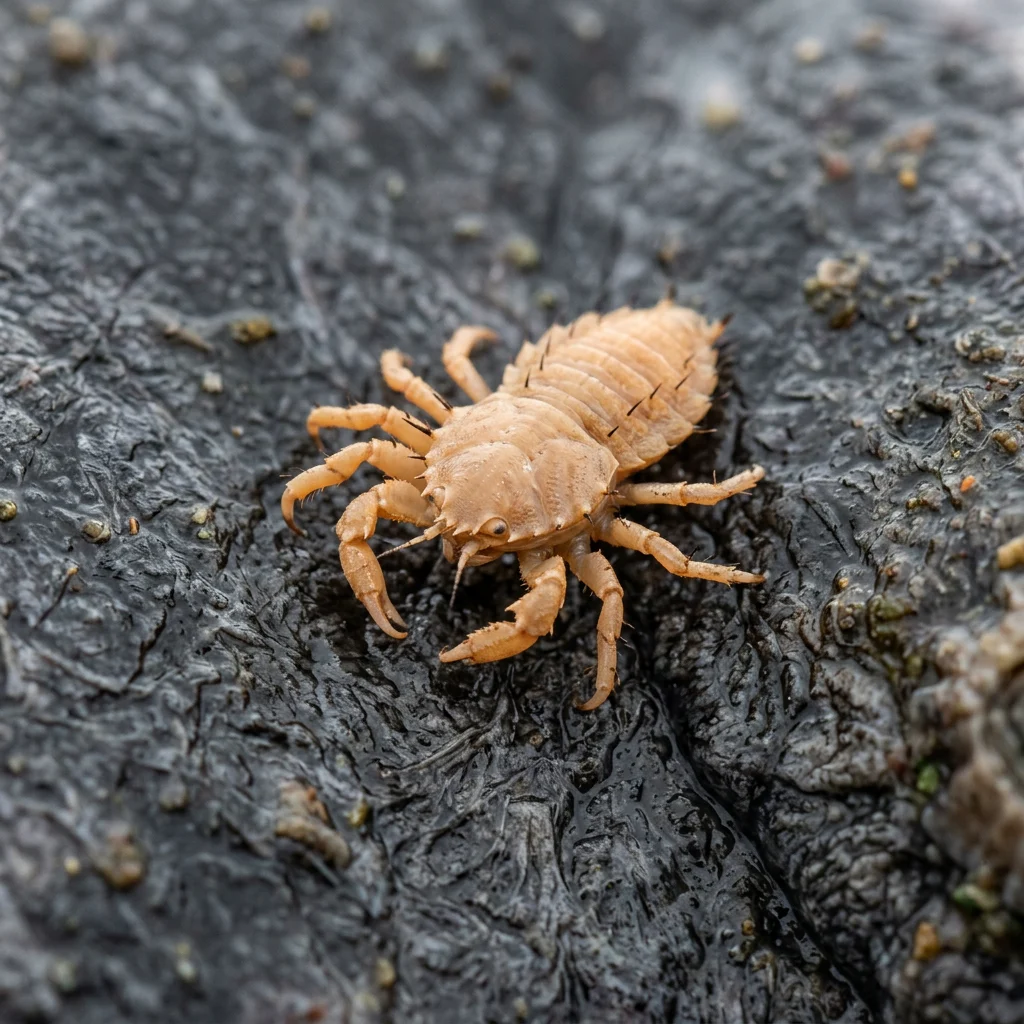
Like tiny flattened crabs with hooked claws.
Cyamids have a short, broad, flattened body, a reduced abdomen and powerful clawed legs that hook into skin. This shape keeps them low against the whale’s body so they are not swept away when the whale swims at speed or breaches. Colour ranges from white and cream to orange and pink, which is why right whale callosities look pale against black skin. Up close they look surprisingly crab-like, but they are related to beach hoppers and skeleton shrimps, not crabs or insects. See types of crustaceans.
Several anatomical features set cyamids apart from free-living amphipods. Their back three pairs of legs end in strong, curved claws, which hook into skin and let the animal hold on even when the whale breaches or swims at speed. Their bodies are flattened from top to bottom, cutting drag, and their mouthparts are reduced and specialised for scraping skin rather than catching floating food. Females carry their eggs in a brood pouch, or marsupium, on the underside of the body. Cyamids cannot swim at all: if one is knocked loose in open water, it almost certainly dies, which is why so much of their biology revolves around never letting go.
What do whale lice eat?

Mostly the whale’s own sloughing skin, plus algae and any wounds.
Whale skin flakes constantly, and cyamids graze it along with diatoms and other algae growing on the surface. They concentrate where the skin is rough or damaged: callosities, barnacle clusters, scars, the genital slit and wounds. Heavy infestations on sick or injured whales are a sign of poor health, which is why researchers note cyamid coverage on stranded or entangled right whales.
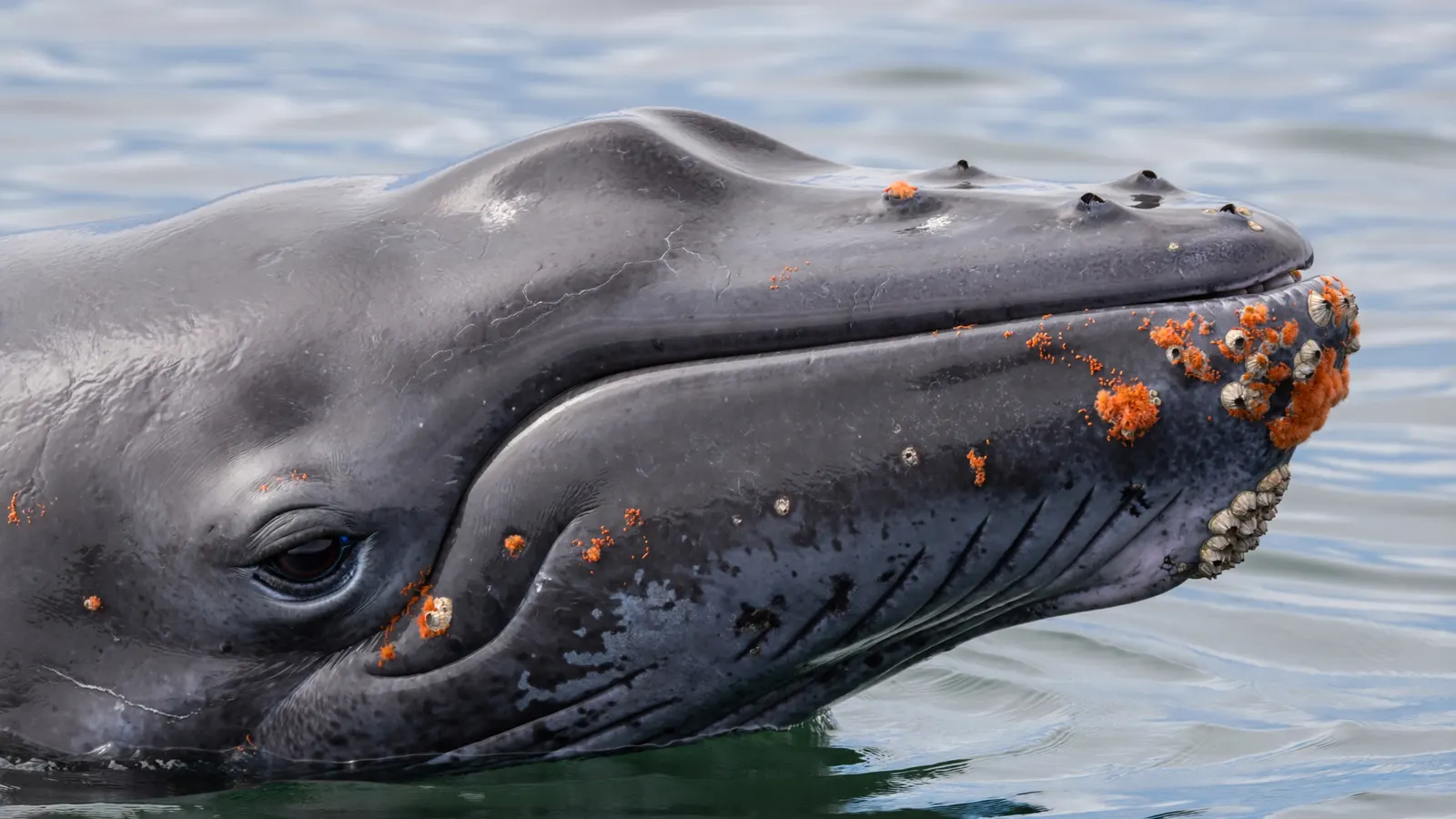
Rowntree found direct evidence of what cyamids eat by looking inside them. On a stranded humpback whale, 99% of 1,011 cyamids collected from black skin on the tailstock had black material in their guts, while 98% of 1,319 collected from white skin on the flipper had white gut contents. In other words, they were eating the outer pigmented layer of the whale’s own skin. Gray whales, which carry heavy loads of barnacles and scars, often show bright orange cyamid patches clustered around barnacle colonies, and whale watchers in the breeding lagoons of Baja California can sometimes see them from the boat.
Do whale lice hurt whales?
On healthy whales, they appear mostly harmless; on injured whales, they may slow healing.
Scientists generally describe cyamids as ectoparasites or commensals. On a healthy whale they may even help by cleaning dead skin. But they can enlarge wounds and colonise injuries, and whales in poor condition often carry very heavy loads. In emaciated North Atlantic right whales, dense orange cyamid patches on the head are a recognised warning sign. See why right whales have callosities.
Why are right whales covered in whale lice?
Right whales carry the most conspicuous cyamid colonies of any whale. Their heads bear callosities, rough patches of thickened skin found on the chin, lip line, above the eyes and on the top of the snout, and these patches are pale only because they are covered in whale lice; the underlying callosity tissue is grey. The pattern of callosities is different on every whale and stays roughly the same through life, so researchers photograph them to identify individuals. Three cyamid species share the right whale’s body. Whitish Cyamus ovalis covers the open surfaces of the callosities, Cyamus gracilis crowds into the deep pits within them, which can be 2 to 4 centimetres deep, and the orange Cyamus erraticus lives on smooth skin, in skin folds and in wounds.
Rowntree’s photographs of southern right whale calves at Península Valdés in Argentina showed that the cyamid community on a calf changes as it grows. Newborn calves develop large orange patches of C. erraticus on their heads, especially on smooth skin with no callosity tissue. When a calf reaches more than about 55% of its mother’s length, at around two months old, those orange patches disappear, and white C. ovalis colonises the developing callosities instead. Rowntree suggested that the orange cyamids are exploiting the fast production of new skin during the calf’s first rapid growth, and move on when growth slows. Estimates of how many cyamids a large whale carries are rough, but figures in the thousands are commonly quoted; one widely repeated estimate is around 7,500 on a single whale.

Which whales have whale lice?
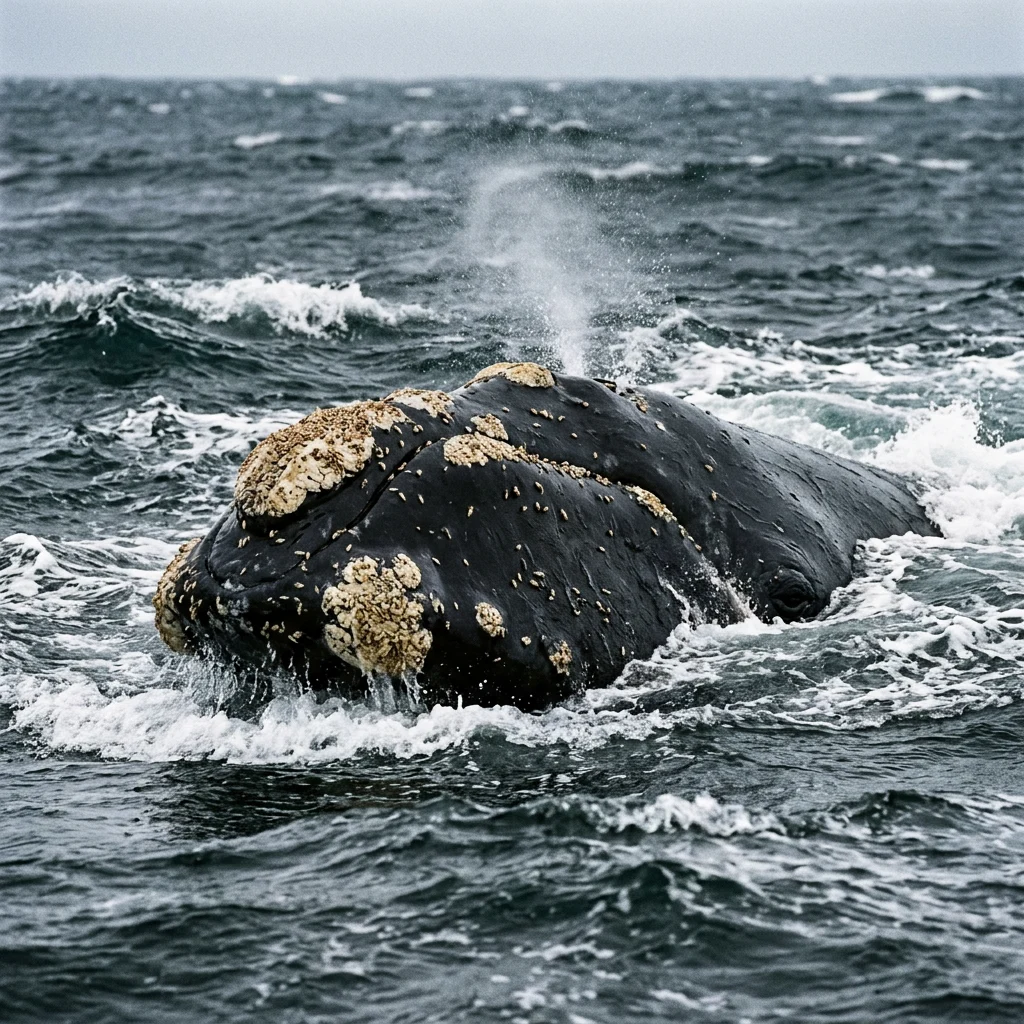
Mostly slower baleen whales, plus some toothed whales.
| Host | Where cyamids live | Notable species |
|---|---|---|
| Right whales | Callosities (white), pits, smooth skin and wounds (orange) | Cyamus ovalis, C. gracilis, C. erraticus |
| Gray whale | Around barnacles and scars | C. scammoni, C. kessleri, C. eschrichtii |
| Humpback | Around barnacles, flippers, genital area | C. boopis |
| Sperm whale | Wounds, head; species differ between the sexes | Neocyamus physeteris (females, calves), C. catodontis (males) |
| Bowhead | Skin and scars | C. ceti |
How do whale lice reproduce?
Whale lice develop directly, without a larval stage. A female broods her eggs and then her young inside the marsupium, and the juveniles emerge as miniature adults that simply crawl onto the surrounding skin. In her study of cyamids from stranded humpback and right whales, the biologist Victoria Rowntree found that some large juveniles still in the brood pouch had whale skin in their guts, suggesting that the young leave the pouch to feed and then return to it, rather like a young kangaroo.
Mating is competitive. Female cyamids can only be fertilised around the time they moult, and because moults are not synchronised, more males than females are ready to mate at any moment. Males therefore practise mate guarding: a male straddles a female, clasping the base of her gills, and holds on until she moults and can be fertilised. On one humpback whale, Rowntree found that about 70% of the cyamids were males and that guarding pairs tended to sit in less crowded areas, apparently to avoid interference from rival males. Cyamids are slow but not sedentary: Rowntree estimated that one could walk the length of a right whale calf in about two hours, and males seemed to roam more than females.
Because there is no swimming stage, a population of whale lice can only spread when two whales touch. Calves pick up cyamids from their mothers almost immediately, and adults exchange them during courtship, mating and the frequent rubbing and rolling of social groups. That dependence on contact is exactly what makes cyamids useful to scientists studying whales.
How do whale lice move between whales?
Only by direct contact.
Females brood their young in a pouch, and juveniles crawl straight onto the host’s skin. A calf picks up its mother’s cyamids in the first days of life, and whales exchange them during mating and close social contact. Because they rarely switch host species, cyamid DNA has been used to study the history and connectivity of right whale populations in different oceans.
How do scientists use whale lice to study whales?
Because whale lice live on one host species, cannot swim and pass only between touching whales, their genes record the history of their hosts. In a 2005 study in Molecular Ecology, Zofia Kaliszewska and colleagues sequenced a mitochondrial gene from the three cyamid species that live only on right whales, sampling lice from North Atlantic, North Pacific and southern right whales. Within each ocean they found high genetic diversity but almost no population structure, implying that the lice, and therefore their hosts, had large populations and frequent contact between whales. The lice on different right whale species had been separated for around 6 million years, a date that helped calibrate when the right whale species themselves diverged. One surprise was that North Pacific C. ovalis nested within the southern population, which implies that at least one right whale crossed the equator in the Pacific within the last one to two million years. The lice showed no sign that right whales had passed through a prolonged population bottleneck in the last half-million years, before modern whaling.
Whale lice are also used to monitor health. For North Atlantic right whales, researchers score photographs of each whale for body condition, skin condition, rake marks and cyamids around the blowholes; heavy cyamid patches on the head are a sign that a whale is in poor condition. A 2016 study in Marine Ecology Progress Series by Rosalind Rolland and colleagues applied this method to 48,560 sightings of 622 identified right whales between 1980 and 2008, tracking how the health of individuals and of the whole population rose and fell over three decades. For a species with only a few hundred animals left, being able to spot a declining whale from a photograph, without touching it, is extremely valuable.
Can whale lice go extinct with their hosts?
Yes, and at least one probably has. Steller’s sea cow, a giant relative of the manatee, was discovered by Europeans in the Commander Islands in 1741 and hunted to extinction by about 1768. It carried its own cyamid, Cyamus rhytinae, which has not been found on any other animal and is presumed to have disappeared with its host. Biologists call this coextinction, and it is a reminder that every whale species carries a small community of specialists whose fate is tied to its own. If the North Atlantic right whale or Rice’s whale were lost, any cyamids found only on them would go too.
Whale lice also shed light on the wider ecology of whale skin. A large whale is a moving island, colonised by barnacles, cyamids, diatoms and, in some cases, remoras and parasitic copepods. Cyamids often settle among barnacles, where the rough shells offer shelter from the water flow, and on gray and humpback whales the two hitchhikers are usually found together. Unlike barnacles, which filter plankton from the passing water and do not feed on the whale, cyamids depend on the whale’s skin itself, which is why biologists usually describe them as ectoparasites, even though healthy whales appear to tolerate them with little harm.
The contrast with seals is instructive. Seals, sea lions, walruses and the North American river otter do carry true lice: insects of the family Echinophthiriidae, a group of sucking lice and the only insects known to parasitise aquatic hosts. Their lives depend on the host’s fur and how it insulates. Fur seals trap a layer of air in their coats, so their lice live in a mostly dry, warm pocket even when the seal is at sea, while lice on blubber-insulated seals must cope with cold water against the skin. Some species cling to the flippers, others to bare skin around the nostrils and eyes. Whales, which lost their fur long ago, have no true lice at all. The niche of a skin-clinging, hitchhiking parasite on cetaceans has been filled instead by crustaceans, which were already adapted to life in seawater. That is why the “lice” on a whale are amphipods while the lice on a seal are insects, even though both groups do a similar job.
The cyamids of gray whales also carry a piece of whaling history in their names. Cyamus scammoni, described by the naturalist William Dall in 1872, honours Charles Melville Scammon, the American whaling captain who found the gray whale’s breeding lagoons in Baja California and later wrote one of the first detailed natural histories of the Pacific’s whales.
Are whale lice real lice?
No. They are amphipod crustaceans, not insects.
Can whale lice live on humans?
No. They are host-specific and cannot survive off whales for long.
What do whale lice eat?
Flaking whale skin, wound tissue and algae on the skin surface.
How big are whale lice?
Roughly 5–25 mm long, depending on species.
Why are right whale callosities white?
Because they are covered in pale cyamids (whale lice).
Do whale lice kill whales?
No, though heavy loads indicate a whale may be sick or injured.
Do dolphins get whale lice?
Yes. Cyamids of the genus Isocyamus live on dolphins and pilot whales, though infestations are usually much lighter than on slow baleen whales.
- Kaliszewska, Z. A. et al. (2005). Population histories of right whales (Cetacea: Eubalaena) inferred from mitochondrial sequence diversities and divergences of their whale lice (Amphipoda: Cyamus). Molecular Ecology 14: 3439–3456.
- Leung, Y. M. (1967). An illustrated key to the species of whale-lice (Amphipoda, Cyamidae). Crustaceana 12: 279–291.
- Würsig, B., Thewissen, J. G. M. & Kovacs, K. M. (eds.) (2018). Encyclopedia of Marine Mammals, 3rd ed. Academic Press.
- Rowntree, V. J. (1996). Feeding, distribution, and reproductive behavior of cyamids (Crustacea: Amphipoda) living on humpback and right whales. Canadian Journal of Zoology 74.
- Rolland, R. M. et al. (2016). Health of North Atlantic right whales Eubalaena glacialis over three decades. Marine Ecology Progress Series 542.
- Pettis, H. M. et al. (2004). Visual health assessment of North Atlantic right whales using photographs. Canadian Journal of Zoology 82.
Blane Perun has been exploring Earth’s oceans and marine life for over 25 years. Founder of TheSea.Org in 1999, underwater photographer, coral aquaculture pioneer, and explorer of 80+ countries.
About Blane Perun → More on Whales →