Alligator Bite Force vs Crocodile Bite Force — The Measured Numbers
The strongest alligator bite ever measured was 2,125 pounds-force (about 9,450 newtons), from a 12.5-foot, 665-pound American alligator named Hercules, in a 2003 study by Gregory Erickson, Kent Vliet and Kristopher Lappin. In 2012 Erickson’s team measured all 23 crocodilian species then recognised and found the strongest bite in a 17-foot saltwater crocodile, at about 3,700 lbf (16,460 N). Body size, not snout shape, explained most of the difference between species, so a crocodile and an alligator of the same size bite with similar force.
Both landmark studies were carried out in Florida, with scientists from Florida State University and the University of Florida, and the 2012 tests took place at the St. Augustine Alligator Farm Zoological Park.
How strong is an alligator’s bite?
An adult American alligator has one of the strongest bites of any animal. The benchmark figure comes from a study published in the Journal of Zoology in August 2003 by Gregory Erickson of Florida State University, Kent Vliet of the University of Florida and Kristopher Lappin of Northern Arizona University. They measured the bite force of more than 40 captive alligators, from about 1 foot to more than 12 feet long.
The strongest bite came from Hercules, a male alligator nearly 12.5 feet long and weighing 665 pounds. He bit down with 2,125 pounds of force, about 9,450 newtons, roughly the weight of a small car concentrated on the teeth. At the time, it was the highest bite force ever measured for a living animal.
The study also showed that bite force increases steadily with body size. Small alligators bite weakly, while large adults bite with enormous force. Because the largest wild alligators exceed 13 feet and can weigh more than Hercules, the strongest alligator bites in the wild are probably somewhat higher than the measured record.
How was alligator bite force measured?
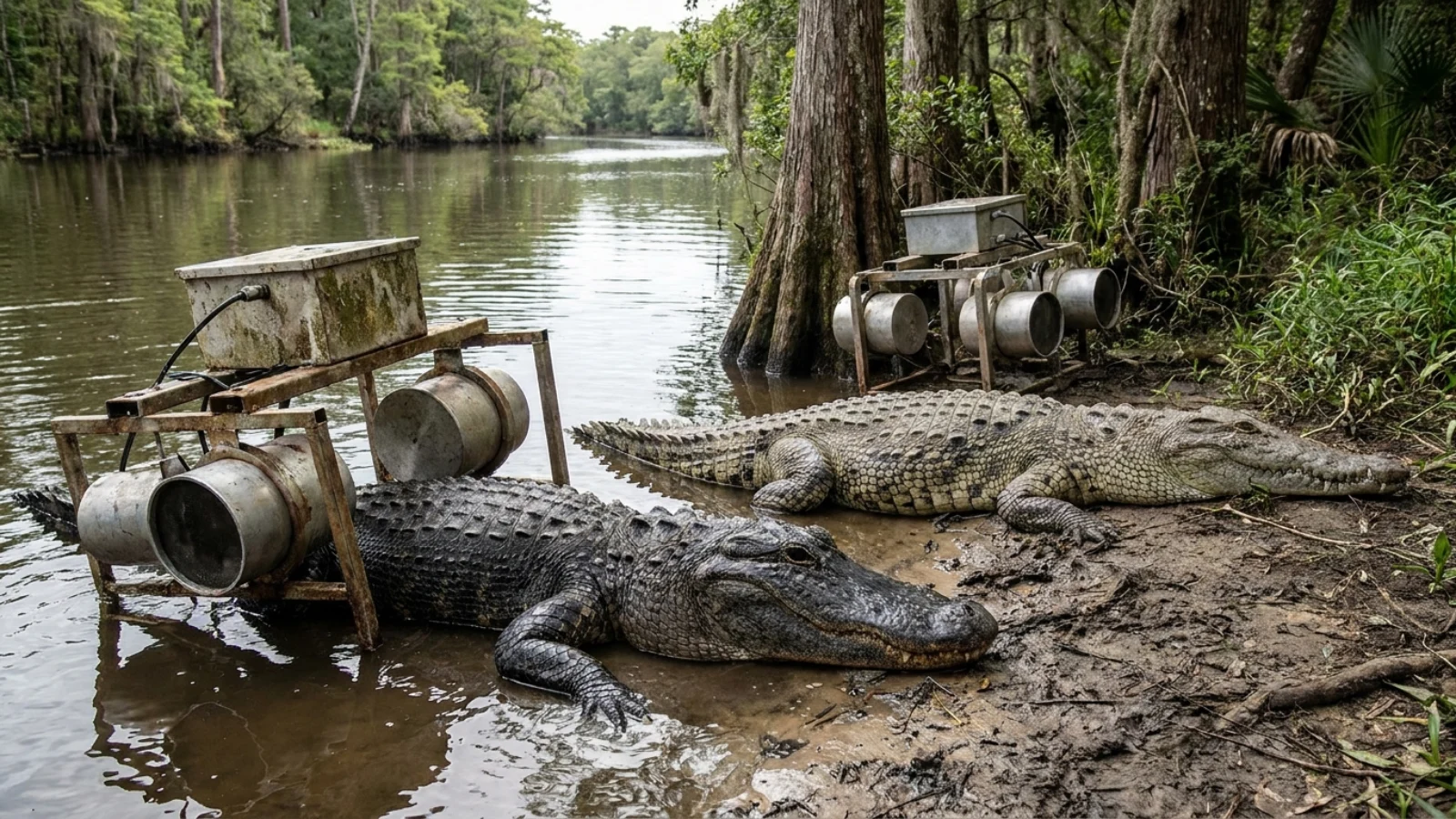
Measuring the bite of a large alligator is not straightforward. In the 2003 study, the researchers used bite bars: metal bars shaped like large tuning forks, fitted with strain gauges that measure how much the metal bends under load. The bars were covered in leather to protect the alligators’ teeth. Each alligator was restrained, and the bar was placed between its back teeth so that it would bite down hard.
For the 2012 study of all crocodilian species, Erickson’s team used a force transducer that he described as a very expensive, very durable, waterproof bathroom scale. Testing a large saltwater crocodile often involved ten or more people to restrain the animal and position the transducer safely.
The researchers measured bites at the back of the jaw, where the force is greatest, because that is where crocodilians crush prey. Bite force at the front teeth is lower, because the front teeth are further from the jaw joint and the muscles have less leverage there.
Which has the stronger bite, an alligator or a crocodile?
The 2012 study, published in PLoS ONE, measured the bite forces of all 23 crocodilian species then recognised, including alligators, caimans, gharials and true crocodiles, most of them at the St. Augustine Alligator Farm Zoological Park in Florida, which keeps every species. The strongest bite came from saltwater crocodiles around 17 feet long, at about 3,700 pounds-force, or 16,460 newtons. That is the strongest bite force ever directly measured in a living animal.
The most important finding was that bite force differences between species were explained mainly by body size, not by the shape of the jaws or teeth. A narrow-snouted gharial, a broad-snouted alligator and a saltwater crocodile of the same body mass bite with broadly similar force. Saltwater crocodiles have the highest bites simply because they grow the largest.
So, in practice, the largest crocodiles bite harder than the largest alligators, because crocodiles such as the saltwater and Nile crocodiles grow much bigger. Size for size, however, the American alligator’s bite is comparable to that of a crocodile. Our alligator vs crocodile guide covers the other differences.
How does an alligator’s bite compare with other animals?
In the 2003 study, the researchers compared their alligator results with published bite forces for other animals. A lion bites with roughly 940 pounds-force and a spotted hyena with about 1,000. A Labrador retriever bites with about 125 pounds-force. A human’s maximum bite at the molars is about 170 pounds-force, roughly one-thirteenth of a large alligator’s.
The only shark tested in comparable studies at the time, a dusky shark, bit with about 330 pounds-force, although larger sharks such as the great white are thought to bite much harder. A 2008 computer model estimated that a 21-foot great white shark might bite with nearly 4,000 pounds-force, but that figure has never been measured directly.
Among extinct animals, scientists have used scaling and modelling to estimate the bites of giants such as Tyrannosaurus rex and the giant crocodile Deinosuchus. These estimates are far higher than any living animal, but they are calculations rather than measurements, and different studies give very different numbers.
Why do alligators have such a strong bite?
Alligators and other crocodilians have a huge mass of jaw-closing muscles, especially a muscle at the back of the skull called the pterygoideus, which bulges at the base of the jaw in big adults. These muscles are arranged to deliver maximum force when the jaws are nearly closed, which is exactly when an alligator is clamping down on prey.
A strong bite is essential to the way crocodilians feed. They catch and hold prey with the jaws alone, often struggling animals much larger than themselves, and must hold on while dragging them into the water. They also crush turtle shells, crab shells and bones, which requires very high forces at the back teeth.
The skull itself is built to withstand these forces. The bones of the snout and palate are thick and reinforced, and the secondary palate, a bony roof that separates the nasal passages from the mouth, strengthens the skull. Our page on the saltwater crocodile skull explains how the skull handles such extreme loads.
Why is an alligator’s jaw weak at opening?
Here is the paradox. Although alligators can close their jaws with enormous force, the muscles that open the jaws are small and relatively weak. That is because opening the jaws requires only enough force to lift the lower jaw, which is aided by gravity when the head is raised. Nature has invested in closing power, not opening power.
This is why wildlife officers and trappers can hold an alligator’s mouth shut with their hands or a few wraps of electrical tape once the jaws are closed. It is also the basis of the famous alligator-wrestling shows in Florida, in which handlers hold the jaws closed. Do not try it: the hard part is getting the jaws closed in the first place, and an alligator’s head can swing sideways with great speed.
The same weakness means that if an alligator ever grabs something, the strongest force it can apply is in closing the jaws. Trappers who work with nuisance alligators in Florida focus on controlling the head and keeping the jaws shut, because once taped, a big alligator is much safer to handle.
Does bite force grow as an alligator grows?
Yes, and dramatically. One of the main aims of the 2003 study was to understand how bite force changes from hatchling to adult, and the answer was that it rises much faster than body length. A one-foot hatchling bites with only a tiny fraction of an adult’s force, enough to catch insects and small fish but not to hurt much more than a finger. Juveniles of 2 to 4 feet bite hard enough to draw blood and grip a fish firmly, which is why even small alligators should never be handled. By the time an alligator reaches 6 feet, its bite can crush turtles and crabs, and the largest adults bite with more than a ton of force.
This happens because muscle force depends on the cross-sectional area of the muscles, and the head of an alligator becomes broader and more heavily muscled as the animal grows. Large males develop especially massive jaw muscles at the back of the head, giving old bulls their characteristic wide, heavy heads.
The change in bite force goes hand in hand with the change in diet described in our guide to what alligators eat. As bite force increases, alligators can tackle harder and larger prey, moving from insects and snails to fish, then to turtles and mammals. A large alligator’s ability to crack turtle shells, which juveniles cannot do, opens up a food source that few other predators in Florida’s lakes can use.
The study also noted that alligators of the same size bite with similar force regardless of sex. Males bite harder overall only because they grow larger than females.
Are bite force numbers in pounds or psi?
Popular articles often quote crocodile bite forces in “psi”, pounds per square inch, but that is a unit of pressure, not force. The figures measured in these studies are forces, given in newtons or pounds-force. Pressure depends on the area over which a force is applied: the same bite produces far higher pressure at the sharp tip of a single tooth than across a broad, flat surface.
The 2012 study measured both total bite force and the pressure under individual teeth, and showed that the narrow tips of crocodilian teeth concentrate force into very high pressures, which helps them puncture tough hides and shells. When comparing animals, it is best to compare forces in newtons or pounds-force, measured at the same position in the jaw, rather than mixing force and pressure figures.
Can an alligator bite through bone?
Yes. An adult alligator’s bite can crush the shells of large turtles, the bones of deer and wild hogs, and the skulls of many prey animals. Alligators often swallow small prey whole and use their bite to crush larger prey before swallowing it in pieces.
The teeth are not designed for cutting. Alligator teeth are conical pegs, built for gripping and puncturing, and they are replaced throughout life. A 2013 study led by Ping Wu and Cheng-Ming Chuong, published in PNAS, found that each of an alligator’s roughly 80 tooth positions can be replaced up to about 50 times, so a long-lived alligator may go through a couple of thousand teeth. To dismember large prey, alligators combine their bite with the death roll, spinning their bodies to twist off chunks of meat, rather than slicing with their teeth.
This bite is why alligator bites on people can cause severe crushing injuries, broken bones and deep punctures, and why any alligator bite, even from a small animal, needs prompt medical attention because of the risk of infection.
How does a crocodile’s bite compare with Deinosuchus?
The prehistoric crocodylian Deinosuchus, which lived in North America in the Late Cretaceous and fed on dinosaurs, is one of the animals scientists have tried to estimate using living crocodilians as a guide. Because the 2012 study showed that bite force scales predictably with body size, Erickson’s team could extrapolate from living species to large extinct ones.
On that basis, they estimated that a large Deinosuchus could have bitten with forces in the tens of thousands of pounds, far above any living animal. National Geographic reported a figure of up to about 23,100 pounds-force for Deinosuchus. Scaling up the results from 17-foot saltwater crocodiles to 20-foot animals gave estimates of about 7,700 pounds-force, comparable to the lower estimates for T. rex.
These figures are informed estimates. They show that crocodilians, ancient and modern, have some of the most powerful bites in the history of life, and that the basic design of their jaws has worked for more than 100 million years.
How dangerous is an alligator bite to people in Florida?
Alligator bites on people in Florida are uncommon, but when they happen, the force involved can cause severe injuries. The Florida Fish and Wildlife Conservation Commission reports an average of about eight unprovoked bites a year serious enough to need medical treatment, and 26 fatal bites between 1948 and 2022.
Most bites happen when people swim or wade in fresh water at dusk or at night, or when they approach or try to handle alligators. Pets are also at risk at the water’s edge. The FWC advises people to swim only in designated areas during daylight, keep pets away from the water and never feed alligators. Our alligators in Florida guide has the full safety advice.
What is the bite force of an alligator?
The strongest measured was 2,125 pounds-force (about 9,450 N), from a 12.5-foot American alligator in a 2003 Florida study.
Is a crocodile’s bite stronger than an alligator’s?
The largest crocodiles bite harder because they grow larger. Size for size, alligators and crocodiles bite with similar force.
What animal has the strongest bite?
The saltwater crocodile, at about 3,700 pounds-force (16,460 N), the strongest bite ever measured in a living animal.
Can you hold an alligator’s mouth shut?
Yes. The jaw-opening muscles are weak, so a closed mouth can be held or taped shut. Never try it with a wild alligator.
How does an alligator’s bite compare to a shark’s?
The only shark measured directly in early studies bit with about 330 lbf. Models suggest great whites may bite harder, but this has not been measured.
How does an alligator’s bite compare to a lion’s?
A large alligator bites about twice as hard as a lion, which manages roughly 940 lbf.
How strong is a human bite?
About 170 pounds-force at most, roughly one-thirteenth of a large alligator’s bite.
Can an alligator bite break bones?
Yes. Large alligators crush turtle shells and the bones of deer and hogs.
- Erickson, G.M., Lappin, A.K. & Vliet, K.A. (2003), “The ontogeny of bite-force performance in American alligator”, Journal of Zoology 260; University of Florida News (2 September 2003).
- Erickson, G.M. et al. (2012), “Insights into the ecology and evolutionary success of crocodilians revealed through bite-force and tooth-pressure experimentation”, PLoS ONE 7(3).
- National Geographic (15 March 2012), “Crocodiles have strongest bite ever measured”.
- Florida Fish and Wildlife Conservation Commission: alligator bite statistics.
Blane Perun has been exploring Earth’s oceans and marine life for over 25 years. Founder of TheSea.Org in 1999, underwater photographer, coral aquaculture pioneer, and explorer of 80+ countries.
About Blane Perun →