Mermaid’s Purse — The Skate Egg Case on Your Beach
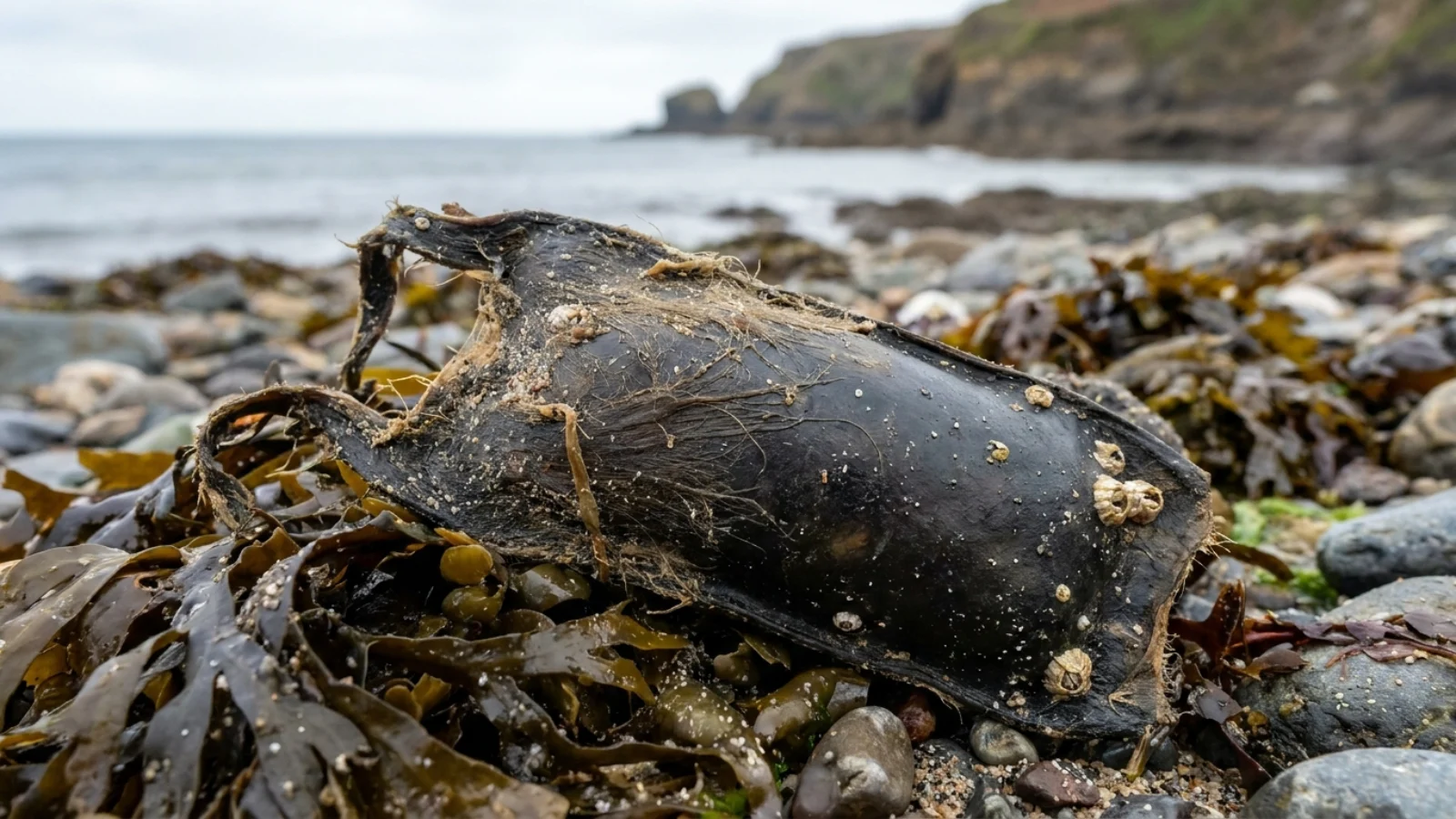
A mermaid’s purse is the tough, leathery egg case of a skate or an egg-laying shark. Skate cases are flat, rectangular pouches with a pointed horn at each corner; inside, a single embryo (occasionally several) grows on a yolk sac for months — about 5–6 months for a little skate and up to 18 months for the giant flapper skate — before a fully formed miniature skate swims out. The cases found on beaches are almost always empty, washed ashore after hatching. On Florida beaches, most belong to the clearnose skate.
What is inside a mermaid’s purse?
A living skate or shark embryo, attached to a yolk sac that feeds it until it hatches. Once the young fish leaves, the case is empty.
After internal fertilisation, a female skate lays her eggs in pairs, each wrapped in a capsule built by a shell gland in the oviduct. The case starts soft and amber, then hardens and darkens in seawater. Females anchor cases in sand, gravel or seaweed, using sticky fibres and the corner horns. Small slits at the horns let seawater in, and the embryo beats its tail to pump fresh, oxygenated water through the case. Over the following months it absorbs the yolk, develops its disc and tail, and finally pushes out through one end of the case as a perfect miniature of its parents. The Shark Trust notes that cases found on the beach are almost always empty, while cases still underwater may contain a living embryo and should be left alone.
How long does it take a skate to hatch?
Anywhere from about five months to a year and a half, depending on the species and water temperature.
| Species | Case length | Development time | Where |
|---|---|---|---|
| Little skate, Leucoraja erinacea | 4.6–6.3 cm | ~5–6 months (aquarium; longer in the wild) | Nova Scotia to North Carolina |
| Clearnose skate, Rostroraja eglanteria | Small, dark brown, translucent | Several months | Atlantic & Gulf coasts incl. Florida |
| Flapper skate, Dipturus intermedius | 20–25 cm | Over a year, up to 18 months | Scotland, northern North Sea |
Cold water slows development, which is why deep- and cold-water skates take the longest. A female little skate lays roughly 10–35 eggs a year, while a clearnose skate can lay up to 66 cases in a breeding season. Even so, egg-laying is a slow way to reproduce compared with bony fish that release millions of eggs, which is part of why big skates are so easily overfished.
How do you identify a mermaid’s purse?
Start with the shape. Four horns at the corners means a skate; long curling tendrils means a catshark; a spiral screw shape means a horn or bullhead shark.
Skate cases are flattened rectangles with a stiff horn at each corner; the length of the horns, the width of the case, whether it has a fibrous “keel” along the edges and its overall size identify the species. Egg-laying sharks make different shapes. Catshark cases are narrower and trail long, curly tendrils that wrap around seaweed. Horn and bullhead sharks lay distinctive cone-shaped cases with a spiral flange, which the mother wedges into rock crevices. Chimaeras, the ghost sharks, lay long, spindle-shaped cases. Use the size and shape first, then compare against a regional ID guide; the UK-based Shark Trust publishes guides and runs the Great Eggcase Hunt, where volunteers have recorded more than 600,000 eggcases since 2003.
Where can you find a mermaid’s purse in Florida?
Look along the wrack line after onshore winds and winter fronts, especially on Gulf beaches with lots of shell and seaweed.
On Florida beaches the most likely source is the clearnose skate, which lives on sandy bottoms close to shore, breeds inshore, and lays leathery dark-brown, translucent cases that Florida wildlife officials note often wash up as mermaid’s purses. They turn up in the tangles of seaweed and shell that line Southwest Florida beaches, the same wrack lines shellers comb on Sanibel and Captiva. Look among the debris where shelling is best, and you may find them beside lightning whelk egg strings, another beach “mystery” that is actually a nursery.
What should you do if you find a mermaid’s purse?
Check whether it is empty, photograph it beside something for scale, and record it. If it feels heavy or full and is still in the water, leave it.
- Empty and dry? It is fine to keep. Hold it to the light: an open end or slit means the young skate has hatched.
- Plump and heavy? It may still contain an embryo. Return it to the sea, ideally weighted among seaweed in the shallows.
- Record it. Photograph the case with a ruler or coin and log it with a citizen-science project; records help map nursery grounds.
- Don’t take cases from underwater nursery sites, where protected species such as the flapper skate may be developing.
Records from the public really matter: in Scotland, egg case finds helped researchers locate nursery grounds of the Critically Endangered flapper skate. For more about the animals that make these cases, see skates, skate vs stingray and, on the shark side, do sharks lay eggs?
Is a mermaid’s purse an egg?
Yes. It is the protective case around a skate or shark egg. The embryo develops inside it on a yolk sac until it hatches.
Are mermaid’s purses alive?
The case itself is not alive, but one still underwater may contain a living embryo. Cases washed up on the beach are almost always empty.
Which animals lay mermaid’s purses?
All skates, some sharks (such as catsharks, horn sharks and bullhead sharks) and chimaeras. Stingrays do not; they give birth to live young.
How long does a skate egg take to hatch?
From about 5–6 months for the little skate to more than a year, up to 18 months, for the flapper skate.
Can I keep a mermaid’s purse?
Empty cases found on the beach are generally fine to keep. Leave any case that seems full or is still in the water.
Why is it called a mermaid’s purse?
Its small, pouch-like shape with corner “handles” looked like a purse to beachcombers, who credited it to mermaids.
What does a shark egg case look like?
Catshark cases are narrow with long curly tendrils; horn and bullhead shark cases are cone-shaped with a spiral flange.
Are there mermaid’s purses in Florida?
Yes. Clearnose skate egg cases wash up on Florida beaches, especially in seaweed wrack after onshore winds.
Blane Perun has been exploring Earth’s oceans and marine life for over 25 years. Founder of TheSea.Org in 1999, underwater photographer, coral aquaculture pioneer, and explorer of 80+ countries. Based in Southwest Florida, where stingrays work the grass flats and smalltooth sawfish still raise their young in the mangroves of Charlotte Harbor and the Ten Thousand Islands.
About Blane Perun → All Rays, Skates & Sawfish →