What Do Crocodiles Eat? — Diet, Hunting and Digestion by Species
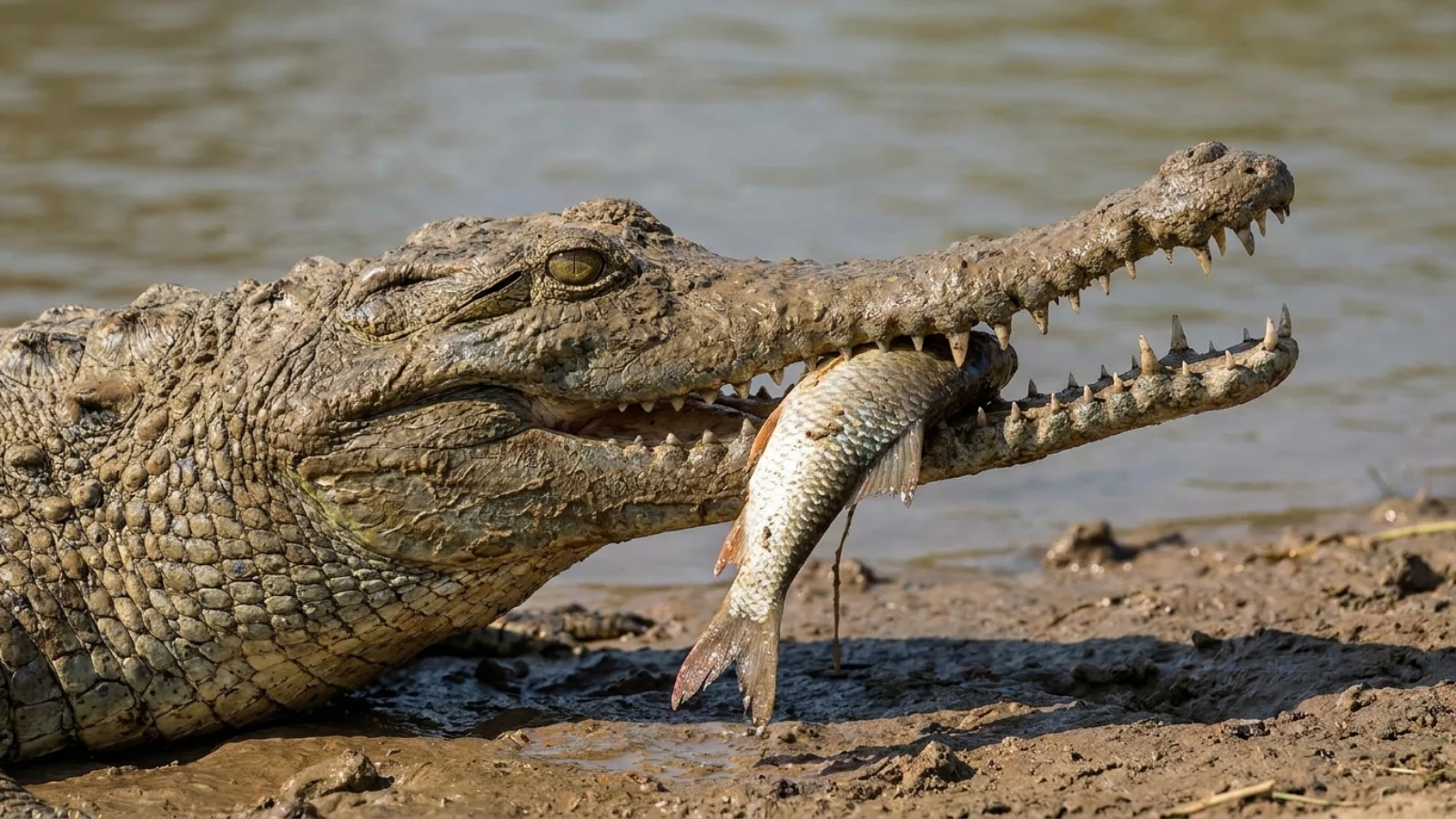
Crocodiles are carnivores that eat almost any animal they can overpower. Hatchlings eat insects, spiders, small crabs, frogs and tiny fish. Adults of most species eat mainly fish, crustaceans, turtles, birds and small to medium mammals. The largest species, the Nile and saltwater crocodiles, also take big mammals such as wildebeest, zebra, buffalo, wild pigs and cattle, and saltwater crocodiles have been seen eating sharks. Narrow-snouted species such as the freshwater crocodile and slender-snouted crocodiles are mostly fish eaters.
A crocodile’s snout is a good guide to its diet. Long, narrow snouts sweep quickly through water to catch fish; broad, heavy snouts are built to grab and hold large animals.
What do crocodiles eat?
All crocodiles are carnivores, and all are opportunists. They eat whatever animals are common in their habitat and small enough to catch and swallow or tear apart. The list of recorded prey is enormous: insects, spiders, snails, crabs, shrimp, fish of every size, frogs, snakes, lizards, turtles, birds from kingfishers to pelicans, rats, monkeys, pigs, deer, antelope, zebra, buffalo, domestic animals, other crocodiles and, occasionally, people.
What a particular crocodile eats depends on three things: its size, its species and where it lives. Size is the most important. A crocodile’s diet broadens as it grows, because bigger jaws can handle bigger prey, and very large crocodiles add big mammals to the menu. Species matters because crocodiles differ in snout shape and hunting style. Habitat matters because a crocodile in a mangrove estuary meets crabs, mudskippers and mullet, while one in an African savanna river meets wildebeest and zebra at the crossing points.
Despite their reputation, most crocodiles eat mainly small and medium-sized prey most of the time. Fish, crustaceans and small vertebrates make up the bulk of the diet of nearly every species. Large mammals are dramatic but occasional meals.
What do baby crocodiles eat?
Newly hatched crocodiles are 20 to 30 cm long, depending on species, and they begin feeding within days of hatching, living at first on the remains of the egg yolk absorbed into their bodies. Their first prey is small: beetles, dragonflies, grasshoppers and other insects, spiders, small crabs, shrimp, snails, tadpoles, frogs and tiny fish. They hunt mostly at night, snapping at prey at the water’s edge or among floating vegetation.
As juveniles grow, they take larger crabs, frogs and fish, and then small reptiles, birds and mammals. In estuaries, young saltwater crocodiles feed heavily on crabs and prawns, while in freshwater swamps juveniles eat insects, frogs and fish.
Young crocodiles are vulnerable to many predators, including birds of prey, monitor lizards, large fish and other crocodiles, so they spend much of their time hidden and feed when they can do so safely. Our page on the life cycle of a crocodile covers each stage from egg to adult.
What do Nile crocodiles eat?
The Nile crocodile is famous for ambushing large mammals at river crossings, but its diet is dominated by fish for much of its life. Studies in southern and eastern Africa have found that juveniles eat mainly insects and other invertebrates, subadults eat mainly fish, and large adults eat fish plus a substantial share of mammals and birds.
The large mammals taken by adult Nile crocodiles include antelope such as impala, waterbuck and kudu, wildebeest and zebra during the great migrations in East Africa, warthogs, buffalo and, occasionally, young hippos, giraffe and big cats that come to drink. During the wildebeest migration across the Mara River in Kenya and Tanzania, crocodiles gather at crossing points and take animals as they swim, and the herds provide food for months.
Nile crocodiles also eat other crocodiles, birds such as herons and cormorants, turtles and carrion. They are also responsible for many attacks on people in Africa, as described in our article on Gustave, the giant Nile crocodile of Burundi.
What do saltwater crocodiles eat?
Saltwater crocodiles have one of the broadest diets of any predator. Juveniles in estuaries and mangroves eat crabs, prawns, insects, mudskippers and small fish. As they grow, they take larger fish, including barramundi and mullet, turtles, snakes, water birds, and mammals such as wallabies, flying foxes, wild pigs, water buffalo and cattle.
Saltwater crocodiles are also among the few animals that regularly eat sharks. Bull sharks enter the same rivers and estuaries as saltwater crocodiles in northern Australia, and crocodiles have been photographed eating them. Large salties have also been recorded taking sea turtles, dugongs and even other large crocodiles. Their bite, measured by Gregory Erickson and colleagues in 2012 at about 16,400 newtons (3,700 pounds-force), is the strongest of any living animal measured.
Like Nile crocodiles, saltwater crocodiles can be dangerous to people, especially in northern Australia, Indonesia, Malaysia and the Solomon Islands. Our saltwater crocodile profile covers their behaviour in depth.
Which crocodiles eat mainly fish?
Crocodiles with long, narrow snouts are specialists in catching fish. The Australian freshwater crocodile, the two slender-snouted crocodiles of Africa, the gharial and the false gharial of Southeast Asia all have slim jaws that can be swept sideways through the water with little resistance, snapping shut on fish that pass close by.
These narrow-snouted species do eat other prey, including insects, frogs, crustaceans, birds and small mammals, but fish dominate their diets. Their jaws are not strong enough to tackle large mammals, which is why they are generally considered harmless to people unless provoked.
Broad-snouted species, such as the Nile, saltwater, mugger, American and Morelet’s crocodiles, have a more varied diet. Their heavy jaws can hold struggling mammals and crush turtle shells, so they can take advantage of a much wider range of prey.
What do muggers and other Asian crocodiles eat?
The mugger, or marsh crocodile, of India, Sri Lanka, Nepal, Pakistan and Iran is a broad-snouted generalist. It eats fish, frogs, snakes, turtles, birds and mammals ranging from rodents and monkeys to deer and, occasionally, domestic animals. In the dry season, when wetlands shrink, muggers may travel overland between pools and eat whatever they find concentrated in the remaining water. Our marsh crocodile profile covers the species.
Muggers are also one of the two crocodilians in which researchers have reported apparent lure use. In 2013, Vladimir Dinets and colleagues described muggers in India and American alligators in the United States lying near water-bird colonies during the nesting season with sticks balanced across their snouts. Wading birds searching for nesting material approached the sticks, and the crocodilians lunged. The behaviour was seen mainly when birds were collecting sticks, which suggests that it is a deliberate hunting strategy.
Smaller Asian crocodiles, such as the Siamese and Philippine crocodiles, eat mostly fish, frogs, snakes, small mammals and invertebrates. Because these species are now rare and live in small, scattered populations, much less is known about their diets in the wild than about those of the Nile and saltwater crocodiles.
How do crocodiles hunt?
Most crocodiles are ambush predators. They lie still in the water, often with only their eyes, ears and nostrils showing, and wait for prey to come within reach. When it does, they lunge with astonishing speed, seizing the animal in their jaws. Small prey is swallowed whole. Larger prey is dragged into the water and held under until it drowns.
Crocodiles cannot chew. To deal with a large carcass, they bite down and spin on their long axis in a manoeuvre known as the death roll, twisting off chunks of meat. Several crocodiles may feed on the same carcass, each gripping it and rolling in turn, which helps them tear it apart.
Crocodiles are also sensitive to vibrations in the water. Their skin, especially around the jaws, carries thousands of small sensory pits, called integumentary sensory organs, that detect tiny pressure changes. These allow crocodiles to locate prey in murky water and at night, when most species do much of their hunting.
Do crocodiles hunt in groups?
Crocodiles are often thought of as solitary hunters, but there is growing evidence that they sometimes cooperate. In 2014, Vladimir Dinets of the University of Tennessee reviewed reports of coordinated hunting in crocodilians, published in Ethology Ecology & Evolution.
The examples included crocodiles circling a school of fish, tightening the ring into a dense ball and then taking turns to dart through the centre and catch fish. The nineteenth-century explorer Nicholas Miklouho-Maclay described a large saltwater crocodile splashing its tail to drive fish towards shore, where smaller crocodiles waited in the shallows. Another report described a large crocodile scaring a pig into a lagoon where two smaller crocodiles lay in ambush.
Perhaps the most detailed observation came from the Okefenokee National Wildlife Refuge in Georgia, where in 2011 about 60 American alligators gathered in a boat basin and took turns herding fish into the shallows against the bulkheads, with a third to a half of the group resting at any time and rotating in. These reports suggest that crocodilians are more socially sophisticated than once thought.
How do crocodiles digest bones and shells?
Crocodiles swallow large pieces of prey, including bones, shells, scales, feathers and hair, so they need a powerful digestive system. Their stomachs produce extremely acidic juices that dissolve bone and turtle shell, and they digest a much larger share of bone than most mammals can. Hair, feathers, hooves and horns are harder to digest, and crocodiles sometimes regurgitate them in pellets, as owls do.
Crocodiles also swallow stones, called gastroliths. These are often found in their stomachs and may help grind up food in the muscular part of the stomach, act as ballast in the water, or both. Scientists still debate their main function.
Digestion is temperature dependent. After a big meal, crocodiles often bask to raise their body temperature, which speeds up digestion. In cold weather, digestion slows, and crocodiles stop eating, because food could rot in the stomach before it is digested.
How often do crocodiles eat?
Much less often than mammals. Because crocodiles are cold-blooded and spend most of their time resting, they need only a fraction of the food that a mammal of the same weight would need. Large adults may eat once a week or less, and a very large meal can sustain a big crocodile for weeks.
Crocodiles can also survive long periods without any food. Large adults can go for months without eating during dry seasons, cold spells or periods when prey is scarce, living off fat stored in the tail and around the organs. Small juveniles, which have less stored fat and grow quickly, need to feed more often.
Feeding is also seasonal. In regions with a wet and a dry season, crocodiles often feed most heavily when falling water levels concentrate fish and force land animals to drink at the few remaining pools, and eat little during the breeding season, when males are busy defending territories and females are guarding nests. This ability to fast is one reason crocodiles survive conditions that would kill warm-blooded predators, and may have helped their ancestors survive the mass extinction 66 million years ago.
Can eating the wrong prey kill a crocodile?
Yes. In northern Australia, the spread of the invasive cane toad has caused mass deaths of freshwater crocodiles. Cane toads produce powerful toxins in glands on their skin, and crocodiles that eat them can die quickly. Australian crocodiles had never encountered this toxin before the toads arrived.
A study published in 2008 in Biological Conservation by Mike Letnic, Jonathan Webb and Richard Shine compared crocodile numbers before and after the toads arrived at four sites in the Northern Territory. Numbers fell by an average of 45%, ranging from 15.6% at one lagoon to 76.9% at the junction of the Victoria and Wickham rivers. Before the invasion, no dead crocodiles had been seen; afterwards, the researchers found 34.
The cane toad is also established in Florida, including the Naples and Fort Myers area, where it is a hazard to pets. There is no evidence that it has harmed Florida’s crocodiles or alligators, which share a long evolutionary history with toxic toads in the Americas.
What do American crocodiles eat in Florida?
Florida’s American crocodiles live in brackish and saltwater habitats in the south of the state, and their diet reflects that. Young crocodiles eat insects, small crabs and small fish in the mangroves. Adults eat fish such as mullet, crabs, turtles, wading birds and small mammals, including raccoons.
American crocodiles are shy and rarely attack people. They usually feed at night and avoid areas of human activity, although some become used to people around marinas and canals. As with alligators, feeding wild crocodiles in Florida is illegal. Our American crocodile profile covers Florida’s crocodiles, and what do alligators eat? covers their freshwater neighbours.
What do crocodiles eat?
Mainly fish, crabs, turtles, birds and mammals. Small crocodiles eat insects and frogs; the largest take animals as big as buffalo.
Do crocodiles eat sharks?
Yes. Saltwater crocodiles have been photographed eating sharks, including bull sharks in Australian rivers.
What do baby crocodiles eat?
Insects, spiders, small crabs, shrimp, tadpoles, frogs and tiny fish.
How long can a crocodile go without eating?
Large adults can go several months without food, living on fat stored in the tail and body.
Do crocodiles eat people?
Nile and saltwater crocodiles sometimes do. Most other species rarely or never attack people.
Can crocodiles digest bones?
Yes. Their very acidic stomach juices dissolve bone and shell, although hair, feathers and hooves may be regurgitated.
Do crocodiles hunt together?
Sometimes. Observations show crocodiles and alligators herding fish and taking turns to feed.
Do crocodiles eat plants?
Not as a main food, but many crocodilian species have been recorded eating fruit.
- Dinets, V. (2014), “Apparent coordination and collaboration in cooperatively hunting crocodilians”, Ethology Ecology & Evolution; Sci.News summary.
- Letnic, M., Webb, J.K. & Shine, R. (2008), “Invasive cane toads cause mass mortality of freshwater crocodiles in tropical Australia”, Biological Conservation 141: 1773–1782.
- Erickson, G.M. et al. (2012), “Insights into the ecology and evolutionary success of crocodilians revealed through bite-force and tooth-pressure experimentation”, PLoS ONE.
- Platt, S.G. et al. (2013), “Frugivory and seed dispersal by crocodilians”, Journal of Zoology.
- IUCN SSC Crocodile Specialist Group: species accounts.
Blane Perun has been exploring Earth’s oceans and marine life for over 25 years. Founder of TheSea.Org in 1999, underwater photographer, coral aquaculture pioneer, and explorer of 80+ countries.
About Blane Perun →