Gustave — The Man-Eating Nile Crocodile of Burundi
Gustave is a giant male Nile crocodile that lives, or lived, in the Ruzizi River and the northern shores of Lake Tanganyika in Burundi. He is believed to be more than 6 m (20 ft) long, to weigh over 900 kg and to have hatched around the 1950s. Local stories blame him for 200 to 300 deaths, but a more careful estimate puts the toll at about 60 or fewer. A two-year effort to capture him in the early 2000s failed, he was last reliably reported in 2009, and claims of his death in 2019 have never been confirmed.
French herpetologist Patrice Faye, who began studying the crocodile in the late 1990s, named him Gustave. Faye spent years collecting reports of attacks and became the central figure in the attempt to catch him.
Who is Gustave the crocodile?
Gustave is the best-known individual crocodile in the world, a male Nile crocodile from Burundi in central Africa that became famous in the early 2000s as a suspected serial man-eater. He lives in the area where the Ruzizi River enters the northern end of Lake Tanganyika, near the capital Bujumbura. That stretch of river and lakeshore is home to fishermen, farmers and villagers who wash clothes and collect water at the water’s edge, and stories of a gigantic crocodile that took people from the shore have circulated there for decades.
Gustave came to international attention through the work of Patrice Faye, a French naturalist who settled in Burundi and began following the crocodile in the late 1990s. Faye collected accounts of attacks, interviewed survivors and families, and became convinced that a single, unusually large crocodile was responsible for many of them. His research drew in National Geographic and a film crew, leading to the 2004 PBS documentary Capturing the Killer Croc. Gustave was also the loose inspiration for the 2007 horror film Primeval.
Unlike many monster stories, Gustave is a real animal. He has been seen and photographed, and his distinctive scars make him identifiable. What is far less certain is the scale of the legend: his exact size, his age and above all the number of people he has killed.
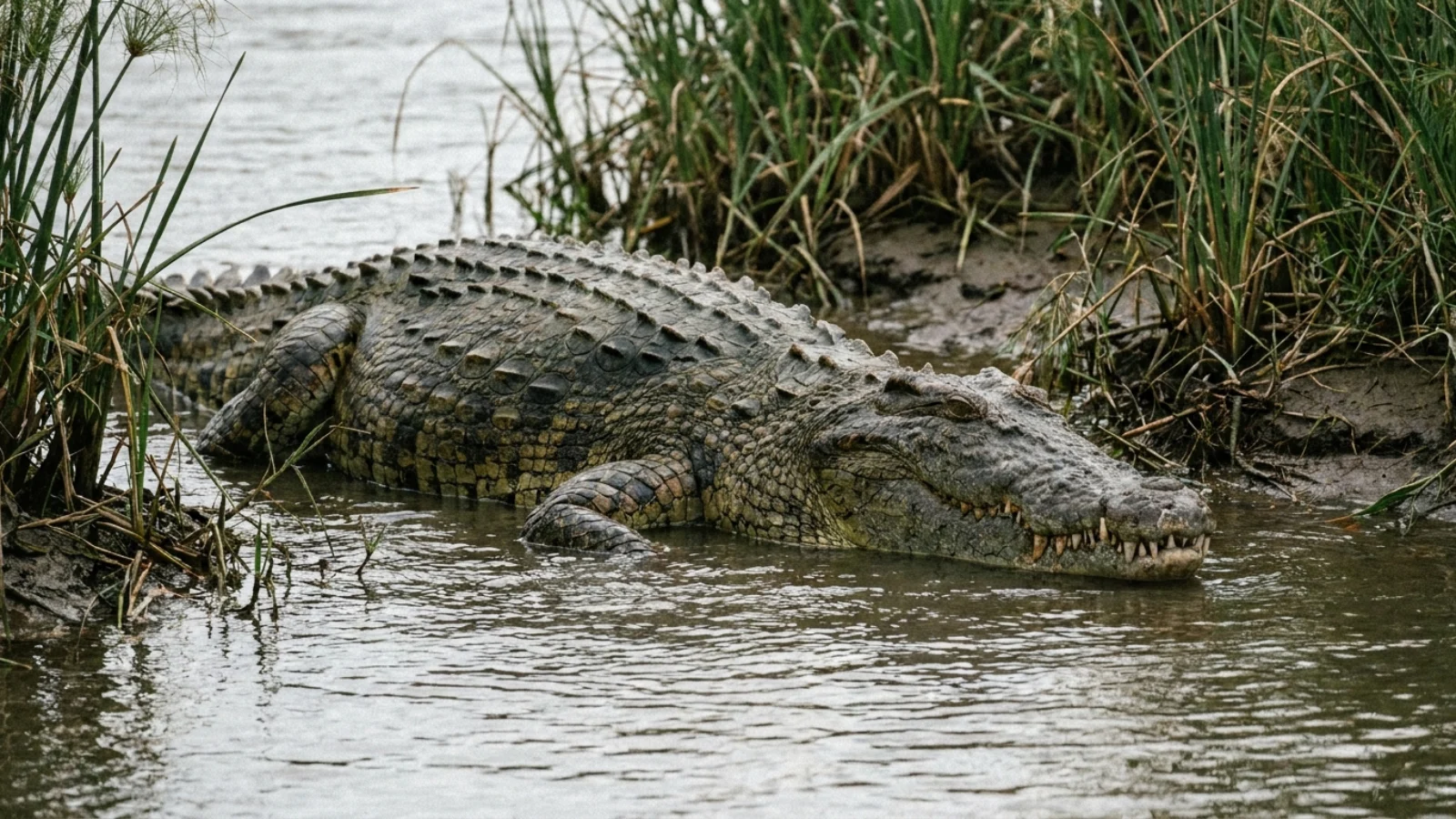
How big is Gustave?
Nobody has ever measured Gustave, because nobody has ever caught him. All estimates come from observation and photographs. National Geographic reported in 2002 that he could easily be more than 6 m (20 ft) long and weigh more than 900 kg (2,000 lb), which would make him one of the largest Nile crocodiles alive. These figures are plausible for an old, dominant male, but they are estimates, and size estimates of large crocodiles seen in the water are notoriously inflated.
For comparison, adult male Nile crocodiles usually measure between about 3.5 and 5 m, and very large males can exceed 5.5 m. A crocodile of over 6 m would be at the extreme end of the range for the species. Only a handful of Nile crocodiles of that size have been measured reliably, and the record for any measured crocodile in captivity belongs to Lolong, a saltwater crocodile of 6.17 m from the Philippines, which died in 2013.
Gustave’s size is also the most likely explanation for his behaviour. A crocodile that large and heavy finds it harder to catch small, fast prey such as fish and antelope, and may turn to larger animals that are easier to ambush at the water’s edge: hippos, buffalo, livestock and, sometimes, people.
How old is Gustave?
Gustave’s age is also estimated, not known. In 2002, National Geographic suggested that he was more than 60 years old and still growing. On that basis, he would have hatched around the 1950s, which would make him around 70 today if he is still alive. Crocodiles continue to grow throughout their lives, but growth slows sharply with age, so a crocodile of Gustave’s size is almost certainly very old.
Nile crocodiles can live for 70 to 100 years in the wild, according to the estimates usually given for the species, so it is possible that Gustave is still alive. Our guide to how long crocodiles live explains how biologists estimate crocodile ages and why records of very old animals are rare. The age estimates for Gustave rest on assumptions about growth rates rather than on a known hatching date, so they should be treated as approximate.
How many people has Gustave killed?
The famous figure is 300. Reports in the international press have often stated that Gustave has killed or eaten as many as 300 people along the Ruzizi River and the shores of Lake Tanganyika. That number comes from local accounts collected over many years, and it has been repeated so often that it is now part of the legend.
Most specialists treat the figure with great caution. Attacks by crocodiles in the region have been common, and not every death can be attributed to one animal. There are many Nile crocodiles in the Ruzizi delta, and many deaths by drowning or crocodile attack were never investigated. The area also went through years of civil war, from 1993 to 2005, in which large numbers of people died and many bodies ended up in rivers, which may have fed both the crocodiles and the rumours. A more recent and more conservative estimate places the number of deaths that could reasonably be blamed on Gustave at about 60 or fewer.
Even 60 deaths would make Gustave one of the most dangerous individual animals on record, but the true total cannot be known. The most reliable conclusion is that a very large male crocodile in the Ruzizi area has killed people repeatedly over several decades, and that the number has been exaggerated in retelling.
What happened when they tried to capture Gustave?
In the early 2000s, Patrice Faye and a team that included a film crew set out to capture Gustave alive. The goal was not to kill him but to remove him from the area, protect local people and study him, possibly in a reserve. The attempt ran over two years and was filmed for Capturing the Killer Croc.
The team built a huge steel trap cage, nearly 9 m (30 ft) long and weighing about 900 kg, designed to close behind a crocodile that entered to take bait. They also set three large snares and installed a hidden infrared camera. Various baits were tried. Smaller crocodiles were caught, but Gustave never entered the trap.
In the final week, a live goat was placed in the cage. That night a thunderstorm knocked out the camera. The next morning the cage was found partly submerged, and the goat was gone. What had happened could not be determined. Soon afterwards, the team had to leave Burundi because of renewed fighting. The capture attempt became one of the most famous failed wildlife operations ever filmed.
Does Gustave have bullet wounds?
Yes, according to observers. Gustave was seen in the late 1990s or early 2000s with three scars that appeared to be bullet wounds, and with a deep wound on his right shoulder. How he got them is unknown. Many people in the area had reason to want him dead, and Burundi was then in the middle of a civil war, so it is likely that he was shot at more than once.
Crocodiles are extremely tough animals. Their bony back armour, or osteoderms, and thick skin can deflect or absorb shots from small-calibre weapons, and they can survive wounds that would kill most mammals. Our crocodile bones page explains how the osteoderms and skeleton protect them. A crocodile that has survived several gunshots and decades of hunting pressure is also likely to be extremely wary of people, which may explain why he avoided the traps.
The scars are also useful for identification. Combined with his size, they allow observers to recognise Gustave in photographs and to distinguish him from other large crocodiles in the area.
Is Gustave still alive?
Nobody knows for sure. The last widely reported credible sighting of Gustave was in 2009, when he was seen in the Ruzizi River near Lake Tanganyika. In March 2019, a travel magazine reported that he had been killed, but the article gave no details of how, where or by whom, and no photographs or remains have ever surfaced. Most writers therefore treat the report as unconfirmed.
If Gustave hatched around the 1950s, he would now be in his seventies. That age is within the range that large Nile crocodiles can reach, and big, old crocodiles often become more secretive over time. It is therefore possible that he is still alive somewhere in the Ruzizi delta. It is equally possible that he died years ago of old age, injury or human action, unnoticed.
The uncertainty is part of the legend. Without a body or a confirmed photograph, every new attack in the area revives the question of whether Gustave is still out there.
Why do some crocodiles become man-eaters?
Nile crocodiles are opportunistic predators that will take almost any animal they can overpower at the water’s edge. People who regularly enter the water to fish, wash, bathe or collect water fit the crocodile’s normal pattern of hunting: they come to the same place at the same time, often with their attention elsewhere. In many parts of Africa, Nile crocodiles kill more people each year than any other large wild predator.
Researchers who study crocodile attacks have identified several factors that increase risk. Large males, which are territorial and need large meals, are responsible for a high proportion of fatal attacks. Human activity in the water, a lack of safe access to clean water, the removal of a crocodile’s natural prey by overfishing or hunting, and the dumping of carcasses in rivers all make attacks more likely.
Once a crocodile has successfully taken a person, it may learn that people are easy prey, which is why authorities in many countries remove crocodiles that repeatedly attack. In Gustave’s case, his great size and age, his wariness after being shot at, and the conditions in Burundi during the war may all have contributed.
How dangerous are Nile crocodiles?
The Nile crocodile is one of the two most dangerous crocodilians to people, along with the saltwater crocodile. Estimates of fatal Nile crocodile attacks across Africa run into the hundreds each year, although many attacks in rural areas are never reported. Our Nile crocodile profile covers the species in detail.
The risk varies greatly from place to place. Where people must use rivers and lakes every day, without fences or safe water points, attacks are frequent. Where people have alternatives, such as wells, pumps and fenced bathing areas, the number of attacks falls sharply. Simple measures such as building fenced enclosures at water-collection points have reduced deaths in several countries.
Crocodiles that live near people are not automatically dangerous. Many large crocodiles share rivers with villages for years without incident. The danger comes from a combination of a large crocodile, regular human contact with the water and a lack of alternatives, the conditions that existed on the Ruzizi.
Could a crocodile like Gustave live in Florida?
No. Florida is home to two crocodilians, the American alligator and the American crocodile, and neither behaves like a Nile crocodile. American crocodiles are shy animals that rarely attack people, and the Florida population, mostly in the southern tip of the state and the Keys, has no record of fatal attacks. Alligators do occasionally kill people, but fatal attacks are rare, and Florida wildlife officers remove alligators that are considered a threat long before they could build a reputation like Gustave’s.
Nile crocodiles have, however, turned up in the wild in South Florida. Between 2009 and 2012, scientists captured three young Nile crocodiles in the region, one of them on the porch of a home near Miami, and a female caught in 2012 was recaptured in 2014. A study published in 2016 in Herpetological Conservation and Biology, co-authored by Kenneth Krysko of the Florida Museum of Natural History, used DNA to confirm that the animals were Nile crocodiles linked to South African populations.
The three crocodiles were genetically identical to one another but did not match the Nile crocodiles held in Florida zoos, which suggested a common source, most likely the exotic pet trade. There is no evidence of a breeding population. Still, Florida already hosts invasive Burmese pythons, Argentine tegus and spectacled caimans, and biologists warned that Nile crocodiles, which tolerate the same subtropical climate, would be a far more dangerous addition. That is why wildlife authorities treat any report of an unusual crocodile in South Florida seriously, and remove non-native crocodilians when they are found.
Is Gustave the crocodile still alive?
Unknown. The last credible sighting was in 2009. A 2019 report that he had been killed gave no details or evidence and has not been confirmed.
How many people did Gustave kill?
Local accounts claim 200 to 300, but specialists consider that exaggerated. A more conservative estimate is about 60 or fewer.
How big is Gustave?
He has never been measured. National Geographic estimated in 2002 that he was more than 6 m (20 ft) long and weighed over 900 kg (2,000 lb).
Where does Gustave live?
In the Ruzizi River delta and along the northern shores of Lake Tanganyika in Burundi, near Bujumbura.
Who named Gustave?
French herpetologist Patrice Faye, who began studying him in the late 1990s and led the attempt to capture him.
Was the movie Primeval based on Gustave?
Loosely. The 2007 film Primeval was inspired by the Gustave story but is fiction.
Why couldn’t they catch Gustave?
He avoided a 9 m steel trap, snares and baits for two years. The team had to leave Burundi because of fighting before they could try again.
Are there Nile crocodiles in Florida?
Three young Nile crocodiles were caught in South Florida between 2009 and 2012, probably escaped or released pets. There is no evidence of a breeding population.
- Wikipedia, “Gustave (crocodile)”, summarising National Geographic (2002) and PBS Capturing the Killer Croc (2004).
- PBS, Capturing the Killer Croc (2004 documentary).
- Mental Floss, “The Killer Crocodile That Haunted the Waters of Burundi”.
- Nature World News (2022), on the Gustave legend and claimed victims.
- Scientific American (2016), “Nile Crocodiles Reported in Florida”, on the study in Herpetological Conservation and Biology.
Blane Perun has been exploring Earth’s oceans and marine life for over 25 years. Founder of TheSea.Org in 1999, underwater photographer, coral aquaculture pioneer, and explorer of 80+ countries.
About Blane Perun →