Alligators in Florida — Where They Live, Mating Season and Safety
Florida has about 1.3 million wild American alligators, found in all 67 counties, in lakes, rivers, swamps, marshes, canals, golf-course ponds and almost any fresh water that holds fish. Courtship starts in early April, mating follows in May and June, females lay 32 to 46 eggs in late June or early July, and the young hatch in late August or early September. Serious bites are rare, averaging about eight unprovoked bites a year that need medical treatment, and 26 fatal attacks were recorded from 1948 to 2022.
The American alligator has been Florida’s official state reptile since 1987, the same year the U.S. Fish and Wildlife Service declared the species recovered.
In Southwest Florida the alligator is the one animal everyone learns to read: the eyes in the retention pond, the bellow across the lake in spring, the 4-foot youngster that will not leave the golf-course water hazard.
Florida gator facts
- Population: About 1.3 million
- Range in Florida: All 67 counties
- Most active: Air temperatures of about 82–92°F
- Courtship: Begins early April
- Mating: May and June
- Eggs: 32–46, laid late June to early July
- Hatching: Late August to early September
- Nuisance hotline: 866-FWC-GATOR (866-392-4286)
How many alligators are in Florida?
The Florida Fish and Wildlife Conservation Commission estimates that about 1.3 million alligators of every size live in the state. That makes Florida, along with Louisiana, one of the two great strongholds of the American alligator, a species whose range runs from North Carolina along the coastal plain to Texas and southeastern Oklahoma.
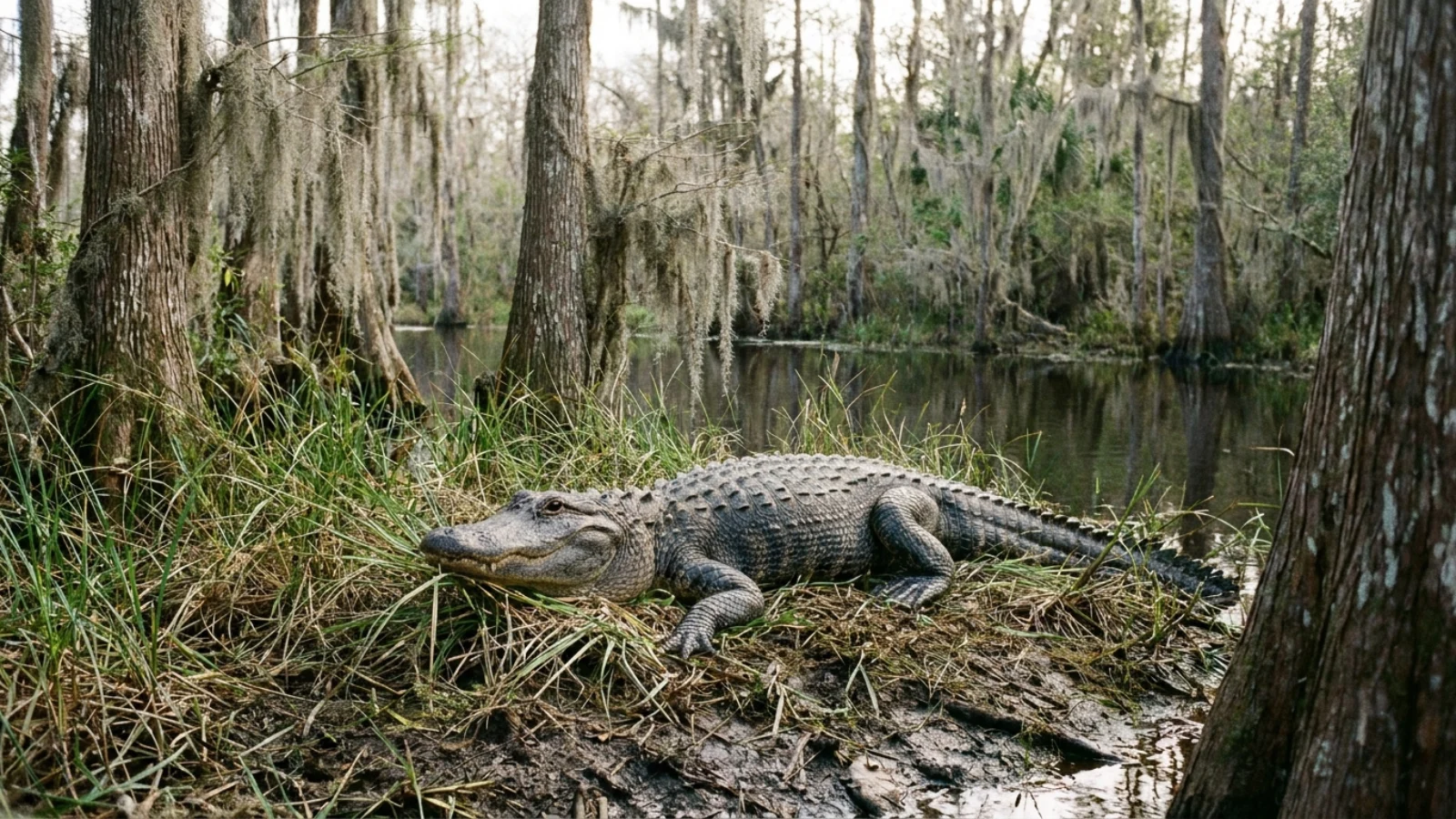
Alligators are found in all 67 Florida counties. They live in lakes, rivers, springs, swamps, marshes, wet prairies, cypress domes and the vast sawgrass of the Everglades, but they are just as at home in the artificial wetlands that people have built: drainage canals, borrow pits, stormwater ponds, golf-course water hazards and the lakes of new housing developments. Any body of fresh or slightly brackish water that holds fish, turtles or other prey can hold an alligator.
That abundance is a modern success story. Alligators were heavily hunted for their hides in the nineteenth and early twentieth centuries, and by the mid-twentieth century populations in Florida and elsewhere were badly depleted. The species was listed as endangered in 1967. With protection, it recovered so well that the U.S. Fish and Wildlife Service declared it fully recovered in 1987. Today alligators in Florida are managed as a valued natural resource, with regulated hunting, nuisance removal and farms that produce hides and meat.
Where do alligators live in Florida?
Alligators are freshwater animals, and in Florida they are most abundant in large lakes, slow rivers and marshes. Lake Okeechobee, the Kissimmee River chain of lakes, Orange Lake, Lake George, the St. Johns River and the Everglades all support high densities. In the Everglades, alligators dig and maintain “gator holes”, pools that hold water and fish through the dry season and provide refuges for many other animals.
Alligators can tolerate brackish water for short periods and often visit tidal creeks and mangrove edges to hunt. They are occasionally seen in salt water, even in the Gulf surf or on beaches, but this is unusual, because unlike crocodiles they lack functional salt glands and must return to fresh water to drink. In South Florida, where American crocodiles live in the brackish and saltwater fringe, the two species can occur within sight of each other.
In suburban Florida, alligators move between ponds and canals, especially in spring when adults are searching for mates and young alligators are dispersing. That is why they turn up in swimming pools, garages, on golf courses and occasionally on front doorsteps. Most of these wandering animals are simply passing through, and if left alone they will usually move on to the next pond within a day or two. Relocating alligators is not an option in Florida: an alligator moved away from its home water tends to try to return and may cause trouble wherever it ends up.
Where can you see alligators in Southwest Florida?
In Southwest Florida, around Naples, Bonita Springs and Fort Myers, alligators are part of everyday life, and there are excellent places to see them safely in the wild. Corkscrew Swamp Sanctuary, run by Audubon east of Naples, has a 2.25-mile boardwalk through old-growth bald cypress where alligators bask beside the dark water. Six Mile Cypress Slough Preserve in Fort Myers has a shorter boardwalk with good views of alligators and wading birds.
Further afield, the Big Cypress National Preserve and the Tamiami Trail (US 41) between Naples and Miami are lined with canals where alligators bask on the banks in winter, and the Kirby Storter boardwalk and the Oasis Visitor Center are reliable stops. At the eastern end of the Trail, Shark Valley in Everglades National Park has a 15-mile loop road, walked, cycled or toured by tram, with some of the most dependable alligator viewing in the state. Myakka River State Park near Sarasota is famous for the number of alligators that gather in the river and on the shores of Upper Myakka Lake.
On Sanibel Island, the J.N. “Ding” Darling National Wildlife Refuge offers alligators along the freshwater edges of its Wildlife Drive, along with roseate spoonbills, ibises and other wading birds. Wherever you go, winter is the best season: cooler mornings bring alligators out to bask, and the dry season concentrates them in the remaining water.
Give alligators distance. A basking gator that raises its head, opens its mouth or hisses is telling you that you are too close.
What do Florida alligators do in winter?
Florida’s winters are mild, but alligators still change their behaviour in the cooler months. When air and water temperatures drop, they become less active, eat little or nothing and spend long hours basking on banks during sunny days to warm up. On cold nights they retreat to deeper water, which holds its heat better than the air, or to burrows dug into the banks of lakes and canals.
Alligators stop feeding when the water gets cold because their digestion slows and food could rot in the stomach. As a result, winter is the season when alligators are least likely to bite and most likely to be seen, lying out on banks in plain view along canals such as those beside the Tamiami Trail. For visitors, the period from December to March is the best time for photographing alligators in the wild.
In North Florida, where winters are colder, alligators sometimes face freezing weather. In shallow water they can survive ice by keeping their nostrils above the surface, a behaviour that has been filmed in the Carolinas. When spring arrives and temperatures rise above the low 80s Fahrenheit, alligators become fully active again, and the cycle of feeding, bellowing and mating begins.
When is alligator mating season in Florida?
Alligator courtship in Florida begins in early April, when the water warms and the days lengthen. Males bellow, a deep, rumbling roar produced while the body is partly submerged, which makes the water above the back dance in a pattern known as the “water dance”. Females bellow too, and groups of alligators may bellow in chorus at dawn. Males also slap their heads on the water and blow bubbles to attract females and warn off rivals.
Mating takes place in May and June. This is when alligators are most active and most mobile, and when adults, especially males looking for mates and young alligators displaced by bigger ones, travel overland between ponds and canals. It is also the season when Floridians report the most alligator encounters and when the state’s nuisance alligator hotline is busiest.
Females build nests in late June or early July, piling mud, leaves and plant material into a mound up to several feet across near the water’s edge. Each female lays about 32 to 46 eggs and guards the nest for roughly two months. The decaying vegetation warms the eggs, and the nest temperature determines the sex of each hatchling.
When do baby alligators hatch in Florida?
Eggs usually hatch in late August or early September. The hatchlings, about 6 to 8 inches long, call from inside the eggs when they are ready, and the mother opens the nest and carries them to the water in her mouth. The young stay in a group, called a pod, close to the mother for months, sometimes into the next year.
Baby alligators are striking little animals, black with bright yellow bands. They are also extremely vulnerable: wading birds, raccoons, otters, large fish, snakes and other alligators all eat them, and most do not survive their first year. If you see a group of hatchlings, the mother is almost certainly nearby and will defend them, so keep your distance.
It is illegal in Florida to take an alligator from the wild or to keep one as a pet without a permit, however small and harmless it looks.
How dangerous are alligators in Florida?
Alligators are large predators, and they can and do bite people, but serious bites are rare given how many people and alligators share the state. According to the FWC, Florida averaged about eight unprovoked bites a year serious enough to need professional medical treatment over a recent ten-year period. The agency estimates that the chance of a Florida resident being seriously injured by an alligator in an unprovoked incident in a given year is roughly 1 in 3.1 million.
From 1948 to 2022, Florida recorded 453 unprovoked bite incidents, 26 of them fatal. Most serious bites happen to people who are swimming or wading in fresh water, often at dusk or at night, or who are retrieving golf balls or fishing at the water’s edge. Children and pets are at higher risk because of their size.
Many bites involve alligators that have lost their fear of people because they have been fed. That is why feeding wild alligators is illegal in Florida, and why the FWC asks anglers to put fish scraps in rubbish bins rather than in the water. Our page on what alligators eat explains why fed alligators become dangerous.
How do you stay safe around alligators?
The FWC’s advice is simple and worth following anywhere in Florida. Supervise children closely near water. Swim only in designated swimming areas and only during daylight, because alligators are most active between dusk and dawn. Do not wade where large alligators are known or likely to be. Keep pets on a leash and away from the edge of lakes, ponds and canals, and never let dogs swim in waters that may hold alligators.
Never feed or entice an alligator, and dispose of fish scraps in bins. Watch and photograph alligators from a safe distance, and never try to remove one from the wild. If an alligator hisses or opens its mouth, back away slowly: it is warning you. Alligators can move quickly over short distances, but they rarely chase people on land.
If you believe an alligator poses a threat to people, pets or property, call the FWC’s Nuisance Alligator Hotline at 866-FWC-GATOR (866-392-4286). An alligator is generally considered a nuisance if it is at least 4 feet long and is believed to be a threat, and the FWC will send a contracted trapper. Smaller alligators can also be removed if they turn up in swimming pools, garages and similar places. To keep alligators out of a yard, a fence should be more than 4.5 feet tall.
Can you hunt alligators in Florida?
Yes. Florida has held a regulated public alligator hunting season since 1988. Hunters must buy a permit through a lottery system, and each permit allows the harvest of a limited number of alligators in a specific management area during a set season in late summer and autumn. Hunting is tightly controlled and has not harmed the state’s population.
The state also licenses alligator farms, which raise alligators for hides and meat, and a nuisance alligator programme that removes problem animals. Alligator meat, usually from the tail, is sold in restaurants and markets across Florida, often fried as “gator bites”.
These programmes give alligators an economic value that helps support their conservation and the protection of the wetlands they live in, a model that many conservationists credit for the species’ recovery.
Alligator or crocodile: which one did you see?
In most of Florida, any large reptile in fresh water is an alligator. Only in the far south, especially around Florida Bay, the Keys, Biscayne Bay and the Everglades coast, are you likely to see an American crocodile. Crocodiles are paler, grey-green rather than black, have a narrower, more pointed snout, and show their lower teeth when their mouths are closed. Our alligator vs crocodile guide explains all nine differences, and our American crocodile profile covers Florida’s rarer reptile.
- Population: About 1.3 million, in all 67 counties
- Bites: About 8 serious unprovoked bites a year; 26 fatal 1948–2022
- Mating: Courtship from early April; mating May–June
- Hatching: Late August to early September
- Rule one: Never feed an alligator: it is dangerous and illegal
How many alligators are in Florida?
About 1.3 million, according to the Florida Fish and Wildlife Conservation Commission, in all 67 counties.
When is alligator mating season in Florida?
Courtship begins in early April, mating happens in May and June, eggs are laid in late June or early July and hatch in late August or early September.
Are there alligators in every lake in Florida?
Not every one, but any freshwater lake, pond or canal in Florida can hold alligators, and it is safest to assume they are present.
Are alligators found in the ocean in Florida?
Rarely. They can visit brackish and salt water for short periods but need fresh water. Crocodiles are the saltwater reptiles of South Florida.
How many people have been killed by alligators in Florida?
From 1948 to 2022, Florida recorded 26 fatal unprovoked alligator bites out of 453 incidents.
What should I do if an alligator is in my yard or pool?
Keep away and call the FWC Nuisance Alligator Hotline at 866-FWC-GATOR (866-392-4286).
Where can I see alligators near Naples or Fort Myers?
Corkscrew Swamp Sanctuary, Six Mile Cypress Slough Preserve, Big Cypress National Preserve and the Ding Darling refuge on Sanibel.
Is it legal to feed alligators in Florida?
No. Feeding or enticing wild alligators is illegal because it teaches them to associate people with food.
- Florida Fish and Wildlife Conservation Commission: alligator facts, bite statistics, nuisance alligator programme and safety advice (as reported by Yahoo/USA Today Network, 2024).
- U.S. Fish and Wildlife Service: American alligator recovery (1987).
- Audubon Florida: Corkscrew Swamp Sanctuary boardwalk.
- National Park Service: Everglades National Park (Shark Valley) and Big Cypress National Preserve.
Blane Perun has been exploring Earth’s oceans and marine life for over 25 years. Founder of TheSea.Org in 1999, underwater photographer, coral aquaculture pioneer, and explorer of 80+ countries.
About Blane Perun →