Do Manatees Bite? — Are Manatees Dangerous to Swimmers?
No. Manatees are not known to bite people. Adults have no front teeth at all, only flat grinding molars far back in the mouth, plus tough pads and muscular, whiskered lips for gripping plants. They are gentle, non-aggressive herbivores. The real risks around manatees are accidental bumps from a large animal and breaking the laws that protect them.
It is a fair question to ask before you get in the water with an animal that can weigh as much as a small car. Manatees are big, they have mouths, and when one swims straight towards you in a spring run it is natural to wonder what it is going to do. The short answer is that manatees do not bite people and are not dangerous in the way that sharks, alligators or even some fish can be. The longer answer explains why, what they actually do with their mouths, and what the real risks are, for you and for the manatee, when people and manatees share the water.
Why manatees don’t bite
No front teeth, no predatory instinct and no reason to.
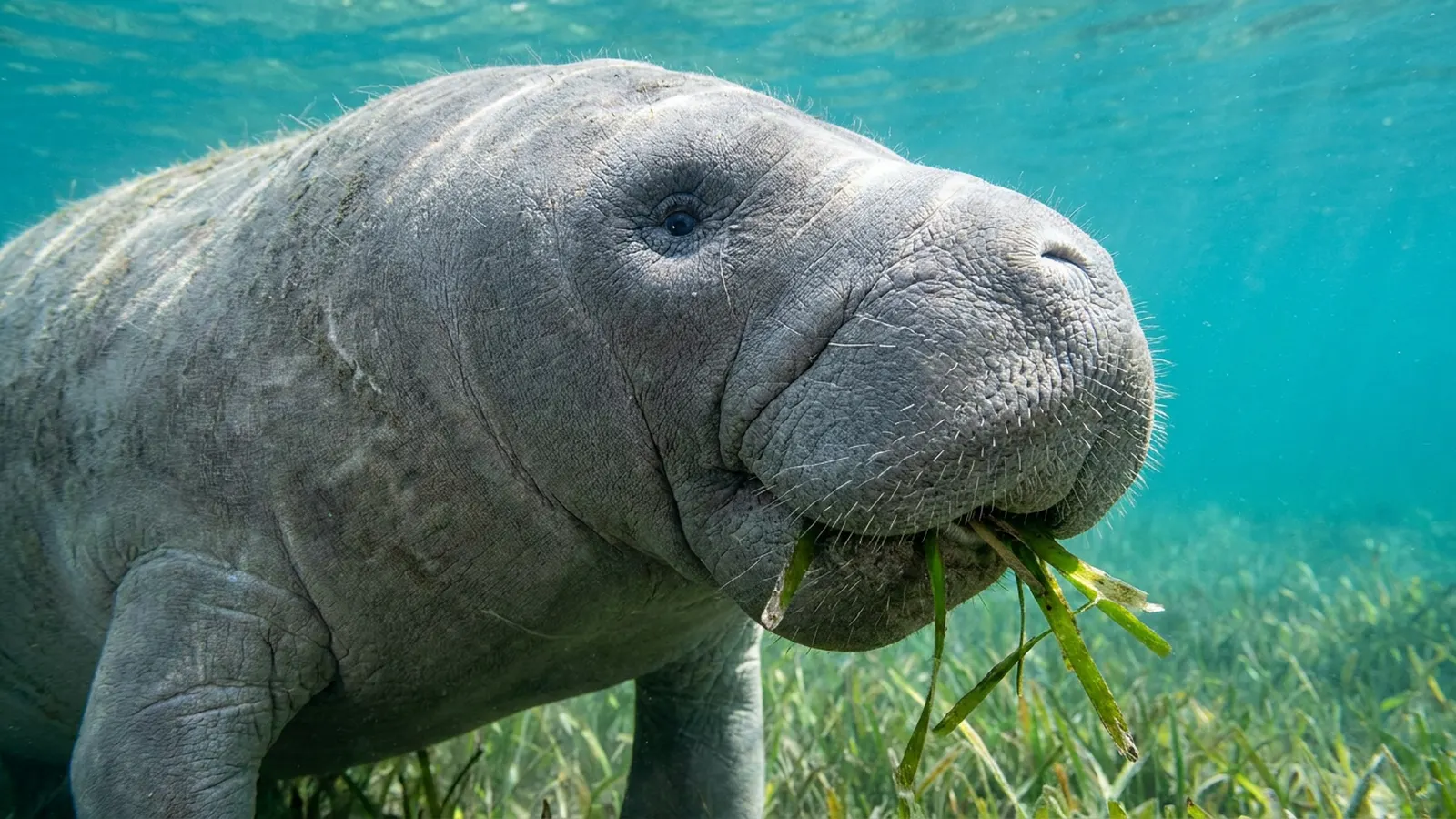
The first reason is anatomical. Adult manatees have no incisors or canines, the front teeth that most mammals use to bite. Instead, the front of the mouth has rough, horny pads on the upper and lower jaws, which they use to grip and crush plants. Their only teeth are molars at the back of the mouth, designed for grinding vegetation. Those molars are unusual: new ones form at the back of the jaw and slowly move forward as the front ones wear down and fall out, a system nicknamed “marching molars”. Our page on manatee teeth explains it in detail. The point here is simple: a manatee’s teeth are deep inside its mouth, where a person’s hand or foot is never going to end up.
The second reason is behavioural. Manatees are herbivores. They eat seagrasses, freshwater plants, algae and other vegetation, and they have no need to catch, grab or kill anything. Our manatee diet page covers what they eat. They are also not territorial. They don’t defend a patch of water, and they don’t fight over food. Even competing males in a mating herd jostle and push rather than bite. Without a predatory or defensive reason to bite, manatees simply don’t.
What manatees do with their mouths
Lips that work almost like hands.
A manatee’s most remarkable feeding tool is its upper lip. It is split into two halves that can move independently, gripping and pulling plants into the mouth, a bit like an elephant’s trunk tip. The lips are covered in stiff whiskers and thousands of fine sensory hairs that help the manatee feel its way through vegetation in murky water. Our page on the manatee skull explains how the downturned snout suits grazing on the bottom.
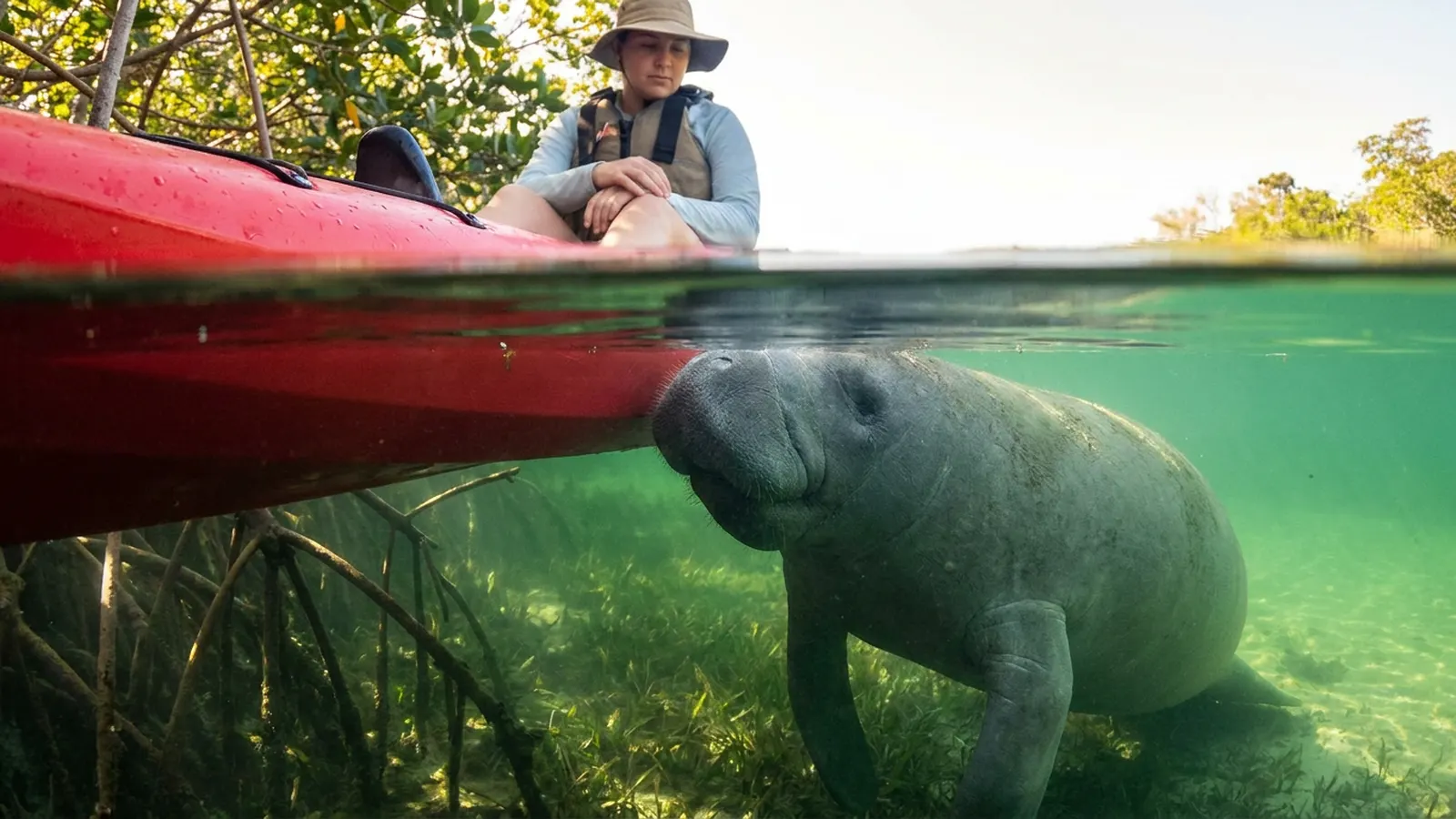
Because the lips are so sensitive and mobile, a curious manatee will sometimes investigate objects with its mouth: a mooring line, a dock piling, a kayak hull and occasionally a swimmer. This “mouthing” is exploration, not aggression, and with no front teeth it is harmless. Even so, it is not something to encourage. A manatee that learns to approach and nuzzle people is more likely to approach boats and docks, where it can be hurt.
Are manatees dangerous at all?
Not aggressive, but large, strong and easy to underestimate.
Manatees are not aggressive, but they are big. Florida manatees are commonly around three metres long and several hundred kilograms, and large adults can exceed a thousand pounds. A startled manatee can thrust off with its tail with real force, and a swimmer who is directly behind or above it at that moment could be hit, or a kayak rocked. That is an accident, not an attack, and it happens mainly when people crowd manatees or approach them suddenly.
Manatees in mating herds are another situation where caution makes sense. A group of males pursuing a female can churn the water, roll and push each other around in shallow areas. They are focused on each other, not people, but a swimmer in the middle of that scrum could get bumped. Our page on manatee mating describes these herds. The answer is simple: keep well away.
There is no meaningful risk of disease from simply being in the water with manatees, but touching any wild animal is never a great idea. The rules against touching exist mainly to protect the manatees, which is the next point.
| Concern | Real risk? | Why |
|---|---|---|
| Being bitten | Essentially none | No front teeth; herbivore; not aggressive |
| Being bumped or tail-slapped | Low, mostly when crowding them | Large, powerful animal that may bolt if startled |
| Getting caught in a mating herd | Low if you keep distance | Males push and roll in shallow water |
| Legal trouble for touching or chasing | Real | Federal and state laws ban harassment |
| Harming the manatee | Real | Disturbance costs energy; feeding changes behaviour |
The bigger danger: what people do to manatees
In any encounter, the manatee has more to lose.
When people ask whether manatees are dangerous, the honest answer is that we are far more dangerous to them. Boat strikes are the largest human-caused source of manatee deaths in Florida, and most adults carry propeller scars. Entanglement in fishing line and crab trap lines, ingestion of hooks and plastic, cold stress, red tide and the loss of seagrass all take a heavy toll. Our manatee predators page explains why humans, not sharks or alligators, are the main threat to adult manatees.
Even well-meaning swimmers can cause harm. Chasing or surrounding a manatee makes it burn energy it needs, especially in winter when it is sheltering from cold water and may not be feeding. Separating a mother and calf can be fatal for the calf. Feeding manatees, or giving them fresh water from a hose, teaches them to hang around docks and marinas, which puts them in the path of boats.
What the law says about touching manatees
Harassment is illegal under federal and Florida law.
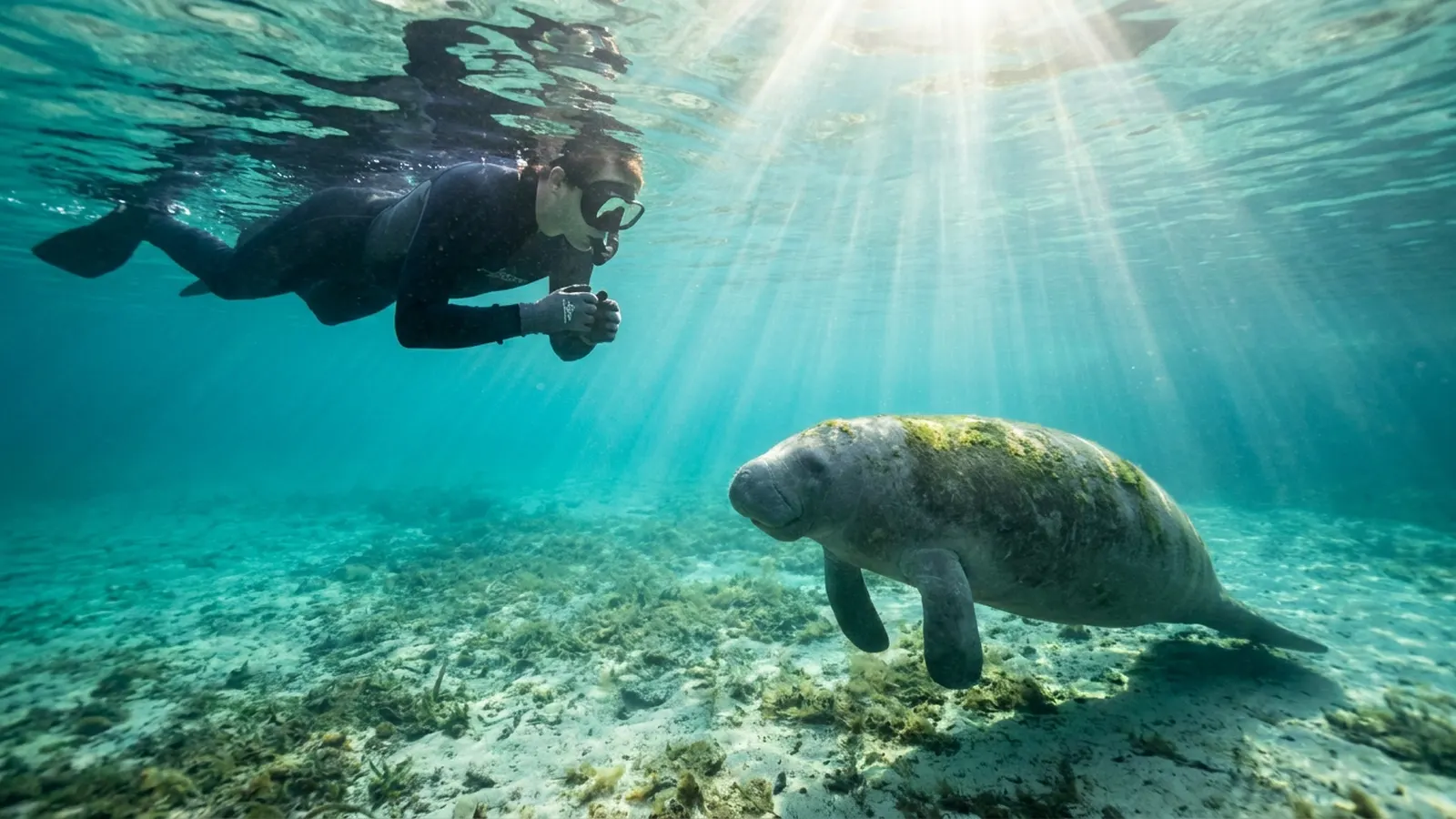
In the United States, manatees are protected by the Marine Mammal Protection Act and the Endangered Species Act, and in Florida by the Florida Manatee Sanctuary Act. These laws make it illegal to harass, harm, pursue or disturb manatees. Touching, poking, riding, chasing, feeding or separating manatees can all count as harassment, and penalties can include fines and, in serious cases, jail time. Where people are allowed to swim with manatees, as in Crystal River, the rules are based on “passive observation”: float quietly, don’t initiate contact, and let the manatee decide how close to come. Our guide to snorkeling with manatees in Crystal River explains how that works in practice.
How I’d behave in the water with a manatee
Stay calm, stay still and let it come or go.
Speaking as someone who has spent a lot of time in the water, on dive trips from Key Largo to the Caribbean and in my own reef tanks at home, I think the most useful rule with any large, gentle animal is to let it set the terms. If a manatee approaches, I’d stay calm, keep my arms close to my body, avoid sudden movements and let it look me over and move on. I wouldn’t reach out to touch it, even if it seems to want contact, and I’d never swim after one that is moving away.
On a kayak or paddleboard the same principle applies: stop paddling, keep the paddle out of the water and let the manatee pass. Our guide to kayaking with manatees covers paddling etiquette, and if you are boating, slow down in posted zones and keep a lookout in shallow water. If a manatee bumps your boat, it is not attacking; it is either curious or trying to get past.
Manatees vs other animals swimmers worry about
Of all the large animals in Florida’s waters, manatees are the least threatening.
Florida swimmers and snorkelers sometimes share the water with alligators in fresh water, bull sharks in bays and rivers, stingrays on sandy bottoms and jellyfish along the beaches. Each of those deserves some respect, and each has a way of hurting people, whether by biting or stinging. Alligators are ambush predators with powerful jaws, bull sharks are opportunistic hunters that tolerate murky, brackish water, and stingrays defend themselves with a barbed tail spine when stepped on, which is why Florida beachgoers learn to shuffle their feet in shallow sand. Even small reef fish can nip: territorial damselfish are well known among reef keepers, and I have kept reef tanks since 1996, for defending their patch of rock against anything that comes too close, including a hand doing maintenance in the tank. Manatees have none of those defences or habits. They have no teeth at the front of the mouth, no claws, no spines and no venom, and they have never been known to defend themselves by attacking. The worst that is likely to happen is a startling bump or a surprised splash. Of all the animals you might meet in a Florida river, a manatee is by far the gentlest. That gentleness is exactly why they need protection from us. An animal that never evolved to fight back depends entirely on the people sharing its water to slow down, keep their distance and leave it alone, and that is a small price for the chance to see one.
Has a manatee ever bitten a human?
There are no known cases of manatees attacking or biting people. They have no front teeth to bite with.
Are manatees aggressive?
No. They are calm, curious herbivores that are not territorial and do not defend themselves by attacking.
Do manatees have teeth?
Yes, but only molars at the back of the mouth, which are replaced throughout life. Adults have no front teeth.
Is it safe to swim with manatees?
Yes, where it is permitted and done with passive observation. Keep your distance and don’t touch them.
What should I do if a manatee swims up to me?
Stay calm and still, keep your hands to yourself and let it move on in its own time.
Can you get in trouble for touching a manatee?
Yes. Touching, chasing, feeding or disturbing manatees can be harassment under federal and Florida law.
Can a manatee hurt you?
Only by accident: a large, startled manatee can bump a swimmer or rock a kayak with its tail.
- U.S. Fish and Wildlife Service: West Indian manatee, Crystal River manatee manners.
- Florida Fish and Wildlife Conservation Commission: manatee protection and viewing guidelines.
- Save the Manatee Club: manatee facts and FAQ, swimming with manatees.
- Marine Mammal Commission: West Indian manatee.
- Reynolds, J.E. and Odell, D.K. Manatees and Dugongs. Facts on File.
Blane Perun has been exploring Earth’s oceans and marine life for over 25 years. Founder of TheSea.Org in 1999, underwater photographer, coral aquaculture pioneer, and explorer of 80+ countries.
About Blane Perun → More on Manatees →