Manatee Skull — The Downward-Angled Snout & Marching-Molar Jaw
A manatee skull is roughly 30 to 40 centimetres long in an adult West Indian manatee, dense and heavy like every other bone in the body. The most distinctive feature is the downward-angled rostrum — the snout end of the skull tilts down at roughly 25 to 35 degrees from the line of the braincase, an adaptation for feeding on bottom-rooted seagrass (this angle is much milder than in dugongs, where the rostrum drops at 70°+). Other key features: a long tooth row with no incisors or canines in the adult, only molars and premolars on the marching-molar conveyor; large auditory bullae (the bony ear capsules) reflecting strong underwater hearing; small high-set orbits with poor vision; nasal openings at the top of the rostrum for surface breathing; and massive facial bone attachments for the muscles that operate the prehensile upper lip. The whole skull is built around three jobs: harvesting bottom vegetation, processing it with continuously replacing teeth, and surfacing to breathe.
A manatee skull is a tool kit. Every feature of it does a job — harvesting vegetation, processing it, breathing at the surface, hearing underwater, anchoring the muscular face. Lay one next to a dolphin skull and the comparisons are educational: same general aquatic-mammal challenges, two completely different evolutionary solutions, a relationship by analogy rather than ancestry. The manatee skull also tells the story of where the species came from. Inside its bone structure are the ancestral signatures of an animal whose closest living relative is the elephant.
The downward-angled rostrum — the skull’s signature feature
The single most distinctive feature of a manatee skull is the way the snout end — the rostrum — tilts downward relative to the rest of the skull. This angle aligns the mouth with the substrate where the animal feeds. On the living animal it pairs with a split, bristled upper lip, described in our page on manatee anatomy.
Look at a manatee skull from the side and you can draw a line along the top of the braincase, then a second line along the top of the rostrum. The two lines meet at an angle. In manatees, this rostral deflection is roughly 25 to 35 degrees below the braincase line. The downward angle means that when a manatee swims horizontally through the water, its mouth points slightly toward the bottom — precisely where the seagrass meadows are. The rostrum angle is the skull-level expression of being a bottom-feeder.
The interesting comparison is with the dugong. Dugong skulls have a much sharper rostral deflection, around 70 degrees or more — the dugong snout points almost straight down. Dugongs are obligate bottom-feeders that uproot seagrass rhizomes, often digging into the substrate, and the extreme rostrum angle is part of that specialisation. Manatees are more flexible feeders that take vegetation from the bottom, mid-water column, and surface, so a milder rostral angle suits them better. Comparing manatee and dugong skulls side-by-side, the difference in rostrum angle is the clearest single feature distinguishing the two groups.
Within the manatees, there are subtle interspecific differences in rostrum angle, with the West Indian, Amazonian, and West African manatees showing slight variations consistent with their different feeding habits. The Amazonian manatee, which feeds heavily on floating and emergent freshwater plants, has the mildest rostrum angle of the three species — closer to a horizontal line, reflecting more surface feeding. The West Indian and West African manatees, which feed more on bottom-rooted seagrass and submerged plants, have slightly steeper rostrum angles.
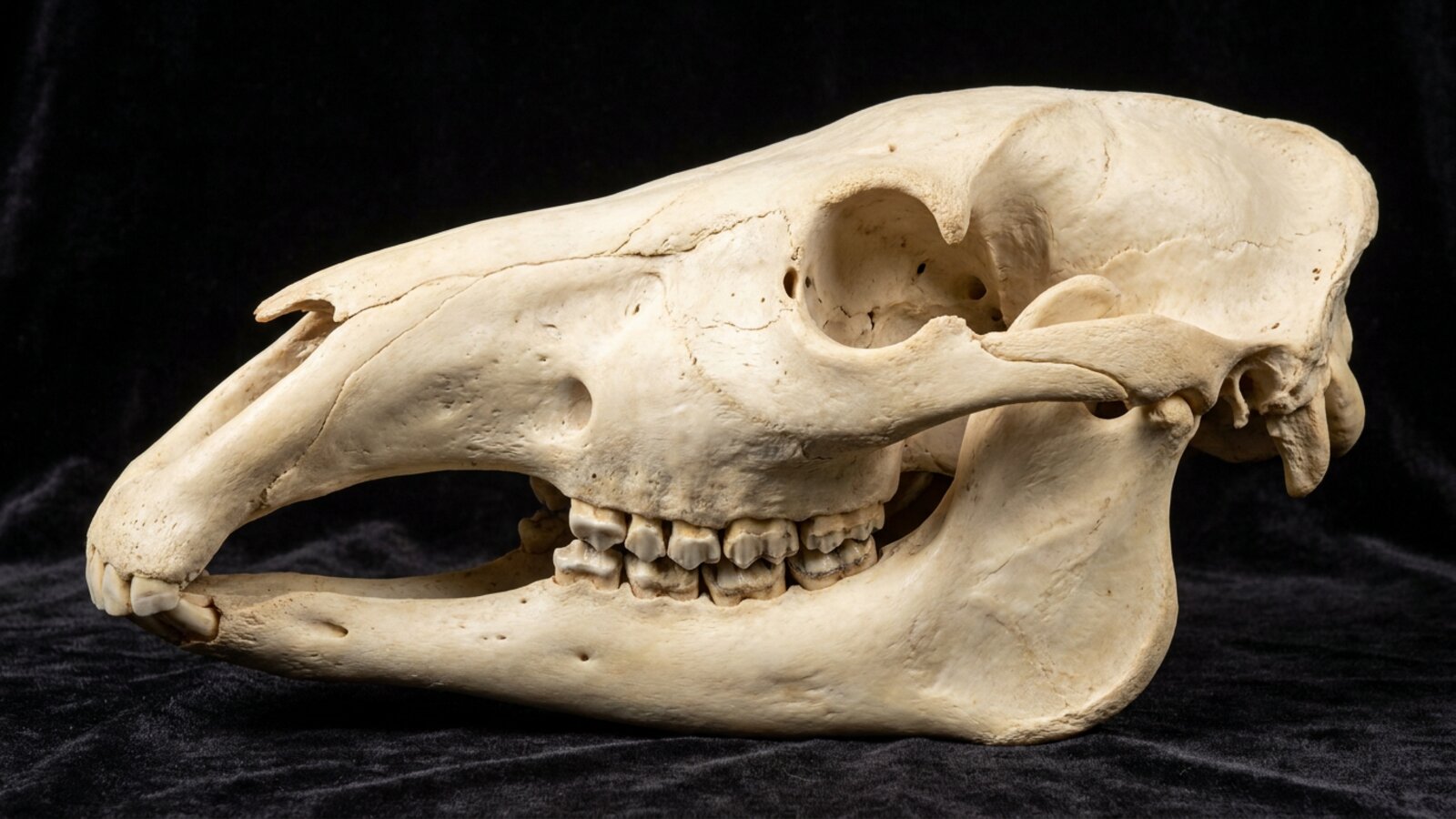
Teeth and the marching-molar dental system
The manatee tooth row, set into the lower part of the upper jaw and across the heavy mandible, holds the famous marching-molar conveyor — the continuous tooth-replacement system that no other living mammal shares except the manatee’s closest distant relative, the elephant.
An adult manatee has only molars and premolars — no incisors, no canines. The tooth row holds six to eight functional teeth per jaw quadrant at any given time, all of them broad flat-crowned grinders for processing fibrous abrasive plant material. New teeth form continuously at the rear of the jaw and migrate slowly forward through the bone at roughly 1 millimetre per month. The teeth at the front of the row wear down, the roots dissolve, and the worn teeth fall out, replaced by the teeth migrating from behind. Over a 60-year lifespan a manatee may go through 30 or more sets of teeth.
The skull bone reflects this dynamic dentition. The jawbones contain extensive resorption and remodelling activity throughout life as old tooth sockets close behind the migrating teeth and new sockets form at the rear. The mandible (lower jaw) is fused at the front symphysis — the two halves of the lower jaw are solidly joined into a single bony unit, providing the strength needed for grinding large volumes of abrasive plant matter. The whole tooth row is set well back from the front of the mouth, leaving the front of the snout free for the prehensile lip apparatus to do its grasping work.
The face — nasal openings, eye sockets, and ear capsules
The arrangement of openings on the manatee skull reflects the demands of an aquatic mammal that breathes at the surface, sees poorly, and hears well.
Nasal openings. The nostrils are at the very top of the rostrum — not at the front, like in a land mammal, but on the upper surface. When a manatee surfaces to breathe, it lifts only the top of the snout above water; the nostrils break the surface, open briefly to take a breath, and close again as the animal submerges. The skull supports this with large rostral nasal openings positioned to align with the surface when the animal is swimming just below it. The internal nasal passages are valved and watertight.
Eye sockets (orbits). The orbits are small relative to the skull size and set high on the sides of the head. Manatees have notoriously poor eyesight, relying mostly on touch and hearing in the turbid water they inhabit. The small high-set orbits reflect this de-emphasis of vision — eyes positioned to monitor the water above (where threats might come from) but not for detailed visual hunting or foraging.
Auditory bullae. The bony capsules surrounding the middle ear, called auditory bullae, are large, dense, and prominent in the manatee skull. Underwater hearing is critical to manatee social communication, navigation, and detection of approaching threats (or boats), and the well-developed auditory bullae reflect this. There are no external ear flaps — the ear canal opening is a small slit just behind the eye — but the internal ear apparatus is sophisticated and the skull bones transmit sound efficiently from the surrounding water to the inner ear.
Bone density — the heavy skull
Like every other bone in the manatee skeleton, the skull bones are pachyostotic — densely mineralised, with the inner marrow cavities reduced or absent. The skull alone weighs several kilograms in an adult animal.
Pachyostosis — the condition of having heavy, dense bones — is a hallmark of all sirenian skeletons, and the skull participates fully. The bone is so dense that manatee skulls are noticeably heavier than skulls of comparably sized terrestrial mammals; a 30 cm West Indian manatee skull may weigh 3–5 kg of solid bone. The function is the same as for the rest of the skeleton: ballast. The dense bones offset the buoyancy of the soft tissues (particularly the large gut full of fermenting vegetation), allowing the manatee to remain neutrally buoyant in shallow water without expending energy on active buoyancy control.
The trade-off is that pachyostotic bones are brittle. A boat strike that fractures a manatee skull causes catastrophic damage; the bones don’t flex like normal mammal bones, they shatter. This is one reason boat-strike injuries are so often fatal — the skull and the equally dense ribs simply don’t absorb impact energy the way ordinary mammal bones do.
Muscle attachments — the face built around the lip
The manatee skull is sculpted to anchor the muscles that operate the prehensile upper lip — the oral disk that does the actual work of harvesting plants. The rugged facial bone surface is one of the skull’s most distinctive features at close inspection.
The premaxilla and maxilla — the upper-jaw bones at the front of the skull — have large, rugose attachment surfaces for the muscles that operate the upper lip. These muscles are massive: the manatee can independently move the two halves of its upper lip, grip plant material with each half, and pull material into the mouth. The musculature is comparable in complexity to the elephant’s trunk (which makes sense given their shared ancestry), and the skull bone has to provide solid anchorage for all of it. Run a finger along the front-side of a manatee skull and you feel pronounced ridges, scars, and roughened surfaces where muscle inserts — far more developed than in a comparable terrestrial herbivore skull.
What you can tell from a manatee skull
For biologists and wildlife managers, an isolated manatee skull yields a surprising amount of information — age, species, sometimes cause of death — even decades after the animal died.
Age. The growth-layer pattern in the dense bone of the auditory bulla — the petro-tympanic complex — can be counted under a microscope to estimate age, in the same way that fish otolith rings or tree rings are counted. This is the standard method for determining a manatee’s age at death, and the records assembled this way are how we know that manatees can live 60+ years in the wild.
Species and population. Subtle differences in skull proportions, rostrum angle, tooth count, and bone density allow specialists to distinguish West Indian, Amazonian, and West African manatees from skull material alone. Genetic sampling from bone powder takes the identification further, allowing identification of population sub-units and even individuals where reference data exists.
Cause of death. Boat-strike injuries leave characteristic fracture patterns on the skull and dorsal ribs; cold stress and starvation deaths leave thinned bone and characteristic dental wear; deaths from natural causes show different signatures. Florida’s wildlife agency examines every recovered manatee skull and uses these patterns to track the cause-of-death breakdown that drives conservation policy.
How big is a manatee skull?
An adult West Indian manatee skull is roughly 30 to 40 centimetres long. The bones are dense and heavy — a skull alone may weigh 3 to 5 kilograms of solid bone. Skull size varies somewhat with the size of the animal, but pachyostosis (bone density) is consistent across the species.
Why is the manatee skull angled downward?
To align the mouth with the substrate where the animal feeds. The downward deflection of the rostrum (snout end) by 25 to 35 degrees relative to the braincase means that a horizontally swimming manatee has its mouth pointing slightly toward the bottom — directly at the seagrass meadows it grazes on. Dugongs have an even more extreme rostral angle (~70°+) reflecting their fully bottom-rooted feeding.
Do manatees have teeth in their skull?
Yes — molars and premolars only, on the marching-molar conveyor. An adult manatee has 6 to 8 functional teeth per jaw quadrant at any given time, all flat-crowned grinders for processing abrasive plant material. The teeth migrate forward through the jawbone at about 1 mm per month, with worn teeth at the front falling out and new teeth forming at the rear. Adult manatees have no incisors or canines.
Do manatees have tusks?
No. Adult manatees lack tusks entirely. This is one of the clearest differences between manatees and their dugong relatives — dugongs have small tusks (more developed in males), an ancestral sirenian trait that manatees have lost. Newborn manatees have tiny vestigial incisor teeth that they lose during development.
Where are the eye sockets on a manatee skull?
Small and set high on the sides of the skull. The orbits are relatively small for the skull size, reflecting manatees’ poor vision and reliance on touch and hearing in turbid water. The high positioning of the orbits gives manatees a wide field of view of the surface (where threats might come from) but not the binocular forward-facing vision of a visual predator.
Where are the nostrils on a manatee?
At the top of the rostrum, on the upper surface of the snout. When a manatee surfaces to breathe, only the top of the snout breaks the water surface, the nostril valves open briefly to take a breath, and the nostrils close again as the animal submerges. The skull supports this with nasal openings positioned exactly where they need to be for surface breathing.
How do manatees hear without external ears?
Through the bony auditory bullae — the large dense ear capsules that form part of the skull. Sound travels well through water, and the bullae transmit sound vibrations efficiently from the surrounding water to the inner ear. External ear flaps would create drag in water and are absent; the ear canal opening is a small slit just behind the eye. Manatees have excellent underwater hearing despite the lack of obvious external ears.
Why is the manatee skull so dense?
Pachyostosis — the same dense-bone condition that affects the rest of the manatee skeleton. The heavy bones serve as ballast, offsetting the buoyancy of the gut and soft tissues so the animal can maintain neutral buoyancy in shallow water without active effort. The trade-off is brittleness: the bones don’t flex on impact, which is one reason boat-strike injuries to the skull are so often fatal.
How can you tell a manatee skull from a dugong skull?
The rostrum angle is the clearest difference. Manatees have a moderate rostral deflection (~30°), dugongs have an extreme deflection (~70°+). Dugongs also have tusks (manatees do not), differ in tooth count and pattern (dugongs have fewer functional teeth without the marching-molar system), and have slightly different braincase proportions. Side-by-side, the two skulls are easy to tell apart.
Can you tell a manatee’s age from its skull?
Yes — by counting growth layers in the dense bone of the auditory bulla under a microscope, the same way fish ear stones (otoliths) or tree rings are counted. This is the standard method for ageing manatees post-mortem, and the records assembled this way confirm that wild manatees can live to 60+ years.
Blane Perun has been exploring Earth’s oceans and marine life for over 25 years. Founder of TheSea.Org in 1999, underwater photographer, coral aquaculture pioneer, and explorer of 80+ countries.
About Blane Perun →