How Do Electric Eels Reproduce? — Foam Nests, Guarding Fathers and Babies That Eat Their Siblings
Electric eels breed in the dry season in shallow, swampy water. The male builds a floating nest of foam, made with his saliva, among plants or roots. The female lays eggs in the nest, often in several batches, and the male fertilises and guards them. The hatchlings feed on later eggs and smaller siblings, and the young stay close to their father for weeks.
If you’ve read about how true eels reproduce, crossing an ocean to spawn once in the open sea and dying without ever seeing their young, the electric eel’s approach will seem like it comes from a different world. And it does. The electric eel isn’t a true eel at all but a South American knifefish, and its breeding behaviour is closer to that of a gourami or betta than a moray. Males build nests of foam, fathers stand guard, and the babies get an unusual head start. Here’s how it works, based on field studies in Brazil and observations in aquariums.
An electric eel isn’t a true eel
That explains why its reproduction is so different.
True eels (order Anguilliformes) are marine-born fish that spawn in the ocean, scatter their eggs and give no care to their young. Electric eels belong to the order Gymnotiformes, the South American knifefishes, a freshwater group whose members generate weak electric fields to sense and communicate. Three species are now recognised: Electrophorus electricus, E. voltai and E. varii. They spend their whole lives in fresh water in the Amazon, Orinoco and Guiana basins, and their breeding is timed to the flood-and-drought rhythm of those rivers. Our main electric eel page covers the animal in general.
When and where electric eels breed
Breeding follows the seasons of the Amazon floodplain.
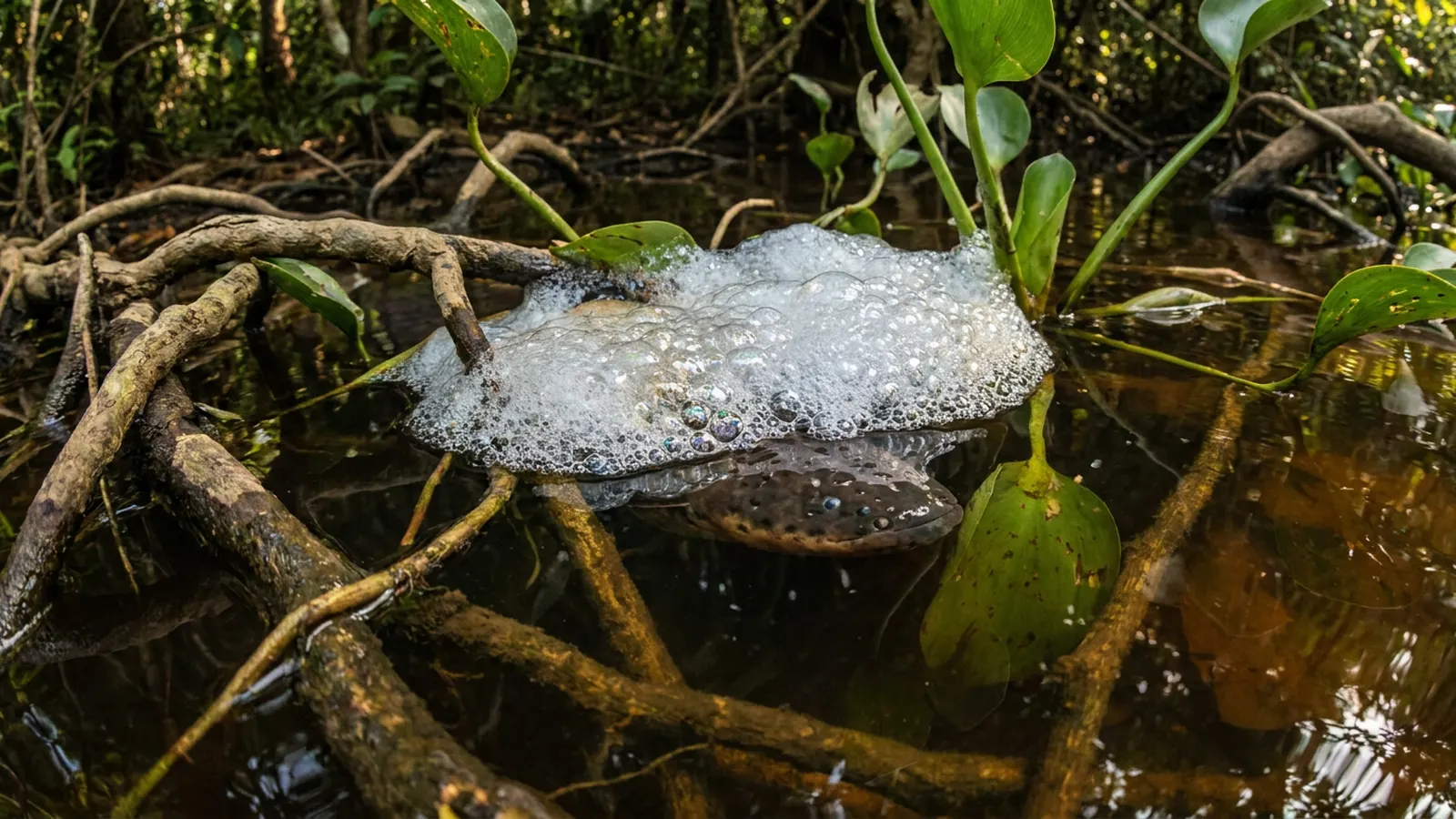
The best field studies of electric eel reproduction come from the floodplains and swamps of northern Brazil. There, electric eels breed during the dry season, when water levels drop and the eels gather in shallow, still pools, swamps and backwaters with dense vegetation and root mats. Breeding in the dry season means the eggs and young develop in sheltered, shallow water. By the time the rains return and the water rises, the young eels are big enough to disperse into the flooded forest, where food is abundant.
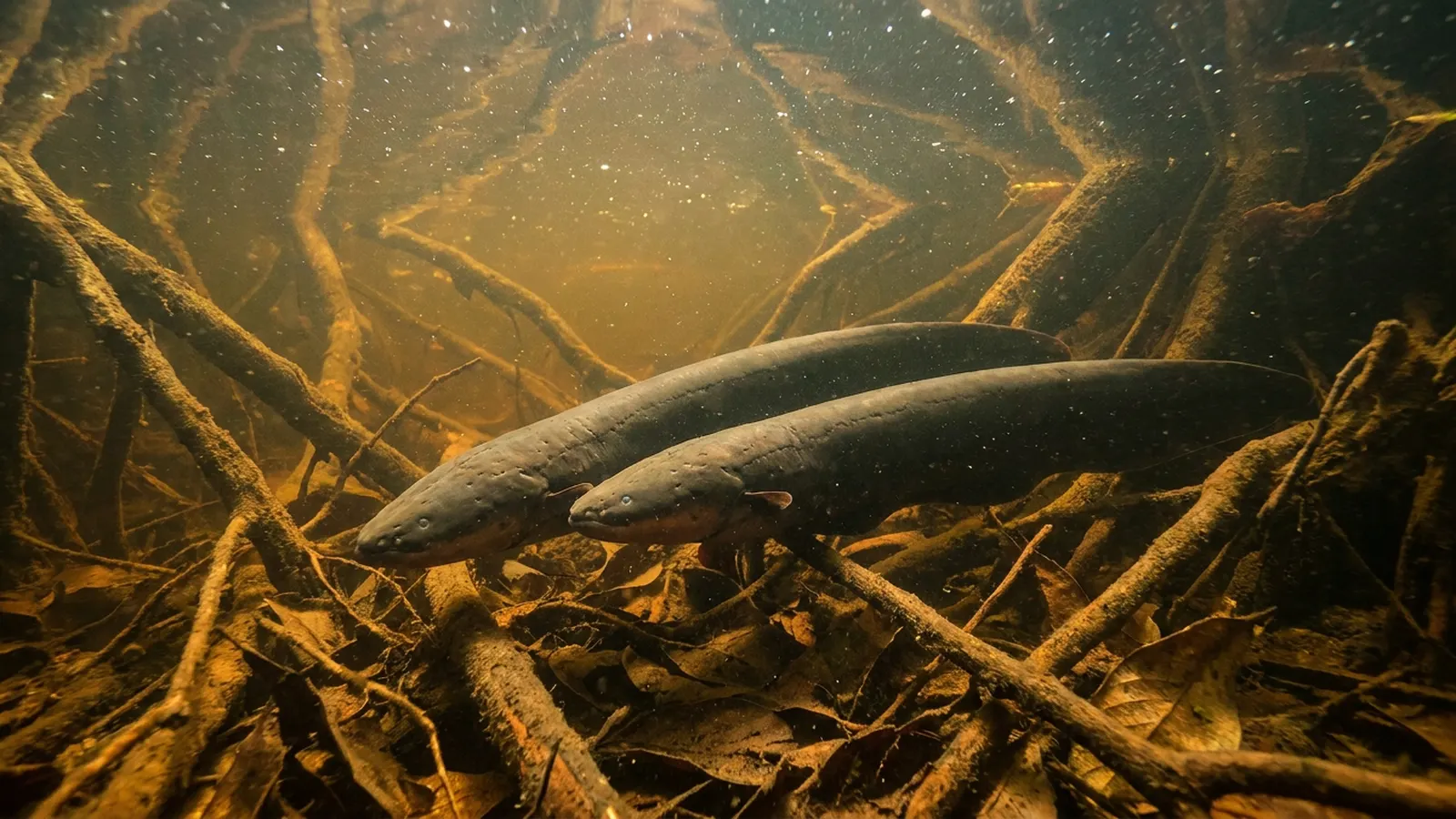
Adult electric eels are mostly solitary, but at breeding time males and females pair up, and the male establishes and defends a nest site. Like the hunting packs of E. voltai described in what electric eels eat, breeding is one of the few times these fish are regularly seen together.
The foam nest
The male blows a raft of bubbles to hold the eggs.
The male electric eel builds a nest by producing foam from his mouth, using saliva to make bubbles that cling together in a floating mass, usually among aquatic plants or roots at the surface. The foam nest keeps the eggs close to the surface, where oxygen levels are highest in warm, stagnant water. That matters for an animal whose habitat is often so low in oxygen that the adults themselves have to breathe air. Foam nests are also found in other fish of oxygen-poor waters, such as gouramis and some catfish, which suggests it’s a good solution to the same problem.
The female then lays her eggs in the nest. Field studies have described females spawning in several batches over a period of time, and a single nest can end up holding more than a thousand eggs in different stages of development. The male fertilises each batch externally, as it’s laid.
Guarding fathers
An electric parent is a formidable bodyguard.
Once the eggs are in the nest, the male guards them. He stays at the nest, chases away intruders and will use his electric discharges against animals that come too close. An electric eel guarding a nest is one of the more dangerous animals to approach in the Amazon, because it is both defensive and capable of delivering high-voltage shocks. Some reports describe the female remaining nearby as well, but the main guarding role belongs to the male.
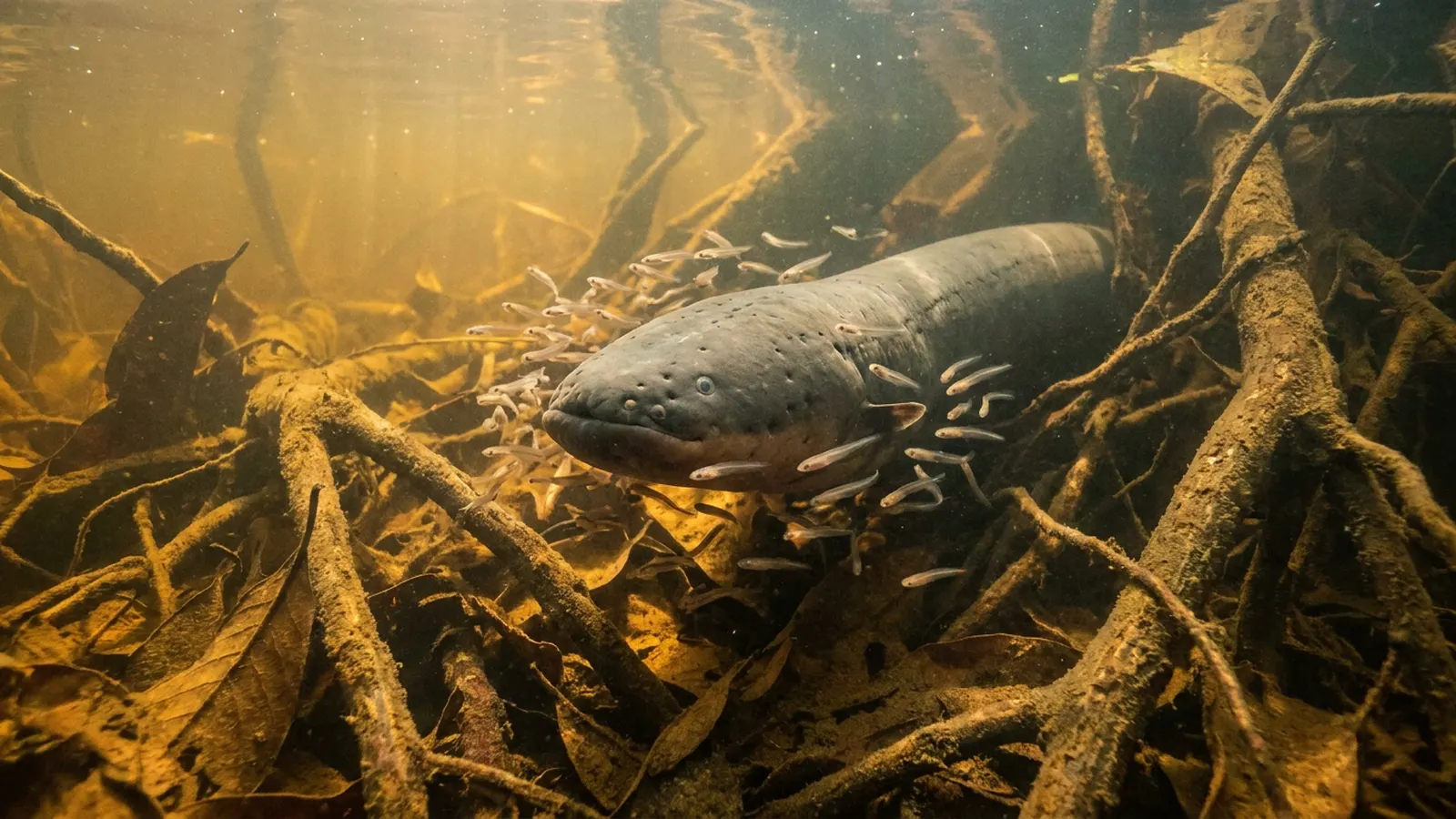
After the eggs hatch, the young eels stay close to their father for a period that can last weeks or longer, living in a group near the nest. The male’s protection gives them a much better chance of surviving their most vulnerable stage. It’s an unusual level of parental investment for a fish, and the opposite of what true eels do. For comparison, see how true eels reproduce.
Babies that eat their siblings
The first meal is close at hand.
Because the female lays eggs in batches over time, the nest contains eggs and larvae of different ages. The first young to hatch don’t have to go looking for food. Field researchers have reported that hatchlings feed on the eggs and embryos from later batches in the same nest. It sounds grim, but it’s an efficient strategy: the early hatchlings get a rich, protected food source right where they are, grow quickly, and develop their electric organs before they have to face the outside world. Similar egg-eating by developing young is known in some sharks and other animals.
As they grow, the young switch to small invertebrates such as insect larvae and tiny crustaceans, then gradually to fish. Their electric organs develop early, and even small juveniles can produce discharges, though much weaker than an adult’s.
| Feature | Electric eel | True freshwater eels | Moray eels |
|---|---|---|---|
| Where it spawns | Shallow freshwater swamps | Open ocean (e.g. Sargasso Sea) | Near reefs |
| Nest | Foam nest | None | None |
| Parental care | Male guards eggs and young | None | None |
| Times per lifetime | Many seasons | Once, then dies | Many times |
| Larva | Small, eel-like | Leptocephalus | Leptocephalus |
Do electric eels use electricity in courtship?
Probably, though the details are still being studied.
All knifefish produce weak electric signals, and in many species these signals carry information about species, sex and readiness to breed. Electric eels use the low-voltage output of their Sachs’ organ for electrolocation, and researchers suspect it also plays a role in recognising and communicating with other eels, including mates. How much courtship depends on electric signals, as opposed to touch, chemistry or behaviour, isn’t yet well understood in electric eels, and it’s an active area of research.
Breeding electric eels in captivity
Rare, but public aquariums have managed it.
Electric eels are kept in many public aquariums, but breeding them is uncommon. They need very large tanks, careful management of water level and quality to mimic the seasonal changes of their habitat, and a compatible pair that won’t injure each other. A few institutions have reported successful spawning, and those events have added to what we know about nest-building and parental behaviour. As someone who has spent decades trying to get corals and fish to grow in aquarium systems, I appreciate how hard it is to recreate the seasonal cues a species like this depends on.
How young electric eels grow up
From nest to flooded forest.
When the rains return and water spreads into the forest, the young eels leave their father and disperse. The flooded forest is full of insects, small crustaceans and young fish, and it offers endless hiding places among roots and leaf litter. Young electric eels grow quickly in these conditions, and their diet shifts steadily toward fish as they get larger. Their electric organs grow with them, and their discharges become stronger as the organs add more electrocytes in series. By the time they reach adult size, often well over a metre, they’re capable of the powerful volleys that make the species famous.
Growth also brings a change in breathing. Electric eels rely on gulping air from early in life, and juveniles, like adults, must surface regularly to breathe. That makes shallow, sheltered water ideal nursery habitat, with the surface always close at hand.
Why their breeding matters for conservation
Healthy floodplains mean healthy electric eels.
Electric eels aren’t currently considered threatened, but their reproduction depends on shallow, vegetated floodplain habitat and on the natural rise and fall of river levels. Dams, which alter flood cycles, and deforestation of floodplain forests both affect the places where electric eels nest. Protecting those seasonal wetlands protects not just the electric eel but the huge diversity of Amazonian fish that breed and feed there. For the name history of this remarkable fish, see what electric eels were called before electricity.
Do electric eels lay eggs?
Yes. Females lay eggs in a foam nest built by the male, often in several batches.
Do electric eels take care of their young?
Yes. The male guards the eggs and the young, which stay near him for weeks after hatching.
When do electric eels breed?
During the dry season, in shallow, swampy, vegetated water.
How many eggs does an electric eel lay?
A nest can accumulate more than a thousand eggs from several batches.
What do baby electric eels eat?
At first, eggs and embryos from later batches in the nest; then small invertebrates, then fish.
Do electric eels reproduce like other eels?
No. True eels spawn in the ocean with no parental care. Electric eels, which are knifefish, build nests in fresh water and guard their young.
- Assunção, M. I. S. & Schwassmann, H. O. (1995). Reproduction and larval development of Electrophorus electricus on Marajó Island (Pará, Brazil). Ichthyological Exploration of Freshwaters 6: 175–184.
- de Santana, C. D. et al. (2019). Unexpected species diversity in electric eels. Nature Communications 10: 4000.
- Bastos, D. A. et al. (2021). Social predation in electric eels. Ecology and Evolution 11: 1088–1092.
- Smithsonian National Museum of Natural History, electric eel research.
Blane Perun has been exploring Earth’s oceans and marine life for over 25 years. Founder of TheSea.Org in 1999, underwater photographer, coral aquaculture pioneer, and explorer of 80+ countries.
About Blane Perun → More on Electric Eels →