What Does an Oceanographer Do? — Daily Work, Careers and How to Become One
An oceanographer is a scientist who studies the ocean as a whole system: how its water moves (physical oceanography), what it is made of (chemical), the seafloor beneath it (geological) and the life within it (biological). Day to day, oceanographers plan and run research cruises, deploy instruments such as CTDs, floats and sonar, analyse data and satellite images, build computer models, and publish their results. Most spend far more time at a computer than at sea.
When people picture an oceanographer, they tend to imagine someone in a wetsuit on the deck of a research ship, or a diver taking samples on a reef. Some oceanographers do that. Many more spend most of their working lives in an office or laboratory, writing code, running models, analysing years of data and writing grant proposals, with a research cruise once or twice a year. The job is broad because the ocean is broad: the same profession covers someone measuring carbon dioxide in seawater, someone mapping an undersea volcano and someone predicting the path of a hurricane.
This page explains what oceanographers actually do, the different specialties, the tools of the trade and what it takes to become one. I’m not a professional oceanographer. My background is decades of reef keeping, coral farming and diving. But running reef systems since 1996 has meant living with the same questions oceanographers ask every day: what is in the water, how is it moving and how is it changing.
The four branches of oceanography
Oceanography is traditionally divided into four main branches. Most oceanographers specialise in one, but the best work often crosses between them.
Physical oceanographers study how the ocean moves and how it stores and transports heat: currents, waves, tides, mixing and the exchange of energy with the atmosphere. Their work underpins climate models and weather forecasts; see our page on physical oceanographers. Chemical oceanographers study the composition of seawater, including salinity, nutrients, oxygen, carbon and pollutants, and how chemicals cycle between the water, the seafloor, living things and the air; our guide to chemical oceanographers covers that field. Geological oceanographers, also called marine geologists, study the seafloor, its sediments and rocks, plate tectonics, underwater volcanoes and the history of the oceans recorded in mud; see geological oceanographers. Biological oceanographers study how marine life interacts with the ocean environment, from plankton blooms to food webs and fisheries.
The line between biological oceanography and marine biology is blurry. As a rough rule, marine biologists focus on organisms themselves, while biological oceanographers focus on how life fits into the physical and chemical ocean system. Our comparison of oceanographer vs marine biologist goes into the differences.
A typical week ashore
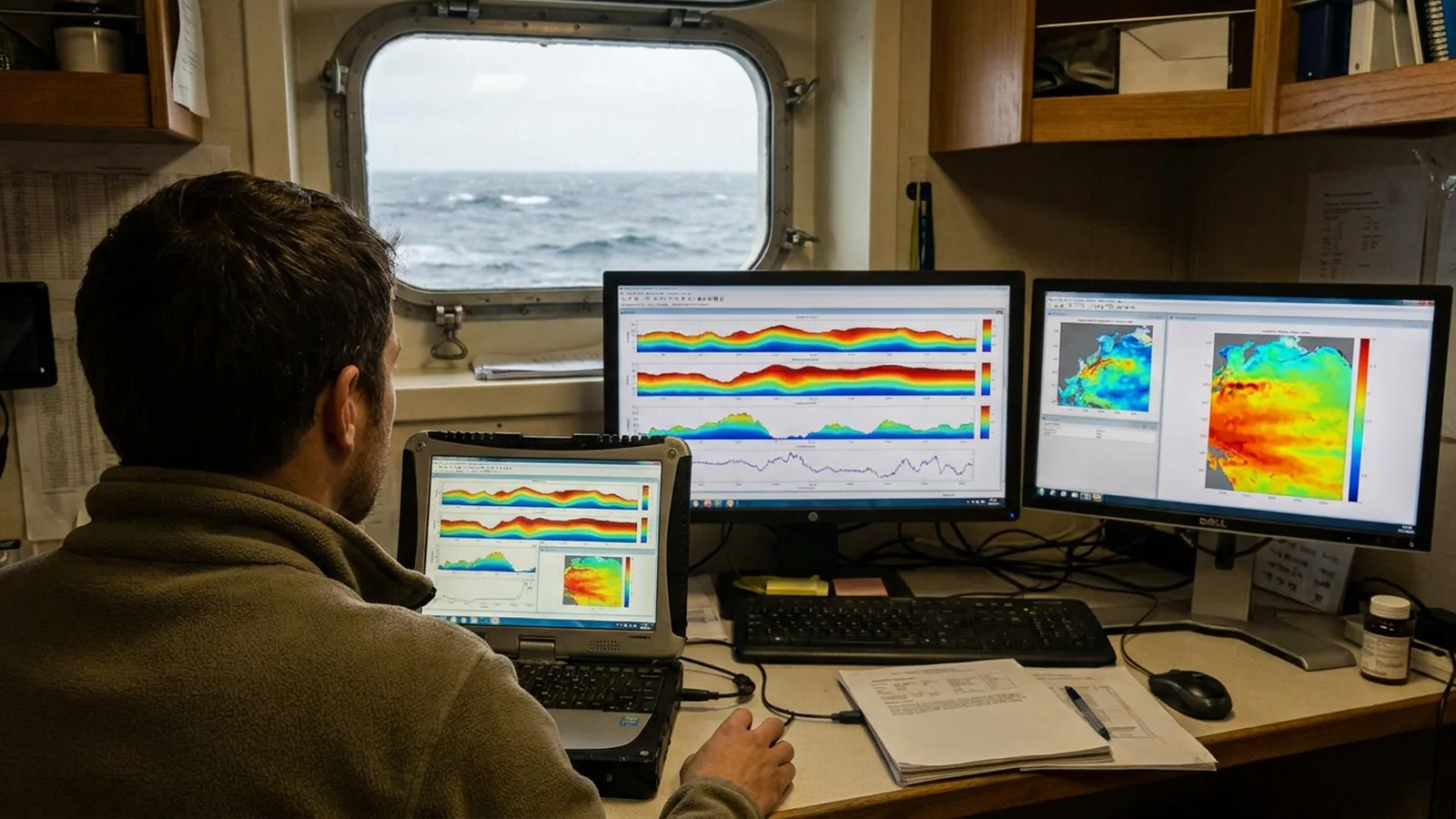
Most of an oceanographer’s time is spent on land, turning measurements into understanding.
A research oceanographer at a university or government lab might spend the week cleaning and analysing data from the last cruise or from an array of instruments, writing and running computer code, comparing observations with model output, reading new papers, supervising students, preparing figures for a paper and writing a grant proposal to fund the next project. Meetings with collaborators, often in several countries, are common, because large ocean projects are almost always international. Many oceanographers also teach, and those in government agencies may spend part of their time producing forecasts, maps or reports that other people depend on.
Programming has become one of the core skills. Ocean data sets are huge, from satellite records covering the whole planet every day to thousands of autonomous floats reporting temperature and salinity profiles. Being comfortable with Python, MATLAB, R or similar tools matters as much today as knowing how to handle samples on a ship. Writing matters too: results only count once they are published, and funding depends on persuading reviewers that a project is worth the cost of ship time and equipment.
Life at sea on a research cruise
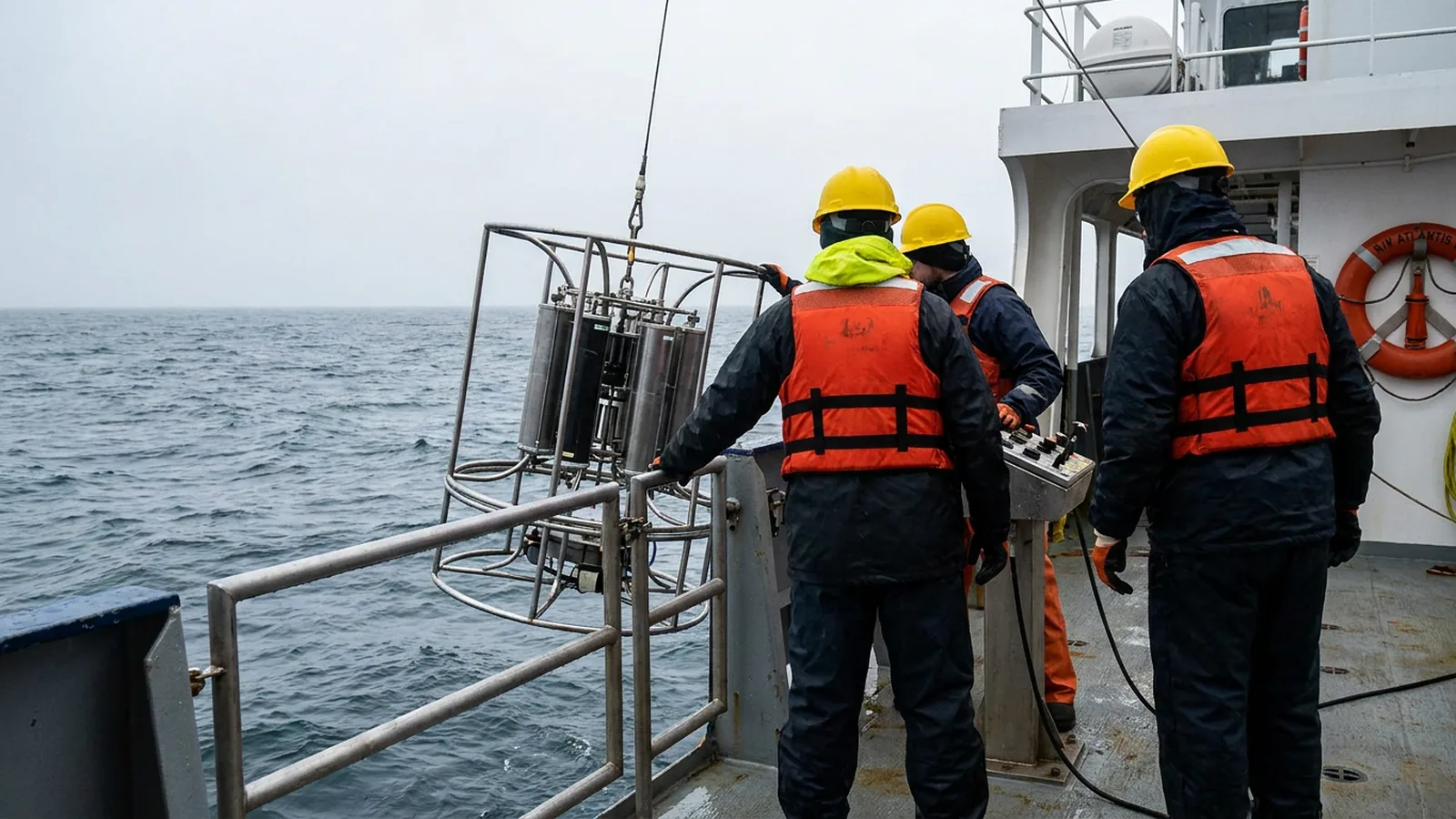
Research cruises are where much of the raw data comes from, and they are intense.
A typical cruise lasts from a few days to six weeks or more aboard a research vessel operated by a university, a government agency or an institution. Work runs around the clock in shifts. A team might stop at a series of “stations” to lower a CTD rosette, a frame carrying sensors for conductivity, temperature and depth along with bottles that snap shut to collect water at chosen depths. Others might map the seafloor with multibeam sonar, tow nets to sample plankton, collect sediment cores, deploy or recover moorings and floats, or run remotely operated vehicles down to the bottom. Cruises are planned months or years ahead, ship time is expensive, and bad weather can wipe out days of work, so oceanographers learn to be flexible.
Not every oceanographer goes to sea. Some work entirely with satellite data or computer models. Others work mainly in coastal waters from small boats, or in labs analysing samples others collect. Seasickness, long days and time away from family are real parts of the job for those who do sail, and many oceanographers say the cruises are both the hardest and the most memorable part of their careers.
The tools of the trade
Modern oceanography relies on a mix of ships, robots, satellites and computers.
The CTD remains the workhorse instrument, measuring salinity, temperature and depth as it is lowered through the water. Our page on how oceanographers measure salinity explains how it works. The Argo programme has put thousands of robotic floats into the world’s oceans; each one drifts at depth, rises to the surface every ten days or so while measuring temperature and salinity, and sends its data by satellite. Gliders and other autonomous vehicles cruise for months collecting data. Echo sounders and multibeam sonar map the seafloor; see what oceanographers use echo-sounding devices to study. Satellites measure sea surface temperature, sea level, ocean colour (a proxy for plankton) and sea ice from space. And numerical models, run on large computers, tie it all together.
| Branch | Main questions | Typical tools | Example employers |
|---|---|---|---|
| Physical | Currents, waves, tides, heat, climate | CTD, Argo floats, moorings, satellites, models | Universities, NOAA, Navy |
| Chemical | Salinity, nutrients, carbon, oxygen, pollution | Water samplers, lab analysers, sensors | Universities, EPA, environmental consultancies |
| Geological | Seafloor, sediments, plate tectonics, past climates | Multibeam sonar, cores, seismic surveys, ROVs | USGS, universities, energy industry |
| Biological | Plankton, food webs, fisheries, ecosystems | Nets, optical sensors, DNA sampling, satellites | Universities, NOAA Fisheries, NGOs |
Where oceanographers work
Oceanographers work in a wider range of places than most people realise.
Universities and research institutions employ many, from major centres such as Scripps Institution of Oceanography and Woods Hole Oceanographic Institution to smaller programmes like the NSU Oceanographic Center in Florida. In the United States, federal agencies including NOAA, the US Geological Survey, NASA and the Environmental Protection Agency employ oceanographers, and the Navy runs one of the largest ocean science operations in the world; see the Oceanographer of the Navy. Private employers include environmental consulting firms, offshore energy companies (oil and gas, and increasingly offshore wind), cable-laying and survey companies, ports and coastal engineering firms. Others work for conservation groups, museums and aquariums, or in science communication and policy.
How to become an oceanographer
There is no single route, but most oceanographers start with a strong degree in a core science and add specialised ocean training later.
A bachelor’s degree in physics, chemistry, biology, geology, mathematics, computer science or engineering is a common starting point; a few universities offer undergraduate degrees in marine science or oceanography. For research positions, a master’s degree or PhD in oceanography or a related field is usually required, and many oceanographers do a postdoctoral position or two before landing a permanent job. Technician and data roles are open to people with bachelor’s or master’s degrees. Useful extras include programming skills, statistics, experience at sea (many programmes offer student cruises), and certifications such as scientific diving if you want to work underwater. Our page on oceanographic engineering salaries covers pay on the engineering side.
My advice to anyone curious is to get your hands wet early. Volunteer at a marine lab, join a citizen science project, or even set up a small reef aquarium and learn to test and manage its water chemistry. I learned more about salinity, alkalinity and how small changes cascade through a system from years of running my own reef tanks than from any book, and the same instincts apply to the ocean on a much bigger scale.
Why the work matters
Oceanographers provide much of the information society relies on without thinking about it.
Their work feeds weather and hurricane forecasts, tsunami warnings, climate projections, fisheries management, safe navigation, the routing of undersea internet cables, offshore construction and the protection of coral reefs. They track rising sea levels and ocean heat, measure ocean acidification and map the seafloor, much of which is still poorly charted; see why we have better maps of Mars than of the ocean. For the famous names who built the field, from Cook and Darwin to Cousteau and Earle, see our hub on famous oceanographers and ocean explorers.

What does an oceanographer study?
The ocean as a system: its physics, chemistry, geology and biology, and how they interact with the atmosphere, the land and climate.
Do oceanographers spend a lot of time at sea?
Usually less than people expect, often a few weeks a year on cruises, with the rest spent analysing data, modelling and writing. Some never go to sea at all.
What degree do you need to be an oceanographer?
A bachelor’s degree in a core science, maths or engineering, followed by a master’s or PhD for most research positions.
Is an oceanographer the same as a marine biologist?
No. Marine biologists study marine organisms; oceanographers study the whole ocean system, of which biological oceanography is one branch.
Where do oceanographers work?
At universities and research institutes, government agencies such as NOAA, USGS and the Navy, consulting firms, energy and survey companies, and conservation groups.
Do oceanographers need to scuba dive?
Not usually. Diving is useful for some coastal and reef work, but most data comes from ships, instruments, robots and satellites.
What skills are most useful?
Strong science and maths, programming and data analysis, comfort working at sea in teams, and clear writing.
- NOAA Ocean Service, “What is oceanography?” and ocean careers resources.
- Woods Hole Oceanographic Institution, oceanography careers and research vessel information.
- Argo Program (argo.ucsd.edu), float array overview.
- US Bureau of Labor Statistics, Occupational Outlook Handbook: Geoscientists.
Blane Perun has been exploring Earth’s oceans and marine life for over 25 years. Founder of TheSea.Org in 1999, underwater photographer, coral aquaculture pioneer, and explorer of 80+ countries.
About Blane Perun → More on Oceanographers →