Eel Facts — 20 Surprising Things About Morays, Congers and Freshwater Eels
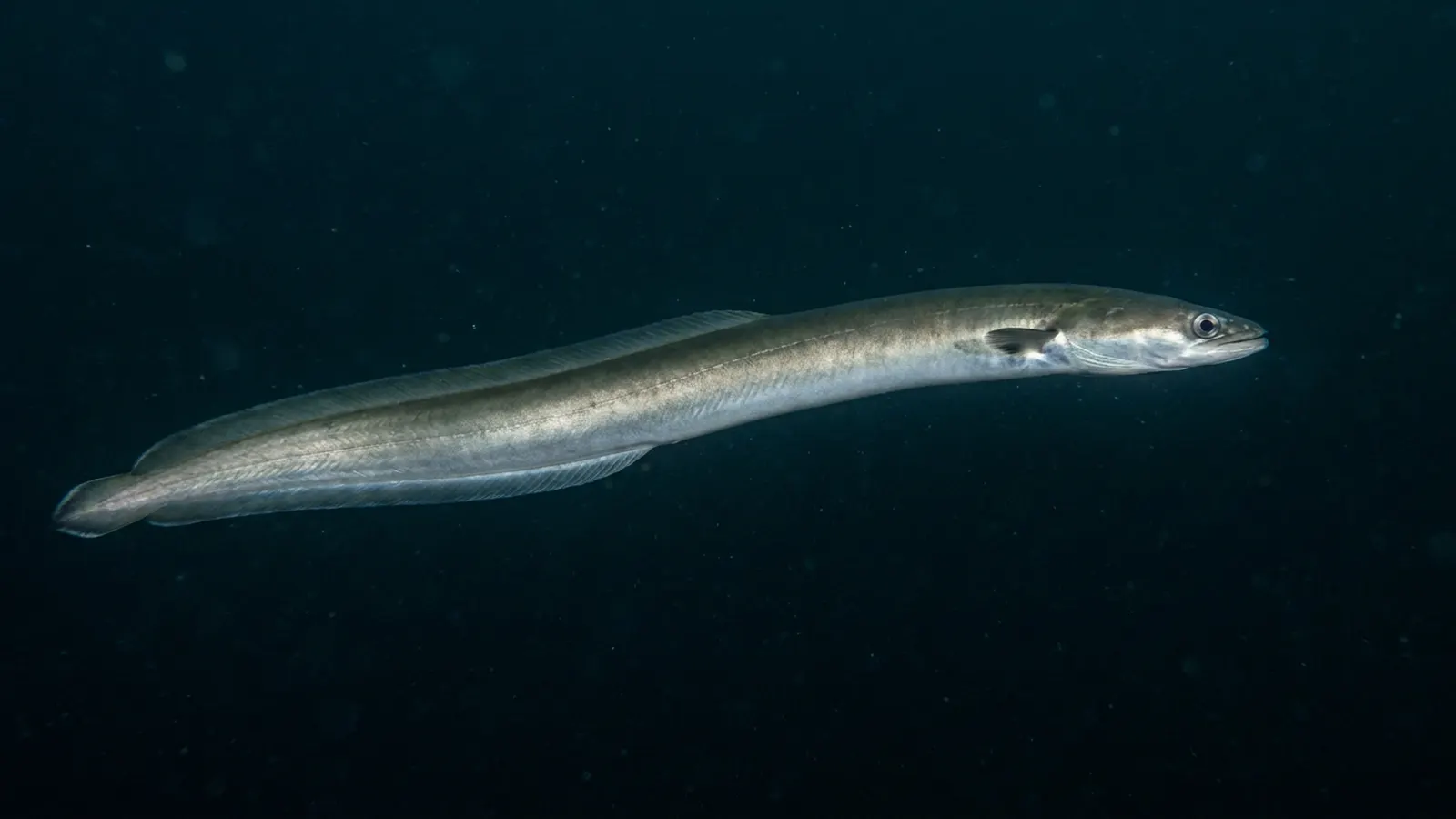
Eels are true bony fish, not snakes, in the order Anguilliformes, with roughly 1,000 species in about 20 families. They include morays, congers, garden eels, snake eels and the freshwater eels of rivers. All start life as see-through, leaf-shaped larvae, and some cross entire oceans to breed once and die.
Eels have a reputation problem. People see a long, slimy body, a mouth full of teeth and a head poking out of a hole, and they decide it’s something to be afraid of. I think eels are some of the most interesting fish in the ocean, and the more you learn about them, the stranger they get. Here are twenty facts I’d want anyone to know before their first dive with a moray, or their first plate of unagi.
What eels actually are
The first few facts are about getting the basics right, because a lot of animals called “eels” aren’t.
1. Eels are fish. They breathe with gills, have fins, a swim bladder and a bony skeleton. The resemblance to snakes is a case of convergent evolution: a long body is a good shape for living in holes and crevices. We cover the differences in are eels related to snakes.
2. There are about 1,000 species of true eel. They belong to the order Anguilliformes and fall into roughly 20 families. Morays (Muraenidae) and snake eels (Ophichthidae) are the biggest groups; congers and garden eels (Congridae) and the freshwater eels (Anguillidae) are the best known after that.
3. The electric eel is not an eel. It’s a South American knifefish, more closely related to catfish and carp than to morays. Wolf eels, lampreys, swamp eels and the “eel” in “eelpout” aren’t true eels either. That’s why the electric eel breathes air and has a long fin under its belly instead of along its back.
4. Many eels have no scales, and some do. Morays and congers are scaleless. Freshwater eels have tiny scales buried in their skin, so small that most people never notice them. Details are in do eels have scales.

Bodies built for holes
Everything about an eel’s anatomy makes sense once you picture it living in a crevice.
5. Most eels have lost their pelvic fins, and morays have lost their pectoral fins too. The dorsal, tail and anal fins merge into a single ribbon that runs around the back half of the body. That lets an eel swim forward or backward with the same wave-like motion and slide in and out of tight holes without anything snagging.
6. Eels can tie themselves in knots. Morays loop their bodies into a knot and slide it toward the head to get leverage when tearing chunks off prey that’s too big to swallow. Hagfish, which aren’t eels at all, use the same trick to strip slime off their skin.
7. Eel slime has jobs. The mucus coating protects against scrapes and parasites, helps some species glide through sand, and cements the walls of garden-eel burrows. In some morays it carries toxins that discourage predators.
8. The green moray isn’t green. The Caribbean green moray (Gymnothorax funebris) has bluish-grey or brown skin covered in a yellow mucus layer. Blue plus yellow reads as green. If you’re curious about other colours, see what color are eels.
9. Freshwater eels can survive out of water for hours. As long as the skin stays wet they can absorb some oxygen through it, which lets them cross damp grass between ponds or wriggle past river barriers.
Facts about moray eels
Morays are the eels divers meet most, and they’re full of surprises.
10. Morays have a second set of jaws in their throat. In 2007 researchers at the University of California, Davis, used high-speed video to show that morays shoot their pharyngeal jaws forward into the mouth, grab prey and haul it down the throat. No other animal is known to use its throat jaws this way. More on this in our page on the moray eel skull.
11. A gaping moray isn’t threatening you. Morays have small gill openings and pump water over their gills by opening and closing their mouths. It looks aggressive, especially with the teeth showing, but it’s breathing.
12. Morays team up with groupers. In the Red Sea, roving coral groupers swim to a giant moray’s hole and shake their heads to invite it on a hunt. The eel flushes fish out of crevices and the grouper catches whatever escapes into open water. It’s one of the best-documented examples of cooperative hunting between two different species of fish.
13. Some morays change sex. The ribbon eel starts life black, becomes a blue-and-yellow male, and may finish as an all-yellow female. A few other morays appear to be both sexes at once. The story is told in our blue ribbon eel profile.
14. Big morays can be poisonous to eat. Giant morays sit high on the reef food chain and can build up ciguatoxin from the fish they eat. Cooking doesn’t destroy it, and several tropical regions advise against eating large morays at all.
Strange behaviours
Eels get up to some things that sound made up.
15. Snake eels can escape from inside a predator. Snake eels have a hard, pointed tail for burrowing backward into sand. When a predatory fish swallows one alive, the eel can drive that tail through the stomach wall. A 2020 Queensland Museum study described snake eels found mummified in the body cavities of predatory fish: they’d escaped the stomach but couldn’t get any further.
16. Garden eels never really leave home. Garden eels spend almost their whole adult lives with their tails anchored in a burrow on a sandy slope, rising to pick plankton from the current and dropping out of sight when anything approaches. In 2020, when Tokyo’s Sumida Aquarium closed during the pandemic, its garden eels forgot about people and started hiding from keepers, so the aquarium asked the public to video-call them. Read more in garden eels out of the sand.
17. A group of eels is called a swarm or a bed. Neither is used much by scientists, but the names show up in quiz books and on our page about what a group of eels is called.
The great eel mystery
For most of human history, nobody knew where eels came from.
18. The baby eel was once classified as a different fish. Eel larvae are flat, transparent and leaf-shaped. In the 1850s one was named Leptocephalus brevirostris, as if it were a separate species. In the 1890s two Italian zoologists watched these larvae turn into young eels in tanks, and the name leptocephalus stuck for the larva of every eel. The full journey is laid out in our eel life cycle guide.
19. No one has ever seen Atlantic eels spawn. European and American eels breed somewhere in the Sargasso Sea, a fact worked out a century ago from where the smallest larvae were found. Adult eels have since been satellite-tracked into the area, but the spawning itself has never been observed and the eggs have never been found there. A young Sigmund Freud spent weeks in 1876 dissecting eels in Trieste looking for male sex organs and gave up without finding them. See how eels reproduce.
20. Raw eel blood is toxic. Eel blood contains a protein toxin that can harm people if it gets into a cut, the eyes or the mouth in quantity. Heat breaks it down, which is one reason eel is always cooked in Japanese cuisine and never served as raw sashimi. Our page on eating eel covers the details.
Eel record holders
A quick comparison of the extremes.
| Record | Species | Figure |
|---|---|---|
| Longest eel | Slender giant moray (Strophidon sathete) | Up to about 4 m |
| Heaviest eel | European conger (Conger conger) | Around 70 kg or more |
| Heaviest moray | Giant moray (Gymnothorax javanicus) | About 30 kg, ~3 m |
| Biggest mouth for its size | Gulper eel | Mouth larger than its body |
| Longest migration | European eel | About 5,000–7,000 km to the Sargasso Sea |
Records for the biggest eels ever caught are a topic of their own, and I’ve collected them in the largest eel ever caught.
Why eels are in trouble
One more fact, and it’s the one that matters most.
The European eel is listed as Critically Endangered by the IUCN, and the American and Japanese eels are listed as Endangered. Because eels still can’t be bred commercially, almost every farmed eel starts as a wild-caught glass eel, and the trade in those tiny eels has attracted smuggling on a scale that European police agencies treat as serious organised crime. Add dams that block migration, hydropower turbines, pollution and parasites, and you have an animal that is being squeezed at every stage of a very long life.
My own advice, if you love eating eel, is to ask where it came from and to treat it as an occasional luxury rather than an everyday dish. And if you’re a diver, give morays the same respect you’d want: don’t feed them and don’t put your hands in their holes. They’ll reward you by sitting still for a portrait.

Are eels fish or snakes?
Fish. Eels breathe with gills and have fins and a bony skeleton. Snakes are reptiles that breathe air with lungs.
How many types of eels are there?
About 1,000 species of true eels in roughly 20 families, including morays, congers, garden eels, snake eels and freshwater eels.
What are three facts about moray eels?
They have a second set of jaws in the throat, they open and close their mouths to breathe, and some species hunt cooperatively with groupers.
Are eels dangerous?
Rarely. Morays bite defensively if hands go near their holes or someone feeds them. Large morays can also carry ciguatera toxin if eaten.
Can eels live out of water?
Freshwater eels can survive for hours out of water if their skin stays moist, and they sometimes cross wet ground between ponds.
Is an electric eel a real eel?
No. It’s a knifefish from South America, more closely related to catfish than to true eels.
Where do eels come from?
All eels hatch as leptocephalus larvae in the sea. European and American freshwater eels hatch in the Sargasso Sea.
- Mehta, R. S. & Wainwright, P. C. (2007). Raptorial jaws in the throat help moray eels swallow large prey. Nature 449: 79–82.
- Bshary, R. et al. (2006). Interspecific communicative and coordinated hunting between groupers and giant moray eels in the Red Sea. PLoS Biology 4: e431.
- Nelson, J. S., Grande, T. C. & Wilson, M. V. H. (2016). Fishes of the World, 5th ed. Wiley.
- Froese, R. & Pauly, D. (eds.). FishBase.
- IUCN Red List assessments for Anguilla anguilla, A. rostrata and A. japonica.
- Queensland Museum (2020), snake eels in predator body cavities, Memoirs of the Queensland Museum – Nature.
Blane Perun has been exploring Earth’s oceans and marine life for over 25 years. Founder of TheSea.Org in 1999, underwater photographer, coral aquaculture pioneer, and explorer of 80+ countries.
About Blane Perun → More on Eels →