What Do Porpoises Eat? — Diet and Hunting of All Seven Species
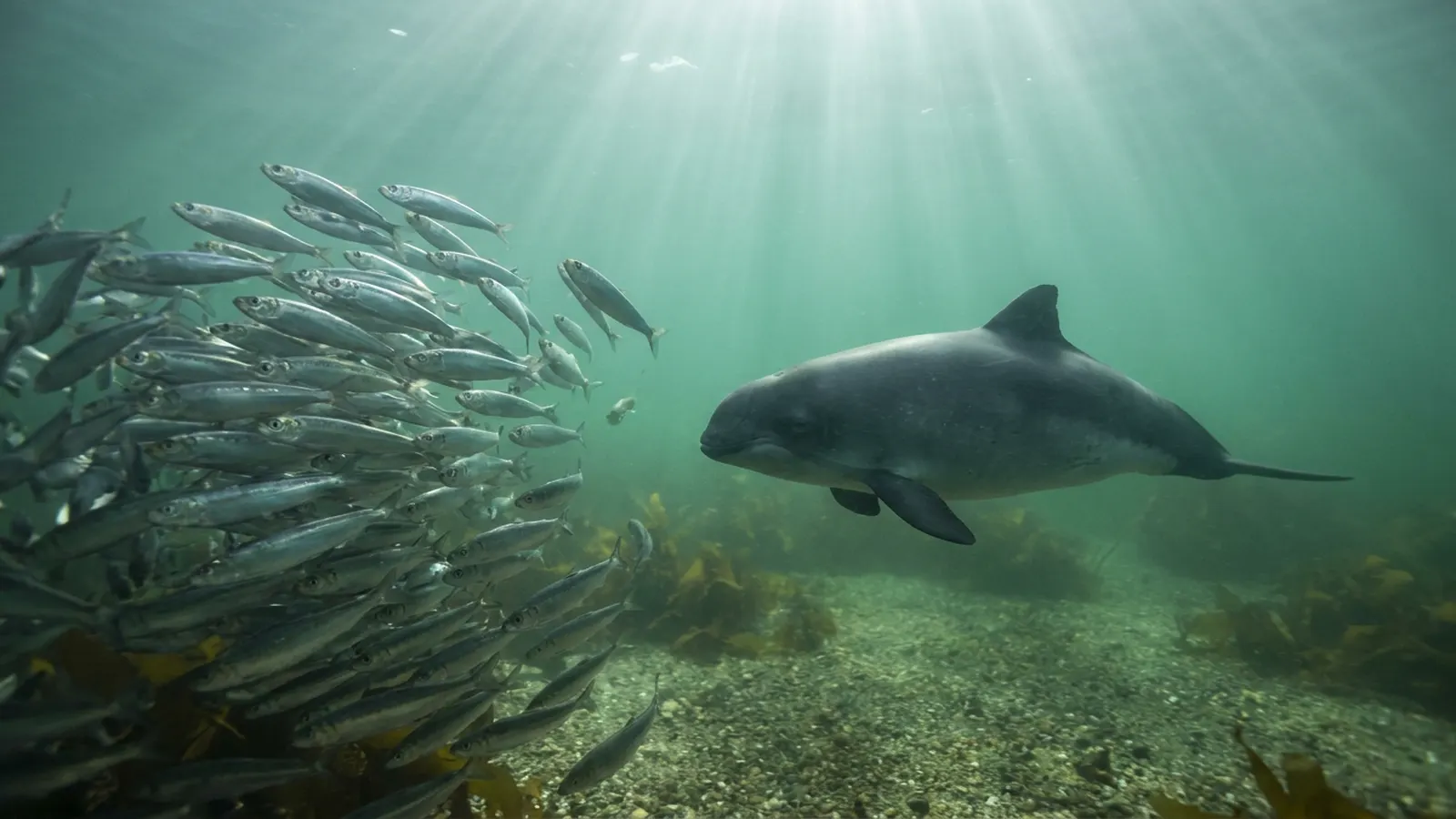
Porpoises eat mainly small fish, usually under about 25 cm long, such as herring, sprat, sand eels, capelin, anchovies and small cod, plus squid, octopus and shrimp. They find prey with high-frequency echolocation, grab it with small spade-shaped teeth and swallow it whole. Because they are small and live in cool water, most porpoises must eat almost constantly.
Porpoises are small, fast-living whales, and their diet reflects that. They don’t take on big prey the way killer whales or sperm whales do. Instead, they hunt large numbers of small fish and squid, often close to the seabed or in coastal waters where those prey gather. A porpoise that misses meals for even a day or two can be in trouble, so feeding shapes almost everything about how these animals live, where they go and why they are so vulnerable to changes in their environment. This page covers what porpoises eat in general, how the diet varies among the seven species, and how they find and catch their food. For an introduction to the family, see our porpoise species guide.
The porpoise menu
Most porpoises are opportunistic predators of small fish. They eat whatever suitable prey is abundant locally, which means their diet changes with place and season.
Across the family, the most important prey are schooling fish that live in coastal and shelf waters: herring, sprat, anchovies, sardines, capelin and sand eels. Many porpoises also eat bottom-living fish such as whiting, small cod, hake, gobies and flatfish, as well as croakers and grunts in warmer water. Cephalopods are a regular part of the diet, especially squid, and some species also take octopus, cuttlefish and shrimp.
Prey is usually small, often just a few centimetres long and rarely much more than 25 centimetres. Porpoises don’t chew. They grab the prey with their small, flattened, spade-shaped teeth and swallow it whole, usually head first so that the fish’s spines fold back. A big meal for a porpoise is many small fish, not one large one.
Why porpoises eat so much
A harbor porpoise weighs around 50 to 60 kilograms, about the same as a small adult human, yet it lives in water that can be close to freezing. Water draws heat away from the body far faster than air, and a small animal has a lot of surface area relative to its volume. To stay warm, porpoises have a thick layer of blubber and a high metabolic rate, and that metabolism needs fuel. Estimates suggest they eat something like 5 to 10 percent of their body weight each day, and possibly more in cold conditions or when nursing.
A 2016 study using high-resolution acoustic tags on wild harbor porpoises in Danish waters found they foraged almost continuously, day and night, and caught small fish at very high rates, often hundreds per hour. The researchers concluded that porpoises live close to their energetic limits, so even short disruptions, from noise or disturbance, could matter. See harbor porpoise for more about this species.
How porpoises find their food
Porpoises hunt with echolocation. They produce rapid series of clicks from a structure in the forehead called the phonic lips, focus the sound through the fatty melon, and listen for echoes that bounce back from prey and the seabed. Porpoise clicks are unusual: they are narrow-band and very high in frequency, around 130 kilohertz, far above human hearing. That makes them good at detecting small targets at short range, which suits hunting small fish in shallow, cluttered coastal water.
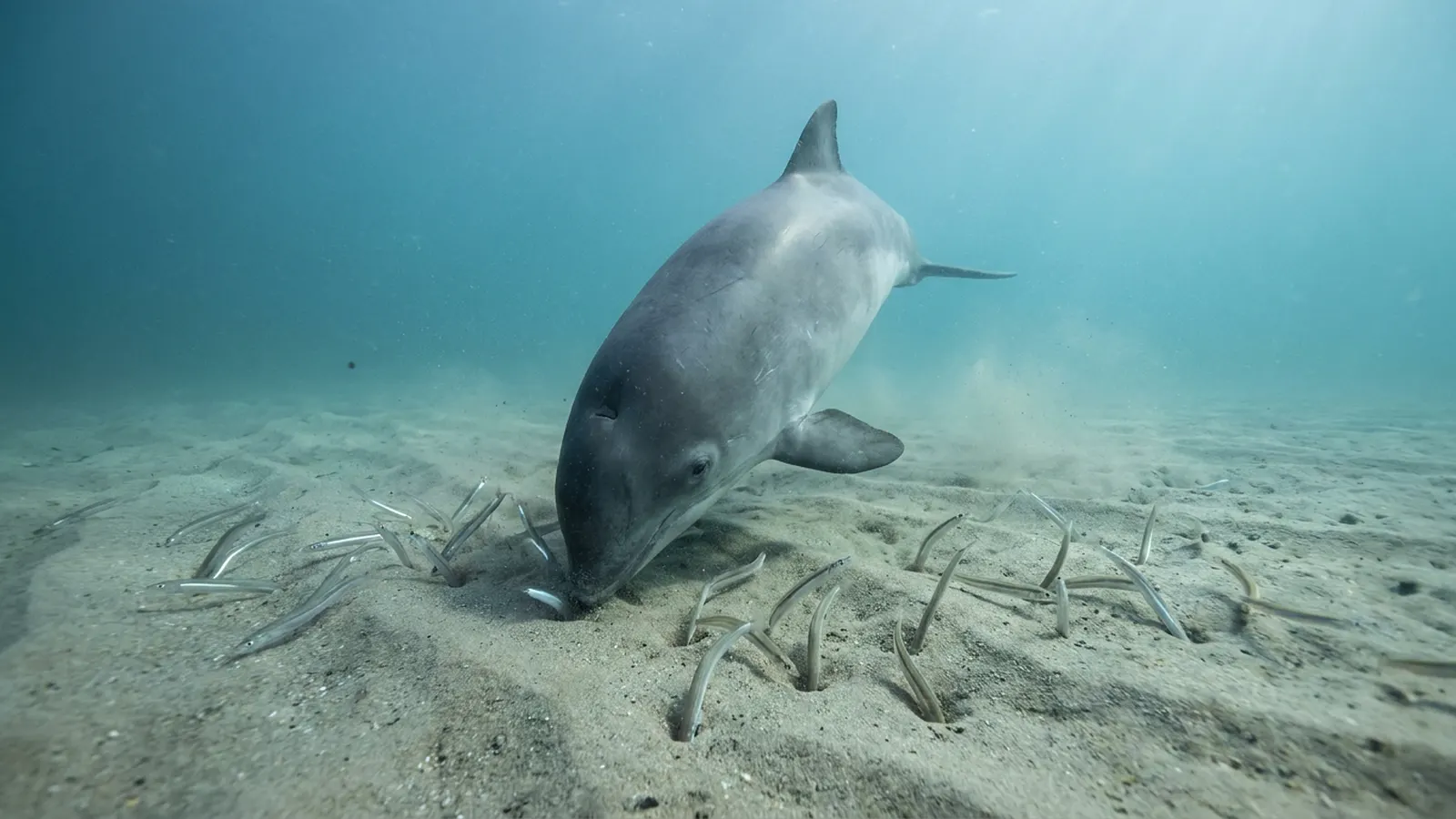
As a porpoise closes in on prey, the clicks speed up into a rapid “buzz”, giving it constant updates on the fish’s position in the final second or two before capture. Acoustic tags record these buzzes, which is how researchers count how often porpoises catch food. Porpoises also use their eyes, especially in clear, shallow water, and may hunt along the seabed by scanning for fish hiding in sand or around rocks.
What each porpoise species eats
The seven porpoises share the same basic diet, but each has its own emphasis depending on where it lives.
Harbor porpoise. Herring, sprat, sand eels, capelin, whiting, small cod and gobies in the North Atlantic; anchovies, herring, smelt and squid in the North Pacific. Diet shifts strongly with season and location.
Dall’s porpoise. Lives offshore in deep North Pacific water and eats more mid-water prey, including lanternfish, small squid, hake and capelin. It can dive to several hundred metres and often feeds at night when deep-water prey migrate upward. See Dall’s porpoise.
Vaquita. Feeds near the bottom in the shallow, murky northern Gulf of California on small fish such as croakers and grunts, plus squid and crustaceans. See vaquita facts.
Burmeister’s porpoise. Eats anchovies, hake and other coastal fish, as well as squid and small crustaceans, along South America’s coasts. See Burmeister’s porpoise.
Spectacled porpoise. So rarely seen alive that its diet is poorly known; the few stomachs examined have contained small fish and squid. See spectacled porpoise.
Finless porpoises. Eat small fish, shrimp, squid and cuttlefish in coastal waters and estuaries of Asia. The Yangtze finless porpoise feeds on river fish in fresh water. See finless porpoises.
| Species | Main prey | Feeding habitat |
|---|---|---|
| Harbor porpoise | Herring, sprat, sand eels, whiting, capelin, squid | Coastal shelf, often near the seabed |
| Dall’s porpoise | Lanternfish, squid, hake, capelin | Offshore, deep water |
| Vaquita | Croakers, grunts, squid, crustaceans | Shallow, murky bottom |
| Burmeister’s porpoise | Anchovies, hake, squid | Coastal |
| Spectacled porpoise | Small fish and squid (poorly known) | Offshore, subantarctic |
| Finless porpoises | Small fish, shrimp, squid, cuttlefish | Coasts, estuaries, Yangtze River |
Do porpoises drink water?
Porpoises rarely drink seawater. Like most marine mammals, they get most of the water they need from their food and from metabolic water, which is released when their bodies break down fat. Their kidneys are efficient at concentrating salt, and fish are a good source of fresh water because their body fluids are less salty than seawater. Squid and other invertebrates are saltier, so a diet heavy in squid makes this harder. This is one more reason a steady supply of fish is so important to porpoises.
What porpoise calves eat
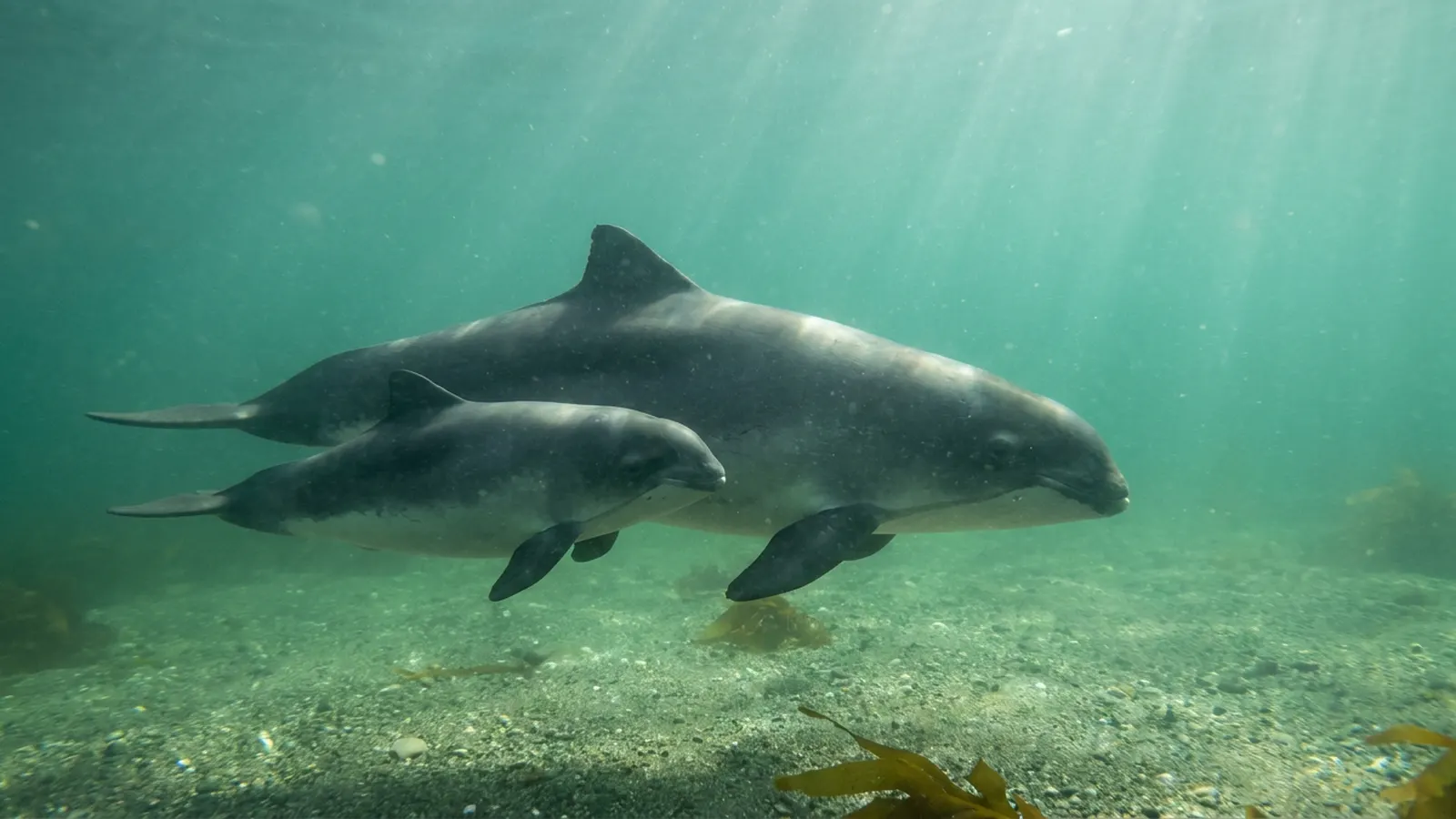
Porpoise calves nurse on their mother’s milk, which is very rich in fat compared with human milk, helping them build blubber quickly in cold water. A harbor porpoise calf typically nurses for several months, and calves begin catching small fish themselves before they are fully weaned, often within the first few months. Because porpoises mature quickly and many females breed every year or two, a mother may be pregnant and nursing at the same time, which makes her own food needs even higher.
How scientists know what porpoises eat
Watching a porpoise eat in the wild is almost impossible, so most of what we know about porpoise diets comes from detective work. Researchers examine the stomachs of porpoises that strand on beaches or die in fishing nets, identifying prey from fish ear bones, called otoliths, and squid beaks, which survive digestion and are distinctive for each species. Chemical tracers in tissues, such as stable isotopes and fatty acids, reveal longer-term diet patterns. Acoustic tags record the buzzes of prey capture, showing how often porpoises feed, and newer DNA methods can identify prey from tiny traces in faeces or stomach contents. Each method has blind spots, so the most reliable picture comes from combining them.
Competition with fisheries
Porpoises eat many of the same fish that people catch, including herring, sprat, sand eels and cod. Changes in fish stocks, whether from overfishing or warming water, can affect porpoise condition and distribution. In the North Sea, for example, shifts in sand eel and herring abundance have been linked to changes in where harbor porpoises are found. The bigger direct problem, though, is that porpoises hunting in the same places as fishing boats are at risk of entanglement in gillnets, the main human-caused threat to most porpoise species. Our ocean food web page shows where porpoises sit among the predators that depend on small fish.
What I take away from the porpoise diet
I’ve kept reef systems since 1996, and one of the first things a reef keeper learns is that the smallest, fastest fish in a tank are the ones you have to feed most often. A tiny animal with a fast metabolism cannot go long without food. Porpoises are the ocean’s version of that rule. They live on a knife edge, eating small meals almost nonstop, which is why noise, depleted fish stocks or anything else that interrupts feeding hits them harder than it would a larger whale.
So when I see porpoise conservation discussed, I think about food as much as about nets. Protecting the small schooling fish that porpoises depend on, from herring to anchovies, is just as important as keeping the porpoises themselves out of fishing gear. For more on how porpoises differ from dolphins, see dolphin vs porpoise, and for where each species lives, see where do porpoises live.
What do porpoises eat?
Mainly small fish such as herring, sprat, sand eels and anchovies, plus squid, octopus and shrimp.
How much does a porpoise eat a day?
Roughly 5–10 percent of its body weight, eaten as many small fish throughout the day and night.
How do porpoises catch fish?
They locate prey with high-frequency echolocation, grab it with small spade-shaped teeth and swallow it whole.
Do porpoises eat squid?
Yes. Squid is a regular part of most porpoise diets, especially for Dall’s porpoise.
Do porpoises chew their food?
No. They swallow prey whole, usually head first.
Do porpoises drink seawater?
Rarely. They get most of their water from their food and from breaking down fat.
What eats porpoises?
Killer whales and large sharks; bottlenose dolphins also kill harbor porpoises in some areas.
- Wisniewska, D.M. et al. (2016). Ultra-high foraging rates of harbor porpoises make them vulnerable to anthropogenic disturbance. Current Biology 26: 1441–1446.
- NOAA Fisheries: Harbor porpoise and Dall’s porpoise species profiles.
- Jefferson, T.A., Webber, M.A. & Pitman, R.L. (2015). Marine Mammals of the World, 2nd ed. Academic Press.
- IUCN Red List of Threatened Species: Phocoenidae assessments.
Blane Perun has been exploring Earth’s oceans and marine life for over 25 years. Founder of TheSea.Org in 1999, underwater photographer, coral aquaculture pioneer, and explorer of 80+ countries.
About Blane Perun → More on porpoises →