Blobfish — The “Ugliest Animal” Is Really a Decompression Victim
The blobfish (Psychrolutes marcidus) is a small deep-sea fish, up to about 30 cm long, that lives on or just above the seafloor at 600–1,200 metres off southeastern Australia, Tasmania and New Zealand. Its famous droopy, melted-jelly face is not what it looks like alive: that shape is decompression damage caused when the fish is dragged up from depth in a trawl net. In its own habitat, under 60 to 120 times surface pressure, a blobfish looks like a fairly ordinary big-headed sculpin-type fish.
The blobfish became the internet’s favourite ugly animal from a single photograph. Almost everything that photo suggests is misleading. The pink, sagging, big-nosed blob is a deep-sea fish that has been ripped out of its environment, decompressed in minutes and laid on a deck. Understanding why it looks that way tells you more about life in the deep ocean than almost any other animal — and it explains why the real threat to blobfish is not ridicule but bottom trawling.
Why does the blobfish look like a blob?
The blobfish looks like a blob because it is built for crushing pressure, not for air. When it is hauled up from 1,000 metres, its soft tissues expand and sag, and the skin and face collapse into the droopy shape seen in photographs.
At the depths where blobfish live, the water pressure is roughly 60 to 120 times what we experience at sea level. Fish in that zone do not need a rigid body to hold their shape — the surrounding water does that for them. The blobfish has a loose, thin skin, very little muscle and a soft skeleton, all supported from the outside by pressure. Remove that pressure in the few minutes it takes a trawl net to reach the surface, and the tissues swell and slump. Scientists call this kind of injury barotrauma: rapid decompression damages cells and connective tissue.
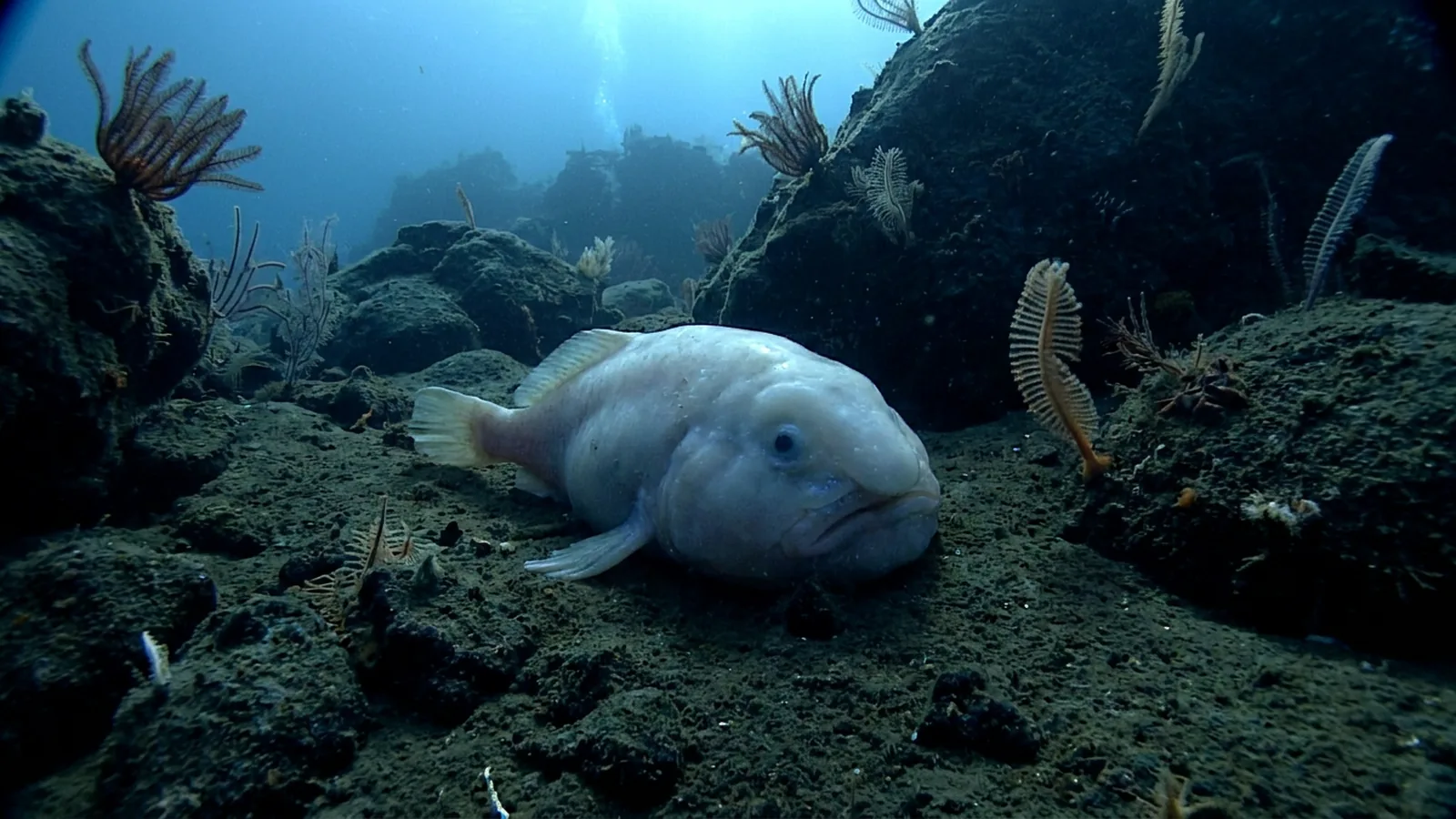
The result is the famous face: a heavy, overhanging “nose” (really the skin of the snout collapsing forward), a downturned mouth and a body that spreads out like a dropped pudding. Out of water, gravity finishes the job. A living blobfish photographed on the seafloor by ROV looks quite different — a broad-headed, tapering fish with a big mouth, small fins and pale, slightly translucent skin.
How does a blobfish float without a swim bladder?
The blobfish floats by having a body that is almost the same density as seawater. Its flesh is largely gelatinous, slightly less dense than the water around it, so it hovers just above the seafloor without spending energy swimming.
Most bony fish control buoyancy with a gas-filled swim bladder. At 1,000 metres a gas bladder is hard to use: the gas is compressed into a tiny volume and filling it costs a lot of energy. The blobfish solves this the way many deep-sea fishes do — by cutting dense tissue. Its body is mostly a watery, jelly-like mass with relatively little muscle and a lightly built skeleton. That makes it close to neutrally buoyant.
The trade-off is that it is not a fast swimmer. It does not need to be. Life on the continental slope rewards conserving energy, not chasing prey. The blobfish is a classic sit-and-wait animal: it drifts slowly just above the bottom and eats what comes to it. Many deep-sea fish share this strategy; the gulper eel and the deep-sea anglerfish are built around the same energy budget.
Where do blobfish live?
The smooth-head blobfish lives off southeastern Australia, Tasmania and New Zealand, on the continental slope at roughly 600 to 1,200 metres deep.
FishBase lists Psychrolutes marcidus as a bathydemersal species — one that lives on or just above the deep seafloor — recorded from about Broken Bay in New South Wales south to Tasmania, with records in New Zealand waters. The water there is cold, permanently dark and food-poor. Temperatures on the slope are typically only a few degrees above freezing.
Several other fatheads in the genus Psychrolutes are also called blobfish, and they turn up in deep water around the world. That matters for the most famous blobfish of all. The specimen nicknamed “Mr Blobby” was trawled in June 2003 on the Norfolk Ridge, northwest of New Zealand, during the NORFANZ expedition aboard RV Tangaroa, from 1,013 to 1,340 metres. It is held at the Australian Museum and has since been identified as Psychrolutes microporos, a close relative — so the face that launched the meme may not technically be a smooth-head blobfish at all.
What do blobfish eat?
Blobfish eat whatever small edible animals drift in front of them, mainly deep-sea crustaceans and other slow-moving invertebrates.
Very little diet data exists for P. marcidus because it is almost never studied alive. What is known comes from trawled specimens and from close relatives. The picture is of an opportunist: it hovers near the bottom with a wide mouth and takes crabs, shrimps, small molluscs, sea urchins and similar prey as they pass. FishBase estimates its trophic level at about 3.4, meaning it feeds mostly on small animals rather than plants or detritus.
This feeding style is efficient on the slope, where food arrives slowly as falling organic material and the animals that feed on it. A blobfish that spent energy chasing prey would lose more than it gained. Instead it lets its near-neutral buoyancy and low metabolism do the work.
How do blobfish reproduce?
Blobfish reproduction has not been directly observed in Psychrolutes marcidus, but its relatives lay large clutches of eggs on the seafloor and at least one species guards them.
The best evidence comes from a cousin, the blob sculpin (Psychrolutes phrictus) of the northeast Pacific. Deep-sea cameras have filmed blob sculpins sitting on nests of thousands of large pink eggs at depths of more than 1,000 metres, keeping them clean and guarding them until they hatch. That kind of parental care is rare among deep-sea fish. It is reasonable to suspect the smooth-head blobfish has a similar strategy, but nobody has documented it, and published sources do not give reliable figures for its age, maturity or lifespan.
What is clear is that deep-sea fish in cold water generally grow slowly and mature late. That makes populations slow to recover if adults are removed.
Is the blobfish endangered?
The blobfish has not been assessed by the IUCN, so it has no official conservation status. Its main threat is being caught accidentally in deep-sea bottom trawls.
Blobfish are not targeted by any fishery and are not eaten. The problem is where they live. The continental slope off southeastern Australia and New Zealand is fished by bottom trawlers for deep-water species such as orange roughy and oreos. Nets dragged across the bottom sweep up whatever is there, and blobfish come up as bycatch. A blobfish brought up from 1,000 metres does not survive.
Because there are no population estimates, nobody can say whether numbers are falling. The precautionary view is simple: a slow, deep-water fish with a small range and constant exposure to trawling is the kind of species that can decline unnoticed. Marine protected areas on the Australian slope and limits on deep trawling help reduce that risk.
How did the blobfish become the “world’s ugliest animal”?
The blobfish was voted the world’s ugliest animal in 2013 in a public poll run by the Ugly Animal Preservation Society, which used it as a mascot for unglamorous species.
The photo behind it all is Mr Blobby, taken by Australian Museum ichthyologist Kerryn Parkinson after the 2003 NORFANZ voyage. After shooting a standard scientific image, she photographed the fish from the front because it looked “comical, charismatic and grumpy.” The picture spread online, became a meme and turned an obscure fathead into one of the most recognised fish in the world.
The 2013 vote was deliberately tongue-in-cheek: the point was that conservation attention goes mostly to cute, furry animals while odd-looking species get ignored. The campaign worked. In March 2025 the blobfish was voted New Zealand’s Fish of the Year in a poll run by the Mountains to Sea Conservation Trust, beating orange roughy — one of the very species whose fishery catches it — by almost 300 votes out of 5,583.
The real lesson of the blobfish is how little we know about the deep sea. One of the most famous fish on the internet has almost no published data on its lifespan, breeding or population. If a fish this famous is still a mystery, the rest of the continental slope is barely explored. You can see more of that world in our guides to the Mariana snailfish, the fangtooth and the giant isopod.
Blobfish vs. blob sculpin: what is the difference?
The blobfish (Psychrolutes marcidus) and the blob sculpin (Psychrolutes phrictus) are close relatives in the same genus, but they live in different oceans and the blob sculpin grows much larger.
| Blobfish | Blob sculpin | |
|---|---|---|
| Scientific name | Psychrolutes marcidus | Psychrolutes phrictus |
| Region | SE Australia, Tasmania, New Zealand | North Pacific (Japan and Bering Sea to California) |
| Size | Up to ~30 cm | Up to ~70 cm |
| Depth | 600–1,200 m | Roughly 800–2,800 m |
| Known for | “Ugliest animal” photo | Males guarding egg nests |
Both have the same loose, gelatinous construction and both suffer the same decompression damage when brought to the surface. If you have seen a photo of a large grey blob fish guarding eggs on the seafloor, it was almost certainly a blob sculpin.
What does a blobfish look like underwater?
In its natural habitat at 600–1,200 metres, a blobfish looks like a normal deep-sea fish: a broad head, wide mouth, tapering body and small fins. The saggy, melted look only appears after it is brought to the surface and decompressed.
Why is the blobfish so ugly?
It is not ugly at depth. The blobfish has loose skin, little muscle and jelly-like flesh supported by water pressure. When it is pulled up quickly from deep water, its tissues are damaged by decompression and collapse, creating the droopy face in famous photos.
How big is a blobfish?
The smooth-head blobfish grows to about 30 cm (12 inches) long. Related species in the same genus, such as the blob sculpin, can reach around 70 cm.
Where do blobfish live?
Blobfish live on the deep continental slope off southeastern Australia, Tasmania and New Zealand, at about 600 to 1,200 metres, where pressure is 60 to 120 times that at sea level.
What do blobfish eat?
Blobfish eat small animals that drift in front of them, mostly deep-sea crustaceans such as crabs and shrimps, plus other slow-moving invertebrates. They hover above the seafloor and wait rather than chasing prey.
Is the blobfish endangered?
The blobfish has not been assessed by the IUCN, so it has no official status. Its main threat is being caught as bycatch in deep-sea bottom trawls, and there is no population data to show whether numbers are falling.
Can you eat blobfish?
Blobfish are not a food fish and are not targeted by any fishery. Their watery, gelatinous flesh has no commercial value; they only reach the surface by accident in trawl nets.
Can a blobfish survive at the surface?
No. A blobfish brought up from deep water suffers decompression damage and cannot survive at surface pressure. No blobfish has been kept alive in an aquarium.
Do blobfish have bones?
Yes. The blobfish is a bony fish, but its skeleton is soft and lightly built, and it has very little muscle. Most of its body is a gelatinous mass that is almost the same density as seawater.
Blane Perun has been exploring Earth’s oceans and marine life for over 25 years. Founder of TheSea.Org in 1999, underwater photographer, coral aquaculture pioneer, and explorer of 80+ countries.
About Blane Perun → More on Bizarre Sea Creatures →