Sea Sapphire — The Glittering Copepod That Can Turn Invisible in an Instant
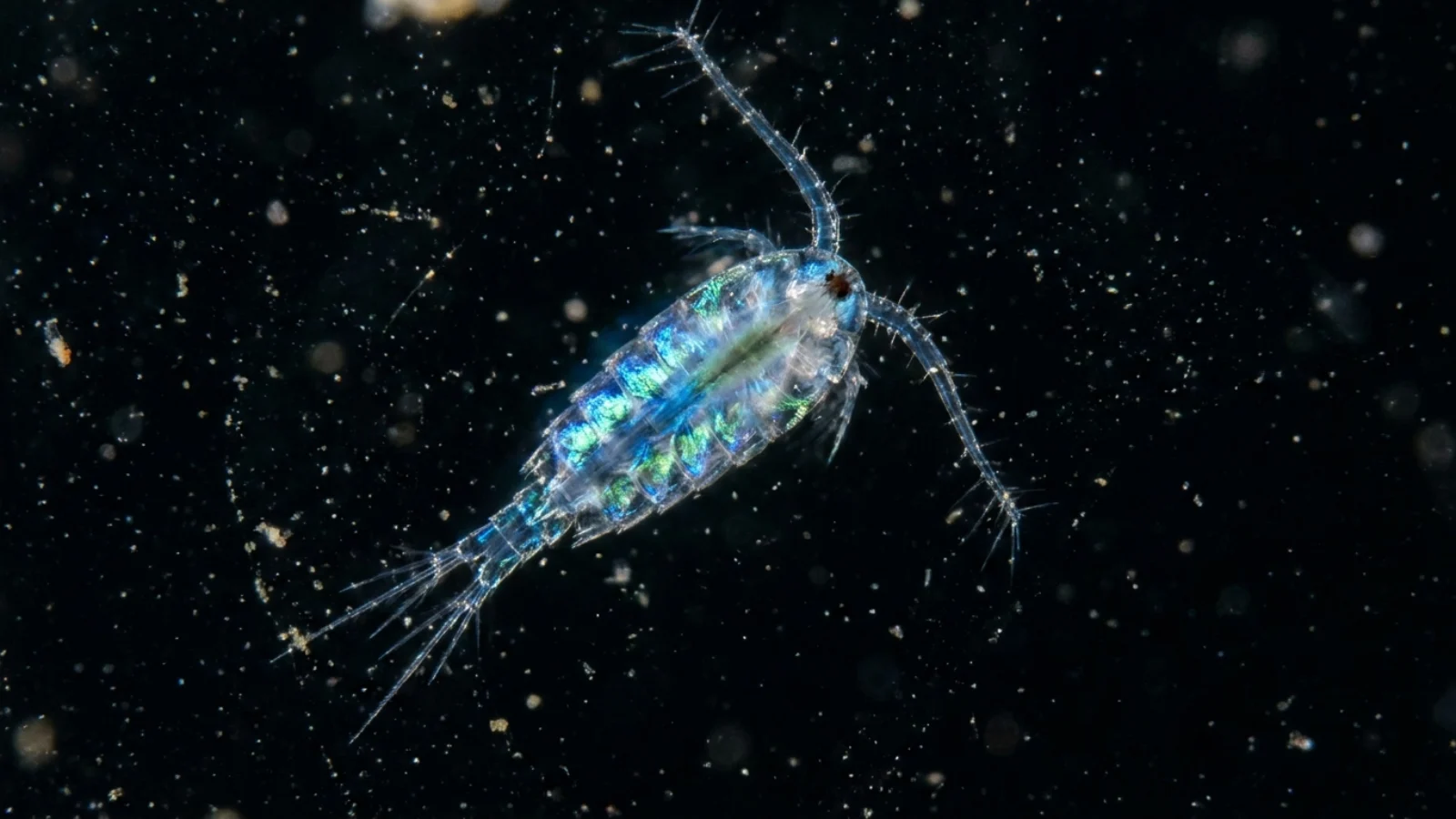
A sea sapphire is a tiny marine copepod, a crustacean of the family Sapphirinidae (mainly the genus Sapphirina), only about one to several millimetres long. The males glitter in brilliant blue, violet, gold or green, not from pigment but from stacked layers of microscopic guanine crystal plates in their skin that reflect light. By changing the angle at which light hits their backs, some species shift that reflection into the ultraviolet and become almost invisible. Females are transparent. Sea sapphires live in warm open-ocean waters worldwide.
On a calm night or in clear tropical blue water, snorkellers sometimes see tiny sparks of blue or gold winking on and off just below the surface. It looks like glitter, or the reflection of something that is not there. Often it is a sea sapphire: a crustacean smaller than a grain of rice that carries one of the most sophisticated optical systems in the animal kingdom — and can switch it off.
How does a sea sapphire make its colour?
A sea sapphire’s colour is structural. Cells in its back hold stacks of extremely thin, transparent guanine crystal plates separated by thin layers of cytoplasm. Light reflecting off the stack interferes, and the spacing between plates decides which colour is reflected.
In 2015 a team at Israel’s Weizmann Institute of Science — Dvir Gur, Lia Addadi, Stephen Weiner, Dan Oron and colleagues, with Viviana Farstey of the Interuniversity Institute for Marine Sciences in Eilat — published the mechanism in the Journal of the American Chemical Society. They found that the reflectors are photonic crystals: regular, periodic stacks of thin hexagonal guanine plates. Guanine is one of the building blocks of DNA, but here it is used as a crystal, the same material many fish use to make their scales silvery.
The key variable is the spacing. Plates set closer together reflect shorter wavelengths, so look bluer; plates farther apart reflect longer wavelengths, so look gold or red. Across species, the thickness of the cytoplasm layer between plates is what makes one male sapphire blue and another violet or yellow. The colour is not paint; it is precision engineering at the scale of a few hundred nanometres.
How can a sea sapphire become invisible?
When some sea sapphires tilt their backs at about 45 degrees to incoming light, the reflected wavelength shifts out of the visible range into the ultraviolet. To a human eye, and likely to many predators, the animal effectively disappears.
The Weizmann team showed that the colour seen from a sea sapphire depends on the angle of light. Head-on, a blue species reflects blue. As the angle steepens, the reflected peak slides toward shorter wavelengths. At around 45 degrees it passes beyond violet into the ultraviolet, and because the rest of the body is transparent, the copepod seems to vanish. Sea sapphires swim in a spiralling motion, so they flash on and off as they move.
This makes the sea sapphire one of very few animals known to switch between brilliant display and near-invisibility simply by changing orientation. The researchers suggested the design could inspire adaptive reflective coatings, optical mirrors and displays that change colour on demand.
Why do male sea sapphires shine?
Only males carry the iridescent plates; females are transparent. Scientists think the colours are a mating signal that males can display to females, then switch off to escape predators.
Bright colour is a risk in open water, where most animals survive by being transparent or silvery. The sea sapphire’s system appears to solve that problem: a male can be visible to a nearby female at one angle and invisible to a fish at another. Some researchers have suggested the flashes are also used in communication between males. No two individuals look quite the same, and colour varies between species, which may help females recognise the right partner.
This is a classic case of sexual selection. Similar trade-offs between showing off and staying hidden shape the colours of reef fish, birds and insects. In the sea sapphire they have been solved with a mirror that can be tilted out of sight.
Photographing them is notoriously hard. The colour only appears at certain angles, so a sea sapphire that blazes blue in one frame can be an almost invisible smudge in the next. Blackwater photographers often shoot bursts as the animal spirals, keeping the frames where the plates catch the strobe. Because the colour depends on angle, two photos of the same individual can look like different animals.
What do sea sapphires eat?
Sea sapphires are associated with salps — transparent, barrel-shaped tunicates that drift in the plankton. Species of Sapphirina feed on salps and live in or on them for part of their lives.
Studies of species such as Sapphirina angusta describe a specialised predator–prey relationship with salps like Thalia democratica. The copepods attach to or enter the salp and feed on its tissues, which some authors describe as parasitic. Different life stages and sexes may spend different amounts of time with their hosts, and observers disagree on details, but the link between sea sapphires and salps is consistent.
Salps are related to the sea squirts divers see on reefs; see our guide to tunicates. They bloom in huge numbers in warm surface waters, and wherever salps are abundant, sea sapphires are likely to be nearby.
What is a copepod?
Copepods are tiny crustaceans, mostly under a few millimetres long, and are probably the most numerous animals in the ocean. They are a staple food for fish, larvae, seabirds and baleen whales.
There are more than 10,000 described copepod species, living everywhere from the deep sea to puddles and groundwater. Most are drab and transparent, with a teardrop-shaped body and long antennae used for swimming. Sapphirinids are unusual: their bodies are broad, flat and almost leaf-like, more like a woodlouse than a typical copepod. Reef aquarists know copepods as natural tank food (see copepods in the aquarium), and they are a key part of the wider zooplankton community covered in planktonic crustaceans and krill.
| Typical copepod | Sea sapphire (Sapphirinidae) | |
|---|---|---|
| Body shape | Teardrop, cylindrical | Flat, oval, leaf-like |
| Colour | Transparent or pale | Males brilliantly iridescent |
| Diet | Phytoplankton, small particles | Associated with salps |
| Size | Mostly 0.5–2 mm | ~1 to several mm |
Where do sea sapphires live?
Sea sapphires live in warm and temperate surface waters of the open ocean worldwide, including the tropical Pacific, Atlantic, Indian Ocean and the Mediterranean.
They are part of the epipelagic plankton, the community of drifting animals in the sunlit top layer of the sea. They are most often seen as brief flashes in blue water on snorkels and safety stops, or under a light during night dives and blackwater dives, when photographers hang over deep water to photograph plankton. Several species occur in the Mediterranean as well as in tropical seas.
If you see a sudden sparkle of blue in open water that vanishes as you look at it, there is a good chance it was a sea sapphire turning edge-on. For other small open-ocean wonders, read about the sea butterfly, the blue glaucus and the benthic comb jelly, and browse our gelatinous and bioluminescent section.
Other animals use structural colour too. Cuttlefish combine pigment cells with reflective iridophores, and comb jellies flash rainbows along their cilia. But few animals switch so completely between dazzling and invisible as the sea sapphire.
What is a sea sapphire?
A sea sapphire is a tiny marine copepod of the family Sapphirinidae, about one to several millimetres long. Males shimmer blue, violet, gold or other colours thanks to crystal plates in their skin.
How do sea sapphires change colour?
Their colour comes from stacked guanine crystal plates. The spacing between plates sets the colour, and the angle of light changes which wavelength is reflected.
How do sea sapphires become invisible?
When some species tilt their backs about 45 degrees to the light, the reflection shifts into the ultraviolet, which humans cannot see, and the transparent body seems to vanish.
Are sea sapphires bioluminescent?
No. They reflect light rather than making it, so they only sparkle when light hits them.
Are all sea sapphires colourful?
No. Only males are iridescent. Females are transparent.
How big is a sea sapphire?
About one to several millimetres long, roughly the size of a grain of rice or a small fish scale.
What do sea sapphires eat?
Sapphirina copepods are associated with salps, drifting tunicates whose tissues they feed on, sometimes living in or on the salp.
Where can you see sea sapphires?
In warm open-ocean surface water worldwide, including the tropics and the Mediterranean, often as flashes of colour on snorkels or blackwater night dives.
Are sea sapphires dangerous?
No. They are tiny crustaceans and harmless to people.
Blane Perun has been exploring Earth’s oceans and marine life for over 25 years. Founder of TheSea.Org in 1999, underwater photographer, coral aquaculture pioneer, and explorer of 80+ countries.
About Blane Perun → More on Bizarre Sea Creatures →