The Edmund Fitzgerald — Lake Superior’s Most Famous Shipwreck
The SS Edmund Fitzgerald was a 729-foot Great Lakes ore carrier that sank in a violent storm on eastern Lake Superior shortly after 7:10 p.m. on 10 November 1975, killing all 29 men aboard. She went down without a distress call about 17 miles from the shelter of Whitefish Bay, and her wreck lies in two large pieces in Canadian waters about 530 ft (160 m) deep. Investigators never agreed on the cause: the US Coast Guard blamed ineffective hatch closures that let the holds flood, while others argued for a grounding on Six Fathom Shoal, giant waves or structural failure.
The Fitzgerald was the largest ship ever lost on the Great Lakes, she vanished without a mayday, no bodies were recovered, and Gordon Lightfoot’s 1976 song “The Wreck of the Edmund Fitzgerald” turned the disaster into a ballad known around the world.
The largest ship on the Great Lakes
The Edmund Fitzgerald was built for the Northwestern Mutual Life Insurance Company of Milwaukee, the first time an American life insurance company had invested in a ship of this kind. In 1957 the company contracted Great Lakes Engineering Works of River Rouge, Michigan, to build her within a foot of the maximum length allowed for passage through the soon-to-be-completed St Lawrence Seaway. She was the first laker built to the full Seaway size of 730 ft long, 75 ft wide and a 25 ft draft, and cost $7 million. Her keel was laid on 7 August 1957. Measured at 729 ft overall, she was the longest ship on the Great Lakes, the “Queen of the Lakes”, until the 730-foot Murray Bay was launched in September 1959; other accounts, such as the Associated Press coverage of the 50th anniversary, say she remained the largest on the lakes until 1971.
She was named after Edmund Fitzgerald, the president and chairman of Northwestern Mutual, whose grandfather and great-uncles had been lake captains. He tried to talk the board out of naming her after him, suggesting names such as Centennial, Seaway and Milwaukee, but the board voted unanimously for his name. More than 15,000 people attended the launch on 7 June 1958, and the day went badly. It took Elizabeth Fitzgerald three attempts to break the champagne bottle on the bow, the yard crew needed 36 minutes to free the keel blocks, and when the ship finally slid sideways into the water she threw up a wave that soaked spectators and struck a pier before righting herself.
By ore-boat standards she was luxurious. The interior was designed by the J. L. Hudson Company, with deep-pile carpets, tiled bathrooms, drapes over the portholes and leather swivel chairs in the guest lounge, two guest staterooms for company passengers, and air conditioning that extended to the crew quarters. Her three cargo holds were loaded through 21 watertight hatches, each 11 by 48 ft and made of 5/16-inch steel. She was built with a coal-fired steam turbine of 7,500 shaft horsepower, converted to burn oil in the winter of 1971 to 1972, and fitted with a diesel bow thruster in 1969.
The “Mighty Fitz” at work
Northwestern Mutual did not run the ship itself. It signed a 25-year contract with Oglebay Norton, which made her the flagship of its Columbia Transportation fleet. For 17 years she carried taconite, pellets of processed iron ore, from the mines of Minnesota’s Iron Range near Duluth to steel mills in Detroit, Toledo and other ports. She was a record-setting workhorse, setting seasonal haul records six times and often beating her own marks; her largest single load was 27,402 long tons in 1969. Loading took about four and a half hours and unloading around 14. A round trip between Superior, Wisconsin, and Detroit usually took five days, and she averaged 47 such trips a season. By November 1975 she had logged an estimated 748 round trips and more than a million miles.
Boat watchers loved her. She was nicknamed the Fitz, the Mighty Fitz, Big Fitz, the Pride of the American Side and the Toledo Express. Captain Peter Pulcer, one of her masters, was known for piping music over the intercom as she passed through the St Clair and Detroit rivers and for giving a running commentary to spectators at the Soo Locks. With hindsight, another nickname, the “Titanic of the Great Lakes”, proved grimly apt.
The final voyage
At 2:15 p.m. on 9 November 1975, the Edmund Fitzgerald left Superior, Wisconsin, under Captain Ernest M. McSorley, carrying 26,116 long tons of taconite pellets for the steel mill on Zug Island near Detroit. Around 5 p.m. she joined a second ore carrier, the Arthur M. Anderson, under Captain Jesse “Bernie” Cooper, bound from Two Harbors, Minnesota, to Gary, Indiana. The weather forecast was not unusual for November: the National Weather Service expected a storm to pass just south of Lake Superior by the next morning. Not everyone agreed. Captain Dudley Paquette of the Wilfred Sykes, which left the same dock about two hours later, predicted that a major storm would cross the lake and took a route along the protected north shore.
The forecast changed at 7 p.m., with gale warnings for the whole lake, and the Fitzgerald and Anderson turned north to seek shelter along the Ontario shore. They met a winter storm at 1 a.m. on 10 November. At 2 a.m. the gale warning was upgraded to a storm warning. The faster Fitzgerald pulled ahead at about 3 a.m. As the centre of the storm passed over the ships, the wind dropped and shifted from north-east to south and then north-west, and after 1:50 p.m. it rose again rapidly. Snow began at 2:45 p.m., and the Anderson lost sight of the Fitzgerald, about 16 miles ahead.
Shortly after 3:30 p.m., McSorley radioed the Anderson to report that his ship was taking on water, had lost two vent covers and a fence railing, and had developed a list. Two of her six bilge pumps were running continuously. Soon after 4:10 p.m. he reported that his radar had failed and asked the Anderson to keep track of him. The Whitefish Point light and radio beacon, the key navigation aids at the eastern end of the lake, were also out, and when the saltwater ship Avafors answered his call for information, its captain heard McSorley say, “I have a bad list, I have lost both radars, and am taking heavy seas over the deck in one of the worst seas I have ever been in.” By evening the Anderson was logging sustained winds of up to 58 knots, gusts of 70 to 75 knots, and waves of 25 ft, with some rogue waves as high as 35 ft.
At about 7:10 p.m., the Anderson radioed to warn of an upbound ship and asked how the Fitzgerald was doing. McSorley replied, “We are holding our own.” It was the last message from the ship. No distress signal was sent, and within ten minutes the Fitzgerald had disappeared from the Anderson‘s radar. She sank in Canadian waters about 17 miles from the entrance to Whitefish Bay, a distance she could have covered in just over an hour.
The search
The response showed how unprepared the system was for a sudden loss. Cooper first called the Coast Guard at Sault Ste Marie at 7:39 p.m. on the distress channel and was told to call back on another channel, because the station’s antennas had been damaged by the storm. When he finally got through at 7:54 p.m., the duty officer asked him to keep watch for a missing 16-foot boat. He reported the Fitzgerald missing at 9:03 p.m. Lacking suitable rescue vessels, the Coast Guard asked the Anderson itself to turn back into the storm to look for survivors, and later asked all ships sheltering in Whitefish Bay to help. The Anderson and the William Clay Ford went out; a Coast Guard aircraft arrived at 10:53 p.m. and a helicopter with a powerful searchlight at 1 a.m. Canadian aircraft joined a three-day search, and Ontario police patrolled the shore. Searchers found debris, including the ship’s lifeboats and rafts, but none of the 29 crew. Most of the men came from Ohio and Wisconsin; the youngest, watchman Karl Peckol, was 20, and the oldest, Captain McSorley, was 63.
Finding the wreck
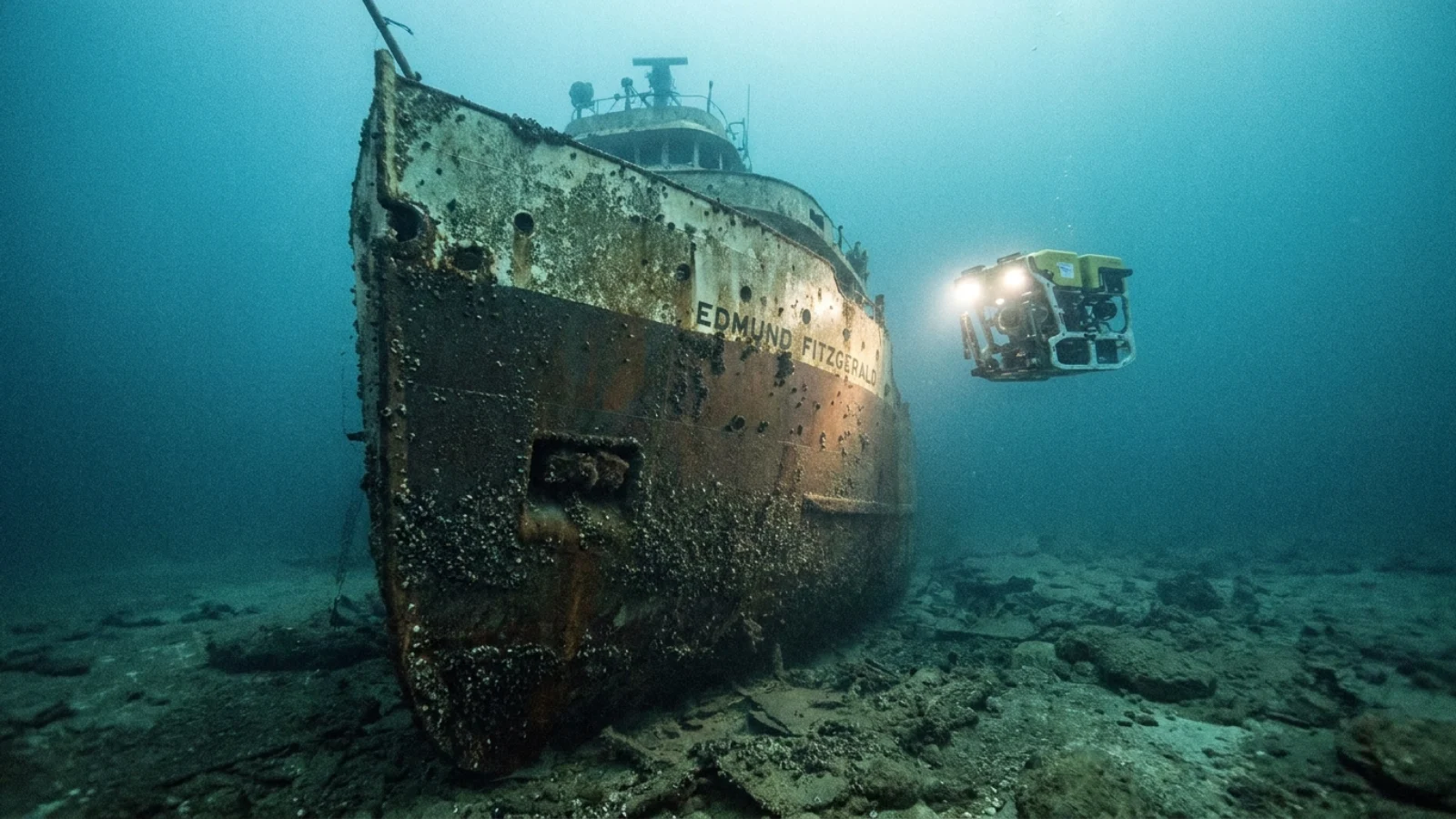
On 14 November 1975, a US Navy P-3 Orion aircraft equipped to detect the magnetic signature of submarines located the wreck. Coast Guard side-scan sonar surveys over the next days showed two large objects close together on the lake floor. In May 1976 the Navy sent down its unmanned submersible CURV-III, which confirmed that the ship lay in two large pieces in about 530 ft of water. The bow section, about 276 ft long, stood upright in the mud; the stern section, about 253 ft long, lay upside down some 170 ft away at an angle of 50 degrees to the bow. Between them lay a mass of taconite pellets and wreckage, including hatch covers and hull plating. The missing middle of the ship had been torn apart.
Why did the Edmund Fitzgerald sink?
Half a century later, there is still no agreed answer. The main hypotheses are these.
Hatch covers and flooding. The US Coast Guard Marine Board of Investigation concluded that the most probable cause was ineffective hatch closures. In its view, waves washing over the deck leaked into the cargo hold gradually and probably imperceptibly through the final day, until the ship lost buoyancy and stability and plunged to the bottom without warning. Pointing out that the video showed most hatch clamps in perfect condition, the board concluded that the few damaged clamps were probably the only ones that had been fastened. The National Transportation Safety Board, reporting on 4 May 1978, reached different conclusions from the Coast Guard. Its review of the survey footage found the No. 1 hatch cover pushed entirely inside its hatch and buckled by external loading, other covers missing, and coamings fractured and distorted. After computer studies of the forces needed to collapse the covers, the NTSB concluded that the ship sank suddenly from flooding of the cargo hold “due to the collapse of one or more of the hatch covers under the weight of giant boarding seas”, rather than from gradual leakage. A dissenting NTSB opinion held that she sank suddenly and unexpectedly after shoaling.
Shoaling. The Lake Carriers’ Association, representing the shipping companies, rejected the hatch-cover explanation and argued that the Fitzgerald had unknowingly grounded on Six Fathom Shoal, north-west of Caribou Island, at a time when the Whitefish Point light and beacon were not working. Officers on the Anderson testified that the Fitzgerald sailed through this area, and a 1976 Canadian hydrographic survey found an unknown shoal extending about a mile farther east than shown on the charts. The Marine Board itself found that the Canadian chart of the area in use in 1973 was based on surveys from 1916 and 1919. A grounding could have damaged the hull, explaining the list and the flooding that McSorley reported.
Rogue waves. Several sources describe the “three sisters”, a sequence of three unusually large waves on Lake Superior in which the first puts water on deck, the second arrives before it can drain and the third overwhelms the ship. Such a group was reported in the vicinity at about the time the Fitzgerald sank, and the Anderson recorded waves of up to 35 ft. In 2005, after running computer models with the actual weather data, Hultquist of the National Weather Service said the ship “ended in precisely the wrong place at the absolute worst time.”
Structural failure. Another hypothesis holds that an already weakened hull, combined with changes to the ship’s winter load line that allowed her to be loaded deeper, made it possible for the storm’s large waves to crack the hull. A former steward testified in a deposition that the keel was only tack-welded and that he had seen broken welds. Her sister ship, the Arthur B. Homer, was permanently laid up only a few years after being lengthened, raising questions about whether both ships shared structural problems; both were built with welded rather than riveted joints, which are less able to flex in heavy seas. The sport diver Fred Shannon, who led a privately funded expedition in 1994, concluded that “massive and advancing structural failure” broke the ship apart at the surface, and an earlier dive from Jacques Cousteau’s Calypso in 1980 had speculated the same.
These explanations are not mutually exclusive. The ship may have been swamped, suffered structural failure or topside damage, grounded on a shoal, or suffered a combination of these, and the wreck itself, broken in two with its midsection destroyed, cannot settle the question.
Expeditions and the protection of the wreck
Several expeditions have visited the wreck. The Michigan Sea Grant Program surveyed it with a towed system and a remotely operated vehicle in 1989, producing 3D video for museums; the Canadian explorer Joseph MacInnis led six submersible dives in 1994; and Shannon’s Deepquest team made seven dives the same year, setting a record of 211 minutes for the longest submersible dive on the wreck. Shannon’s group found the remains of a crewman in coveralls and a life jacket beside the bow, an indication that at least one man knew the ship might sink. Shannon also argued that, because of errors in the boundary shown on the charts, part of the wreck site lies in US waters.
In 1995 two technical divers, Terrence Tysall and Mike Zee, reached the wreck on trimix, the only people known to have touched it. They had six minutes on the wreck and took about three hours to return to the surface. Ontario has since tightened protection. An April 2005 amendment to the Ontario Heritage Act allows the province to require licences for dives, submersibles, sonar or cameras near protected sites, with fines of up to CA$1 million, and regulations issued in January 2006 protect a 500 m radius around the Fitzgerald as a watery grave.
The bell
At the request of crew families, a 1995 expedition led by MacInnis recovered the ship’s bell on 4 July 1995, using the Newtsuit atmospheric diving suit. A replica engraved with the names of the 29 men was left in its place. The original bell, donated by 46 relatives together with Mariners’ Church of Detroit and the Great Lakes Shipwreck Historical Society, is the centrepiece of the memorial at the Great Lakes Shipwreck Museum at Whitefish Point, Michigan.
The song
The day after the sinking, Mariners’ Church in Detroit rang its bell 29 times, once for each man lost. The Canadian singer Gordon Lightfoot read about the disaster in an article called “The Cruelest Month” in the 24 November 1975 issue of Newsweek and wrote “The Wreck of the Edmund Fitzgerald”, which became a hit in 1976 and refers to the tolling of the Detroit church bell. The song is the main reason the Fitzgerald is remembered when many other Great Lakes wrecks are forgotten. After Lightfoot died on 1 May 2023, Mariners’ Church rang its bell 29 times for the crew and a 30th time for the singer.
What changed after the sinking
The loss of the Fitzgerald led to changes in Great Lakes shipping rules and practices, including mandatory survival suits, depth finders, positioning systems, increased freeboard and more frequent vessel inspections. Since 1980 survival suits have been required in each crew member’s quarters and at their usual work station, with strobe lights on life jackets and suits. Frederick Stonehouse, author of a 1977 book on the wreck, has pointed out that before 1975 a ship of similar size was lost on the lakes every six or seven years, and none has been lost since. The Fitzgerald was also far from the first casualty in her area: between 1816 and 1975, the waters around Whitefish Point claimed at least 240 ships. For the wider story, see our guide to Lake Superior shipwrecks.
The 50th anniversary
The 10 November 2025 anniversary drew crowds to memorials around the lakes. At Whitefish Point, the Great Lakes Shipwreck Historical Society held a ceremony for crew families, which was livestreamed, and its executive director, Bruce Lynn, said the museum was on track for its busiest year. Debbie Gomez-Felder, daughter of crewman Oliver “Buck” Champeau, who was 41 when he died, has rung the bell at the ceremony for about 30 years. In Detroit, Mariners’ Church rang its bell 30 times, the last for all sailors lost on the Great Lakes. In Minnesota, Split Rock Lighthouse held its annual memorial, begun about 40 years ago by former site manager Lee Radzak, with the reading of the 29 names, a tolling bell and the lighting of the beacon. For other famous wrecks, see our shipwrecks hub, the Titanic and the shipwrecks of Canada.
When did the Edmund Fitzgerald sink?
On 10 November 1975, shortly after 7:10 p.m., in a storm on eastern Lake Superior.
How many people died on the Edmund Fitzgerald?
All 29 crew members died, and no bodies were ever recovered.
How deep is the Edmund Fitzgerald?
About 530 ft (160 m), according to the US Navy survey; some recent reports give 535 ft.
Where is the Edmund Fitzgerald wreck?
In Canadian waters of Lake Superior about 17 miles from the entrance to Whitefish Bay, north-north-west of Whitefish Point, Michigan.
What were the last words from the Edmund Fitzgerald?
Captain McSorley’s last message, at about 7:10 p.m., was “We are holding our own.”
Why did the Edmund Fitzgerald sink?
No one knows for sure. The Coast Guard blamed leaking hatch covers; others propose a grounding on Six Fathom Shoal, rogue waves or structural failure.
Can you dive the Edmund Fitzgerald?
Not legally without a licence. Ontario protects a 500 m radius around the wreck as a grave site.
Where is the Edmund Fitzgerald’s bell?
It was recovered in 1995 and is displayed at the Great Lakes Shipwreck Museum at Whitefish Point, Michigan.
- Wikipedia contributors, “SS Edmund Fitzgerald” (2023 snapshot, accessed November 2026), drawing on the USCG Marine Board report (1977) and NTSB report (4 May 1978).
- Bauer, S., Associated Press (November 2025), “The legend lives on: wreck of the Edmund Fitzgerald still resonates 50 years later”, via PBS Wisconsin.
- Minnesota Historical Society (2025), “Split Rock Lighthouse Edmund Fitzgerald 50th anniversary commemoration”.
- Stonehouse, F. (1977), The Wreck of the Edmund Fitzgerald.
Blane Perun has been exploring Earth’s oceans and marine life for over 25 years. Founder of TheSea.Org in 1999, underwater photographer, coral aquaculture pioneer, and explorer of 80+ countries.
About Blane Perun →