What Animals Live in the Pacific Ocean? — From Coral Triangle Reefs to the Mariana Trench
The Pacific, the largest and deepest ocean, holds an enormous range of life: whales (blue, humpback, gray, sperm), orcas and dolphins, sea otters and sea lions, sharks from great whites to whale sharks, giant Pacific octopus, Humboldt squid, sea turtles, salmon and bluefin tuna, and the most diverse coral reefs on Earth in the Coral Triangle. Even its deepest trenches host snailfish and amphipods.
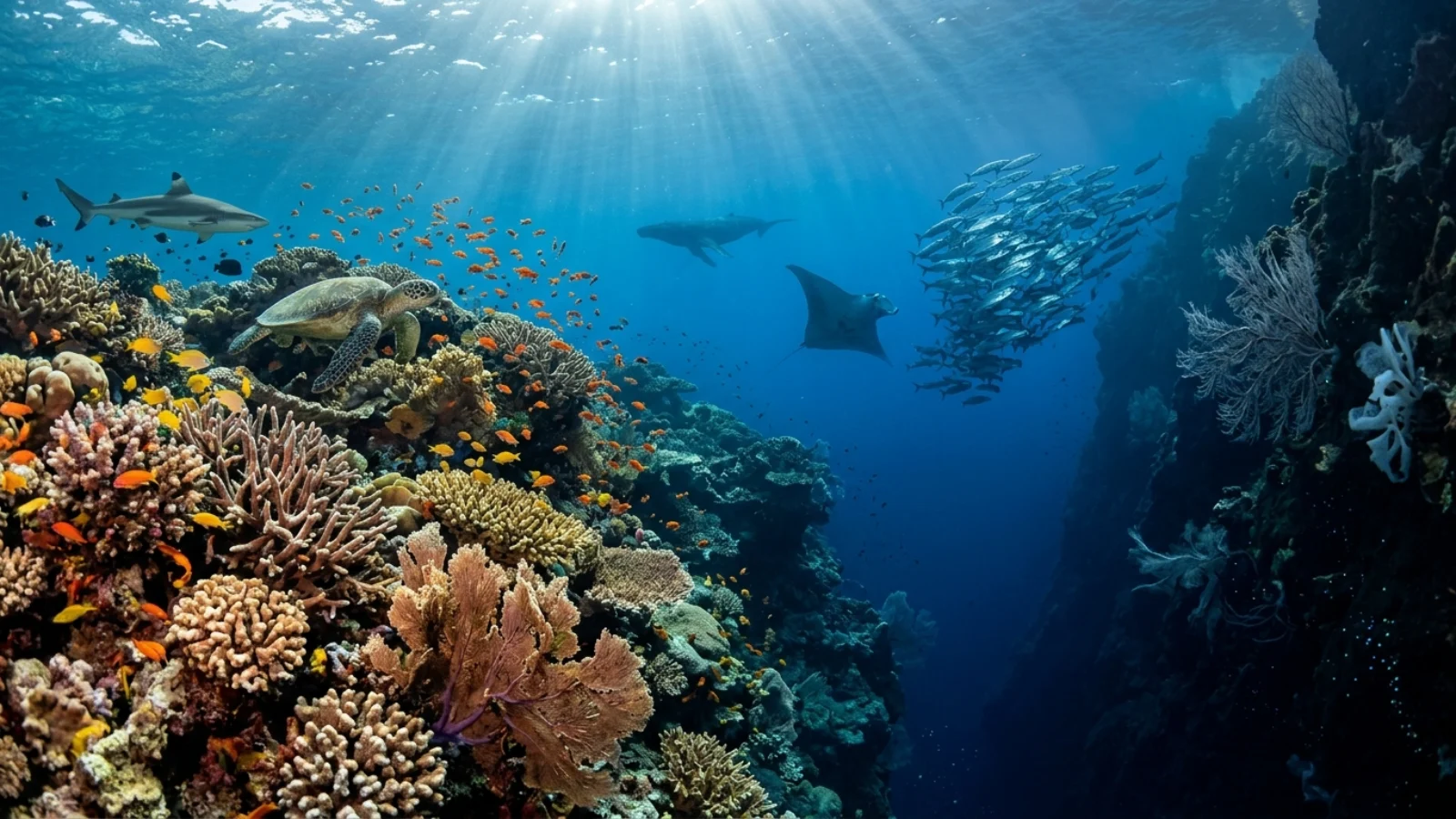
Because it spans from the Arctic to Antarctica and from tropical reefs to 11 km-deep trenches, the Pacific contains almost every kind of marine habitat. Its western tropical region, the Coral Triangle between Indonesia, the Philippines and Papua New Guinea, has the highest marine biodiversity anywhere, with about three-quarters of all known coral species. Its cold eastern and northern waters support some of the world’s most productive fisheries and marine mammal populations.
Why does the Pacific hold so much life?
Because it is so big, so deep and so varied.
The Pacific covers about 165 million square kilometres, roughly a third of Earth’s entire surface and about 46% of its water surface, and it holds about half of all the ocean water on the planet. Its average depth is around 4,000 metres, and at the Challenger Deep in the Mariana Trench it plunges to about 10,900 metres. It reaches from the Bering Sea, which freezes in winter, to the edge of Antarctica, and it contains an estimated 25,000 islands, more than any other ocean. Ferdinand Magellan named it the “peaceful sea” in 1520, after a calm crossing, but in reality it contains almost every marine environment that exists: coral reefs, kelp forests, mangroves, seagrass meadows, cold upwelling coasts, open blue water, seamounts, hydrothermal vents and the deepest trenches on Earth.
Three features in particular explain the abundance. The western tropical Pacific is old, warm and full of islands, which over millions of years has allowed species to diverge and accumulate, producing the richest coral reefs anywhere. The eastern margins, off California and Peru, are swept by cold currents that bring deep, nutrient-rich water to the surface, feeding enormous blooms of plankton and the fish, birds and mammals that eat them. And the ocean’s vast size lets highly migratory animals, from turtles to tuna, link these regions together, feeding in one corner and breeding in another. A list of “Pacific animals” is therefore really a list of several very different ecosystems.
What animals live in each Pacific habitat?
Here are representative animals by habitat, from the shore to the abyss.
| Habitat | Example animals |
|---|---|
| Coral reefs (tropical west) | Reef sharks, parrotfish, clownfish, mimic octopus, sea snakes, giant clams |
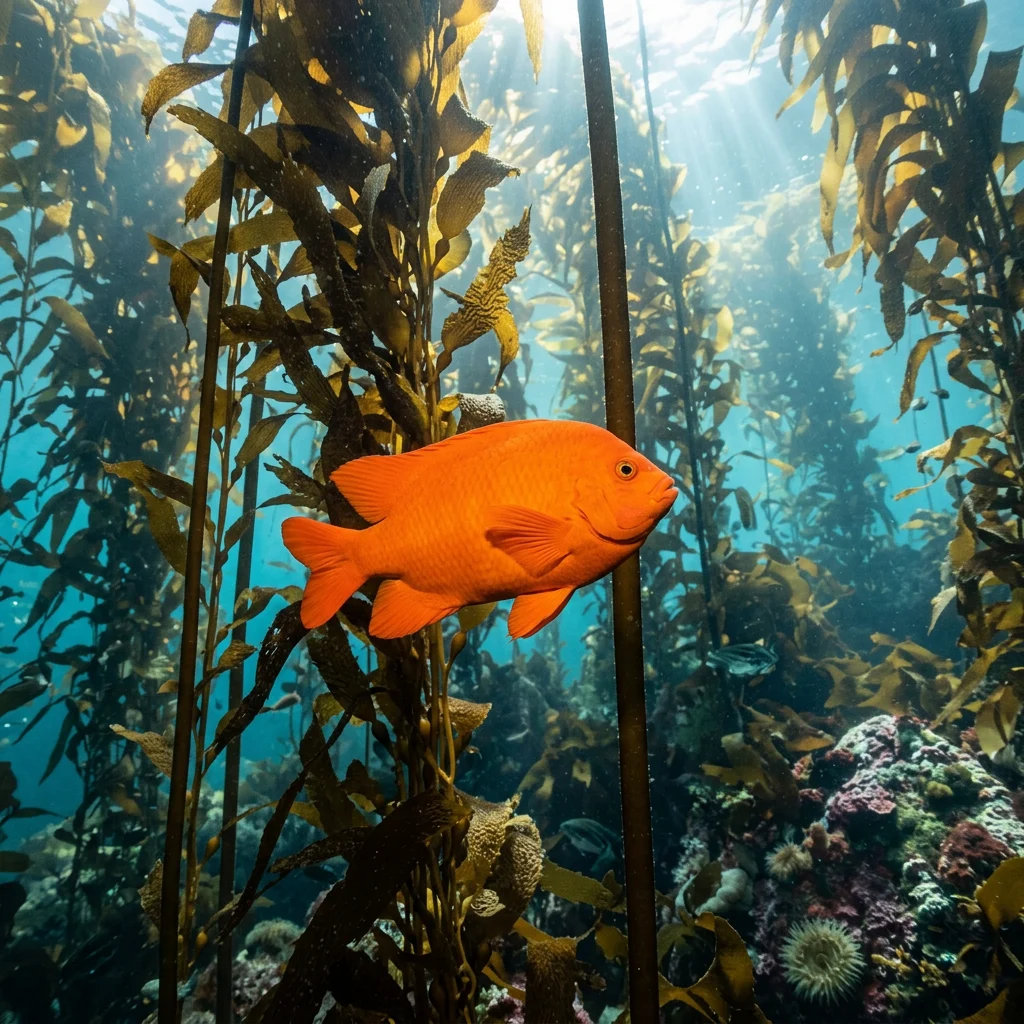
| Kelp forests (east) | Sea otters, garibaldi, sea urchins, California sea lions |
| Open ocean | Blue whales, bluefin tuna, leatherbacks, oceanic sharks, spinner dolphins |
| Cold north | Giant Pacific octopus, salmon, Steller sea lions, orcas |
| Upwelling coasts | Humboldt squid, anchoveta, Humboldt penguins |
| Deep sea and trenches | Mariana snailfish, dumbo octopus, anglerfish, amphipods |
Why is the Coral Triangle so rich?
The Coral Triangle covers about 5.7 million square kilometres of sea across six countries: Indonesia, Malaysia, the Philippines, Papua New Guinea, Timor-Leste and the Solomon Islands. Although it occupies only about 1.6% of the world’s ocean area, it contains roughly 76% of the world’s shallow-water reef-building coral species and about 37% of all reef fish species. The Bird’s Head Seascape in Indonesian Papua alone holds more than 570 coral species. Six of the world’s seven sea turtle species are found in the region. It is also a region of people: about 120 million live in the Coral Triangle, and some 2.25 million of them are fishers who depend directly on healthy reefs.
For divers this is the home of muck diving, the slow search over volcanic sand for strange small animals such as frogfish, ghost pipefish, flamboyant cuttlefish, pygmy seahorses and the mimic octopus, which impersonates venomous animals to deter predators. On the reefs themselves, bumphead parrotfish, Napoleon wrasse, reef sharks, giant clams and sea snakes are common sights. Because so many species overlap here, the Coral Triangle is often called the “Amazon of the seas”, and it is a priority for reef conservation through the six-nation Coral Triangle Initiative.
What lives in Pacific kelp forests?
Along the cool coasts of North America, from Baja California to Alaska, giant kelp and bull kelp form underwater forests that shelter rockfish, the bright orange garibaldi, sea stars, abalone, sea urchins, harbour seals and California sea lions. The most famous resident is the sea otter. Otters eat sea urchins, and where otters are present they keep urchin numbers low enough for kelp to thrive; where otters disappear, urchins can graze the forest down to bare rock, creating so-called urchin barrens. That chain of effects has made the sea otter a textbook example of a keystone species. Sea otters have the densest fur of any animal, up to about 150,000 hairs per square centimetre, and that fur almost drove them to extinction. Commercial hunting between 1741 and 1911 reduced the world population to perhaps 1,000 to 2,000 animals in 13 scattered colonies before an international treaty in 1911 banned the hunt. Otters have since recovered across much of their range, although the southern sea otter of California still numbers only a few thousand.
What lives in the Pacific’s upwelling zones?
Off Peru and northern Chile, the cold Humboldt Current and strong coastal upwelling create one of the most productive marine ecosystems on Earth. Its signature animal is the Peruvian anchoveta, a small schooling fish that supports one of the largest single-species fisheries in the world; the catch reached about 13.1 million tonnes in 1971 before collapsing in the El Niño of 1972, compounded by overfishing. Strong El Niño events in 1982–83 and 1997–98 caused further crashes, because warm surface water shuts off the upwelling that feeds the plankton. The anchoveta in turn feeds Humboldt penguins, Peruvian boobies, pelicans, sea lions, dolphins and the large, aggressive Humboldt squid, which hunts in packs and has expanded its range northward along the American coast in recent decades.
A similar, if smaller, upwelling system runs along California and Oregon in spring and summer. It is the reason blue whales and humpbacks gather off California to feed on krill, why Monterey Bay is so rich in seabirds and marine mammals, and why marine heatwaves that suppress upwelling can be so damaging.
Which marine mammals live in the Pacific?
Dozens of whale, dolphin, seal and sea lion species, plus sea otters and dugongs.
Gray whales migrate each year between Arctic feeding grounds and Baja California lagoons; humpbacks travel from Alaska to Hawaii and Mexico. Blue whales feed off California, and sperm whales hunt squid in deep water. Sea otters keep Pacific kelp forests healthy by eating urchins, and dugongs graze seagrass in the western Pacific. See marine mammals.
What sharks and fish live in the Pacific?
From whale sharks and great whites to tuna, salmon and lanternfish.
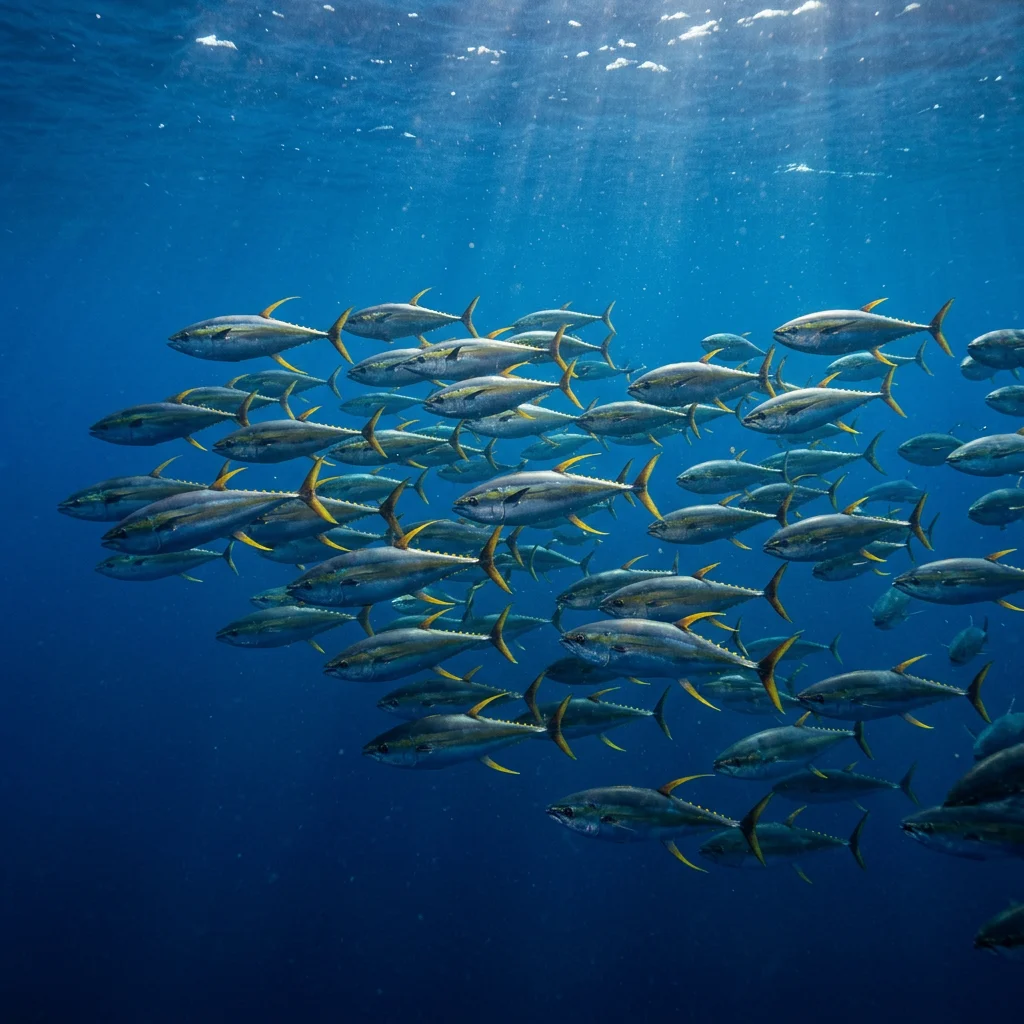
Great white sharks gather off California and Guadalupe Island; whale sharks feed in the Philippines and the Galápagos; hammerhead schools gather at Cocos Island. Pacific bluefin tuna cross the entire ocean, spawning near Japan and feeding off California. Five species of Pacific salmon run up rivers from California to Japan. See whale sharks in the Philippines and sharks.
Which animals migrate across the Pacific?
The Pacific’s size makes it the setting for some of the longest migrations in the animal kingdom. Gray whales travel between feeding grounds in the Bering, Chukchi and Beaufort Seas and calving lagoons in Baja California, a round trip that NOAA puts at about 10,000 miles (roughly 16,000 km) and in some cases more than 14,000 miles. A small western population of fewer than 300 gray whales feeds off Russia’s Sakhalin Island and Kamchatka. North Pacific humpbacks feed off Alaska and British Columbia and breed in Hawaii, Mexico and Central America.
Pacific bluefin tuna hatch in the western Pacific, around Japan and the Sea of Japan. Many juveniles begin a crossing of more than 8,000 kilometres to the coast of California shortly after their first birthday, spend several years feeding and growing in the eastern Pacific, and return westward to spawn at around age seven. Western Pacific leatherback turtles make a similar journey in the other direction: females nesting in Indonesia, Papua New Guinea and the Solomon Islands travel nearly 7,000 miles, a trip of 10 to 12 months, to feed on jellyfish off the US West Coast. Leatherbacks can dive to about 4,000 feet, deeper than any other turtle. Pacific salmon complete the picture, hatching in rivers from California to Japan, spending years at sea and returning to their home streams to spawn and die.
What rare and unusual animals live in the Pacific?
Some found nowhere else, and some among the strangest on Earth.
The Pacific’s islands, trenches and isolated coasts hold many animals with tiny ranges, several of them among the most threatened species on Earth.
Which animals are found only on Pacific islands?
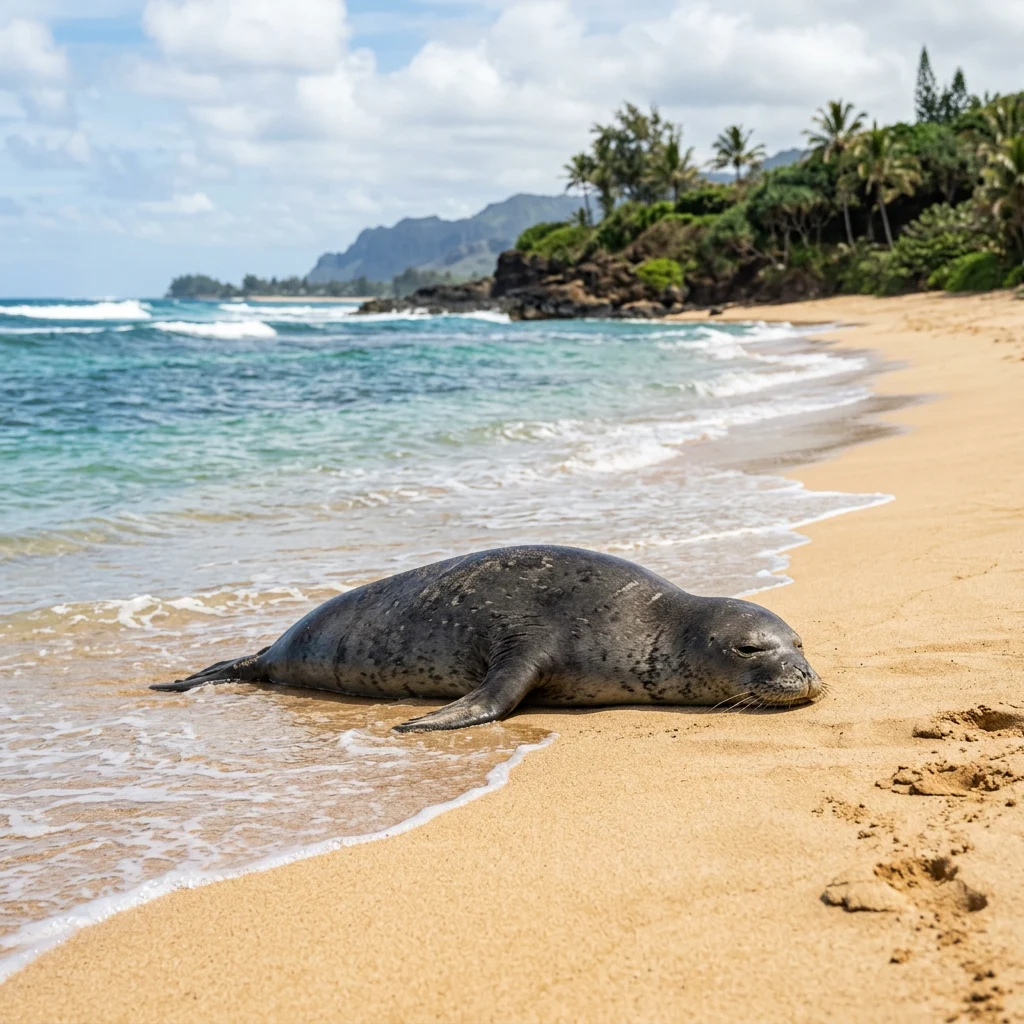
Remote archipelagos have produced animals found nowhere else. In the Galápagos, the marine iguana is the only lizard in the world that forages in the sea, diving to graze on algae, and the Galápagos penguin lives almost on the equator thanks to cold currents. In Hawaii, the Hawaiian monk seal is endemic to the archipelago; NOAA estimates the population at about 1,600 animals, nearly 1,200 of them in the remote northwestern islands of Papahānaumokuākea and about 400 in the main islands. Listed as endangered in 1976, monk seals face food shortages, shark predation on pups, entanglement in marine debris and sea-level rise eroding the low islands where they haul out. New Zealand’s coasts hold Hector’s dolphin and its critically endangered subspecies, the Māui dolphin, and Indonesian waters are home to the second species of coelacanth, a lobe-finned fish once thought extinct.
What lives in the deep Pacific?
Most of the Pacific is deep, dark and cold, and most of its animals live there. Lanternfish, bristlemouths and other small fish migrate up and down each day through the water column, feeding near the surface at night. Below them live anglerfish, dragonfish, vampire squid, dumbo octopuses and glass sponges. In 1977 the submersible Alvin discovered hydrothermal vents on the Galápagos Rift at about 2,500 metres, along with giant tube worms, clams and shrimp living on bacteria that draw energy from the chemicals in vent water rather than from sunlight. That discovery changed ideas about where life can exist, and Pacific vent fields have since yielded many new species, including hairy-clawed yeti crabs.
The deepest fish ever recorded are Pacific snailfish. In August 2022 a team led by Alan Jamieson of the University of Western Australia filmed a snailfish of the genus Pseudoliparis at 8,336 metres in the Izu-Ogasawara Trench south of Japan, and caught two snailfish at 8,022 metres in the Japan Trench. Below about 8,200 metres, fish appear to give way to invertebrates: amphipods, sea cucumbers, worms and giant single-celled xenophyophores live on the floors of the deepest trenches.
Where can you see Pacific marine life?
Many of these animals can be seen without a research vessel. The lagoons of Baja California, such as San Ignacio and Ojo de Liebre, are among the best places in the world to watch gray whales; NOAA notes that calves are born in Mexico’s shallow lagoons and bays between early January and mid-February, so late winter is the time to go. Hawaii’s humpback season runs through the northern winter, and whale-watching boats leave from Maui and the Big Island. Monterey Bay in California offers year-round sea otters along the shore and seasonal blue and humpback whales offshore when upwelling is strong.
For reef life, Raja Ampat in the Bird’s Head Seascape, Komodo, the Lembeh Strait and the Philippines’ Tubbataha and Anilao are classic Coral Triangle destinations, while Palau and the outer Great Barrier Reef offer walls, channels and big schools of fish. The Galápagos and Costa Rica’s Cocos Island are known for schooling hammerheads and other pelagic animals in cooler, current-swept water, and are best suited to experienced divers. Wherever you go, choose operators that follow local wildlife rules on approach distances, never feed or touch marine animals, and remember that many of the Pacific’s most charismatic species, from leatherbacks to monk seals, are endangered and easily disturbed.
What threatens Pacific marine life?
Overfishing, bycatch, coral bleaching, plastic pollution and warming waters.
The Great Barrier Reef and Coral Triangle reefs have suffered repeated bleaching. Pacific leatherback turtles have declined sharply. The Great Pacific Garbage Patch accumulates plastic, and marine heatwaves like “the Blob” have triggered die-offs. Large marine protected areas such as Papahānaumokuākea in Hawaii protect some of the most intact ecosystems.
The scale of some of these problems is now well measured. Western Pacific leatherbacks have declined by more than 80% and Eastern Pacific leatherbacks by more than 97%, according to NOAA. The vaquita, a small porpoise found only in Mexico’s upper Gulf of California and drowned as bycatch in gillnets, is the world’s rarest marine mammal; the 2024 survey sighted only six to eight animals. A 2018 study in Scientific Reports led by Laurent Lebreton estimated that the Great Pacific Garbage Patch between Hawaii and California covers about 1.6 million square kilometres and holds at least 79,000 tonnes of plastic, nearly half of it by mass from fishing nets.
Warming water is the newest pressure. A marine heatwave nicknamed “the Blob” spread across the northeast Pacific from 2014 to 2016. Its effects rippled through the food web: about 62,000 dead common murres washed up from California to Alaska between 2015 and 2016, and a 2020 study led by John Piatt of the US Geological Survey estimated that the true toll approached one million birds. Repeated mass bleaching has hit the Great Barrier Reef and reefs across the Coral Triangle. Against that, the Pacific also holds some of the largest marine protected areas on Earth, including Papahānaumokuākea in Hawaii, which was greatly expanded in 2016, and recovery stories such as the sea otter and the eastern gray whale show that Pacific wildlife can rebound when it is given protection.
What animals live in the Pacific Ocean?
Whales, dolphins, sea otters, seals, sharks, tuna, salmon, octopus, squid, sea turtles, corals and countless invertebrates.
What is the largest animal in the Pacific?
The blue whale, the largest animal ever known.
Where is the most biodiversity in the Pacific?
In the Coral Triangle around Indonesia, the Philippines and Papua New Guinea.
Are there sharks in the Pacific Ocean?
Yes, many, including great whites, tiger sharks, hammerheads, makos and whale sharks.
What lives at the bottom of the Pacific?
Snailfish, amphipods, sea cucumbers, xenophyophores and microbes, even in the Mariana Trench.
What endangered animals live in the Pacific?
The vaquita, Hawaiian monk seal, Pacific leatherback turtle and Māui dolphin, among others.
What is the deepest-living fish in the Pacific?
A snailfish filmed at 8,336 m in the Izu-Ogasawara Trench off Japan in 2022, the deepest fish ever recorded.
- Veron, J. E. N. et al. (2009). Delineating the Coral Triangle. Galaxea 11.
- NOAA Fisheries: Species directory (Pacific species).
- IUCN Red List: Phocoena sinus (vaquita); Vaquita Survey Expedition 2024 results.
- Lebreton, L. et al. (2018). Evidence that the Great Pacific Garbage Patch is rapidly accumulating plastic. Scientific Reports 8: 4666.
- Piatt, J. F. et al. (2020). Extreme mortality and reproductive failure of common murres resulting from the northeast Pacific marine heatwave of 2014–2016. PLOS ONE 15(1): e0226087.
- NOAA Fisheries: Gray whale; Leatherback turtle; Hawaiian monk seal species pages.
- Smithsonian Ocean: The great Pacific migration of bluefin tuna.
- Minderoo-UWA Deep Sea Research Centre (2023). Deepest fish filmed and caught, Izu-Ogasawara and Japan trenches.
Blane Perun has been exploring Earth’s oceans and marine life for over 25 years. Founder of TheSea.Org in 1999, underwater photographer, coral aquaculture pioneer, and explorer of 80+ countries.
About Blane Perun → More on Oceans →