Cowfish — The Horned Boxfish That Can Poison Its Own Tank
A cowfish is a boxfish (family Ostraciidae) with a pair of horn-like spines projecting forward above its eyes. The best-known species, the longhorn cowfish (Lactoria cornuta), lives on Indo-Pacific reefs, seagrass and harbours and grows to about 46 cm. Its body is sealed inside a rigid shell of fused bony plates, and when stressed it can release a skin toxin, pahutoxin, that is lethal to other fish in a closed tank.
The cowfish is the boxfish that looks like it was assembled from spare parts: a rigid, box-shaped body, a small pouting mouth, two eyes set high on the head, a pair of forward-pointing horns and a fan of a tail that can be as long as the body itself. It is not a joke of evolution. Every one of those features is part of one of the most heavily armoured designs among reef fishes.
What is a cowfish, exactly?
Cowfish are boxfishes with horns. They belong to the family Ostraciidae, the same family as the trunkfishes and the yellow boxfish.
Boxfishes are members of the order Tetraodontiformes, which also contains the triggerfish, the pufferfish, the porcupinefish and the filefish. The family contains roughly two dozen living species in six genera. “Cowfish” is a common name rather than a single scientific group: it is applied to boxfishes that carry horn-like spines above the eyes, chiefly the Indo-Pacific longhorn cowfish (Lactoria cornuta) and the Atlantic scrawled cowfish (Acanthostracion quadricornis) and honeycomb cowfish (A. polygonius).
The species name cornuta is Latin for “horned”, and Linnaeus described the species in 1758. When aquarists say “cowfish” without qualification, they almost always mean the longhorn, which is the most widely traded cowfish in the hobby.
| Species | Where | Max length | Notes |
|---|---|---|---|
| Longhorn cowfish, Lactoria cornuta | Indo-Pacific, Red Sea to French Polynesia | 46 cm | Longest horns; yellow to olive with blue spots |
| Scrawled cowfish, Acanthostracion quadricornis | Western Atlantic, Massachusetts to Brazil | 55 cm | Blue scrawls; mostly seagrass beds, 1–80 m |
| Honeycomb cowfish, Acanthostracion polygonius | Western Atlantic and Caribbean | about 50 cm | Hexagonal honeycomb pattern |
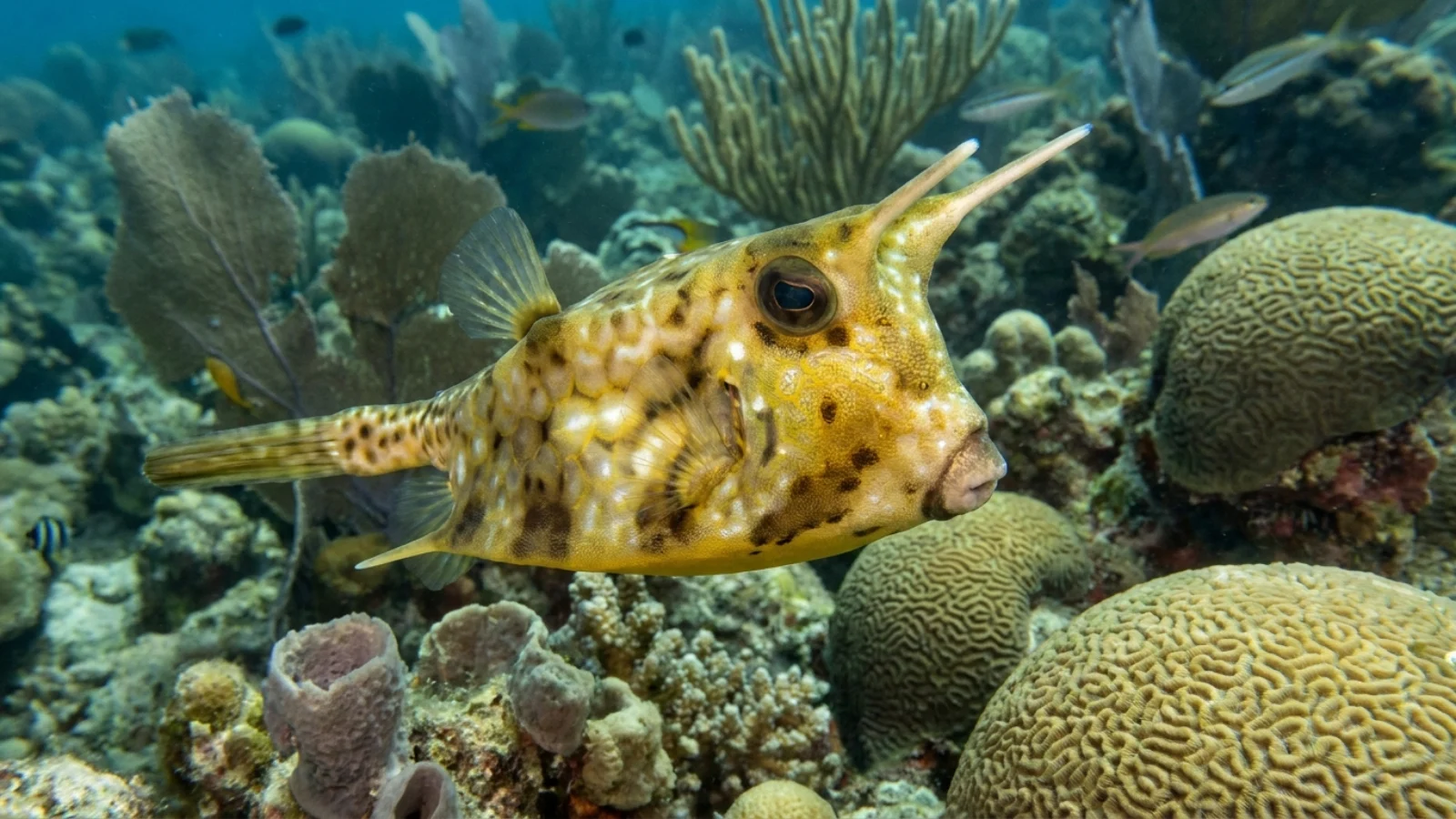
How big do cowfish get?
A longhorn cowfish can reach 46 cm (18 in) in total length, although most adults seen on reefs are smaller.
FishBase lists a maximum of 46 cm total length and a common length of about 40 cm for the longhorn. The scrawled cowfish of the Caribbean is the largest cowfish, with a recorded maximum of 55 cm. A big chunk of the longhorn’s length is its tail, which in adults can be as long as the rest of the body.
Why does a cowfish have horns?
The horns are hollow spines of mineralised collagen that make the fish awkward and painful to swallow.
A cowfish cannot outswim much of anything, so its defence is to be hard to eat. The horns project forward from above the eyes, and a second pair of spines points backward from the rear of the carapace. A predator that tries to engulf the fish head-first or tail-first meets a spike. The horns are mostly hollow, and if they are broken they can regrow over a few months.
What is the cowfish’s shell made of?
The body is enclosed in a carapace of hexagonal bony plates fused together, with gaps only for the eyes, mouth, gills, fins and tail.
Those plates are modified scales. The result is a rigid box: a cowfish cannot flex its body to swim the way most fish do. Instead it sculls along with its dorsal, anal and pectoral fins, hovering and turning with surprising precision, and saves the tail for bursts of speed. The boxfish shape famously inspired a car-industry concept design, though, as a later section explains, the real hydrodynamics turned out to be very different from the story told about them.
Are cowfish poisonous?
Yes. Under stress, cowfish and other boxfishes secrete pahutoxin from their skin, a soap-like toxin that is lethal to other fish in confined water.
Pahutoxin (also called ostracitoxin) is a choline chloride ester of a fatty acid that behaves like a detergent and resembles the saponins of sea cucumbers. It is haemolytic, meaning it destroys red blood cells, and it is heat-stable and foams in water. In the open sea it disperses and simply makes the fish distasteful to predators. In a closed aquarium or a fish bag, it can kill every fish in the system, sometimes including the cowfish itself. Separately, boxfish have been linked to ciguatera poisoning, and they are not generally eaten, although the Caribbean scrawled cowfish is eaten locally and is considered good food in parts of its range.
Where do cowfish live?
The longhorn cowfish ranges across the Indo-Pacific, from the Red Sea and East Africa to the Marquesas and Tuamotu islands, and from southern Japan to Lord Howe Island.
Despite the reef-fish label, longhorns are as much fish of sand and weed as of coral. FishBase describes them inshore on coastal muddy or sandy bottoms in still bays, harbours and estuaries, often in weedy areas near rocks or reefs, from 1 to 100 m. Juveniles gather in small groups near river mouths and even in brackish water, and adults tend to be solitary and shy. In the Atlantic, the scrawled cowfish is a fish of seagrass beds from Massachusetts and Bermuda to Brazil, and young use mangroves. Both fit the reef-edge habitats described in coral reef lagoons.
What do cowfish eat?
Small bottom-dwelling invertebrates, which the longhorn digs out by blowing jets of water into the sand.
This is one of the most fun behaviours to watch underwater. The cowfish hovers head-down over the sand, puffs a jet of water out of its small mouth and blows a pit, then picks off the worms, small crustaceans and molluscs it exposes. Atlantic cowfish also eat tunicates, sponges, soft corals, anemones, hermit crabs and some algae. The mouth is small, with lips built for picking rather than biting.
How do cowfish reproduce?
Males establish territories and court females at dusk; eggs and larvae are pelagic.
Boxfishes generally spawn in pairs in the water column around sunset after a male courts one or more females in his territory. Longhorn cowfish spawn close to the bottom, which may help them avoid egg predators. The larvae drift in the plankton and already begin forming the boxy carapace while still tiny, which is why juvenile cowfish look like miniature yellow dice with horns.
How does a cowfish’s armour grow with the fish?
A suit of armour made of rigid plates has an obvious problem: the animal inside keeps growing. A 2022 study in the Journal of Anatomy by L. Eigen and colleagues used high-resolution micro-CT scanning to map the hundreds of plates, called scutes, that cover the longhorn cowfish, in fish spanning nearly a tenfold range in length. The answer was surprisingly simple. Rather than adding new scutes as it grows, a cowfish keeps roughly the same number throughout life, and each scute gets larger, thicker and especially wider. Growth was tightly controlled, with little variation between individuals.
The details are revealing about where a box is weakest. In young fish, the scutes along the edges of the carapace, the weak points of any box-shaped structure, were among the thickest and most reinforced, and they thinned more slowly than others as the fish grew. Smaller scutes with more variable curvature were found only in the few areas with complex shapes, such as around the fin bases, the mouth and the anus. A follow-up in 2024 in Communications Biology by the same group compared thousands of scutes from 13 boxfish species with very different cross-sections. Certain scute types turned up in the same body regions whatever the overall carapace shape, separating edges from flat areas, and the head, with its many openings, from the more closed belly. The proportions of edge scutes changed systematically with body shape, which the authors interpreted as a way of keeping the armour resistant to bending across very different body plans.
Does the boxfish shape really make a good car?
The boxfish became a design icon because its carapace was thought to have unusually low drag and to steady itself automatically, swinging back into line with the flow like a weather vane. That story inspired a concept car. In 2015, S. Van Wassenbergh and colleagues tested it in the Journal of the Royal Society Interface, combining flow-tank measurements of drag and turning forces with computer simulations of water flow around the body.
Their results reversed both assumptions. Drag reduction was relatively poor compared with more ordinary fish shapes. And instead of stabilising the fish, the flow over the carapace produced destabilising turning forces. The authors argued that this solves a long-standing puzzle: a fish whose shape held it rigidly on course would struggle to manoeuvre among coral and rock, yet boxfishes turn and tilt constantly in their complex reef territories. An unstable body, steered by small fin movements, is exactly what a slow but agile manoeuvrer needs.
Can cowfish make sounds?
Yes. The longhorn cowfish is known to make a grunting noise when caught, and a 2021 study in the Journal of Anatomy by E. Parmentier and colleagues examined how it produces sound. The fish has two pairs of sound-producing muscles attached to the swim bladder. It makes two kinds of sounds: hums, which are long trains of low-amplitude pulses, and clicks, which are shorter and louder. The muscle structure matched the sounds. The outer muscles had features suited to fast, strong, short contractions, consistent with clicks, while the inner muscles had the thinnest fibres and the most mitochondria, suited to fast contractions sustained over long periods, consistent with hums. The study also compared the calls with the fish’s hearing.
Sound may matter in breeding too. A 2026 study of the related white-spotted boxfish, Ostracion meleagris, used synchronised video and sound recordings of 13 spawning events to show that a distinctive “spawning hum” forms part of the mating sequence, and that it differs from the hum the fish make when handled. Whether longhorn cowfish use a similar call while spawning has not been shown in the sources reviewed here.
How do longhorn cowfish breed?
Males and females look alike in colour: both are yellow to olive, with white or bluish spots, and there is no obvious sexual dimorphism in pattern. In one set of measurements summarised in reference accounts, females were larger, at 83 to 250 mm long with an average of 121 mm, against 65 to 155 mm and an average of 103 mm for males. Females also weighed more, 17 to 156 g with an average of 33 g, against 12 to 116 g and an average of 26 g for males. These are sample figures, well below the species’ maximum size.
The species is described as forming harems of three to four females per male. Courtship takes place in pairs just before or after sunset, and females may also spawn during the day under heavy cloud cover. In the population described, the spawning season ran from February to early October. Eggs and larvae drift in the plankton, and wrasses and damselfish are among the egg predators on the reef. Larger boxfishes can chase these predators off, but longhorn cowfish are reported to spawn close to the bottom, which may help hide both the spawning pair and the eggs.
What is pahutoxin, chemically?
Pahutoxin, formerly called ostracitoxin, was described in 1967 in the journal Science by Boylan and Scheuer in a paper titled “Pahutoxin: A Fish Poison”. Its formula is C23H46ClNO4: a choline ester of a 3-acetoxy fatty acid with a 16-carbon chain, carried as the chloride salt. That structure, with a charged head and a long oily tail, is why it behaves like a detergent. It is unusual for a fish toxin in being a non-peptide, it is heat-stable and does not pass through dialysis membranes, and it foams in water. It is toxic to fish, including other boxfish, and in its general properties it resembles toxins from sea cucumbers and red tides. The toxin is released in the skin mucus when the fish is stressed, which is why a crowded bag or a chase around a tank is far more dangerous than a cowfish living calmly on the reef.
Is the longhorn cowfish spreading?
The longhorn already has one of the widest ranges of any boxfish, from the Red Sea and East Africa to the Marquesas and Tuamotus and from southern Japan to Lord Howe Island, and reference accounts also list it off southern Africa in the Atlantic. Records along the coasts of India have attracted attention. A 2021 preprint, not yet peer reviewed at the time it was posted, reported the first longhorn cowfish from the coast of Karnataka, near Karwar, after earlier reports from the Bay of Bengal, Goa and Lakshadweep. The first fish was collected around the passage of Cyclone Ockhi, and a second specimen turned up a year later close to the first. The authors suggested that cyclones may carry these slow-swimming fish into new areas, but that remains a hypothesis. On the Atlantic side, FishBase notes that the scrawled cowfish has been reported from the tip of South Africa, far outside its main western Atlantic range.
How do the Atlantic cowfishes differ in diet and habits?
The two western Atlantic species overlap widely but differ in habitat. The scrawled cowfish lives mainly in seagrass beds from shallow water to about 80 m, usually at 10 to 30 m, and young fish use mangrove areas. FishBase lists its food as sessile invertebrates such as tunicates, gorgonians and anemones, slow-moving crustaceans, sponges, hermit crabs and marine plants. It matures at around 22 cm and is regarded as an excellent food fish, marketed fresh, although there are reports of ciguatera from it. The honeycomb cowfish is a fish of clear water around coral reefs, at 3 to 80 m, from New Jersey and Bermuda to Brazil. It feeds on sponges, soft corals, tunicates and shrimp, is described as uncommon and wary, and is eaten fresh, generally roasted, in parts of its range. Ciguatera has been reported from all three cowfish species covered on this page.
Can you keep a cowfish in a reef tank?
You can, but it is a specialist fish: it grows large, nips invertebrates and can poison the whole system if it is badly stressed.
The longhorn is the best-known cowfish in the aquarium trade, but a fish that can reach 46 cm outgrows most home aquariums, and its natural diet of worms, molluscs, small crustaceans and sponges makes it a poor match for a mixed reef tank. The real risk is toxin: a badly stressed cowfish can release pahutoxin into a closed system. Sources differ on whether a fish that has already died is a danger. Aquarists commonly warn that it is, while one reference account states that the toxin is made only by a living fish, so a dead fish carries at most residual toxin released before death. See our reef aquarium fish selection guide before buying one.
Why is it called a cowfish?
Because of the two horn-like spines that project forward above its eyes, like the horns of a cow.
How big does a cowfish get?
The longhorn cowfish reaches up to 46 cm (18 in) total length. The Atlantic scrawled cowfish is larger, up to 55 cm.
Are cowfish poisonous to humans?
They are not venomous and pose no risk to divers. Their skin toxin, pahutoxin, mainly affects fish. Boxfish have been linked to ciguatera poisoning, so most are not eaten.
Can a cowfish kill other fish in a tank?
Yes. A stressed or dying cowfish can release pahutoxin into the water, which can kill tankmates in a closed aquarium.
What do cowfish eat?
Small bottom invertebrates such as worms, crustaceans and molluscs. Longhorns blow jets of water into sand to uncover prey.
Where do cowfish live?
Longhorns live across the Indo-Pacific from the Red Sea to French Polynesia. Scrawled and honeycomb cowfish live in the western Atlantic and Caribbean.
Is a cowfish the same as a boxfish?
A cowfish is a type of boxfish. All cowfish belong to the boxfish family Ostraciidae; the name refers to species with horns.
Are cowfish endangered?
No. The longhorn cowfish is listed as Least Concern by the IUCN (2023 assessment).
- Froese, R. & Pauly, D. (eds.). Lactoria cornuta, Longhorn cowfish. FishBase, fishbase.se.
- Froese, R. & Pauly, D. (eds.). Acanthostracion quadricornis, Scrawled cowfish. FishBase.
- IUCN Red List of Threatened Species. Lactoria cornuta (assessed 18 August 2023): Least Concern.
- Matsuura, K. Ostraciidae. In Smith, M. M. & Heemstra, P. C. (eds.), Smiths’ Sea Fishes. Springer-Verlag.
- Randall, J. E., Allen, G. R. & Steene, R. C. (1990). Fishes of the Great Barrier Reef and Coral Sea. University of Hawaii Press.
- Eigen, L. et al. (2022). Ontogeny of a tessellated surface: carapace growth of the longhorn cowfish Lactoria cornuta. Journal of Anatomy. doi:10.1111/joa.13692
- Eigen, L. et al. (2024). Comparative architecture of the tessellated boxfish (Ostracioidea) carapace. Communications Biology. doi:10.1038/s42003-024-07119-z
- Van Wassenbergh, S. et al. (2015). Boxfish swimming paradox resolved: forces by the flow of water around the body promote manoeuvrability. Journal of the Royal Society Interface. doi:10.1098/rsif.2014.1146
- Parmentier, E. et al. (2021). Sound production, hearing sensitivity, and in-depth study of the sound-producing muscles in the cowfish (Lactoria cornuta). Journal of Anatomy. doi:10.1111/joa.13353
- Parmentier et al. (2026). The spawning hum in the reproductive sequence of the boxfish Ostracion meleagris. Journal of Fish Biology. doi:10.1111/jfb.70693
- Boylan & Scheuer (1967). Pahutoxin: a fish poison. Science 155: 52. doi:10.1126/science.155.3758.52
- Muhammed Zafar Iqbal, A. et al. (2021). First report of Lactoria cornuta from Karnataka, west coast of India: role of tropical cyclones in range extension. bioRxiv preprint, not peer reviewed. doi:10.1101/2021.06.28.450260
- Froese, R. & Pauly, D. (eds.). Acanthostracion polygonius, Honeycomb cowfish. FishBase.
- Wikipedia. Longhorn cowfish and Pahutoxin (breeding, size samples, toxin chemistry; secondary source).
Blane Perun has been exploring Earth’s oceans and marine life for over 25 years. Founder of TheSea.Org in 1999, underwater photographer, coral aquaculture pioneer, and explorer of 80+ countries.
About Blane Perun → More on Reef Fish →