How Long Can Seals Hold Their Breath? — From Minutes to 2 Hours
It depends on the species, but most seal dives last 5 to 30 minutes, and the record-holders can stay under for one to two hours. Weddell seals usually dive for no more than 15 minutes but have been recorded holding their breath for 73 minutes. Northern elephant seals often dive for about 20 minutes and can stay down for over an hour, and southern elephant seals typically stay under 20 to 30 minutes, with breath-holds of up to about two hours reported. Sea lions and fur seals make shorter dives, typically 5 to 7 minutes. Seals do it by exhaling before they dive, storing oxygen in blood and muscle rather than lungs, and slowing their hearts.
A seal does not take a deep breath before diving; it breathes out and carries its oxygen in its blood and muscles, which is how an elephant seal can stay down for an hour or more.
How long can seals hold their breath?
Seals are among the best breath-holders of any mammal, but the answer varies enormously from species to species and from dive to dive. Most dives are short and well within a seal’s comfortable limits: a few minutes to around half an hour. The deep-diving true seals, especially Weddell seals and elephant seals, can go much longer, with breath-holds of more than an hour recorded and about two hours reported for the southern elephant seal.
Sea lions and fur seals, which belong to a different family, the eared seals, generally make shorter and shallower dives. If you are not sure which is which, see our guide to seal vs sea lion. In both families, the longest dives are rare. A seal, like a free-diving human, does most of its work well inside its limits, saving maximum dives for exceptional circumstances.
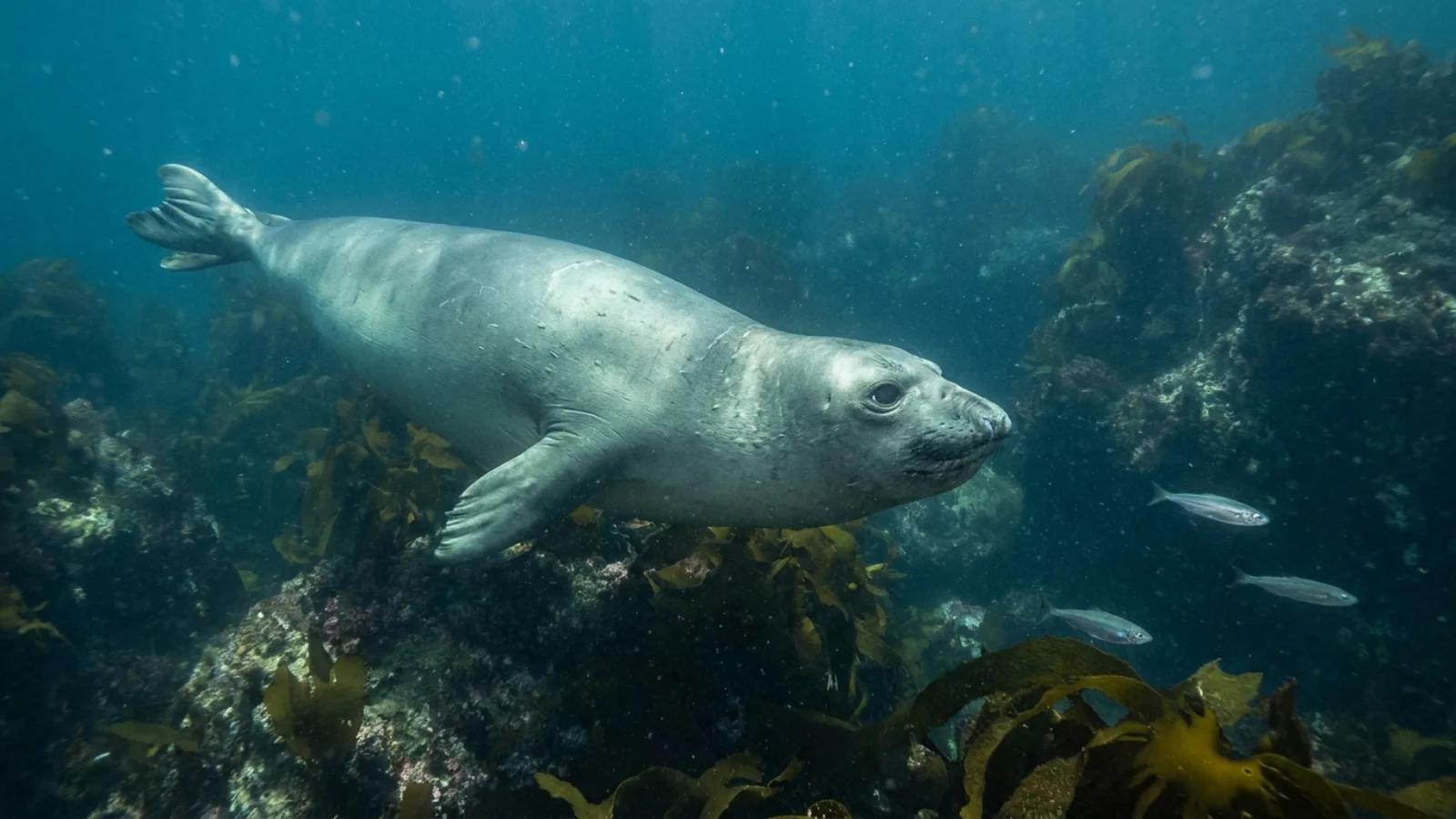
Breath-hold times by species
The best-known records come from Antarctic Weddell seals and the two species of elephant seal, which have been studied for decades with time-depth recorders, usually attached to the head. These devices log depth, dive duration, bottom time, surface time and the number of dives, so researchers can see how long seals actually stay down in the wild.
When foraging, the Weddell seal typically dives for no more than 15 minutes and to depths of about 400 metres, but it can dive for as long as 73 minutes and reach about 600 metres. Northern elephant seals often dive to 350 to 650 metres for as long as 20 minutes, and they can dive to 1,500 metres and stay down for over an hour. Southern elephant seals frequently dive to 400 to 800 metres and stay under for 20 to 30 minutes; according to BBC Wildlife, breath-holds of up to two hours are known, and a male has been recorded at 2,388 metres.
Eared seals are more modest. The dives of sea lions and fur seals typically last 5 to 7 minutes, with average depths of 30 to 45 metres. There are exceptions: the New Zealand sea lion has been recorded diving to 460 metres and staying submerged for as long as 12 minutes. Grey seals, true seals of the North Atlantic, feed mostly on fish living on or near the seabed at depths down to 70 metres or more, and leopard seals are mostly shallow divers, although they do dive deeper than 80 metres in search of food.
Why do seals breathe out before they dive?
It seems backwards, but it is one of the keys to deep diving. Before a dive, a seal exhales much of the air in its lungs and shuts its nostrils and throat. For a seal, air in the lungs is more of a problem than a resource at depth.
As a seal descends, water pressure squeezes its body. Its airways are supported by cartilage rings and smooth muscle, and its chest and the tiny air sacs of the lungs, the alveoli, can collapse completely during deep dives. Any remaining air is pushed into the stiffer bronchioles and the windpipe, where gas cannot easily pass into the blood. That stops nitrogen from dissolving into the blood under pressure, which protects the seal from decompression sickness, the bends, as well as from oxygen toxicity and nitrogen narcosis. The middle ear has blood sinuses that probably fill during the dive, preventing painful ear squeeze. Leopard seals have a reinforced windpipe to stop it collapsing under pressure and re-inflate their lungs at the surface.
Diving on emptied lungs also helps with buoyancy. Weddell seals, for example, become negatively buoyant within the first 30 to 50 metres after leaving a breathing hole in the ice, which lets them glide down with little effort.
Where seals store their oxygen
If not in the lungs, where? The answer is the blood and muscles. Seals have large amounts of haemoglobin in their blood and myoglobin in their muscles, the proteins that carry and store oxygen. This provides enough oxygen to stay submerged for long periods. Deep-diving species such as elephant seals also have huge blood volumes, up to 20 percent of their body weight. BBC Wildlife notes that southern elephant seals carry about three times as much oxygen in their blood as humans do, and store more in their tissues.
Seals also keep an extra reserve in the spleen. In northern elephant seals, the spleen contracts during a dive, squeezing stored red blood cells into circulation. Studies of diving northern elephant seals found that by three minutes into a dive, their spleens had on average contracted to a fifth of their original size, a sign of the automatic nervous response that comes with diving. The circulatory system is elaborate as well; networks of blood vessels called retia mirabilia line the trunk and limbs and increase oxygen storage.
The dive response: slowing the heart and sharing out oxygen
Storing oxygen is only half the story. The other half is using it slowly. When a seal dives, its heart rate drops, and blood flow is mostly restricted to the heart, brain and lungs. Working muscles fall back on the oxygen already stored in their myoglobin. This combination of a slower heart and redirected blood flow is the dive response, and it lets a seal stretch its oxygen stores much further.
Seals’ blood pressure has to be kept stable through all of this. Pinnipeds have bulb-shaped ascending aortas, the main artery leaving the heart, and the bulb is largest in species that dive deepest and longest. This helps the seal maintain its blood pressure while the heart beats slowly.
What limits a seal’s dive?
Every dive is a balance between the oxygen a seal carries and the oxygen it burns. Researchers talk about the aerobic dive limit, roughly the longest dive a seal can make on its stored oxygen without needing a long recovery at the surface. For juvenile leopard seals, the aerobic dive limit averages about seven minutes, which appears to stop them reaching krill in winter, when krill live deeper.
Carbon dioxide matters too. In a 2026 study in the Journal of Experimental Biology, six grey seals dived voluntarily in a simulated foraging set-up, swimming between a breathing chamber and an underwater feeder, while researchers altered the air they breathed at the surface. The study set out to test whether the build-up of carbon dioxide across a series of dives prolongs surface recovery and reduces how efficiently seals can gain energy, an effect thought to limit foraging.
Light and time of day shape dives as well. Tracking Weddell seals in the Ross Sea through 24-hour daylight, light-dark cycles and polar night, a 2024 study in Communications Biology found that the seals switched from mainly night-time diving in summer to mainly daytime diving for the rest of the year, and that the rhythm of their dive depth, duration and surface recovery was most strongly daily during the months with normal light and dark. Weddell seals generally dive deeper and longer during the day than at night.
How long can elephant seals stay at sea?
Elephant seals do not just make long dives; they make them back to back. Female northern elephant seals have been tagged diving almost continuously for 20 hours or more a day, mostly in water 400 to 600 metres deep, where small fish are plentiful. In 2013 a deep-sea camera recorded a female northern elephant seal at 894 metres slurping up a Pacific hagfish from the seabed. Elephant seals seem to find prey in the dark at least partly by sight, helped by the bioluminescence of some prey.
Diving deep also keeps them safe. Out at sea, northern elephant seals dive beyond the reach of surface-hunting orcas and white sharks, which may explain why they spend so little time at the surface.
Do seals sleep underwater?
Yes, and while holding their breath. In a 2023 study in Science, Kendall-Bar and colleagues recorded brain activity in wild northern elephant seals diving in Monterey Bay, California. The seals took short naps of less than 20 minutes during dives, reaching depths of up to 377 metres while asleep. Combining the brain recordings with dive data from 334 free-ranging seals and more than half a million sleeping dives, the researchers found that elephant seals averaged only about two hours of sleep per day during seven months at sea, rivalling the African elephant for the least sleep of any mammal.
Earlier observations had already shown elephant seals sleeping for minutes at a time while drifting slowly downward in a belly-up position.
Do seal pups have to learn to hold their breath?
Yes. Breath-holding ability is not fully formed at birth. Seals, like all marine mammals, need time to develop the oxygen stores, swimming muscles and neural pathways required for effective diving and foraging. In many true seals the mother nurses her pup on extremely rich milk for a short period and then leaves, and the pup lives off its fat reserves for weeks or even months while it matures. During that time young seals build up the blood and muscle oxygen stores that adults rely on. Some pups can swim almost from birth, but others wait days or weeks before entering the water, and elephant seals start swimming weeks after weaning.
That slow development has consequences. Juvenile leopard seals, with an aerobic dive limit of only about seven minutes, cannot follow krill when it moves deeper in winter, so they rely on other food until they grow. The record-breaking dives in every species come from adults that have had years to build up their oxygen stores and diving skills.
How scientists measure seal dives
Most of what we know about seal breath-holding comes from small electronic tags. Time-depth recorders and satellite-linked time-depth recorders are usually attached to a seal’s head and record depth, bottom time, total dive time, surface time, time hauled out, pitch and roll and the total number of dives, along with the date and time. When the seal hauls out again, or through satellite links, researchers retrieve months of dive records. Newer studies add accelerometers, cameras and even brain-wave sensors, which is how researchers learned that elephant seals nap in the middle of a dive.
How do sea lions and fur seals compare?
Eared seals have different priorities. They tend to feed closer to shore in rich upwelling zones near their breeding colonies, make shorter foraging trips and rely on speed and agility rather than long, deep dives. Their dives typically last 5 to 7 minutes. Some female otariids can dive to 400 metres, and the New Zealand sea lion holds the family’s depth record at around 460 metres. For details on sea lion lungs and diving, see how do sea lions breathe?
Walruses, the third pinniped family, have a diet that does not require them to dive very deep or very long.
Seals vs other breath-holders
Seals are not the only champions. Some sea turtles can stay underwater for hours; see how long can sea turtles hold their breath? and how long can a pilot whale hold its breath? Among seals, though, the elephant seals and the Weddell seal stand out, routinely making dives that would be impossible for almost any other mammal, then doing it again a few minutes later, day after day for months at sea.
Why seal diving matters for conservation
Understanding how long seals can stay down helps explain where they can feed and how vulnerable they are to change. Species that rely on long, deep dives need productive feeding areas within reach of their physiological limits; if prey moves deeper, as krill do in winter for young leopard seals, the animals may be unable to follow. Polar species also depend on sea ice for breathing holes and resting, and Weddell seals must maintain their breathing holes in fast ice and find new ones. Gillnets and seine nets are also a significant cause of death for seals, because even an animal capable of an hour-long dive must eventually reach the surface to breathe.
So, how long can seals hold their breath?
Most seal dives last somewhere between 5 and 30 minutes. Weddell seals have stayed under for 73 minutes, northern elephant seals for more than an hour and southern elephant seals for up to about two hours. Seals manage it by breathing out before they dive, storing oxygen in blood and muscle, keeping a reserve of red blood cells in the spleen and sending blood only to the organs that need it most. Sea lions and fur seals, built for speed rather than depth, usually surface after 5 to 7 minutes. For more about the deepest divers, see our profiles of the elephant seal and the Weddell seal.
| Species | Typical dive | Longest / deepest recorded |
|---|---|---|
| Weddell seal | Up to 15 min, ~400 m | 73 min; ~600 m |
| Northern elephant seal | ~20 min, 350-650 m | Over 1 hour; 1,500 m |
| Southern elephant seal | 20-30 min, 400-800 m | Up to ~2 hours; 2,388 m |
| Grey seal | Short dives to ~70 m | Deeper than 70 m |
| Sea lions and fur seals | 5-7 min, 30-45 m | NZ sea lion: 12 min; 460 m |
How long can a seal stay underwater?
Most dives last 5 to 30 minutes; Weddell seals reach 73 minutes and elephant seals over an hour.
Which seal holds its breath the longest?
The southern elephant seal, with breath-holds of up to about two hours reported.
Do seals breathe in or out before diving?
Out. They exhale and let their lungs collapse at depth, which helps prevent the bends.
Where do seals store oxygen?
In blood haemoglobin and muscle myoglobin, plus red blood cells released from the spleen.
How deep can seals dive?
Southern elephant seals have been recorded at 2,388 m and northern elephant seals at 1,500 m.
How long can sea lions hold their breath?
Typical dives last 5 to 7 minutes; New Zealand sea lions have stayed under 12 minutes.
Do seals sleep underwater?
Yes. Elephant seals nap for under 20 minutes during dives and sleep about 2 hours a day at sea.
Do seals get the bends?
Generally no; lung collapse at depth stops nitrogen entering the blood.
- Kendall-Bar, J.M. et al. (2023), “Brain activity of diving seals reveals short sleep cycles at depth”, Science.
- Shero, M.R. et al. (2024), “Breath-hold capacities and circadian dive rhythmicity shape optimal foraging strategies in a polar marine mammal, the Weddell seal”, Communications Biology.
- Bønnelycke, E.S. et al. (2026), “Accumulation of CO2 limits energy gain in freely diving grey seals”, Journal of Experimental Biology.
- BBC Wildlife (Discover Wildlife), “Southern elephant seal facts”; Wikipedia contributors, “Pinniped”, “Northern elephant seal”, “Weddell seal”, “Leopard seal” (accessed November 2026).
Blane Perun has been exploring Earth’s oceans and marine life for over 25 years. Founder of TheSea.Org in 1999, underwater photographer, coral aquaculture pioneer, and explorer of 80+ countries.
About Blane Perun →