Seals — Every True Seal Species, Compared
Seals are marine mammals in the pinniped group, which also includes sea lions, fur seals and the walrus. “True seals” or earless seals (family Phocidae) number about 18 living species. They lack external ear flaps, swim with side-to-side strokes of their hind flippers and move on land by wriggling on their bellies. They range from the 1.3 m ringed and Baikal seals to the southern elephant seal, whose males can exceed 4,000 kg. Seals live in every ocean, from the Antarctic pack ice to Hawaiian beaches, plus two inland lakes.
From grey seals hauled out on British beaches to monk seals snoozing on Kauai, seals are often the first marine mammals people see up close. This page indexes every seal species profile on TheSea.Org and answers the core questions about the group.
What is the difference between seals, sea lions and walruses?

| Feature | True seals | Sea lions & fur seals | Walrus |
|---|---|---|---|
| External ears | No | Yes, small flaps | No |
| Swimming | Hind flippers | Front flippers | Hind flippers |
| On land | Wriggle on belly | Walk on four flippers | Walk on four flippers |
| Noise | Quieter; grunts, songs | Loud barking | Bells, whistles, bellows |
| Species | ~18 | ~15 | 1 |
See sea lions and walrus for the other pinniped families.
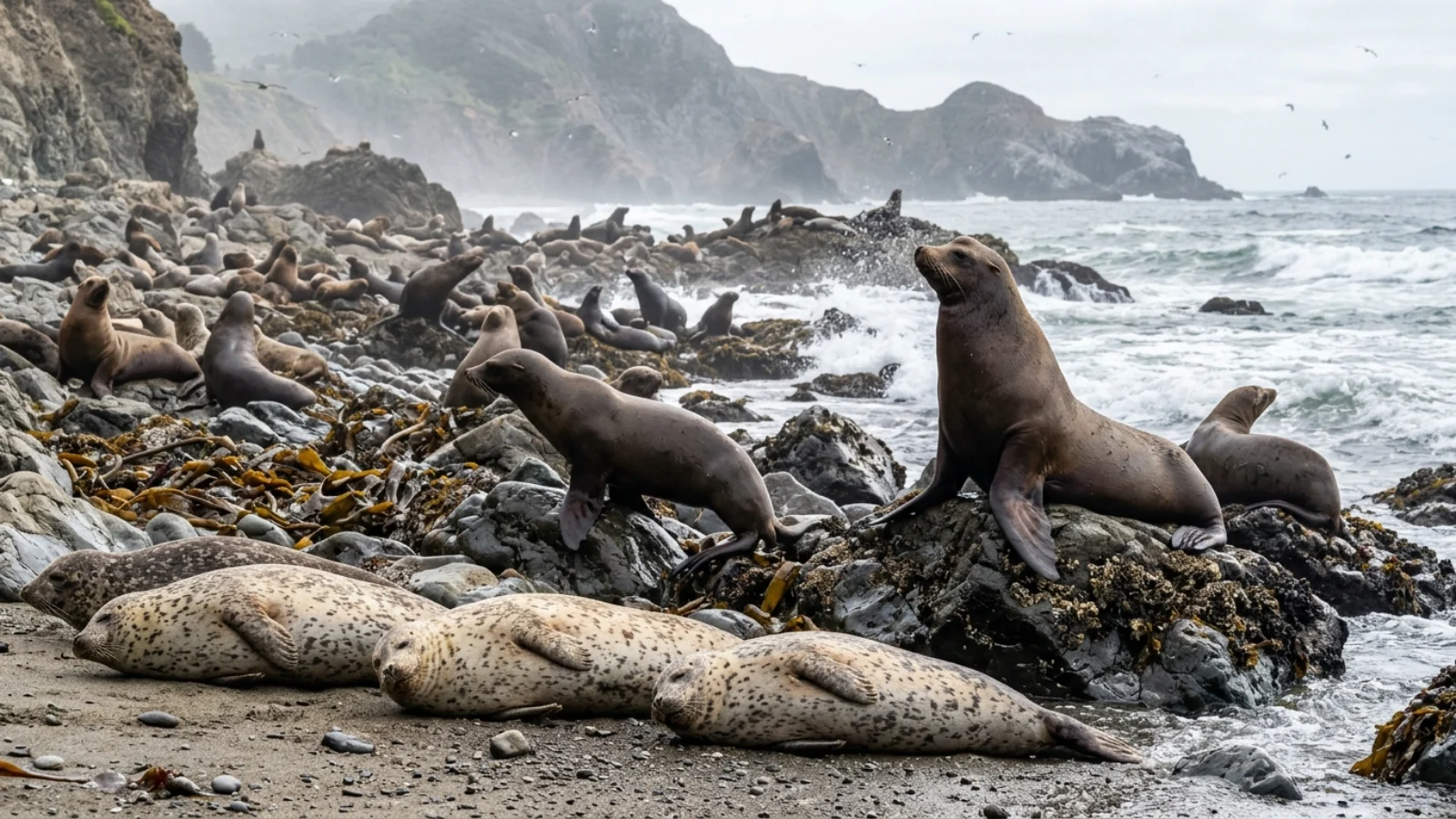
Where did seals come from?
Seals are carnivorans, members of the same mammal order as dogs, bears and weasels, that returned to the sea. Genetic and fossil evidence now points to a single origin for all pinnipeds (seals, sea lions, fur seals and the walrus), probably from a group close to Enaliarctos, an early pinniped whose relatives on land were the ancestors of today’s bears and mustelids. The oldest known true seal is Noriphoca gaudini, described from rocks in Italy dating to the late Oligocene or earliest Miocene, roughly 23 million years ago. By about 15 million years ago, phocid fossils were common along the coasts of the North Atlantic.
Living true seals fall into two subfamilies that roughly match the two hemispheres. The Phocinae, or “northern seals”, include the harbor, spotted, grey, ringed, Baikal, Caspian, harp, ribbon, bearded and hooded seals. The Monachinae, or “southern seals”, include the monk seals, both elephant seals and the four Antarctic seals: Weddell, crabeater, leopard and Ross. Researchers now think the monachines evolved in the Southern Hemisphere, which explains why the northern elephant seal and the monk seals look like outliers on a map: their lineages spread north from a southern origin. Counts of living species range from 18 to 19, depending mainly on whether the Saimaa ringed seal of Finland is treated as its own species or as a subspecies of the ringed seal.
How is a seal’s body built for the sea?
A seal is shaped like a torpedo with a thick wrapping. Its neck is short, its limbs are tucked into the body as far as the elbow and knee, and its skin sits over a layer of blubber that in some polar species makes up a large share of total body weight. Blubber is insulation, streamlining and an energy store at once. It lets a mother seal fast while she nurses and lets a male elephant seal go without eating for months during the breeding season. Seals can also shut down blood flow to the skin to save heat in icy water, or open it up to dump heat when they are hauled out in the sun.
True seals swim with their back end. The hind flippers are angled backwards and sweep from side to side like a fish’s tail, while the short front flippers steer and brake. That makes them efficient, steady swimmers but poor walkers. Because the hind flippers cannot rotate forward under the body as a sea lion’s can, a seal on land has to hump along on its belly, a movement sometimes called galumphing. Ringed seals and other ice-living species carry strong claws on their front flippers, which they use to scrape breathing holes through sea ice and to haul out onto floes.
Seals also have one of the most sensitive touch systems of any mammal. Their whiskers, or vibrissae, are thick, richly supplied with nerves and, in most true seals, have a wavy, beaded outline that reduces vibration as the seal swims. In a well-known experiment published in Science in 2001, Guido Dehnhardt and colleagues showed that blindfolded harbor seals could follow the invisible wake left by a miniature submarine through the water, using their whiskers alone. In murky harbors or the darkness of deep water, a seal can track the swirling trail of a fish that passed by seconds earlier.
Which seals live where?
The harbor seal is the most widespread seal, found along coasts of the North Atlantic and North Pacific. It is a coastal animal that hauls out on sandbars, rocks and quiet beaches, and it is the seal most people in North America and Europe see. The grey seal is larger and lives on both sides of the North Atlantic; Britain holds a large part of the world population. In the Arctic, ringed seals are the most abundant and most ice-dependent species. Females give birth inside snow lairs dug above breathing holes in the sea ice, which hide the pups from polar bears and shelter them from the cold. Bearded seals feed on the bottom of shallow Arctic shelves, using their long, drooping whiskers to find clams, crabs and shrimp. Harp seals and hooded seals breed on pack ice in the North Atlantic, while spotted and ribbon seals use the ice of the Bering and Okhotsk seas.
Two seals live in inland waters. The Baikal seal lives only in Lake Baikal in Siberia and is the only seal confined entirely to fresh water. The Caspian seal lives in the Caspian Sea, the world’s largest lake, where it breeds on winter ice in the shallow north. Finland’s Lake Saimaa also holds a small, isolated population of ringed seals that were cut off from the sea as the land rose after the last ice age.
In the Southern Ocean, the crabeater seal is probably the most numerous seal in the world, with estimates in the millions, though counting animals spread across shifting pack ice is difficult. Despite its name it eats mainly Antarctic krill, which it strains from the water through elaborately lobed cheek teeth. The Weddell seal lives further south than any other mammal and spends the winter under the fast ice, keeping breathing holes open by rasping at the ice with its teeth. The leopard seal is the top predator among seals, taking krill, fish, penguins and the pups of other seals. The Ross seal, with its huge eyes and short snout, is the least known; it lives in thick pack ice that ships rarely reach.
The monk seals are the only true seals adapted to warm water. The Hawaiian monk seal lives mostly in the remote Northwestern Hawaiian Islands, with a smaller and growing group in the main islands. The Mediterranean monk seal survives in scattered colonies in Greece and Türkiye, on the Cap Blanc peninsula of Mauritania and Western Sahara, and in the Madeira archipelago. Many of these seals now give birth in sea caves, a habit thought to be a response to centuries of persecution on open beaches.
What climates do seals prefer?
Most seals live in cold polar and temperate waters, where food is rich: the Arctic (ringed, bearded, harp, hooded seals), the North Atlantic and North Pacific (harbor and grey seals), and the Antarctic (Weddell, crabeater, leopard, Ross and elephant seals). Monk seals are the exception, living in warm subtropical waters. Two species live in landlocked waters: the Baikal seal in Siberia’s Lake Baikal and the Caspian seal.
How deep can seals dive?
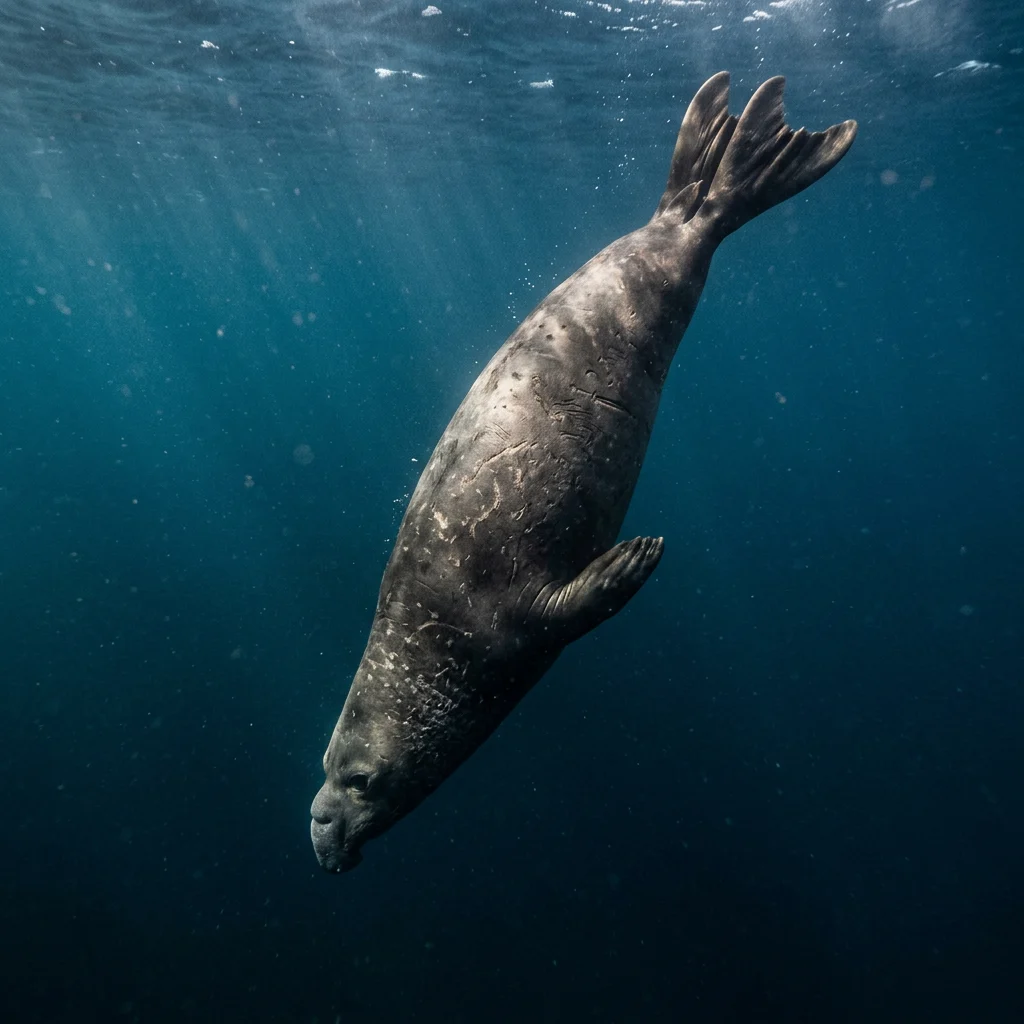
Elephant seals are among the deepest-diving mammals: southern elephant seals have been recorded below 2,000 m and can stay down for nearly two hours. Weddell seals dive to about 600 m and hold their breath for over an hour. Seals store oxygen in blood and muscle, slow their heart rates, and exhale before diving.
The details of how they manage it are a lesson in physiology. A diving seal stores most of its oxygen not in its lungs but in its blood and muscles. Seals have a large blood volume, a high concentration of haemoglobin, and very high levels of myoglobin, the oxygen-binding protein that makes their muscle look almost black. Many seals exhale before diving, and as they descend the lungs collapse, pushing the remaining air into the stiff upper airways where little gas can enter the bloodstream. That reduces the risk of decompression sickness. At the same time the heart slows sharply and blood is redirected to the brain and heart, while the gut, kidneys and much of the muscle run on stored oxygen or tolerate low oxygen for the length of the dive.
Elephant seals take this further than any other seal. At sea they dive almost continuously, day and night, for months, coming up for only a few minutes between dives. The deepest dive recorded for a southern elephant seal reached about 2,388 m. Hooded seals are the deepest divers among North Atlantic seals and can pass 1,500 m, though most of their dives last 15–20 minutes and reach 100–600 m.
How do seals raise their pups?
True seals have one of the most compressed parenting schedules in the animal kingdom. Females usually give birth to a single pup each year, on land or on ice, and most species follow a “capital breeding” strategy: the mother arrives fat, stays with her pup without feeding, and transfers her stored energy to it as extremely rich milk. Lactation lasts from five to seven weeks in monk seals down to just three to five days in the hooded seal, the shortest nursing period known for any mammal. Hooded seal milk is more than 60 percent fat, and a pup that weighs about 24 kg at birth can reach around 42 kg by the time it is weaned. Then the mother simply leaves, and the pup lives off its own blubber while it learns to swim and feed.
Weaned pups often go through a long fast. In the hooded seal it lasts about two weeks; northern elephant seal weaners may stay ashore for 9–12 weeks before going to sea. Harbor seals are a partial exception: their pups can swim within hours of birth, and mothers make short feeding trips during the nursing period, a pattern closer to that of sea lions.
Mating systems vary with where seals breed. On crowded beaches, as in elephant seals and grey seals, a few large males defend groups of females and most males never breed, which drives the enormous size difference between the sexes. Seals that breed on drifting pack ice, where females are spread out and the ice keeps moving, tend to have smaller size differences, and in many species mating takes place in the water. Male bearded seals, Weddell seals and several other species court with long underwater songs and trills that can carry for kilometres. In most seals the fertilised egg pauses for weeks to months before implanting in the womb, which lets the birth fall at the same time each year even though the pregnancy itself is shorter.
What do seals eat?
Mostly fish, squid and crustaceans. Crabeater seals strain krill through lobed teeth, leopard seals hunt penguins and other seals, and bearded seals feed on clams and shrimp on the seafloor. See which seals eat penguins and can seals drink sea water.
Are seals endangered?
Most seal species are not, but several are in trouble. The Hawaiian monk seal (about 1,600 animals) and the Caspian seal are endangered; the Mediterranean monk seal is recovering slowly and was moved from Endangered to Vulnerable by the IUCN in 2023; and the Caribbean monk seal was declared extinct in 2008, the only true seal known to have been driven extinct by people. Arctic ice seals are threatened by sea-ice loss. Read more on monk seals and Hawaiian monk seal lifespan.
What has happened to seal populations?
Seals have a long history of commercial hunting for oil, fur and meat, and their recoveries show what protection can do. Northern elephant seals were hunted so heavily for their oil in the 19th century that the species was thought to be extinct by 1892. A remnant of roughly 20 animals survived on Isla Guadalupe off Mexico. Under protection, first in Mexico and later in the United States, the population has grown to more than 200,000, though genetic studies show the species still carries the low diversity left by that bottleneck. Grey seals and harbor seals in many parts of Europe and North America have also recovered strongly since hunting and bounty schemes ended.
Other species have not been so fortunate. The Caribbean monk seal, last seen with certainty in the 1950s, was hunted out across the Caribbean and Gulf of Mexico and was declared extinct in 2008. The Caspian seal numbered about 1.5 million a century ago and has declined by more than 90 percent; estimates now range from fewer than 70,000 to around 168,000, and fishing nets alone killed more than 17,000 in 2019. The Hawaiian monk seal fell to about a third of its historic size. NOAA estimates the population at about 1,600 animals, and it has grown slowly since 2013, helped by rescue and rehabilitation work that the agency credits for up to 30 percent of the seals alive today. The Mediterranean monk seal, with an estimated 815 to 997 animals, was moved from Endangered to Vulnerable by the IUCN in 2023 after decades of protection in Greece, Türkiye and Madeira.
Disease can strike suddenly. Outbreaks of phocine distemper virus, a relative of canine distemper, killed more than 23,000 harbor seals in European waters in 1988 and about 30,000 in 2002. Today the most widespread long-term threat to northern seals is the loss of sea ice. Ringed, bearded, harp, hooded and spotted seals all depend on ice for pupping, resting or moulting, and warm winters with thin or late ice can cause pup deaths across whole breeding areas. In Lake Saimaa, where mild winters now often leave too little snow for natural birth lairs, volunteers pile snow by hand into drifts so that the roughly 500 remaining seals can still breed.
How can you see seals responsibly?
Seals are among the easiest marine mammals to watch from shore. Grey seal colonies in Britain and Ireland, harbor seals on the sandbanks of the Wadden Sea, elephant seals at Piña Piedras Blancas and Año Nuevo in California, and Hawaiian monk seals resting on beaches in the main Hawaiian Islands can all be seen without a boat. The basic rules are the same everywhere: keep your distance, stay downwind and below the skyline, keep dogs leashed, and back off if a seal lifts its head, stares at you or starts moving towards the water. A seal that stampedes into the sea wastes energy it needs and can crush or abandon a pup.
A lone pup on a beach is usually not orphaned. Harbor seal and monk seal mothers regularly leave pups ashore while they feed, and grey seal pups are left alone for long periods after weaning. Moving or handling the pup is the most common way well-meaning people cause harm. In the United States seals are protected under the Marine Mammal Protection Act, and in the case of Hawaiian monk seals the Endangered Species Act as well, so disturbing them can be an offence; most other countries have similar protection.
How many species of seals are there?
About 18 true seals, plus around 15 fur seals and sea lions and the walrus, for roughly 33–34 pinniped species.
What is the biggest seal?
The southern elephant seal; males can reach about 4,000 kg and 5–6 m.
What is the smallest seal?
The ringed and Baikal seals, about 1.1–1.5 m long.
What is the difference between a seal and a sea lion?
Seals lack ear flaps and wriggle on land; sea lions have ear flaps and walk on four flippers.
Where do seals live?
In all oceans, mostly polar and temperate waters, plus Lake Baikal and the Caspian Sea.
Are seals endangered?
Most are not, but the Hawaiian monk seal and Caspian seal are endangered, the Mediterranean monk seal is Vulnerable and the Caribbean monk seal is extinct.
How long can seals hold their breath?
Elephant seals can stay underwater for nearly two hours; most seals dive for 5–30 minutes.
- Berta, A., Sumich, J.L. & Kovacs, K.M. (2015). Marine Mammals: Evolutionary Biology, 3rd ed.
- Pinnipeds.org (Seal Conservation Society). Species information pages.
- IUCN Red List. Phocidae species assessments.
- McIntyre, T. et al. (2010). Southern elephant seal diving records.
- Dehnhardt, G., Mauck, B., Hanke, W. & Bleckmann, H. (2001) Hydrodynamic trail-following in harbor seals (Phoca vitulina). Science 293: 102–104.
- Härkönen, T. et al. (2006) A review of the 1988 and 2002 phocine distemper virus epidemics in European harbour seals. Diseases of Aquatic Organisms 68: 115–130.
- NOAA Fisheries. Hawaiian monk seal species page (population ~1,600).
- US Marine Mammal Commission. Mediterranean monk seal (population 815–997; IUCN downlisting 2023).
- NAMMCO. Hooded seal species account (lactation, milk composition, diving).
- Hoelzel, A.R. et al. (2024) Genomics of post-bottleneck recovery in the northern elephant seal. Nature Ecology & Evolution 8: 686–694.
Blane Perun has been exploring Earth’s oceans and marine life for over 25 years. Founder of TheSea.Org in 1999, underwater photographer, coral aquaculture pioneer, and explorer of 80+ countries.
About Blane Perun →More on Marine Mammals →