What Do Sea Turtles Eat? — Diet by Species
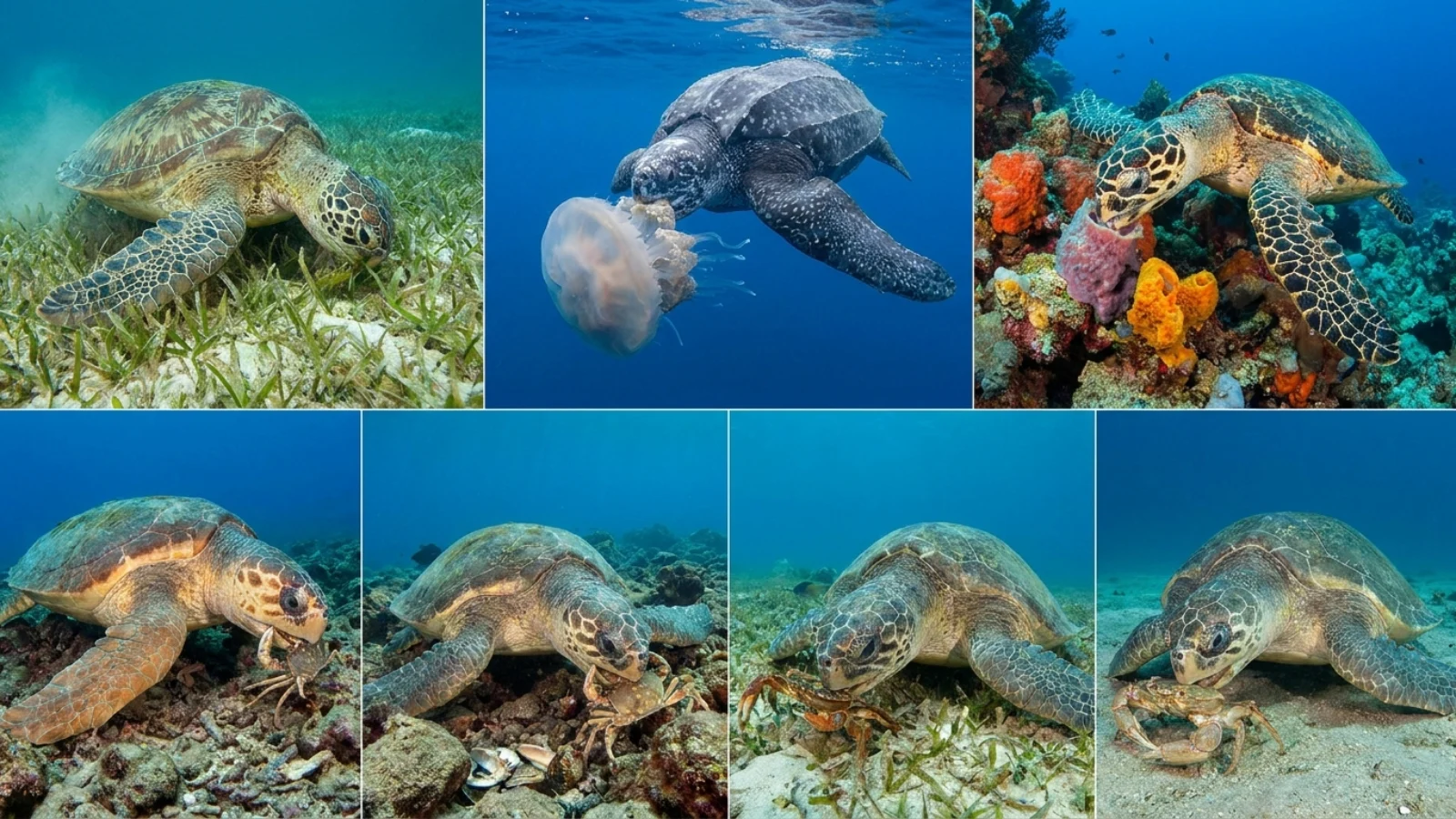
It depends on the species. Adult green sea turtles are herbivores that graze seagrass and algae, and they are the only sea turtle that is plant-eating as an adult. Leatherbacks feed almost entirely on jellyfish and other soft-bodied animals such as salps. Hawksbills eat mainly sponges, which make up 70 to 95 percent of their diet in the Caribbean. Loggerheads use powerful jaws to crush whelks, conchs, clams and horseshoe crabs. Kemp’s ridleys eat mostly crabs, olive ridleys eat a wide range of invertebrates, and flatbacks eat soft corals, sea cucumbers, shrimp and jellyfish. Young turtles of most species start life eating small animals in floating sargassum.
Seven species, seven menus: seagrass for greens, jellyfish for leatherbacks, sponges for hawksbills and crabs and shellfish for the rest.
What do sea turtles eat?
There are seven living species of sea turtles: the green, loggerhead, hawksbill, leatherback, Kemp’s ridley, olive ridley and flatback. They look broadly similar, but their diets are very different, and each species has jaws, throats and even flippers adapted to its food. Broadly, the loggerhead, Kemp’s ridley, olive ridley and hawksbill are omnivores throughout their lives, eating everything from crabs, shellfish and sponges to seagrass, seaweed, jellyfish, worms and fish. Many of them still specialise on particular prey. The green turtle switches from an omnivorous diet when young to an almost entirely plant-based diet as an adult. The leatherback feeds almost exclusively on jellyfish.
Diet also changes with age. For their first few years, most sea turtles live in the open ocean, floating in seaweed and feeding on small animals they find there. Only later do they move to coastal feeding grounds and adopt the adult diet of their species. That shift from open-ocean drifting to coastal feeding is one of the main reasons sea turtles are so hard to study, and why the diets of young turtles were a mystery for so long.
What do baby sea turtles eat?
After hatching and scrambling to the sea, young sea turtles head offshore. In 1987 the turtle biologist Carr found that young green and loggerhead turtles spend much of their early ocean life in floating mats of sargassum seaweed. Where there is no sargassum, young turtles feed near upwelling fronts, where currents gather food.
Sargassum mats are floating buffets. Loggerhead hatchlings live in them, and a single mat can contain as many as 100 species of animals on which the young turtles feed, including barnacles, crab larvae, fish eggs and hydrozoan colonies. Even insects such as ants, flies, aphids, leafhoppers and beetles get blown onto the mats by the wind and become turtle food. Young green turtles in the open ocean feed on zooplankton and small swimming animals before they move into coastal seagrass meadows and switch to plants. A young green turtle’s menu can be surprisingly broad: fish and their eggs, sea hare eggs, hydrozoans, bryozoans, molluscs, jellyfish, echinoderms, tunicates, worms, sponges, algae, seagrass and crustaceans have all been recorded.
Green sea turtles: the grazers
The green sea turtle, Chelonia mydas, is the only sea turtle that is herbivorous as an adult. Adults usually live in shallow lagoons and feed mostly on various species of seagrass and on algae. Its name comes from this diet: not from the colour of its shell, which is olive to black, but from the greenish fat beneath it.
The green turtle’s jaw is built for grazing. The sheath of the upper jaw has a denticulated edge, and the lower jaw has stronger, serrated denticulation, which helps it cut and chew green and red algae such as sea lettuce, as well as seagrass blades. As young green turtles mature and their diet changes, their skull and jaw shape change with it.
Green turtles can have a big effect on the meadows where they feed. In the Cocos (Keeling) Islands, a remote atoll in the eastern Indian Ocean, seagrass meadows have suffered devastating declines, and green turtle grazing has been identified as a key pressure on the seagrass Thalassia hemprichii. A 2026 study in Ecology and Evolution found that plots protected from grazing in cages for over two years had more shoots, more leaf area and more biomass, along with higher primary production and nutrient storage, showing both how hard turtles can graze and how meadows can recover when grazing pressure eases.
Leatherbacks: the jellyfish specialists
The leatherback, Dermochelys coriacea, is the largest sea turtle, with adults typically 250 to 700 kilograms, and it lives almost entirely on jellyfish. It also eats other soft-bodied animals, including siphonophores, salps and pyrosomes, and cephalopods, and is believed to take small crustaceans, fish, sea urchins and snails. Because leatherbacks eat so many jellyfish, they help control jellyfish populations.
A leatherback has no teeth. Instead it has points on the cutting edge of its upper jaw and backward-pointing spines lining its throat, which help it swallow slippery prey and stop it from escaping. Jellyfish are mostly water, with fluids as salty as seawater, so a leatherback takes in a great deal of salt. It has much larger salt-excreting tear glands than other sea turtles, and its tears can carry nearly twice the salt concentration of other species.
Jellyfish are poor food, energy-wise, so leatherbacks have to eat huge quantities and travel to find them. Unlike other sea turtles, they feed in cold waters where jellyfish are abundant, ranging in the Atlantic from the North Sea to the Cape of Good Hope. One tracked leatherback swam about 20,000 kilometres over 647 days from a nesting beach in West Papua, Indonesia, to feeding grounds off the United States. Pacific leatherbacks migrate roughly 9,700 kilometres to eat jellyfish off California. They follow their prey through the day, staying deeper in daylight and shallower at night, when jellyfish rise.
Feeding grounds like these are vital. Using cameras attached to turtles, Wallace and colleagues reported in Scientific Reports in 2018 that a single foraging season off Nova Scotia, Canada, could supply 59 percent of a non-breeding leatherback’s annual energy budget and 29 percent of the needs of a female on a typical two-year breeding cycle. Even so, the maximum rate at which leatherbacks can take in energy is nearly four times lower than that of mammals and birds, because gelatinous prey contains so little energy.
Hawksbills: the sponge eaters
The hawksbill, Eretmochelys imbricata, is a reef turtle whose main food is sponges. Sponges make up 70 to 95 percent of the hawksbill’s diet in the Caribbean. Hawksbills are selective, eating only certain species and ignoring many others; Caribbean populations feed mainly on a few orders of demosponges. Some of the sponges they eat, such as Chondrilla nucula and Tethya actinia, are highly and often lethally toxic to other animals, and hawksbills also choose sponges packed with glassy silica spicules.
Hawksbills eat other things too: algae, marine plants, jellyfish and comb jellies, sea anemones, molluscs, fish and crustaceans. They even eat the Portuguese man o’ war, closing their eyes as they feed, because the stinging cells cannot penetrate their armoured heads. Because of what it eats, hawksbill flesh can become toxic to people. The hawksbill is also biofluorescent, the first reptile recorded with this trait, and researchers do not know whether the glow comes from its diet, which includes fluorescent hard corals.
We look at how turtles interact with reefs in sea turtles and coral reefs, and at the sponges themselves in what eats a sea sponge?.
Loggerheads: the shell crushers
The loggerhead, Caretta caretta, is named for its large head; the part of the skull behind the eyes is large and bulbous to hold its extensive jaw muscles. It is omnivorous, feeding mainly on bottom-dwelling invertebrates such as whelks, conchs, bivalves and horseshoe crabs, and it has a longer list of known prey than any other sea turtle. Other recorded foods include sponges, corals, sea pens, worms, sea anemones, squid and octopus, barnacles, amphipods, isopods, Portuguese men o’ war, bryozoans, hydrozoans, sea urchins, sand dollars, sea cucumbers, starfish, tunicates, fish and fish eggs, hatchling turtles, including its own species, algae and plants. When migrating through the open sea, loggerheads eat jellyfish, floating molluscs, egg clusters, squid and flying fish.
Loggerheads crush their prey with their powerful jaws. They also use their front flippers like hands: projecting scale points on the leading edge act as pseudo-claws to tear large pieces of food, and the turtle turns its neck sideways to eat food held on these points. Inside, the front of the throat is lined with inward-pointing, mucus-covered papillae that filter out foreign objects such as fish hooks. Digestion speeds up as water temperature rises. Research on sea turtle evolution suggests that limbs originally shaped for swimming have also been adapted to help turtles hold, swipe and handle food.
Kemp’s ridley and olive ridley: crab hunters
The two ridleys are both mainly carnivorous. Kemp’s ridley feeds on molluscs, crustaceans such as floating crabs and shrimp, jellyfish, fish, algae and sea urchins. Juveniles are mainly surface feeders in the open sea, while adults are opportunistic bottom feeders that eat mostly crabs. Studies comparing turtles raised in captivity before release with wild turtles found little difference in their diets, but diet composition varies between regions depending on what prey is available.
The olive ridley is predominantly carnivorous too. Common prey includes tunicates such as salps and sea squirts, starfish, sea urchins, bryozoans, squid, bivalves, snails, barnacles, shrimp, crabs, rock lobsters and sipunculid worms. Remains of open-ocean fish and fish eggs in its stomach suggest it also feeds in the open ocean, and in areas with no other food it will eat filamentous algae. Olive ridleys that feed from seafloor communities are affected when pollution reduces the productivity of those communities.
Flatbacks: Australia’s soft-food specialists
The flatback, Natator depressus, nests only in northern Australia and has a small range. It is omnivorous but eats a mainly carnivorous diet, feeding on soft corals, sea cucumbers, shrimp, jellyfish, molluscs and other invertebrates. Its shell is much thinner than that of other sea turtles. Because the flatback has such a small range, it is less studied than the others, and the IUCN lists it as Data Deficient.
How do sea turtles find their food?
Each species forages in its own way. Leatherbacks track daily vertical migrations of jellyfish, diving deeper by day and feeding near the surface at night. Leatherbacks are among the deepest-diving marine animals, recorded at depths as great as 1,280 metres, which gives them access to prey across a huge range of depths. Bottom-feeding loggerheads and ridleys search the seabed, while hawksbills browse sponges on reefs and green turtles graze in the shallows.
Why do sea turtles eat plastic?
Plastic is one of the most serious threats to sea turtles because it looks like food. Floating plastic bags resemble jellyfish, and leatherbacks and loggerheads, which both eat jellyfish, mistake them for prey. An estimated one-third of adult Pacific leatherbacks have swallowed plastic. Turtles ingest a wide range of floating debris, including bags, sheets, pellets, balloons and abandoned fishing line.
Even a small amount can be deadly. Plastic can block or perforate the gut, and when it fills the stomach it dilutes the turtle’s food, reducing nutrient intake and slowing growth, which in turn delays sexual maturity. In 2018 Wilcox, Puckridge, Schuyler and colleagues analysed 246 sea turtle necropsies and 706 stranding records in Scientific Reports. They found that turtles that died of causes unrelated to plastic had less plastic in their guts, and that there was a 50 percent probability of death once a turtle had 14 pieces of plastic in its gut. Chemicals such as polychlorinated biphenyls released from plastics can also accumulate in turtle tissues.
Do sea turtles get high on jellyfish?
A popular internet story claims that turtles eat jellyfish to get high. Turtles eat jellyfish because jellyfish are food; we check the claim in do jellyfish make turtles high?.
Why diet matters for sea turtle conservation
Every species’ diet ties it to a particular habitat. Green turtles depend on healthy seagrass meadows and algae beds; hawksbills on coral reefs and their sponges; loggerheads and ridleys on seabeds rich in crabs and shellfish; leatherbacks on productive cold-water feeding grounds thousands of kilometres from where they nest. Damage to any of these habitats affects the turtles that feed there.
Diet can also bring turtles into conflict with fisheries. Entanglement in shrimping nets remains one of the main threats to crab-eating Kemp’s ridleys. After the Deepwater Horizon disaster in April 2010, 156 sea turtle deaths were recorded from ten days after the accident onwards, most of them Kemp’s ridleys. Jellyfish-feeding leatherbacks are caught as bycatch in open-ocean fisheries; in the 1990s an average of about 1,500 mature females were caught each year in the eastern Pacific alone. Protecting what turtles eat is as important as protecting the beaches where they nest.
Food also sets the pace of a turtle’s life. Sea turtles are thought to reach sexual maturity at roughly 10 to 20 years old, depending on the species and the method used to estimate it, and reliable figures are hard to obtain. A turtle that feeds on poor food, or whose gut is partly filled with plastic, grows more slowly and takes longer to mature, which means fewer breeding years and fewer hatchlings for populations that are already slow to recover. In that sense, a healthy seagrass meadow, sponge-rich reef or jellyfish bloom is as much a part of sea turtle conservation as a protected nesting beach.
So, what do sea turtles eat?
Sea turtles eat a little of everything as a group, but each species has its own specialty. Green turtles graze seagrass and algae. Leatherbacks live on jellyfish, helped by spines in their throats. Hawksbills eat toxic, glass-filled sponges on coral reefs. Loggerheads crush whelks, conchs and horseshoe crabs. Kemp’s and olive ridleys hunt crabs and other invertebrates, and flatbacks eat soft corals and sea cucumbers. Almost all of them start life eating small animals in floating sargassum. For more on each species, see our sea turtles hub.
| Species | Adult diet | Feeding tool |
|---|---|---|
| Green | Seagrass, algae | Serrated jaw for grazing |
| Leatherback | Jellyfish, salps, siphonophores | Throat spines |
| Hawksbill | Sponges (70-95%), jellyfish, algae | Selective reef browsing |
| Loggerhead | Whelks, conchs, clams, horseshoe crabs | Massive crushing jaws, pseudo-claws |
| Kemp’s ridley | Mostly crabs, shrimp, molluscs | Bottom feeding |
| Olive ridley | Tunicates, crabs, shrimp, urchins | Open-ocean and seabed feeding |
| Flatback | Soft corals, sea cucumbers, shrimp | Shallow-water foraging |
What do sea turtles eat?
Diets vary: greens eat seagrass and algae, leatherbacks jellyfish, hawksbills sponges, loggerheads and ridleys crabs and shellfish.
Are sea turtles herbivores?
Only adult green sea turtles are; the other six species are omnivores or mainly carnivores.
What do baby sea turtles eat?
Small animals such as crab larvae, barnacles, fish eggs and hydrozoans, often in floating sargassum.
Do sea turtles eat jellyfish?
Yes. Leatherbacks live almost entirely on jellyfish, and loggerheads, hawksbills and ridleys eat them too.
What do hawksbill turtles eat?
Mainly sponges, which make up 70 to 95 percent of their diet in the Caribbean.
Do sea turtles have teeth?
No. They have beaks; leatherbacks also have backward-pointing spines in the throat.
Why do sea turtles eat plastic?
Floating plastic bags look like jellyfish; about a third of adult Pacific leatherbacks have eaten plastic.
How much plastic kills a sea turtle?
A 2018 study found a 50 percent chance of death once a turtle had 14 pieces in its gut.
- Wilcox, C., Puckridge, M., Schuyler, Q.A. et al. (2018), “A quantitative analysis linking sea turtle mortality and plastic debris ingestion”, Scientific Reports.
- Wallace, B.P., Zolkewitz, M. & James, M.C. (2018), “Discrete, high-latitude foraging areas are important to energy budgets and population dynamics of migratory leatherback turtles”, Scientific Reports.
- O’Dea, C. et al. (2026), “Turtle herbivory suppresses seagrass function but reveals recovery potential in a remote coral reef atoll”, Ecology and Evolution.
- Wikipedia contributors, “Sea turtle”, “Green sea turtle”, “Loggerhead sea turtle”, “Hawksbill sea turtle”, “Leatherback sea turtle”, “Kemp’s ridley sea turtle”, “Olive ridley sea turtle” and “Flatback sea turtle” (accessed November 2026).
Blane Perun has been exploring Earth’s oceans and marine life for over 25 years. Founder of TheSea.Org in 1999, underwater photographer, coral aquaculture pioneer, and explorer of 80+ countries.
About Blane Perun →