Weddell Seal — The Seal That Lives Under the Antarctic Ice All Winter
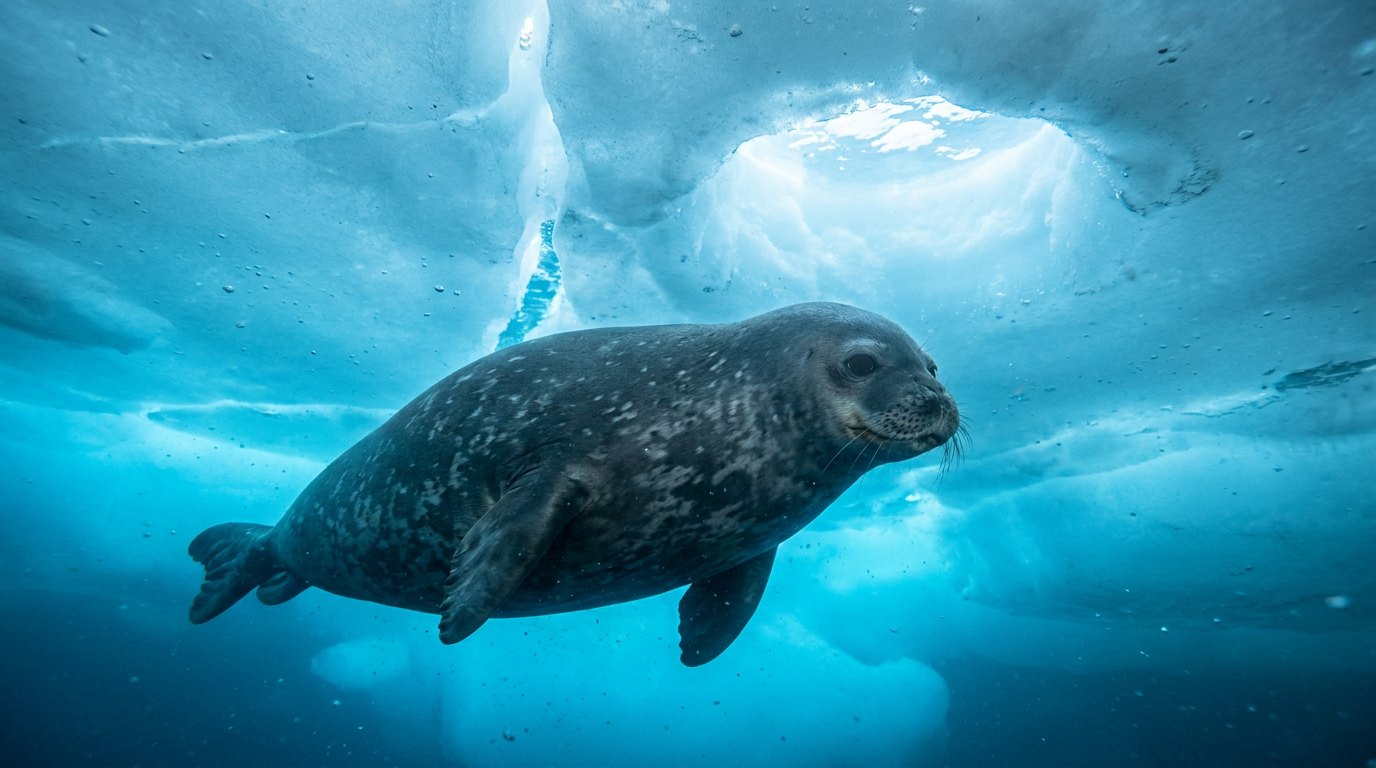
The Weddell seal (Leptonychotes weddellii) is a large true seal of the Antarctic coast and the world’s southernmost breeding mammal, living on and under the fast ice attached to the continent. Adults reach 2.5–3.3 m and 400–600 kg, with females slightly larger than males. Weddell seals dive to around 600 m and can stay under for over an hour, keeping their breathing holes open through the ice by sawing at it with their teeth.
In McMurdo Sound, Antarctica, researchers lower hydrophones through holes in ice two metres thick and hear what sounds like a science-fiction soundtrack: whistles, chirps, descending trills and pulsing tones. Those are Weddell seals, singing in the dark beneath the ice. The Weddell seal is the most southerly mammal on the planet and one of the best-studied wild animals in Antarctica, thanks to a population at McMurdo that scientists have followed continuously since 1968.
Where do Weddell seals live?
Around the entire Antarctic coast, mainly on fast ice — sea ice frozen to the shore — rather than on drifting pack ice. Some breed as far south as about 78°S in McMurdo Sound, closer to the South Pole than any other mammal regularly breeds.
Small numbers also breed on sub-Antarctic islands such as South Georgia and the South Orkneys, and vagrants have reached New Zealand, Australia and South America. In winter many Weddell seals stay under the ice, surviving months of darkness in water near −1.9 °C, the freezing point of seawater.
How do Weddell seals keep breathing holes open?
With their teeth. Weddell seals ream and saw at the ice using their forward-pointing upper canines and incisors, swinging the head from side to side to keep holes and cracks open.
The behaviour lets them live far from open water, but it comes at a cost. Older Weddell seals often have badly worn and broken teeth, and dental wear is thought to limit lifespan: a seal that can’t maintain breathing holes or eat properly is unlikely to survive long. Few wild Weddell seals live beyond about 20–25 years.
How deep can a Weddell seal dive?
Weddell seals commonly feed at 200–400 m and dive for up to about 15 minutes, but they have been recorded reaching about 600 m and staying underwater for 73 minutes.
Under the ice there is no surface to come up to except their own holes, so navigation matters as much as breath-holding. Studies at McMurdo with animal-borne cameras showed Weddell seals use light coming through the ice, the geomagnetic field and possibly sound to find their way back. They hunt Antarctic silverfish by approaching from below and silhouetting them against the bright ice, and they sometimes blow bubbles into cracks to flush out hiding fish.
What do Weddell seals eat?
Mostly fish, especially Antarctic silverfish and, for large seals, Antarctic toothfish, along with squid, octopus and crustaceans.
Antarctic toothfish — sold as “Chilean sea bass” — can weigh more than 100 kg, and Weddell seals are among the few predators able to tackle them. The expansion of the toothfish fishery in the Ross Sea has prompted research into whether removing large toothfish could affect Weddell seals; the Ross Sea Marine Protected Area, created in 2016 and the largest in the world at its creation, was designed partly with that food web in mind.
Why do Weddell seals sing?
Weddell seals are among the most vocal seals, producing dozens of distinct call types underwater. Males use songs to defend underwater territories around breathing holes and to attract females.
Calls can be heard through the ice by people standing on the surface, and some calls carry for kilometres underwater. Different regional populations have recognisably different call repertoires — a kind of dialect. Pups begin vocalising soon after birth, and mothers and pups recognise each other’s calls.
How do Weddell seals raise their pups?
Pups are born on the fast ice in early spring (September–November), about 1.2–1.5 m long and 22–30 kg. They nurse for about 5–6 weeks and start swimming at around two weeks old.
Weddell seal milk is extremely rich, and pups more than triple their birth weight before weaning, while mothers lose a large share of their body mass. Pups go into the water with their mothers early to learn to dive and find breathing holes. Females mature at 3–6 years and males at 7–8. Because the McMurdo Sound population has been tagged and monitored for more than five decades, it is one of the longest-running studies of any wild mammal, revealing how sea-ice conditions and prey shape breeding success year to year.
Can you see Weddell seals on an Antarctic trip?
Yes. Weddell seals are one of the easiest Antarctic seals to see, because they haul out on coastal ice and beaches and are famously relaxed around people.
On Antarctic Peninsula expedition cruises, Weddell seals are often found sleeping on beaches and ice near landing sites, sometimes letting out a sleepy grunt or a yawn that shows off their ice-worn teeth. They are more placid than leopard seals and far less likely to react to visitors, but IAATO guidelines still ask visitors to stay at least 5 m (15 ft) away from seals and further from mothers with pups.
Their plump, cigar-shaped bodies, small heads and spotted grey-and-silver coats make them easy to identify. Compared with the slim, reptilian-headed leopard seal, a Weddell seal looks almost cuddly — an impression that hides one of the most extreme lifestyles of any mammal.
How many Weddell seals are there?
A 2021 study using satellite images and help from more than 330,000 citizen-science volunteers estimated about 202,000 female Weddell seals — far fewer than the 800,000 previously assumed.
The researchers stressed that the lower number does not necessarily mean a recent collapse; it is a more accurate baseline for tracking change. The IUCN lists the Weddell seal as Least Concern, and it is protected under the Antarctic Treaty and the Convention for the Conservation of Antarctic Seals. Commercial hunting was minimal: a Soviet expedition took 107 Weddell seals in 1986–87.
The main long-term concerns are changes in sea ice, which seals need for breeding, and in the fish they eat. Their main natural predator is the killer whale; seal-hunting Type B orcas knock Weddell seals off floes with waves. See orca (killer whale) and our leopard seal profile for the other Antarctic seal predator.
Where do Weddell seals live?
On the fast ice around the Antarctic coast. They breed farther south than any other mammal, to about 78°S in McMurdo Sound.
How deep can Weddell seals dive?
Usually 200–400 m, with a recorded maximum of about 600 m. The longest recorded dive lasted 73 minutes.
How big are Weddell seals?
Adults are 2.5–3.3 m long and weigh 400–600 kg, with females slightly larger than males.
How do Weddell seals breathe under the ice?
They keep breathing holes open by sawing and reaming the ice with their forward-pointing teeth.
What do Weddell seals eat?
Mainly fish such as Antarctic silverfish and toothfish, plus squid, octopus and crustaceans.
How many Weddell seals are there?
A 2021 satellite study estimated about 202,000 females, much lower than earlier estimates of around 800,000.
Do Weddell seals sing?
Yes. They produce many call types underwater, used in territorial defence and courtship, and populations have distinct dialects.
How long do Weddell seals live?
Up to about 20–25 years. Worn teeth from cutting ice may limit lifespan.
- Pinnipeds.org (Seal Conservation Society). Weddell seal — size, diving records, nursing, vocalisations.
- LaRue, M. et al. (2021). Insights from the first global population estimate of Weddell seals in Antarctica. Science Advances (via ScienceDaily, Oct 2021).
- Rotella, J. et al. Erebus Bay Weddell seal population study, Montana State University (continuous since 1968).
- IUCN Red List. Leptonychotes weddellii — Least Concern.
Blane Perun has been exploring Earth’s oceans and marine life for over 25 years. Founder of TheSea.Org in 1999, underwater photographer, coral aquaculture pioneer, and explorer of 80+ countries.
About Blane Perun → More on Seals →