How Long Do Sea Turtles Live? — Lifespan by Species
Most sea turtles are estimated to live 50 years or more, and the largest species probably live 70 to 90 years. NOAA Fisheries estimates that green and loggerhead turtles can live 70 years or more, hawksbills 50 to 60 years, leatherbacks 50 years or more, olive ridleys 30 to 50 years and Kemp’s ridleys at least 30 years. A 2020 genetic study predicted maximum lifespans from about 50 years for the flatback to about 90 years for the leatherback. No one knows for certain, because sea turtles take decades to mature and no wild turtle has been followed for its whole life. One captive green turtle, Myrtle at the New England Aquarium, is believed to be up to 95.
Most sea turtles are thought to live 50 years or more, and green and loggerhead turtles 70 or more, but exact wild lifespans are still unknown.
How long do sea turtles live?
Sea turtles are among the longest-lived animals in the ocean, but their exact lifespan is one of the biggest gaps in what we know about them. NOAA Fisheries lists the lifespan of most species as “unknown”, followed by an estimate: at least 70 years for green turtles, 70 years or more for loggerheads, 50 to 60 years for hawksbills, 50 years or more for leatherbacks, 30 to 50 years for olive ridleys and at least 30 years for Kemp’s ridleys.
Those figures are best estimates, not records. Sea turtles grow slowly, migrate thousands of kilometres and spend years in the open ocean where nobody can follow them. Most tags fall off or are lost long before a turtle dies, and so far no wild sea turtle has been tracked from hatching to old age. Researchers piece together lifespan from bone growth rings, tagged females returning to nest over decades, chemical signals in tissues and, most recently, genetics.
What is clear is that sea turtles live on a slow timescale. Most species take one to three decades or more to reach maturity, and then breed for many years after that. A turtle that survives its dangerous early years can expect to live for several decades, and some probably live close to a century.
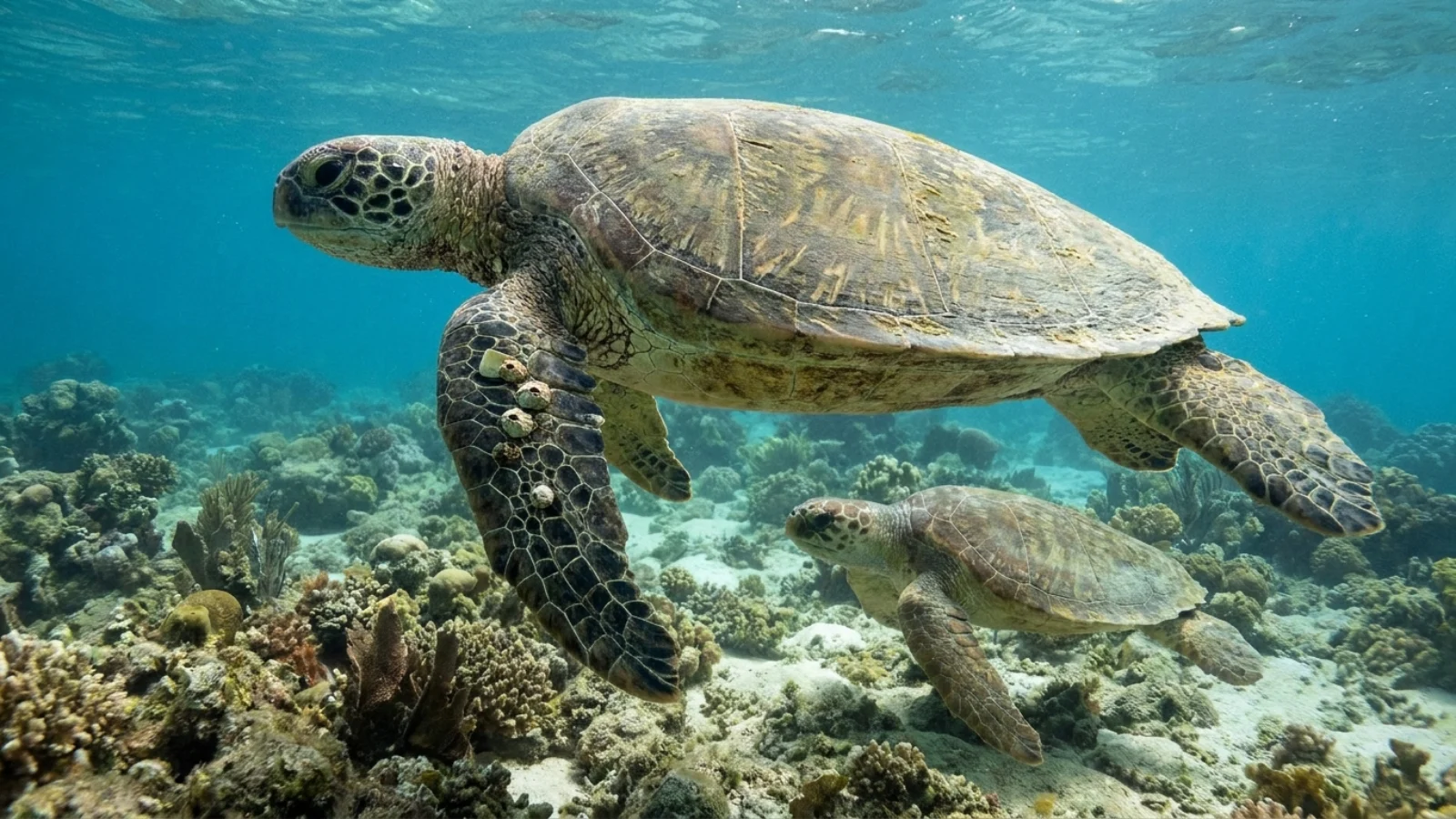
Sea turtle lifespan by species
The seven species differ in size, diet and habitat, and their lifespans appear to differ too. The largest species, the leatherback and the green turtle, tend to have the longest estimated lifespans, while the small ridleys appear to have the shortest.
| Species | Estimated lifespan | Age at maturity |
|---|---|---|
| Green turtle | 70+ years (NOAA) | 25-35 years (NOAA) |
| Loggerhead | 70+ years; 80+ in NOAA text | About 35 years (NOAA) |
| Hawksbill | 50-60 years (NOAA) | 20-35 years (NOAA) |
| Leatherback | 50+ years (NOAA) | 9-20 years (NOAA) |
| Olive ridley | 30-50 years (NOAA) | Around 14 years (NOAA) |
| Kemp’s ridley | At least 30 years (NOAA) | About 13 years (NOAA) |
| Flatback | About 50 years (genetic estimate) | 12-23 years (skeletochronology) |
Green turtle lifespan
NOAA Fisheries says green turtles “could live for at least 70 years or more”, and other sources put the figure higher: Wikipedia’s account of the species says individuals that reach maturity may live to 80 or even 90 years in the wild. Green turtles are also among the slowest to mature. NOAA gives 25 to 35 years for females, and some populations are thought to take 20 to 50 years, because growth depends heavily on how much seagrass and algae they can find. Adult females migrate to breed every two to five years and, once at the nesting beach, nest about every two weeks over several months, laying about 110 eggs per nest. For more on the species, see our green sea turtle profile.
Loggerhead lifespan
NOAA’s loggerhead page gives two figures: an estimated lifespan of 70 years or more in its quick facts, and 80 years or more in its section on lifespan and reproduction. Wikipedia’s loggerhead account, drawing on other studies, gives a maximum lifespan of 47 to 67 years and maturity at 17 to 33 years, which shows how uncertain these numbers remain. NOAA says females reach maturity at about 35 years, return to breed every two to three years and lay three to five nests a season, each with about 100 eggs.
A skeletochronology study published in 2015 by Turner Tomaszewicz and colleagues looked at 146 loggerheads that had stranded dead along the Baja California Peninsula in Mexico, a feeding area for North Pacific loggerheads that nest in Japan. The turtles ranged from 3 to 24 years old, suggesting that they stay in the area for more than 20 years before heading back across the Pacific to breed. From that, the researchers estimated that these loggerheads mature at about 25 years.
Hawksbill lifespan
NOAA estimates that hawksbills live 50 to 60 years, although life expectancy is unconfirmed, and that they mature at 20 to 35 years depending on factors such as food supply. A study of the central Pacific population used bomb radiocarbon, the carbon-14 spike left in the environment by nuclear weapons testing in the 1950s and 1960s, along with growth models, to estimate that hawksbills reach maturity at about 72 centimetres shell length and 29 years old, within a range of 23 to 36 years. Females return to nest every one to five years and lay three to five nests a season, averaging 130 to 160 eggs each.
Leatherback lifespan
Very little is known about the lifespan of the largest sea turtle. NOAA estimates 50 years or more and gives longevity estimates of 45 to 50 years or more, with maturity at an average of 9 to 20 years. Females return every two to four years and nest several times a season at intervals of 8 to 12 days, laying around 100 eggs each time. A genetic study discussed below predicted that leatherbacks have the longest maximum lifespan of all sea turtles.
Olive ridley and Kemp’s ridley lifespan
The two ridleys are the smallest sea turtles, and they appear to have the shortest lives and the earliest maturity. NOAA estimates that olive ridleys live 30 to 50 years and mature at around 14, and that Kemp’s ridleys live at least 30 years and mature at about 13. Both are famous for arribadas, mass nesting events in which large numbers of females come ashore together. Olive ridley females nest every year, laying one to three clutches of about 100 eggs; Kemp’s ridleys nest every one to three years, laying an average of two to three clutches.
Flatback lifespan
The flatback, found only around Australia and New Guinea, is the least studied. In 2022, Turner Tomaszewicz, Avens and colleagues published the first skeletochronology-based age estimates for the species in PLOS ONE, using the upper arm bones of 74 flatbacks from across northern Australia. They estimated that flatbacks mature at 12 to 23 years, with a mean of 16.3 years, and found a 45-year-old male that had been reproductively mature for 31 years.
How do scientists tell a sea turtle’s age?
There is no simple way to look at a sea turtle and know how old it is. Size is a poor guide, because growth rates vary so much between individuals and populations: two turtles of the same length can differ in age by many years. Instead, researchers use several methods, each with its own strengths.
The most reliable is capture-mark-recapture, in which turtles are tagged and recaptured over many years. A 2025 review of age determination methods for amphibians and reptiles in the journal Animals described it as potentially the most reliable approach because it gives a precise chronological age, but noted that it is time-consuming and not always possible. For sea turtles, it works best for nesting females that return to the same beaches for decades.
The most widely used method is skeletochronology. Like trees, turtle bones lay down growth marks, called lines of arrested growth, during periods of slow growth. By cutting thin cross-sections of the humerus, the upper arm bone of the front flipper, and counting the marks, scientists can estimate how old a turtle was when it died and how fast it grew. The flatback and Pacific loggerhead studies both used this method on stranded turtles. The bones also record when a turtle reached maturity, because growth slows sharply once an animal starts putting energy into reproduction.
Bomb radiocarbon dating offers an independent check. Atmospheric nuclear tests in the mid-20th century released a pulse of carbon-14 that entered the ocean and every animal’s tissues. Because scientists know how the pulse changed year by year, measuring carbon-14 in a turtle’s bone or shell layers can anchor the growth marks to calendar years. That is how the central Pacific hawksbill study estimated an age at maturity of about 29 years.
Newer molecular methods are being developed. The 2025 review noted that telomere length and DNA methylation, the chemical tags on DNA that change with age, are promising and minimally invasive, but still need refinement and testing on more species.
The genetic clue to maximum lifespan
One of the most intriguing approaches does not estimate the age of an individual turtle at all. Instead, it predicts how long a species can live. Researchers have found that the density of CpG sites, places where a cytosine is followed by a guanine in the DNA sequence, in the promoter regions of certain genes is predictive of maximum lifespan across vertebrates.
In 2020, Mayne, Tucker, Berry and Jarman applied this method to five sea turtle species in PLOS ONE. They noted that sea turtles are particularly difficult animals for lifespan estimation because of their migrations, their longevity and their high juvenile mortality, which all make it hard to track individuals over their lifetimes. Their predicted maximum lifespans ranged from 50.4 years for the flatback to 90.4 years for the leatherback. Those figures broadly agree with NOAA’s estimates and support the idea that the largest sea turtles can live for close to a century.
Why do sea turtles take so long to grow up?
Sea turtles have what biologists call a slow life history: they grow slowly, mature late and reproduce many times over a long adult life. It is a strategy that works when adults are hard to kill and can produce many young over decades, even though most of those young die.
After hatching, young sea turtles head to the open ocean, where they spend several years drifting and feeding in a stage once called the lost years, because scientists had so little idea where the young turtles went. They then move to coastal feeding grounds, where they grow slowly for years or decades on seagrass, sponges, crabs or jellyfish, depending on the species. Diet strongly affects how fast they grow; for more, see what do sea turtles eat? Only when they are large enough do they begin making migrations back to breeding areas.
Maturity also varies within a species. Like many reptiles, turtles from the same feeding area do not all mature at the same size or age. Genetics, the quantity and quality of food and population density can all affect when an individual starts to breed.
How many sea turtles survive to adulthood?
Very few. A green turtle may lay about 110 eggs in a nest and several nests in a season, and other species lay similar numbers, but the vast majority of hatchlings never reach maturity. Wikipedia’s green turtle account cites an estimate that only about 1 percent of hatchlings reach sexual maturity, and estimates for other species and populations vary widely. Eggs are dug up by predators, hatchlings are eaten by birds, crabs and fish on their way to the sea, and juveniles face sharks, larger fish and human threats for years.
That is why the long lifespan matters so much. A female that survives to adulthood may nest every few years for decades, laying thousands of eggs over her life. The flatback study’s 45-year-old male, which had been mature for 31 years, shows how long a single turtle can contribute to its population. For more on the early years, see baby sea turtles.
What is the oldest sea turtle?
The oldest known sea turtle is probably Myrtle, a green turtle at the New England Aquarium in Boston. Myrtle arrived at the aquarium in 1970 from an aquarium in Provincetown, Massachusetts, and is believed to be up to 95 years old. At her May 2024 checkup she was described as being in robust condition, and she weighs over 500 pounds. In more than five decades at the aquarium she has been seen by roughly 50 million visitors.
In the wild, ages above about 50 years are hard to confirm, because tags rarely last that long and turtles that die at sea are seldom recovered. The genetic estimates and long-term nesting studies suggest that some wild turtles reach similar ages, but the record for a wild sea turtle is unknown.
What shortens a sea turtle’s life?
Most sea turtles that die young are killed by predators or by people. Bycatch, accidental capture in fishing gear, is one of the most serious threats; NOAA describes it as the biggest threat to Kemp’s ridleys. The 2015 Baja California study estimated that about 43,000 loggerheads forage in that area and that fewer than 10 percent of those that spend more than 20 years there would survive, because of high rates of bycatch. A turtle that needs 25 years to mature is especially vulnerable to threats that kill even a small fraction of juveniles every year.
Long lifespans and late maturity also make sea turtle populations slow to recover. Kemp’s ridley nests at Rancho Nuevo, Mexico, fell from tens of thousands of nesting females in 1947 to a record low of 702 nests in 1985, representing fewer than 250 nesting females. Nesting increased by about 15 percent a year through 2009 under protection, but since 2010 it has fluctuated rather than rising steadily. Leatherbacks have declined about 40 percent globally over the past three generations, and by more than 80 percent in the western Pacific. Because a turtle hatched today may not breed until the 2040s or 2050s, conservation measures take decades to show their full effect.
Why wild sea turtles rarely reach their maximum age
A species’ maximum lifespan and the age most individuals actually reach are very different things. Sea turtles live dangerous lives, with predators, long migrations, disease and fishing gear, so few wild turtles may ever reach the ages predicted by genetics. Captive animals such as Myrtle show what a sea turtle can achieve when those dangers are removed, while wild turtles that survive to old age are probably the exception. That gap is one reason conservationists focus so heavily on protecting large juveniles and adults: every year an adult survives adds to the number of clutches it can produce.
So, how long do sea turtles live?
Most sea turtles are thought to live 50 years or more. NOAA estimates at least 70 years for green turtles, 70 to 80 or more for loggerheads, 50 to 60 for hawksbills, 50 or more for leatherbacks, 30 to 50 for olive ridleys and at least 30 for Kemp’s ridleys, and a genetic study predicts maximum lifespans from about 50 years for the flatback to about 90 for the leatherback. They take 10 to 35 years or more to mature, and very few hatchlings ever get that far. The oldest known individual, Myrtle the green turtle, is believed to be up to 95. For more on these animals, visit our sea turtles hub.
What is the average lifespan of a sea turtle?
Most species are estimated to live 50 years or more; green and loggerheads 70 or more.
Which sea turtle lives the longest?
Genetic estimates point to the leatherback, at about 90 years; green turtles may live 70 to 90 years.
Which sea turtle has the shortest lifespan?
The ridleys: olive ridleys about 30 to 50 years, Kemp’s ridleys at least 30.
How old is the oldest sea turtle?
Myrtle, a green turtle at the New England Aquarium, is believed to be up to 95.
When do sea turtles reach maturity?
From about 9 to 20 years in leatherbacks to 25 to 35 years in green turtles.
How do you tell a sea turtle’s age?
Mainly by counting growth marks in its arm bones (skeletochronology), or by long-term tagging.
Can sea turtles live 100 years?
Possibly, but no wild sea turtle has been confirmed to reach 100.
How many baby sea turtles survive?
Very few; one estimate for green turtles is about 1 percent to maturity.
- NOAA Fisheries species pages: green, loggerhead, hawksbill, leatherback, olive ridley and Kemp’s ridley turtles (accessed November 2026).
- Mayne, B., Tucker, A.D., Berry, O. & Jarman, S. (2020), “Lifespan estimation in marine turtles using genomic promoter CpG density”, PLOS ONE 15: e0236888.
- Turner Tomaszewicz, C.N. et al. (2022), “Age-specific growth and maturity estimates for the flatback sea turtle (Natator depressus) by skeletochronology”, PLOS ONE 17: e0271048.
- Turner Tomaszewicz, C.N. et al. (2015), “Age and residency duration of loggerhead turtles at a North Pacific bycatch hotspot using skeletochronology”, Biological Conservation.
- Guarino, F.M. & Mezzasalma, M. (2025), “State-of-the-art age determination methods for amphibians and reptiles”, Animals.
- Popular Science (2024), “Myrtle the Turtle ‘in robust condition’ at age 95”; Wikipedia contributors, “Sea turtle”, “Green sea turtle”, “Loggerhead sea turtle” and “Hawksbill sea turtle” (accessed November 2026).
Blane Perun has been exploring Earth’s oceans and marine life for over 25 years. Founder of TheSea.Org in 1999, underwater photographer, coral aquaculture pioneer, and explorer of 80+ countries.
About Blane Perun →