The Old Man of the Sea — Nereus, Proteus and Phorcys in Greek Mythology
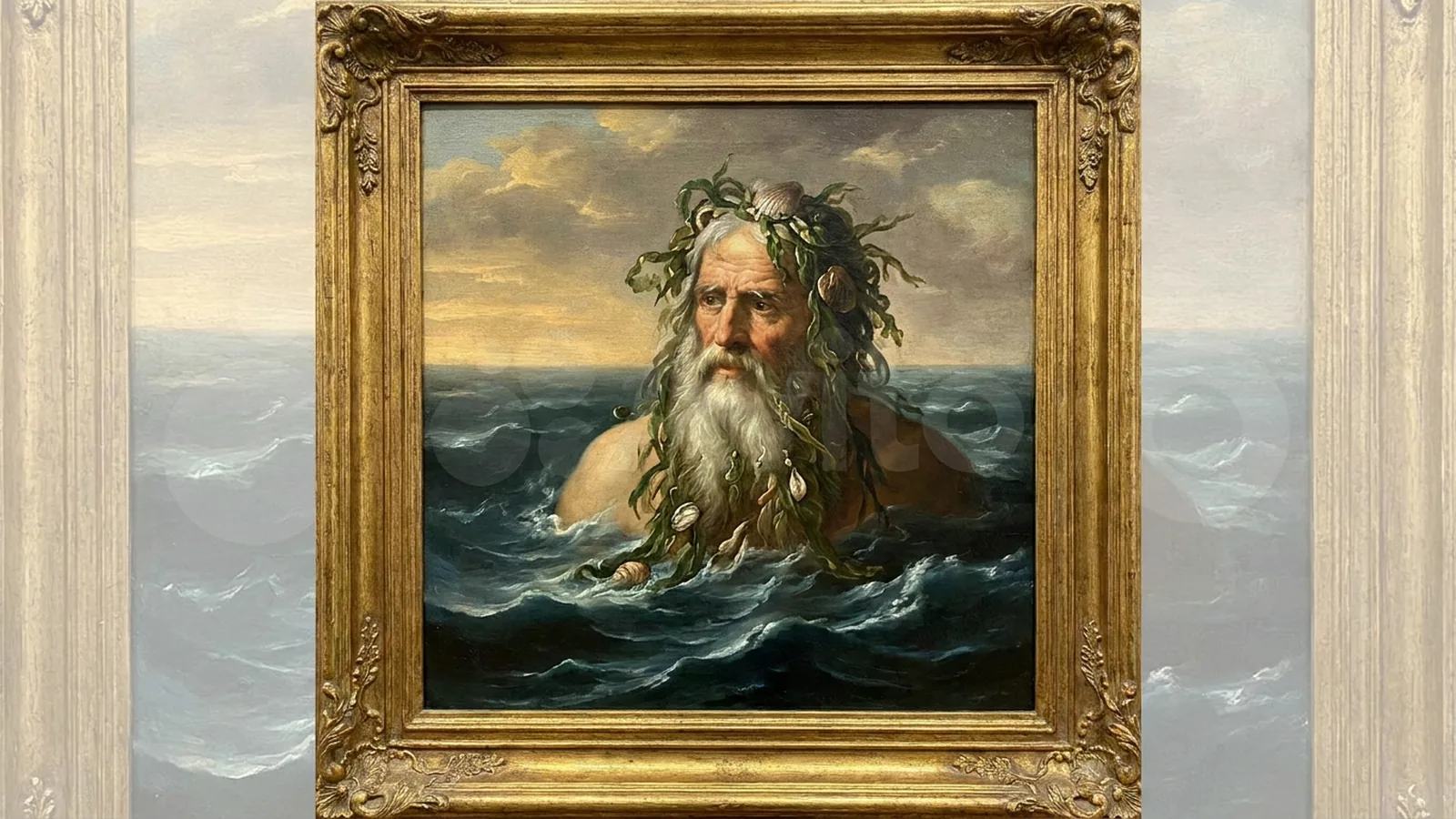
“The Old Man of the Sea” (halios gerōn) is a title Homer and other Greek writers give to several ancient sea gods, mainly Nereus, Proteus and Phorcys. All three are older than Poseidon, wise and able to see the future. Nereus and Proteus are famous shape-shifters: Heracles wrestled Nereus and Menelaus wrestled Proteus, holding on while they changed into lions, serpents and water, until they gave a true answer.
Greek mythology has a lot of sea gods, and the ones that interest me most are not the powerful ones but the old ones. Poseidon is all storm and temper. The old men of the sea are something else: ancient, slippery, honest when cornered, and in touch with everything that has happened or will happen. They live in the sea the way an old fisherman lives on a harbour wall, watching everything and saying little. If you want to know something, you have to catch one and hold on.
The phrase “old man of the sea” is a title rather than a name. Homer uses it for different gods in different places, and later writers argued about who was meant. Here are the three main candidates and their stories.
Nereus: the honest old man
Nereus is the original Old Man of the Sea. In Hesiod’s Theogony he is the eldest son of Pontus, the primordial sea, and Gaia, the Earth.
Hesiod praises him above all for his character: he is truthful, gentle, never forgets what is right and thinks only just and kindly thoughts. He lived in the depths of the Aegean with his wife Doris, a daughter of Oceanus, and their fifty daughters, the Nereids, the beautiful sea nymphs who ride dolphins and help sailors. Two of those daughters became especially famous: Amphitrite, who married Poseidon, and Thetis, the mother of Achilles. Nereus himself is often shown in Greek art as an older man with a beard, sometimes with a fish’s tail, holding a staff or a sceptre.
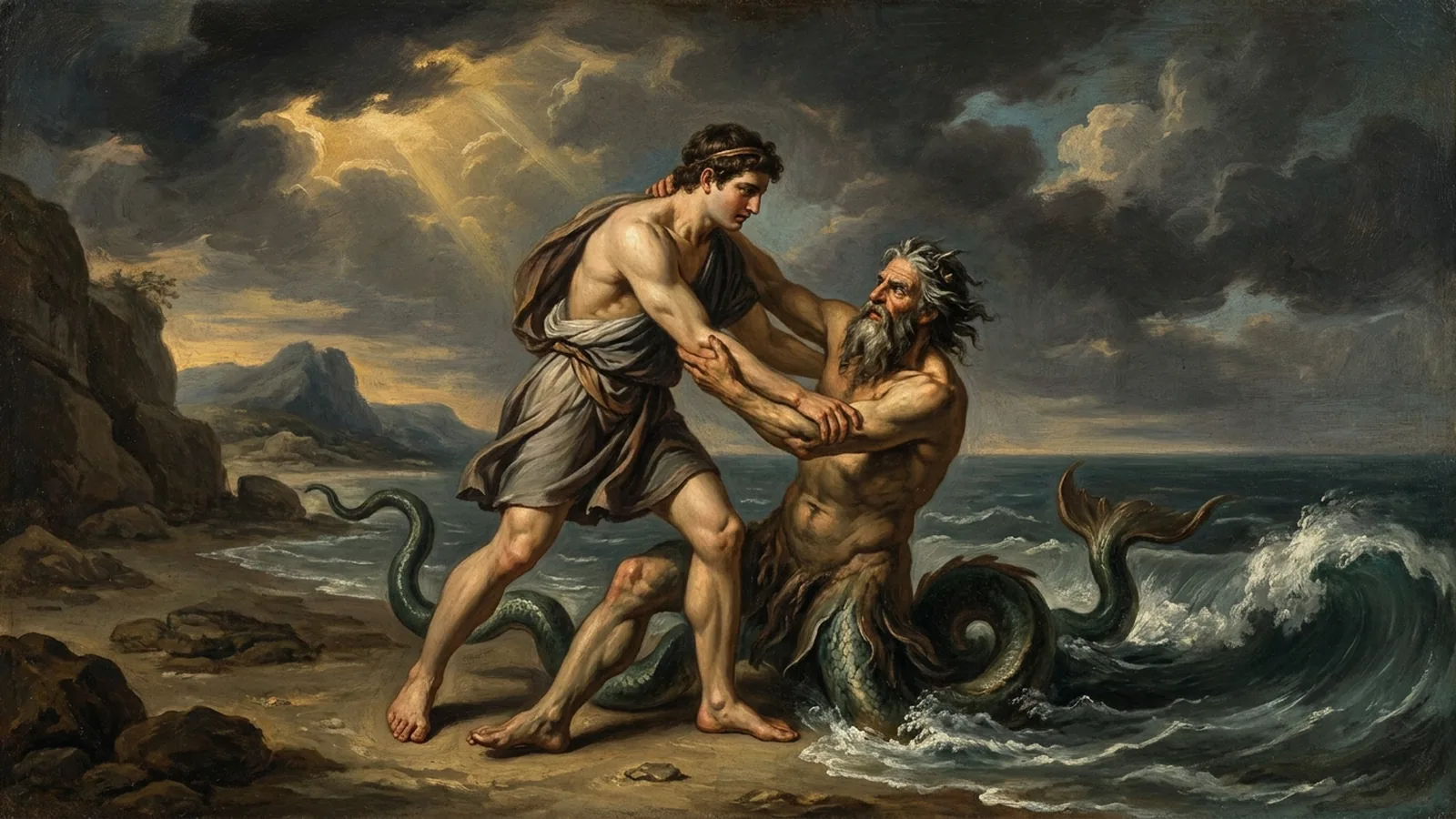
His best-known story involves Heracles. For his eleventh labour, Heracles had to fetch the golden apples of the Hesperides but did not know where their garden was. Nymphs told him that Nereus knew. Heracles found the old god asleep on the shore and seized him. Nereus changed into one form after another, including fire and water, but Heracles did not let go, and in the end Nereus told him the way. Greek vase painters loved this scene and showed Heracles wrestling a figure with a fish tail, sometimes with snakes or flames sprouting from it to show the transformations.
Proteus: the shepherd of seals
Proteus is the shape-shifter everyone remembers, thanks to one of the most vivid scenes in Homer’s Odyssey.
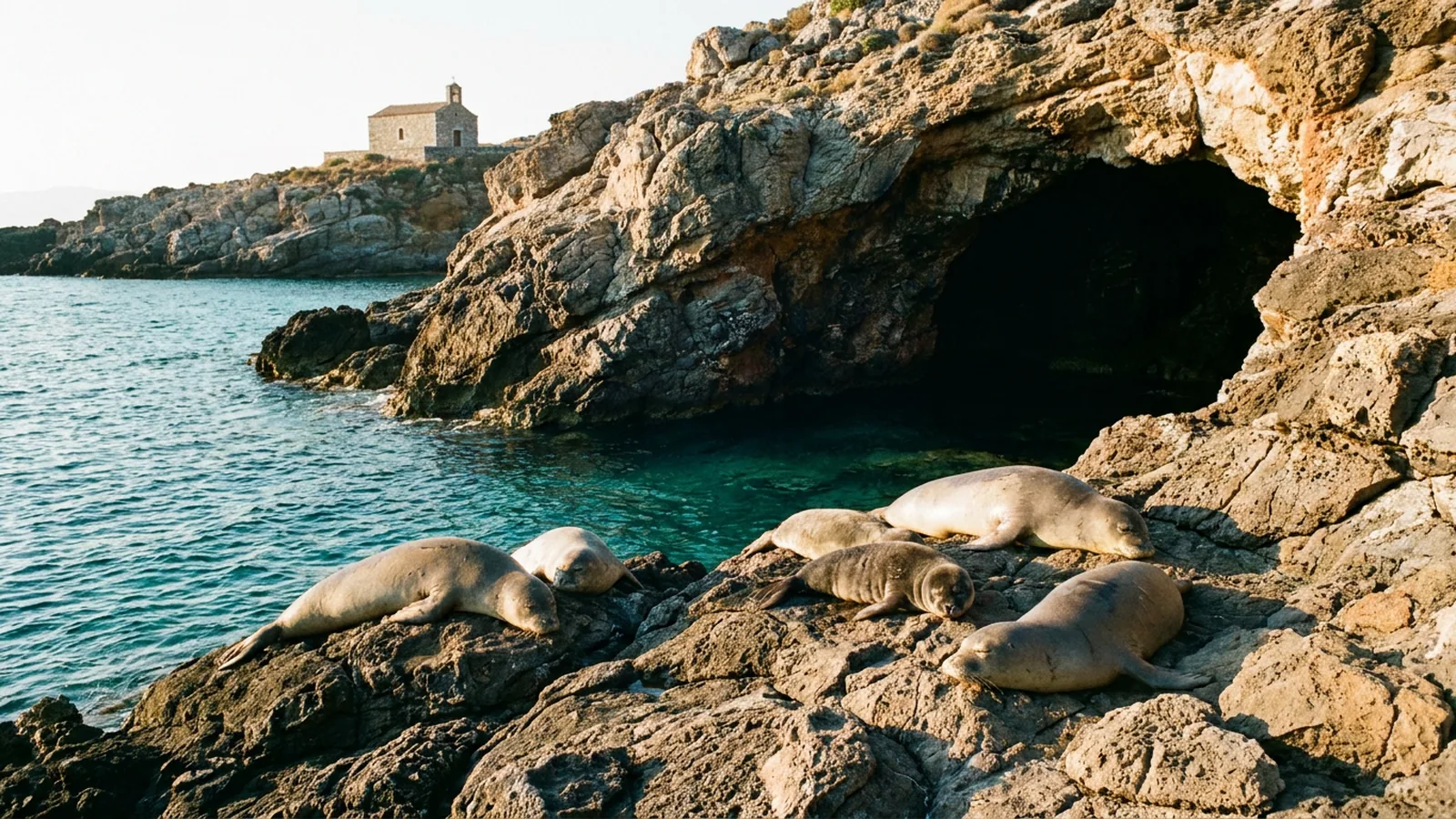
In Book 4, Menelaus tells how he was stranded on the island of Pharos, off the coast of Egypt, on his way home from Troy. The winds would not let him leave and his men were starving. Eidothea, the daughter of Proteus, took pity on him and explained that her father, the old man of the sea, served Poseidon and herded his seals. Every day at noon Proteus came out of the sea, counted his seals as they lay on the beach, and then lay down among them to sleep.
Eidothea dug four hiding places in the sand and covered Menelaus and three of his men with freshly skinned sealskins. The smell was so awful that she put ambrosia under their noses to make it bearable. When Proteus lay down, they leapt up and grabbed him. He turned into a bearded lion, a serpent, a leopard, a huge boar, running water and a tall tree, but they held on. Finally he returned to his own shape and answered. He told Menelaus which gods he had offended and how to get home, and gave him news of his brother Agamemnon’s murder and of Odysseus held captive by the nymph Calypso.
The Roman poet Virgil retold a similar story in the Georgics, where the beekeeper Aristaeus catches Proteus to learn why his bees have died. Proteus’s name gave us the word “protean”, meaning able to change shape or take many forms.
Phorcys: father of monsters
The third old man of the sea is darker. Phorcys is another son of Pontus and Gaia, and he is remembered less for wisdom than for his children.
With his sister Ceto, Phorcys fathered some of the most frightening beings in Greek myth: the Graeae, three grey-haired sisters who shared one eye and one tooth; the Gorgons, including Medusa, whose gaze turned people to stone; and in some accounts the dragon Ladon, who guarded the golden apples, and the sea monster Scylla. His daughter Thoosa was the mother of the Cyclops Polyphemus by Poseidon. In the Odyssey, Phorcys gives his name to a sheltered harbour on Ithaca, where the Phaeacians set the sleeping Odysseus ashore at the end of his wanderings. Homer calls him the old man of the sea in that passage. Phorcys represents the hidden dangers of the deep, the things that lurk below and occasionally surface.
| God | Parents | Family | Famous story | Character |
|---|---|---|---|---|
| Nereus | Pontus and Gaia | Husband of Doris; father of the 50 Nereids | Wrestled by Heracles for the way to the Hesperides | Truthful, gentle, just |
| Proteus | Usually Poseidon, or Oceanus and Tethys | Father of Eidothea | Caught by Menelaus on Pharos; by Aristaeus in Virgil | Evasive, prophetic, keeper of seals |
| Phorcys | Pontus and Gaia | Husband of Ceto; father of Gorgons and Graeae | Gives his name to the harbour on Ithaca | Dark, the hidden dangers of the deep |
Why wrestle a sea god for answers?
The wrestling scenes are among the oldest and strangest in Greek myth. They say something about how the Greeks thought about the sea and about knowledge.
The sea is the most changeable thing in the natural world. It can be calm, stormy, clear or murky in the course of an afternoon, and it takes every shape of whatever holds it. A god of the sea who changes form constantly is a natural way to express that. At the same time, the sea was the source of everything that came over the horizon: news, trade, invaders, returning ships. An old god who has watched it all for ages would know the answers to questions no one on land could answer. To get the truth from him, you have to hold on through all his changes, which is a neat image for persistence in the face of a confusing world.
There is also a practical sailor’s lesson buried in the Proteus story. Menelaus is stuck because he does not understand the winds and the gods behind them. What he needs is local knowledge, and he gets it from someone who lives there. Any diver who has turned up at a new site and asked the local guides about currents will recognise the idea.
The idea of the old sea god also fits the age of the gods themselves. Nereus, Proteus and Phorcys all belong to an older order than Poseidon and the Olympians. They are the sea as it was before the gods of Homer’s world took charge, and they survive as reminders that the sea is older than any ruler. They are rarely worshipped in big temples, they do not demand sacrifices the way Poseidon does, and they rarely take sides in human wars. Their role is to know things. In that sense they are closer to the natural world than any other figures in Greek religion, which is perhaps why the image of an old, bearded sea god who knows everything has lasted so long in art and literature.
The real seals in Proteus’s story
Proteus’s seals are not fantasy. The Mediterranean was once home to many seals, and one species still survives there.
The animals Homer describes are almost certainly Mediterranean monk seals, which in ancient times hauled out on open beaches in large groups, exactly as the Odyssey describes. Centuries of hunting and disturbance pushed the survivors into remote sea caves, and the species became one of the most endangered seals in the world. Conservation work in Greece, Turkey and the Atlantic colonies off Madeira and Cabo Blanco has helped numbers recover somewhat in recent decades. Homer’s detail about the terrible smell of the sealskins is accurate too; anyone who has been near a seal haul-out will confirm it.
Proteus also lives on in biology. The olm, a blind cave salamander from the Balkans, is Proteus anguinus, and a common genus of bacteria is also named Proteus for its ability to change shape. Not a bad legacy for a god who never wanted to be caught.
Other “old men of the sea”
The phrase has been borrowed many times, which can make searching for it confusing.
In the Arabian Nights, Sinbad meets a very different Old Man of the Sea on his fifth voyage: a wretched old man who asks to be carried across a stream, then wraps his legs around Sinbad’s neck and refuses to get off until Sinbad gets him drunk and escapes. That figure gave English the expression “an old man of the sea” for a burden you cannot shake off. Ernest Hemingway’s 1952 novella The Old Man and the Sea is about a Cuban fisherman, Santiago, and his struggle with a giant marlin; it has no connection to Greek myth, though the image of an old man wrestling with the sea is curiously similar. For the rest of the Greek sea family, see our guide to Greek sea gods and goddesses.
Who is the Old Man of the Sea in the Odyssey?
In Book 4 it is Proteus, whom Menelaus captures on Pharos. In Book 13, Homer also uses the title for Phorcys, whose harbour is on Ithaca.
Is Nereus the Old Man of the Sea?
Yes. Nereus is the original and most common holder of the title, the truthful father of the Nereids.
What could Proteus turn into?
In the Odyssey: a lion, a serpent, a leopard, a boar, running water and a tall tree.
Why did Heracles wrestle Nereus?
To learn where the Garden of the Hesperides was, so he could fetch the golden apples for his eleventh labour.
Who are Phorcys’s children?
With Ceto he fathered the Graeae and the Gorgons, and in some sources Ladon, Echidna and Scylla.
What does “protean” mean?
Able to change frequently or take many forms. It comes from the shape-shifting sea god Proteus.
- Homer, Odyssey, Book 4 (Proteus and Menelaus) and Book 13 (harbour of Phorcys).
- Hesiod, Theogony, on Nereus, Phorcys and Ceto.
- Apollodorus, Bibliotheca 2.5.11 (Heracles and Nereus).
- Virgil, Georgics, Book 4 (Aristaeus and Proteus).
- IUCN Red List, Monachus monachus (Mediterranean monk seal).
Blane Perun has been exploring Earth’s oceans and marine life for over 25 years. Founder of TheSea.Org in 1999, underwater photographer, coral aquaculture pioneer, and explorer of 80+ countries.
About Blane Perun → More Sea Myths & Legends →