Yacare Caiman — Millions Strong in the Pantanal
The yacare caiman (Caiman yacare), also called the Paraguayan or piranha caiman, is a medium-sized caiman of the Paraguay–Paraná river system and southern Amazon. Males reach about 2–3 m and up to about 58 kg; females about 1.4 m. It is famous for the huge numbers seen in Brazil’s Pantanal, where estimates run into millions of animals, and is listed as Least Concern after recovering from intense illegal hunting in the 1980s.
Few sights in South American wildlife travel match a dry-season pool in the Pantanal, packed with yacare caimans lying shoulder to shoulder while fish thrash in the shrinking water. Densities there can be so high that a single pool holds hundreds of animals. The species was hunted to the edge in the 1980s and then made one of the most striking recoveries of any crocodilian, which makes it both a wildlife spectacle and a case study in what protection can achieve.
How big are yacare caimans?
Males usually reach 2–3 m and up to about 58 kg; females are much smaller, about 1.4 m and 14–23 kg.
That makes the yacare a medium-sized crocodilian, similar to the spectacled caiman and far smaller than the black caiman of the Amazon. Published maximums vary: most references give males 2–3 m in total length including the tail, and National Geographic describes yacares reaching about 8 feet (2.4 m). The difference between the sexes is large, as in most crocodilians, because males keep growing for longer and invest more in size, which helps them win fights and hold breeding areas. Hatchlings are tiny by comparison, with a snout–vent length of about 12.5 cm, roughly the length of a pencil including the tail.
How do you identify a yacare caiman?
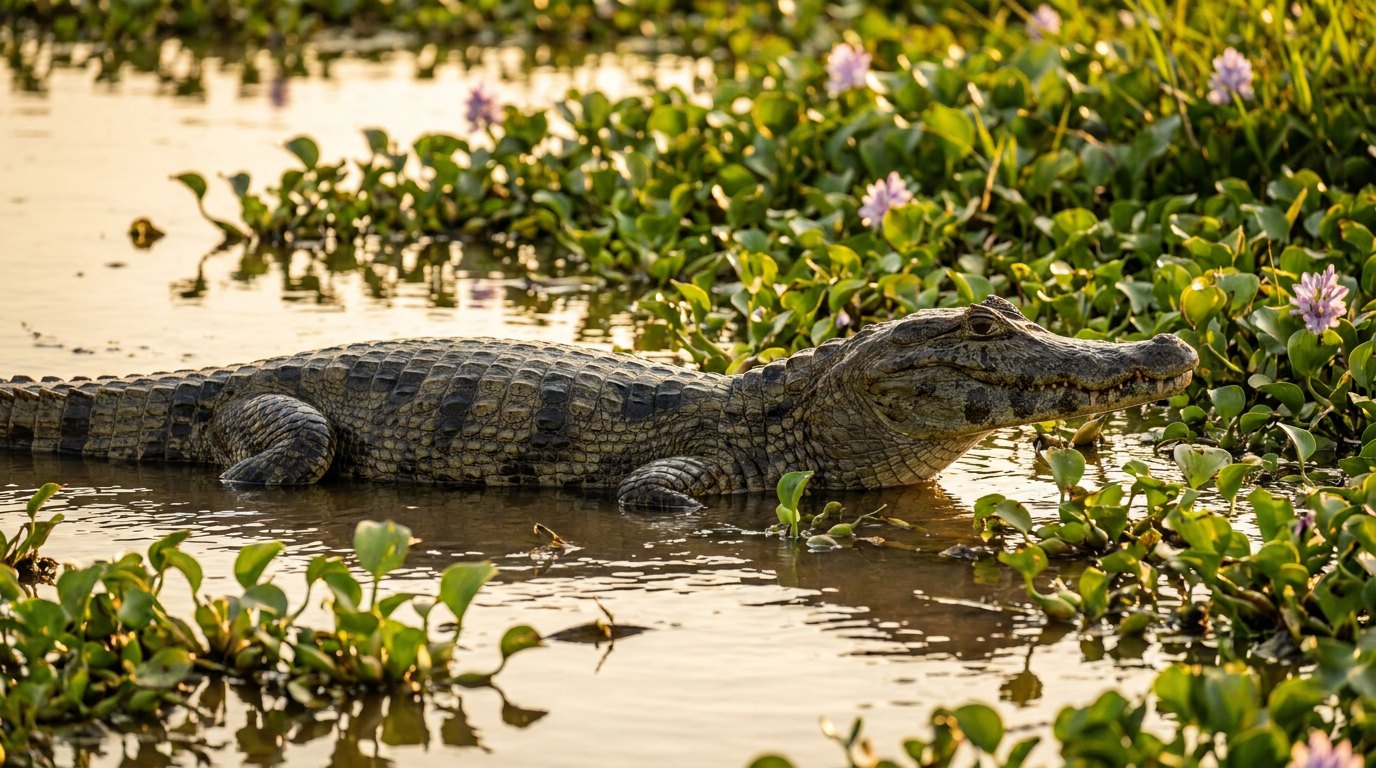
Yacares are brown or dark olive-brown with darker blotches and crossbands, most obvious on the tail and on the lower jaw, which usually carries three to five dark spots. The snout is smooth, broad and medium in length. Like other caimans in the genus Caiman, it has a curved bony ridge between the eyes that looks like the bridge of a pair of glasses, plus small bumps on the upper eyelids. The back and much of the body are armoured with osteoderms, bony plates set in the skin.
The most distinctive feature is the teeth. A yacare has about 74 teeth, and some of the long teeth in the lower jaw poke up through holes in the upper jaw, so their tips show on top of the snout when the mouth is closed. That jagged look, along with a diet rich in piranhas, gave the species the name piranha caiman. Other names include jacaré-do-pantanal, Paraguayan caiman, red caiman and southern spectacled caiman.
Within its range, the main look-alikes are the spectacled caiman, Caiman crocodilus, to the north, and the broad-snouted caiman, Caiman latirostris, to the east and south. The broad-snouted caiman has a noticeably wider, shorter snout and an olive colour, while spectacled caimans are usually paler and lack the strongly spotted lower jaw. The black caiman, which reaches the northern edge of the yacare’s range in Bolivia, is far larger and very dark, with pale bands on the lower jaw.
Is the yacare a separate species?
Most current lists treat it as one, but the question is not fully settled. The French zoologist François Marie Daudin described it in 1802 as Crocodilus yacare, using a name derived from jacaré, the Old Tupi word for a caiman or alligator that passed into Portuguese. In 1936 it was reduced to a subspecies of the spectacled caiman, Caiman crocodilus yacare, and it appeared under that name in many books for decades. Later work restored it as Caiman yacare, but genetic and morphological studies have produced mixed results, and the two forms meet and may hybridise in parts of Bolivia and Brazil.
Where do yacare caimans live?
In the Pantanal of Brazil, Bolivia and Paraguay; the Paraguay and Paraná river systems south to northern Argentina; and the southern Amazon tributaries in Bolivia and Brazil. They use rivers, lakes, marshes, flooded grassland and cattle ranch ponds. It is one of three species of Caiman in South America and one of the most common crocodilians on the continent.
The Pantanal is the heart of its range. This vast seasonal wetland along the upper Paraguay River floods for months each year, when rain swells the rivers and water spreads across grasslands and forest. In the dry season the water retreats into rivers, lagoons and isolated pools, and the animals that live there, from fish to capybaras to caimans, follow it. The yacare is adaptable and lives happily in artificial habitats too, including the ponds and ditches dug for cattle on the Pantanal’s ranches, called fazendas.
How many yacare caimans are there?
Millions. Aerial surveys of the Brazilian Pantanal carried out in the 1990s and published in 2000 by Guilherme Mourão and colleagues counted caimans along transects and produced estimates in the millions for that part of the wetland. Figures of about 10 million for the Pantanal as a whole, based on 1996 data, are widely quoted, and the Pantanal is often described as holding the largest concentration of crocodilians in the world. These are estimates with wide margins, because caimans are hard to count from the air, many hide under vegetation, and numbers change sharply between wet and dry years, but there is no doubt that the yacare is one of the most numerous crocodilians on Earth.
What do yacare caimans eat?
Mostly fish, including piranhas, plus snails, crabs, insects, frogs, snakes and occasionally birds and small mammals. As the Pantanal floods recede, caimans gather at pools where trapped fish are easy to catch, then disperse again when the rains return. Young caimans eat mainly insects, snails and other invertebrates, and the proportion of fish and larger prey rises as they grow.
A common hunting method is to wait. Caimans lie motionless in shallow water, often facing into a current where a channel drains a pool, and snap sideways at fish that brush against their jaws. During the dry season, when fish are concentrated, caimans may barely need to move to feed, and dozens can line a single channel. Researchers working in the Amazon have also argued that caimans help fish populations rather than harming them, because their droppings return nutrients to nutrient-poor waters, a reminder that a predator’s role in a wetland is more complex than the number of fish it eats.
How do yacare caimans cope with the dry season?
The Pantanal’s flood cycle shapes almost every part of a yacare’s year. In the wet season, water spreads across a huge area and caimans scatter across flooded fields, forest edges and marshes, feeding widely and nesting. As the water falls, they retreat to whatever wet places remain: river channels, permanent lagoons, ranch ponds and shrinking lagoons called baías and seasonal channels called corixos. That is when the famous crowds form, with caimans packed into pools alongside wading birds and trapped fish.
Crowding brings both opportunity and risk. Food is easy to catch while fish are concentrated, but competition rises, disease and parasites spread more easily, and small caimans become prey for large ones. When a pool dries out completely, caimans walk overland to find new water, sometimes in groups, and are often seen crossing roads and fields at night. Others bury themselves in mud or shelter under vegetation and wait for the rains, surviving for weeks on stored fat with their metabolism slowed. Like all reptiles they rely on outside heat to control body temperature, basking on banks in the morning, lying with jaws open to shed heat at midday and slipping into water to cool off.
Climate change is altering this rhythm. Long-term studies of the Pantanal show reduced rainfall, shorter flood pulses and longer, drier fire seasons since the mid-2010s. A yacare can survive a bad dry year, but repeated droughts reduce nesting, shrink the area of good habitat and expose animals to fire, which is why scientists see the health of the flood cycle as the key to the species’ future.
How do yacare caimans breed?
Breeding usually takes place from December to February, in the middle of the rainy season. Females build mound nests of mud and rotting vegetation, often on floating mats of plants or on forested islands, and lay around 22–35 eggs, occasionally as many as 44. The heat of decomposing plants helps incubate the eggs, which hatch after about two to three months, typically around March. As in other crocodilians, the temperature inside the nest during incubation determines whether each hatchling becomes male or female. Studies of yacare nests have found high rates of multiple paternity, meaning a single clutch often has more than one father.
Nests face many risks. Rising floodwater can drown eggs, and coatis, foxes and tegu lizards dig into mounds to eat them; in some years drought kills embryos or prevents nesting altogether. Females usually guard their nests, but they do so less where human hunting pressure is high, and hatching success falls as a result. After hatching, young caimans stay in groups, called crèches, near their mother for a time. A single lagoon can hold hundreds or even thousands of hatchlings, most of which will be eaten by birds, fish, snakes and larger caimans before they reach adulthood.
What eats yacare caimans?
Adults have few predators, but they are not at the top of the Pantanal food chain. Jaguars in the Pantanal regularly kill caimans, often ambushing them at the water’s edge and killing them with a bite to the head, and caimans are among the jaguar’s most important prey in parts of the wetland. Green and yellow anacondas also take caimans. Eggs and young have a much longer list of enemies, from tegus and coatis to herons, storks, large fish and other caimans. The yacare is therefore both a major predator and a major food source, and changes in its numbers ripple through the whole wetland.
Is the yacare caiman endangered?
No, it is Least Concern. In the 1970s and 1980s, organised poaching gangs (“coureiros”) killed huge numbers of yacare caimans in the Pantanal for the international skin trade. They shot masses of animals at drying water holes, took only the less bony parts of the hide that could be made into leather, and left the carcasses to rot. Researchers have estimated that the total killed ran well into the millions, and the species was described at the time as heading for oblivion. A crackdown by the Brazilian government, tighter international trade controls under CITES and falling demand for wild skins allowed a rapid recovery.
The IUCN has listed the yacare as Least Concern since 1996, and it remains on CITES Appendix II, which allows controlled trade. The US Fish and Wildlife Service listed it as endangered in 1970 and downgraded it to threatened in 2000. Today Bolivia runs a managed wild harvest of yacare skins, and caiman farming and ranching operate in parts of Brazil. Modern threats include wildfire, drought, dams and agricultural drainage. The 2020 Pantanal fires burned roughly a quarter to a third of the wetland, depending on the estimate, and killed large numbers of animals, and fire seasons in the region have become longer and more severe as rainfall and flood pulses have declined.
How do yacare caimans and people share the Pantanal?
Most of the Pantanal is private land, divided into large cattle ranches, and the yacare has lived alongside cattle for centuries. Ranch ponds, drainage ditches and flooded pastures give caimans extra habitat, and conflicts are generally minor; caimans rarely threaten cattle, though they may take poultry or dogs near water. The bigger tensions come from changes to the landscape itself: conversion of native vegetation to planted pasture and crops on the surrounding plateaus, which alters how water and sediment flow into the wetland, and proposed dams and waterways on the Paraguay River and its tributaries.
Tourism has given the yacare economic value alive. Many fazendas now combine ranching with wildlife lodges, and the sight of hundreds of caimans in a single pool is one of the main draws for visitors, along with jaguars, giant otters and hyacinth macaws. Where wild harvesting is allowed, as in Bolivia, the programme is designed to take a limited number of large animals while leaving breeding females and young, so that local communities earn income without depleting the population. Both models depend on the same thing: keeping the wetland wet.
Where can you see yacare caimans?
The Brazilian Pantanal is the easiest place in the world to see wild crocodilians in large numbers. The northern Pantanal is reached from Cuiabá and the Transpantaneira, a dirt road that runs south from Poconé to Porto Jofre across dozens of wooden bridges, with caimans visible in the roadside ditches and pools along much of its length. The southern Pantanal is reached from Campo Grande and towns such as Miranda and Corumbá, where many ranches now run wildlife lodges. The dry season, roughly from July to October, is the best time, because animals concentrate around the remaining water; the same period is also prime season for jaguar watching along the rivers near Porto Jofre.
Yacares are wary of people and attacks are very rare, but they are wild animals with strong jaws. Do not wade into murky water where they are present, keep a few metres away from basking animals, never feed them, and keep children and dogs at a distance. Night spotlighting trips, where guides pick out the red eyeshine of caimans with a torch, give a sense of just how many animals share a single lagoon.
How big is a yacare caiman?
Males reach about 2–3 m and up to about 58 kg; females about 1.4 m and 14–23 kg.
Where do yacare caimans live?
In the Pantanal and the Paraguay–Paraná river basin of Brazil, Bolivia, Paraguay and northern Argentina, plus southern Amazon tributaries.
How many yacare caimans are there?
Population estimates for the Pantanal run into the millions; around 10 million is a commonly quoted figure.
Are yacare caimans dangerous to humans?
Attacks are very rare. They are wary of people, but should never be approached closely, fed or handled.
Why are they called piranha caimans?
Because piranhas are a major prey item and because their long lower teeth often protrude through holes in the upper jaw.
Is the yacare caiman endangered?
No. It has been Least Concern on the IUCN Red List since 1996, after recovering from heavy poaching in the 1970s and 1980s.
When is the best time to see yacare caimans?
The Pantanal dry season, roughly July to October, when caimans crowd around the remaining water.
- IUCN SSC Crocodile Specialist Group. Crocodiles: Status Survey and Conservation Action Plan, 3rd ed., species accounts.
- Mourão, G., Coutinho, M., Mauro, R. et al. (2000). Aerial surveys of caiman, marsh deer and pampas deer in the Pantanal wetland of Brazil. Biological Conservation 92: 175–183. doi:10.1016/S0006-3207(99)00051-8
- IUCN Red List. Caiman yacare, Least Concern (1996).
- National Geographic (2013). “Yacare caiman,” on the Pantanal recovery.
- Murray, C.M., Crother, B.I. & Doody, J.S. (2020). The evolution of crocodilian nesting ecology and behavior. Ecology and Evolution. doi:10.1002/ece3.5859
- Barros-Rosa, L. et al. (2026). Climatic and hydrological changes drive fire regime transitions in the Pantanal. Global Change Biology. doi:10.1111/gcb.71089
- Wikipedia: Yacare caiman; Pantanal.
Blane Perun has been exploring Earth’s oceans and marine life for over 25 years. Founder of TheSea.Org in 1999, underwater photographer, coral aquaculture pioneer, and explorer of 80+ countries.
About Blane Perun →More on Crocodiles →