USS Indianapolis — Sharks, Survivors and the 2017 Discovery
USS Indianapolis was a US Navy heavy cruiser torpedoed by the Japanese submarine I-58 in the Philippine Sea at 00:15 on 30 July 1945, days after delivering parts of the Hiroshima atomic bomb to Tinian. She sank in about 12 minutes. Of the 1,195 men aboard, about 300 went down with the ship and some 880 to 890 were left in the water with few rafts and little food or fresh water. The Navy did not notice she was missing, and survivors were found by chance three and a half days later. Only 316 survived exposure, dehydration, salt-water poisoning and shark attacks. It remains the greatest loss of life at sea in US naval history. The wreck was found in August 2017 at a depth of about 5,500 m (18,000 ft).
The cruiser was lost in the last weeks of the war, after one of its most secret missions, and the men in the water were left there because nobody was keeping track of her. Her captain then became the only US captain court-martialled for losing his ship in combat in the Second World War.
A treaty cruiser and a president’s ship
Indianapolis was built by the New York Shipbuilding Corporation at Camden, New Jersey, laid down on 31 March 1930 and launched on 7 November 1931. She was the second of two Portland-class cruisers, the third class of so-called treaty cruisers built by the United States after the Washington Naval Treaty of 1922 limited the size of warships. Because her armour was thin she was first designated a light cruiser, CL-35, but her 8-inch guns made her a heavy cruiser under the London Naval Treaty, and she was reclassified CA-35 on 1 July 1931. Four Parsons geared turbines driving four shafts, fed by eight boilers, gave her 107,000 shaft horsepower and a design speed of 32.7 knots. She was commissioned on 15 November 1932.
In her early years she was a ship of state as much as a warship. In July 1933 she embarked President Franklin D. Roosevelt at Campobello Island in New Brunswick and carried him to Annapolis, where he hosted six members of his Cabinet aboard. For eight years she served as flagship of the commander of Scouting Force 1, and her crew nicknamed her “Indy”.
The Pacific war
The Second World War took Indianapolis across the Pacific. She took part in the carrier raid on Japanese forces at Lae and Salamaua in New Guinea, and later fired her main guns into the bay at Kiska during the Aleutian Islands campaign. From 1943 to 1945 she was the flagship of Admiral Raymond Spruance, commanding the Fifth Fleet in the great island campaigns of the Central Pacific. She had a major role in the bombardment of Saipan from 13 June 1944, and during the Battle of the Philippine Sea on 19 June, the day of the “Great Marianas Turkey Shoot” in which American pilots destroyed a reported 426 Japanese aircraft for the loss of 29, her gunners shot down a torpedo plane.
Off Okinawa in March 1945 she spent seven days firing 8-inch shells into the beach defences and shot down six aircraft. On 31 March, the day before the landings, a Japanese fighter dived out of the morning twilight at her bridge. The ship’s 20 mm guns hit it and made it swerve, but the pilot released his bomb from about 25 ft before crashing into the sea near the stern. The bomb went down through the mess hall, the berthing compartment and the fuel tanks and through the keel, exploding beneath the ship. Nine men were killed. With damaged propeller shafts, ruptured fuel tanks and ruined water-distilling plant, she steamed under her own power to Mare Island in California for repairs. That damage is what put her on the West Coast in the summer of 1945, and in line for a secret mission.
The secret cargo
After her repairs, Indianapolis was ordered to carry the enriched uranium and other components of the atomic bomb code-named “Little Boy” to the island of Tinian in the Marianas. The uranium was about half of the world’s supply of uranium-235 at the time. She left Hunters Point Naval Shipyard in San Francisco on 16 July 1945, within hours of the Trinity test in New Mexico, and set a speed record of 74.5 hours to Pearl Harbor, averaging 29 knots. She sailed on alone and delivered her cargo to Tinian on 26 July. Ten days later, on 6 August, the bomb was dropped on Hiroshima. By then the ship that brought it was already on the bottom of the Philippine Sea.
The sinking
From Tinian, Indianapolis went to Guam, where some of her crew who had finished their tours were replaced, and on 28 July she sailed unescorted for Leyte in the Philippines, where the crew was to train before joining a task force off Okinawa. The seas were moderate, visibility was poor, and she was steaming at about 17 knots.
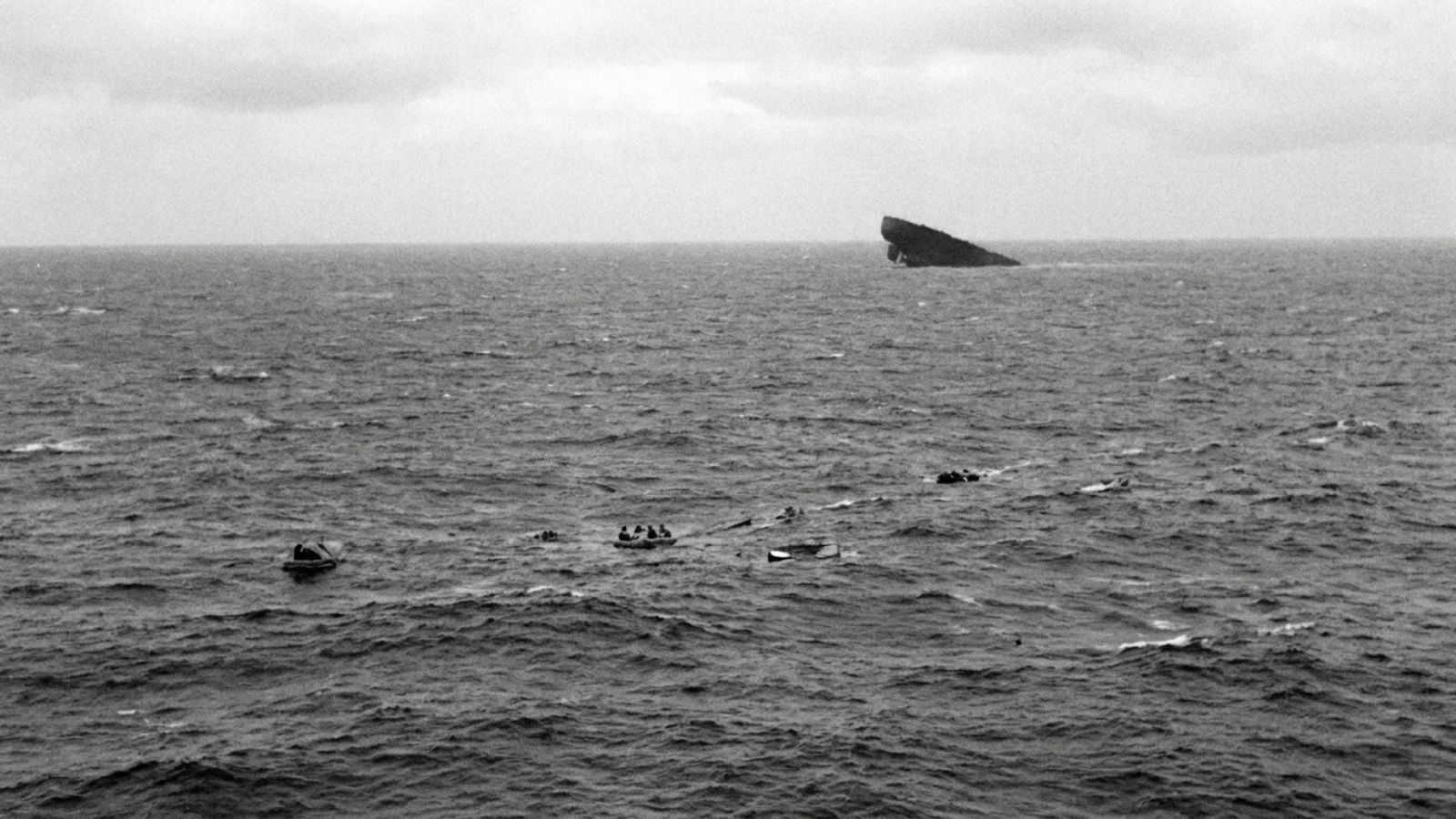
At 00:15 on 30 July 1945 she was struck on the starboard side by two Type 95 torpedoes from the submarine I-58, commanded by Commander Mochitsura Hashimoto, who at first thought he had found a battleship. One torpedo hit the bow, the other amidships. The bow was torn away, and the ship, which had become top-heavy with the guns and fire-control equipment added during the war, took on a heavy list and settled by the head. About twelve minutes later she rolled over, her stern rose into the air and she sank. Some 300 of the 1,195 men aboard went down with her. The rest, roughly 880 to 890 men depending on the count, were left in the open sea, many of them injured, many without life jackets, and with few rafts.
Four days in the water
What followed is what has made the Indianapolis one of the most notorious disasters of the war. The men drifted in groups, some clinging to rafts and wreckage, others kept afloat only by life jackets. One large group of about 300 men held together through four days and five nights. They suffered from thirst and from hypernatremia, the dangerous rise in blood sodium that comes from drinking sea water; from sunburn and dehydration by day and hypothermia at night; and from severe peeling of the skin caused by long exposure to salt water and fuel oil. Some found tins of Spam and crackers among the floating wreckage. Many became delirious and hallucinated. Some killed themselves.
The sharks
Then there were the sharks. Hundreds were drawn to the area, apparently by the noise of the explosions and the scent of blood. At first they took the dead and badly wounded, then began attacking the living. Estimates of the number of men killed by sharks range widely, from a few dozen to as many as 150. A 2007 Discovery Channel documentary described it as the worst series of shark attacks on humans in recorded history and blamed mostly the oceanic whitetip, an open-ocean species that investigates anything floating; tiger sharks may also have killed some sailors. The same documentary concluded that most of the deaths were caused by exposure, salt-water poisoning and dehydration, with the bodies of the dead then taken by sharks. Exactly how many men the sharks killed, as opposed to men who had already died, can never be known.
The story became widely known through the 1975 film Jaws, in which the shark hunter Quint describes surviving the sinking and the sharks that followed. That speech brought the disaster to a wide public thirty years after the event.
Why nobody came
The Navy did not notice that Indianapolis was missing. The headquarters on Guam and on Leyte that plotted ship movements assumed that large warships would arrive on time unless told otherwise, so her position on their boards was a prediction, not a report. When she was due at Leyte on 31 July, she was simply removed from the board on Guam and marked as arrived on Leyte. The officer at Tacloban responsible for tracking her knew at once that she had not arrived, but did not investigate or report it; he and several superiors were later reprimanded. The Navy’s first statement said that distress calls had been keyed and “possibly” transmitted, but that none had been received. Declassified records later showed that three stations did receive the signals and none acted: one commander was drunk, another had ordered that he not be disturbed, and a third thought it was a Japanese trap. The Navy later created a Movement Report System to prevent a ship from going missing unnoticed again.
The rescue
The survivors were found by accident. At 10:25 on 2 August, three and a half days after the sinking, Lieutenant Wilbur “Chuck” Gwinn, flying a PV-1 Ventura on a routine patrol, spotted men in the water. He dropped a life raft and a radio transmitter and called for help, and all available air and surface units were sent. The first to arrive was a PBY-5A Catalina flown by Lieutenant Commander Robert Adrian Marks. After dropping rafts, Marks took a vote of his crew and, against standing orders, landed his flying boat in swells about 12 ft (3.7 m) high. He picked up 56 men, tying some to the wings with parachute cord, and the damage left the aircraft unable to fly. After dark the destroyer escort Cecil J. Doyle, the first of seven rescue ships, turned its searchlight into the sky as a beacon for the men still in the water. The ships picked up the rest, and Cecil J. Doyle later sank Marks’s damaged plane. Of the nearly 900 men who had gone into the water, only 316 survived; two of those rescued died later in August 1945.
The court-martial of Captain McVay
Captain Charles B. McVay III, who had commanded the ship since November 1944, was among the last to leave her and was rescued with his men. In November 1945 he was court-martialled on two charges: failing to order his men to abandon ship in time, and hazarding his ship by failing to zigzag. He was cleared of the first and convicted of the second. The trial was controversial from the start. His orders had allowed him to zigzag at his discretion, weather permitting; he had not been told that a Japanese submarine was operating along his route; and Commander Hashimoto, the commander of I-58, testified that zigzagging would have made no difference to his attack. Fleet Admiral Chester Nimitz remitted the sentence and restored McVay to duty, and he retired as a rear admiral in 1949.
Many survivors never blamed their captain, but some families of the dead did, and McVay received hate mail for years. He died by suicide in 1968, at the age of 70.
Clearing his name
The campaign that cleared McVay began with a schoolboy. In 1996 a sixth-grader named Hunter Scott began researching the sinking for a class history project, interviewing survivors and drawing national publicity. At about the same time survivors asked Captain William J. Toti, the last commanding officer of the nuclear submarine USS Indianapolis (SSN-697), to help, and Toti’s analysis showed that zigzagging would not have saved the cruiser from at least one torpedo hit. Survivors testified before the Senate Armed Services Committee on 14 September 1999. In October 2000 Congress passed a resolution, signed by President Bill Clinton, stating that McVay’s record should show that “he is exonerated for the loss of Indianapolis”. The resolution noted that, although several hundred US Navy ships were lost in combat in the Second World War, McVay was the only captain court-martialled for the sinking of his ship. In July 2001 the Secretary of the Navy directed that the language be entered into his service record. On 20 December 2018 the crew of Indianapolis was collectively awarded the Congressional Gold Medal.
Finding the wreck
For decades nobody knew exactly where she lay. Expeditions in 2001, with four survivors aboard, and in 2005, covered by National Geographic, searched with sonar, cameras and submersibles without finding conclusive wreckage. The breakthrough came in July 2016, when naval records were found showing that the tank landing ship LST-779 had passed Indianapolis eleven hours before the torpedoes struck. This meant the cruiser had been moving faster and was farther west than assumed, possibly 25 miles (40 km) west of the reported position.
On 19 August 2017 the research vessel Petrel, part of the USS Indianapolis Project funded by the Microsoft co-founder Paul Allen, found the wreck in the North Philippine Sea at a depth of about 18,000 ft (5,500 m), among undersea mountains. The great depth has kept her well preserved. The main hull lies in a large impact crater. The bow, which broke off before the ship sank, lies about 1.5 miles (2.4 km) to the east; the two forward 8-inch guns, which broke away at the surface and mark the ship’s last position, lie about half a mile east of the main wreck; and aircraft wreckage lies about 0.6 miles to the north. The stern turret is still in place. The discovery was revealed to the public on 13 September 2017 in a live PBS broadcast, and the full story of the search was told in a second PBS documentary in January 2019.
The last survivor
Since 1960, survivors have met for reunions in Indianapolis. Fourteen of the 32 then living attended the 70th reunion in 2015, and seven of twenty attended in 2017. With the death of Cleatus Lebow in September 2022, only one crew member remained: Harold Bray, a seaman second class who had been aboard for just two weeks, his first posting, when she sank. After the war he became a police detective and lived for many years in Benicia, California, where a monument with a life-sized bronze statue of him was unveiled in 2023; the statue’s wristwatch is stopped at the moment he would have hit the water. He turned 99 on 13 June 2026, according to Military Times.
The ship is also remembered in her namesake city. The USS Indianapolis Memorial, carved in limestone and granite on the city’s Canal Walk and listing the names of the crew, was designated a national memorial by Congress in 1993 and dedicated on 2 August 1995, and a museum gallery opened at the Indiana War Memorial in 2007. In 2011 the I-465 beltway around the city was named the USS Indianapolis Memorial Highway.
Indianapolis among the great wrecks
Most famous wrecks are remembered for the moment of sinking. The Indianapolis is remembered for what came after: days in the open ocean, failures ashore, and a long fight over who was to blame. Compare the shallow-water war grave of the USS Arizona, sunk at the start of the Pacific war, or read about how often shark attacks happen today.
When did the USS Indianapolis sink?
At about 00:15 on 30 July 1945 in the Philippine Sea; she sank in roughly 12 minutes.
How many people died on the USS Indianapolis?
Of 1,195 men aboard, about 879 died and 316 survived; about 300 went down with the ship and the rest died in the water.
How many USS Indianapolis sailors were killed by sharks?
Nobody knows; estimates range from a few dozen to as many as 150, and many of the dead had already died of exposure.
What kind of sharks attacked the USS Indianapolis survivors?
Mainly oceanic whitetip sharks, according to most accounts; tiger sharks may also have been involved.
Who sank the USS Indianapolis?
The Japanese submarine I-58, commanded by Mochitsura Hashimoto, with two torpedoes.
Where was the USS Indianapolis wreck found?
In the North Philippine Sea, at about 5,500 m (18,000 ft), by Paul Allen’s research vessel Petrel on 19 August 2017.
Are there any USS Indianapolis survivors still alive?
Harold Bray, the last survivor, turned 99 on 13 June 2026, according to Military Times.
Was Captain McVay exonerated?
Yes. Congress passed a resolution in October 2000, and the Navy entered it into his record in July 2001.
- Wikipedia contributors, “USS Indianapolis (CA-35)” (2023 snapshot, accessed November 2026).
- Military Times (15 June 2026), “Last living USS Indianapolis survivor turns 99”.
- Stanton, D. (2001), In Harm’s Way (as summarised in the sources above).
Blane Perun has been exploring Earth’s oceans and marine life for over 25 years. Founder of TheSea.Org in 1999, underwater photographer, coral aquaculture pioneer, and explorer of 80+ countries.
About Blane Perun →