USS Arizona — The Pearl Harbor Wreck That Still Leaks Oil
USS Arizona was a US Navy battleship sunk at her mooring off Ford Island during the Japanese attack on Pearl Harbor on 7 December 1941. A bomb that struck near her No. 2 turret at about 08:06 set off her forward magazines, tearing the ship apart and killing 1,177 of the 1,512 men aboard, roughly half of all American deaths that day. She was never raised. Her hull still lies on the harbour floor beneath the USS Arizona Memorial, a war grave holding most of her lost crew, and fuel oil still seeps from it to the surface.
No other single ship lost more men at Pearl Harbor, and no other wreck is visited by so many people. The Arizona is at once a tomb, a national memorial, a protected archaeological site and a slow-motion environmental question.
A battleship named for a new state
USS Arizona was the second and last ship of the Pennsylvania class, ordered on 4 March 1913 and named for the 48th state, which had joined the Union the year before. Her keel was laid at the Brooklyn Navy Yard on 16 March 1914, with the Assistant Secretary of the Navy, Franklin Delano Roosevelt, in attendance. The builders hoped to set a world record of ten months from keel-laying to launch, and the New York Times promised “the world’s biggest and most powerful” super-dreadnought, but the work ran slow, and she was launched on 19 June 1915, about fifteen months after it began. A crowd estimated at 75,000 watched. Because Arizona had just banned alcohol, the state’s governor arranged for two christening bottles: one of sparkling wine from Ohio and one of water from the Roosevelt Dam.
She was a big ship for her time: 608 ft (185.3 m) long, 97 ft (29.6 m) across the beam and displacing about 29,158 long tons at standard load, some 4,000 tons more than the Nevada-class battleships before her. Twelve 14-inch guns sat in four triple turrets, numbered I to IV from bow to stern, and twenty-two 5-inch guns in casemates along the hull were meant to drive off torpedo boats. Four sets of Parsons steam turbines, fed by twelve Babcock & Wilcox boilers, gave her a designed speed of 21 knots. Her armour followed the “all-or-nothing” principle: a belt of Krupp armour 13.5 inches thick protected only the machinery spaces and the magazines, the parts of the ship whose loss would be fatal. Within that armoured box, the magazines held the propellant that would one day destroy her.
Two decades of peacetime service
Arizona was commissioned on 17 October 1916, and her career began badly: on her shakedown cruise a turbine stripped off Guantanamo Bay, and repairs back in New York took almost four months, with yard workers cutting holes in the upper decks to lift the damaged casing out. She left the yard on 3 April 1917, three days before the United States declared war on Germany, but spent the First World War on the American side of the Atlantic as a gunnery training ship. After the armistice she crossed to Europe and, on 13 December 1918, was one of nine battleships and twenty-eight destroyers that escorted President Woodrow Wilson into Brest on his way to the Paris Peace Conference. In 1919 she was sent to Smyrna (now Izmir) during the Greek landings there, and American citizens sheltered aboard her during the chaos in the city.
From 1921 she was based on the West Coast, at San Pedro in Los Angeles, and spent the 1920s on what the naval historian Paul Stillwell called “a great deal of sameness and repetition”: gunnery practice, torpedo-defence drills and the annual Fleet Problems that pitted most of the fleet against itself. In 1929 to 1931 she was rebuilt at Norfolk Navy Yard, gaining tripod masts, extra deck armour, anti-torpedo bulges and new geared turbines taken from a cancelled battleship. In February 1932, during an exercise called Grand Joint Exercise No. 4, carrier aircraft “attacked” Pearl Harbor on a Sunday morning and were judged successful, nearly a decade before the real attack.
In 1933 her sailors helped with relief work after the Long Beach earthquake, and in 1934 she appeared in the James Cagney film Here Comes the Navy. Budget cuts left her at anchor for most of the late 1930s; in the 1936–37 fiscal year she spent 267 days in port. After her last Fleet Problem, off Hawaii in April and May 1940, the Pacific Fleet was kept at Pearl Harbor as a deterrent to Japan, and Arizona went with it.
How she came to be at Pearl Harbor that morning
Chance played a part. On 22 October 1941, in heavy fog during an exercise, Arizona was struck in the bow by the battleship Oklahoma. She had been due to sail for an overhaul at Bremerton in Washington State in November; the collision damage was repaired in dry dock at Pearl Harbor instead, and she stayed in Hawaii. Her last sortie was a night-firing exercise on 4 December with Nevada and Oklahoma, after which all three moored along Ford Island. On 6 December the repair ship Vestal came alongside to help with minor repairs. Arizona was the flagship of Battleship Division One, and its commander, Rear Admiral Isaac C. Kidd, was aboard, as was her captain, Franklin Van Valkenburgh.
The attack
Shortly before 08:00 on Sunday 7 December 1941, aircraft from six Japanese carriers struck the fleet. Arizona‘s air-raid alarm sounded at about 07:55 and the crew went to general quarters. Shortly after 08:00 ten Nakajima B5N2 “Kate” bombers, five each from the carriers Kaga and Hiryu, attacked her from about 3,000 m (9,800 ft). Each carried a 41 cm battleship shell converted into an armour-piercing bomb weighing 797 kg (1,757 lb).
The bombers scored four hits and three near misses. A near miss off the port bow led some observers to believe she had been torpedoed, although no torpedo damage has ever been found on the wreck. The sternmost bomb glanced off Turret IV, went through the deck and exploded in the captain’s pantry. Two more struck on the port side amidships. The last, at about 08:06, hit near Turret II and probably pierced the armoured deck close to the forward magazines.
About seven seconds later the forward magazines detonated. The blast vented mostly through the sides of the ship and wrecked much of her forward interior. The forward turrets and conning tower dropped some 25 to 30 ft (7.6 to 9.1 m), the foremast and funnel collapsed forward, and the ship was effectively torn in two. Debris rained down on Ford Island, and the shock wave blew out the fires on Vestal alongside. Survivors later described the force in vivid terms; an Associated Press account says the blast set off more than a million pounds of stored gunpowder and lifted the ship 30 to 40 ft out of the water. Fires burned for two days. Of the 1,512 men aboard, 1,177 sailors and Marines were killed, close to half of all the Americans who died in the attack.
Why did one bomb destroy a battleship?
Two explanations compete, and the wreck is too badly broken to settle the question. The first is that the bomb exploded in or near a magazine of black powder, used for saluting guns and the aircraft catapult, which then set off the smokeless-powder magazines for the main guns. A 1944 Bureau of Ships report suggested that a hatch to the black-powder magazine had been left open, perhaps with flammable material nearby, and the Naval History and Heritage Command has noted that black powder may have been stored outside the armoured magazine. The second is that the bomb went straight through the armoured decks into one of the main magazines. Against this, smokeless powder is relatively hard to detonate, and the 14-inch powder bags needed a black-powder pad to ignite them quickly; the few seconds between the hit and the explosion seem too short for burning smokeless powder alone. The preliminary damage report of January 1942 listed seven bomb hits and a torpedo, and one bomb was thought to have gone down the funnel, but the funnel cap was later found intact when the superstructure was cut away.
Heroes of the ship
Lieutenant Commander Samuel G. Fuqua, Arizona‘s damage-control officer and the senior surviving officer, received the Medal of Honor for directing the fight against the fires and getting survivors off the wreck. Rear Admiral Kidd, the first American flag officer killed in the Pacific war, and Captain Van Valkenburgh, who reached the bridge and was trying to fight his ship when the magazines exploded, were awarded the Medal of Honor posthumously. The ship herself received one battle star.
Salvage: what was taken and what was left
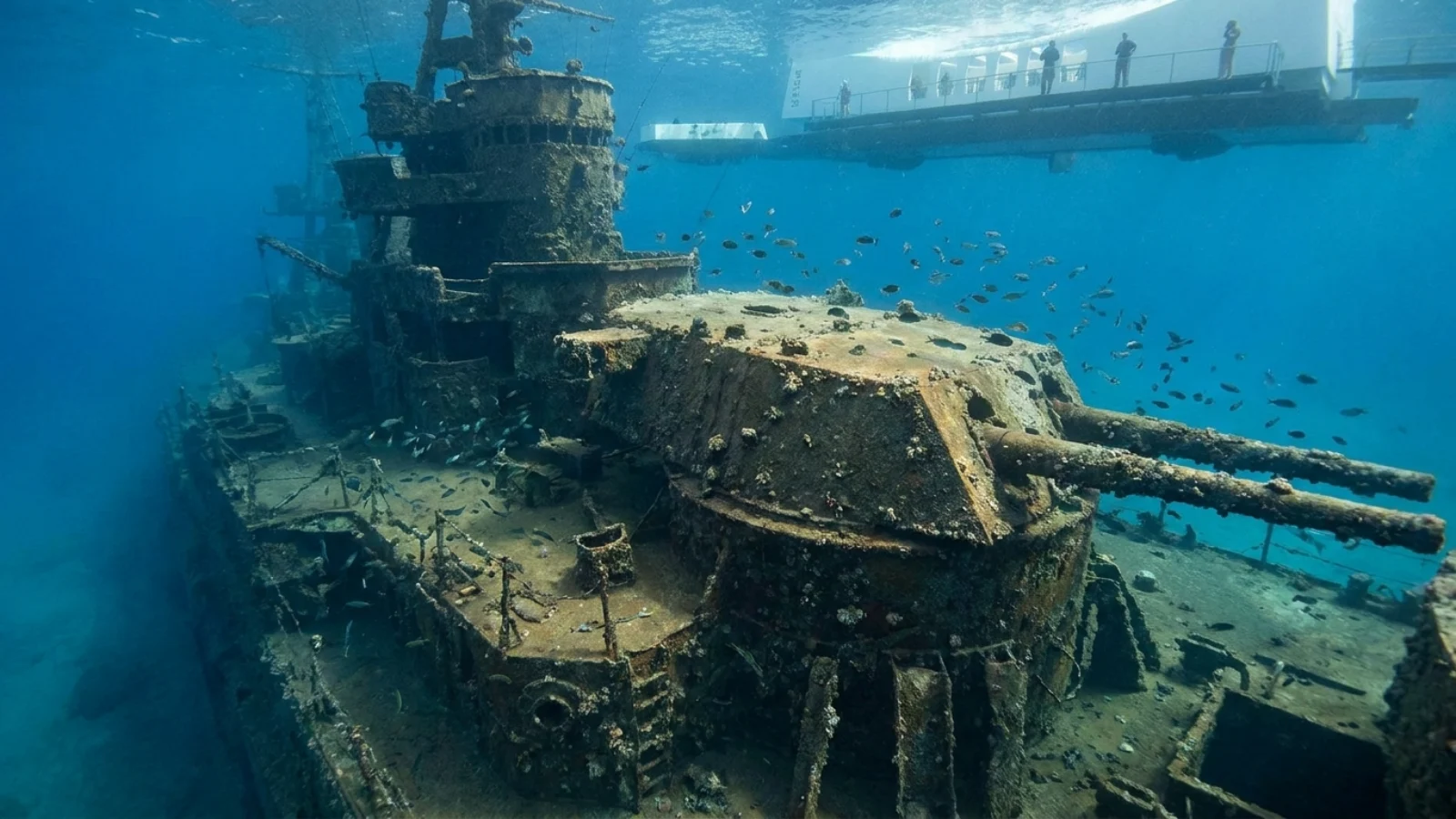
Unlike most of the battleships sunk or damaged that day, Arizona was judged beyond repair even if she could be raised. She was placed “in ordinary” on 29 December 1941 and struck from the Naval Vessel Register on 1 December 1942. Her surviving superstructure was cut away in 1942 and most of her main armament was removed over the next eighteen months. The two aft turrets were taken ashore for the Army’s coast defences on Oahu, as Battery Arizona at Kahe Point and Battery Pennsylvania on the Mokapu Peninsula; Battery Pennsylvania fired for the first and last time on V-J Day in August 1945, and Battery Arizona was never completed. The guns of Turret II were straightened, relined and installed on Nevada in 1944, and fired on Iwo Jima and Okinawa. The two forward turrets themselves were left in place, and the barbette of one turret still shows above the water.
The hull was never raised. Most of the men killed aboard her are still inside, and the figures given differ. The National Park Service memorial description says the wreck marks the resting place of 1,102 of the 1,177 killed; more recent reporting by the Associated Press and Honolulu media says more than 900 remain entombed. Either way, the ship is a war grave, and the Navy has said that removing her oil could disturb the remains of the dead and the urns of survivors.
Building the memorial
The idea of a permanent memorial took years to realise. Admiral Arthur W. Radford, commanding the Pacific Fleet, fixed a flagpole to the remains of the mainmast in 1950 and, from 7 March 1950, instituted the raising of the colours over her remains. The Navy placed a 10 ft basalt stone and plaque over the midships deckhouse on 7 December 1955, and President Eisenhower approved a national memorial in 1958, on condition that it be largely privately funded. Contributions came from the Territory of Hawaii, from viewers of a 1958 This Is Your Life programme about Samuel Fuqua, from the sale of plastic model kits of the ship, from federal legislation sponsored by Senator Daniel Inouye, and, famously, about $64,000 from a benefit concert given by Elvis Presley on 25 March 1961, his last live performance until 1968.
The memorial was designed by the Honolulu architect Alfred Preis, who, because he was born in Austria, had been held at the Sand Island internment camp at the start of the war. The Navy asked for a bridge-like structure floating above the ship and holding 200 people. Preis’s 184 ft (56 m) white structure sags in the middle and rises at both ends, which, he said, “expresses initial defeat and ultimate victory”. Critics first called it a “squashed milk carton”. It straddles the hull without touching it and has three parts: an entry room, an assembly room with seven open windows on each wall and in the ceiling, and a shrine room whose marble wall carries the names of the dead. An opening in the floor looks down onto the sunken decks. The memorial was dedicated on Memorial Day, 30 May 1962, and the wreck itself became a National Historic Landmark on 5 May 1989. The salt air stains the marble, and the shrine wall was replaced in 1984 and again in 2014.
The “tears of the Arizona”
The most striking thing many visitors notice is the oil. Arizona had been topped up with fuel the day before the attack, and much of it is still trapped inside the hull and tanks, which lie in the soft mud of the harbour floor. Small drops rise to the surface and spread into rainbow sheens, known as the “tears of the Arizona” or “black tears”. Reported rates are small but persistent: about 2.3 quarts (2.2 L) a day by one estimate, or about half a gallon a day according to the Honolulu newsroom Civil Beat, which in 2020 reported total estimates of 14,000 to 64,000 gallons leaked since 1941 and a National Park Service estimate that the seep could continue for 500 years.
Whether the oil should be removed is a hard question. A 2001 National Geographic feature raised concern that corroding bulkheads and tanks might one day rupture and release much more oil at once. A 2008 Department of Defense report found that the type of oil leaking was particularly persistent in the environment and that more research was needed. The Navy and the Park Service have pointed to the marine life that has colonised the wreck, including seahorses first seen on her deck in 2005, as a sign that the seep is not a significant concern, while environmental groups argue that chronic small leaks can do harm over time. The Navy’s position has been that pumping out the fuel would risk damaging artefacts and disturbing the dead. In 2004 the Navy and the Park Service carried out a detailed computerised mapping of the hull, designed to respect its status as a war grave, and the Park Service says it monitors the condition of the ship.
The last survivors
For decades, survivors of the attack could choose to have their ashes placed inside the ship by Navy divers, rejoining their shipmates; by 2020, more than 40 urns had been placed there. Veterans who served on Arizona at other times may have their ashes scattered over her. A plaque in the shrine room lists the names of some thirty crew members who survived the sinking.
The last of them is gone. Lou Conter, who was a quartermaster on the main deck when the attack began at 7:55 a.m., died at his home in Grass Valley, California, on 1 April 2024, at the age of 102. He had been born in Ojibwa, Wisconsin, in 1921, and regularly attended the annual Pearl Harbor remembrance ceremonies. He rejected the label of hero for himself, saying that the 2,403 men who died that day were the heroes.
Visiting the memorial today
The USS Arizona Memorial is part of Pearl Harbor National Memorial and is run jointly by the National Park Service and the Navy, an arrangement in place since 1980. The memorial can be reached only by boat from the visitor centre, which opened in 1980; it was visited by more than 1.5 million people in 2005, and more recent estimates range from about 1.7 million to more than 2 million visitors a year. One of the ship’s three anchors, weighing 19,585 lb (8,884 kg), stands at the entrance to the visitor centre, and one of her two bells is displayed there. The other anchor and a mast are in Wesley Bolin Memorial Plaza in Phoenix, and the second bell hangs in the bell tower of the Student Union Memorial Center at the University of Arizona in Tucson, where it is rung after home football wins.
The ship is under the control of the National Park Service, but the Navy still holds title to it. Arizona is not in commission, but she keeps the right to fly the US flag as if she were an active naval vessel. Visitors once tossed leis into the water through the floor opening; because the strings are a hazard to marine life, leis are now placed on the railings in front of the names. The wreck lies a short drive from Honolulu; see our guide to Honolulu for the wider island.
The Arizona among the great wrecks
Many famous wrecks, such as the Titanic or the Lusitania, lie far out at sea and can be seen only by submersible or by technical divers. The Arizona is different: she lies in shallow water in a working naval harbour, a few feet beneath a building visited every day, and she is still technically part of the US Navy. For other vessels that were salvaged rather than left in place, see shipwrecks that have been raised.
Where is the USS Arizona?
On the bottom of Pearl Harbor, off Ford Island on Oahu, Hawaii, beneath the USS Arizona Memorial.
How many people died on the USS Arizona?
1,177 sailors and Marines of the 1,512 aboard, about half of all American deaths in the Pearl Harbor attack.
How many bodies are still in the USS Arizona?
Sources differ: the memorial figure is 1,102 of the 1,177 dead, while recent AP and Honolulu reporting says more than 900.
Why does the USS Arizona still leak oil?
She was fully fuelled the day before the attack and much of that oil is trapped in the hull; estimates put the seep at roughly 2.3 quarts to half a gallon a day.
What sank the USS Arizona?
A Japanese armour-piercing bomb that hit near Turret II at about 08:06 and set off the forward magazines.
Is any USS Arizona survivor still alive?
No. Lou Conter, the last survivor, died on 1 April 2024 at the age of 102.
Why was the USS Arizona never raised?
The magazine explosion damaged her so badly she could not have returned to service, and she became a war grave.
When was the USS Arizona Memorial built?
It was dedicated on Memorial Day, 30 May 1962, to a design by Alfred Preis.
- Wikipedia contributors, “USS Arizona (BB-39)” and “USS Arizona Memorial” (2023 snapshot, accessed November 2026).
- Associated Press (1 April 2024), “Lou Conter, last survivor of USS Arizona from Pearl Harbor attack, dies at 102” (via KUNC).
- Civil Beat (24 February 2020), “Oil constantly leaks from the USS Arizona. Is that an environmental problem?”
- Stillwell, P. (1991), Battleship Arizona: An Illustrated History (as summarised in the sources above).
Blane Perun has been exploring Earth’s oceans and marine life for over 25 years. Founder of TheSea.Org in 1999, underwater photographer, coral aquaculture pioneer, and explorer of 80+ countries.
About Blane Perun →